


Let's be honest. For a while, "winging it" on the financial front is a startup founder's superpower. But there comes a day when you stare at a spreadsheet that looks like abstract art, an investor asks about LTV:CAC, and you realize your financial strategy is built on hope and late-night pizza receipts.
This is that awkward growth phase. Financial puberty, if you will. It’s the point where you need C-suite financial strategy, but the idea of a $300k+ full-time executive salary makes you want to curl up in a ball.
Enter the fractional CFO. Think of them as your part-time financial co-pilot—all the big-brain strategy, none of the soul-crushing payroll commitment. They’re for startups that are scaling fast and can't afford to fly blind anymore.
Remember when your biggest financial stress was whether the company card could handle another round of tacos? Those were the days. The books were simple, your runway was a hopeful guess, and "financial modeling" was a few scribbles on a whiteboard. It had a certain charm, sure. But that charm doesn't scale.
Fast forward to today. You're spending more time wrestling with cash flow projections than you are talking to customers. You're trying to build a rocket ship, but you've accidentally become a part-time accountant, and you're not even very good at it.
This isn’t just about messy books; it's about the massive opportunities you're missing. It’s that nagging feeling you’re leaving money on the table, making critical decisions with junk data, and basically steering the ship with a blindfold on.

Your bookkeeper is a hero. They perfectly document the past. But who’s looking forward? Who's building the financial story that will actually get your next funding round across the finish line? If you don’t have a good answer, hope you enjoy your new second job as Chief Spreadsheet Officer.
The pain usually shows up in a few familiar ways:
This is precisely where a fractional CFO steps in. It’s about getting that C-suite foresight without having to mortgage your office ping-pong table for the C-suite salary. They've seen this movie before and can help you skip the scary parts.
This isn't just a founder problem. It's a market solution. Check out the benefits of outsourcing accounting services to see how this fits into the bigger picture. It's time to pull your head out of the spreadsheets and get back to building your empire.
Let's get one thing straight: a fractional CFO is not a super-accountant. Your accountant tells you what you spent last month. Your fractional CFO tells you what you should spend next month to avoid driving off a cliff in six. See the difference?
This isn't about vague PowerPoints. We're talking about tangible, high-stakes work that can make or break a scaling company. This is the person who builds the financial model that VCs will try—and fail—to poke holes in.
Before a fractional CFO, your financials are a pile of data. After, they're a story. A story with a beginning (your traction), a middle (your growth plan), and an end (your profitable future). Their job is to turn chaos into a compelling narrative.
Here’s what that actually looks like:
Beyond the spreadsheets, they provide the high-level guidance you've been craving. They are the objective, slightly annoying voice in the room asking the hard questions.
Think of them as your financial conscience. They’re the one asking, "Are we sure this marketing spend has a positive ROI?" or "Do the unit economics on this new feature actually work?" It's the tough love your company needs to survive.
The rise of this role isn't a fluke. The fractional CFO market has exploded, hitting an estimated $4-6 billion annually. It's the most in-demand fractional executive role, with demand more than doubling year-over-year. The secret is out. Discover more insights from the 2025 Fractional CFO Industry Report.
You’re not paying for their time; you’re paying for outcomes. This is where the rubber meets the road.
What You're Actually Buying:
A great fractional CFO doesn't just close your books; they help write your company's next chapter.
Let's talk about the big question. Discussing money can feel weird, but let’s be adults here. The last thing you need is a surprise invoice that makes you question all your life choices.
You’re not buying a service; you're investing in a brain. Fortunately, the pricing isn't some dark art. It usually falls into a few buckets.
The market for these services is white-hot, which tells you one thing: it works.
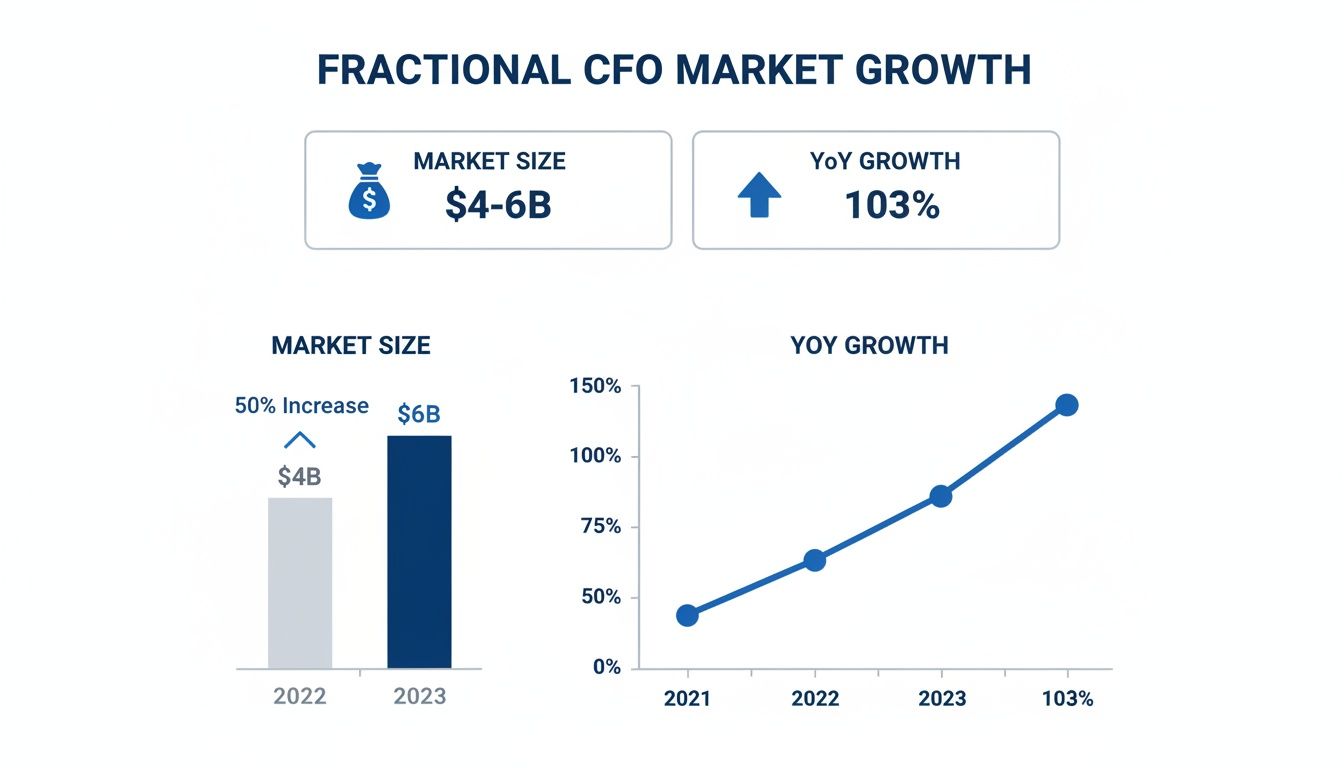
With a bonkers 103% year-over-year growth, this is clearly how smart companies are building their finance functions now.
This is the standard for a reason. You pay a flat monthly fee and get a dedicated partner who is deeply embedded in your business. It creates predictability, which is a founder's best friend.
A retainer isn't about paying for hours—it's about securing a strategic seat at the table.
Think of it as a subscription to senior financial expertise. You get the continuity of a team member without the drama of a full-time salary, benefits, and equity. It’s the sweet spot.
Got a specific, one-off goal? Prepping for a Series A? Navigating an acquisition? For these well-defined missions, a project-based fee makes sense.
You agree on a fixed price for a specific deliverable. It's clean, contained, and you know the cost upfront. It’s like hiring a demolition expert; you don’t need them every day, but when you need a wall knocked down, you call the best.
I’ll be blunt: if a fractional CFO only offers an hourly rate, run. It creates a terrible incentive structure. You want a partner focused on results, not on milking the clock.
Hourly billing means you'll hesitate to ask a quick question, worried it will show up on the next invoice as a $500 "brief consultation." This is the fastest way to a transactional, ineffective relationship. A true partner aligns their success with yours, not the clock.
The real win here is the cost savings. Businesses slash CFO-related costs by 30-40% by going fractional, avoiding salaries from $250,000 to $400,000. Instead, you’re looking at $5,000 to $15,000 per month. That's math that even I can get behind. You can explore more about fractional CFO pricing models and their value to see the breakdown.
Timing is everything. Hire a fractional CFO too early, and you’re burning cash. Wait too long, and you’re paying a premium for someone to clean up a disaster that was entirely preventable. No pressure.
So, when is the right moment? It’s not about revenue. It’s about complexity. It’s that gut feeling when you realize your fantastic bookkeeper is out of their depth trying to predict the future.
If you find yourself nodding to more than one of these, you probably should have made this call yesterday.
A fractional CFO is the difference between navigating with a GPS and using a crumpled napkin sketch you drew from memory. One gets you there, the other gets you lost.
Let's be real. Not every two-person startup needs a fractional CFO.
You might not be ready if:
This isn't a niche trend anymore. Up to 70% of SMBs now see fractional CFO services as a smart alternative to a full-time hire. The fastest-growing adopters are companies that just closed a Series A in the $5-30M revenue range. Want to know more? Check out the growing popularity of fractional financial leadership.
The decision boils down to this: Is your lack of financial strategy costing you more than a fractional CFO would? When the answer is yes, you know it's time.
Alright, you hired a rockstar fractional CFO. They’re building brilliant models and charming investors. Huge win. But now… who’s going to do the actual work?
This is where so many founders stumble. A brilliant strategy is useless without solid execution. It’s like an architect handing you blueprints for a skyscraper but forgetting to hire the construction crew. You’re left with a very expensive piece of paper.
Your fractional CFO is the strategist. They are not there to reconcile bank statements. You can't afford their rates for that, and they'd hate doing it anyway.

This is where the traditional model falls apart. You hire the big brain, but then you’re stuck trying to find a separate, expensive US-based accountant to implement their plans. Suddenly, your "cost-effective" solution isn't so effective.
And surprise! Your new full-time job is sifting through resumes and conducting endless interviews.
We saw this happen over and over. It's why we built HireAccountants. We bridge that gap.
Imagine pairing your high-level fractional CFO with an execution team that’s just as skilled but costs up to 80-90% less. That’s the magic formula. World-class strategy backed by an affordable powerhouse team.
Here's the setup:
This lets your CFO focus on high-value work, knowing their plans will be flawlessly executed by a team in your time zone.
This isn't just about saving money, though the savings are insane. It's about building a smarter finance function. You get an entire finance department for less than one mid-level US accountant.
Let's be honest. You didn’t start a company to become an expert in international payroll and HR compliance. That's why we handle all of it. You find the perfect person, we manage the rest.
Our AI-powered matching system delivers a shortlist of pre-vetted candidates in under 24 hours. You hire in days, not months. For a deeper look, check out our guide on how to find a good accountant.
Combine world-class fractional CFO services with our on-demand talent, and you finally build a finance team that’s agile, powerful, and ridiculously efficient.
Alright, you're sold. But hiring the first person with a slick LinkedIn profile is a fast track to regret. Get it right, and you pour rocket fuel on your growth. Get it wrong, and you’ve just hired a very expensive bookkeeper.
Let's make sure you get it right.
Before you look at a single resume, know what you need them to do. What’s the mission-critical objective?
Are you prepping a Series A in six months? Is your cash flow a dumpster fire?
Write down your top three priorities. For example:
Now you have a scorecard. You're hiring a solution, not just a person.
Every consultant sounds impressive on paper. Your job is to find out if they've actually been in the trenches.
Here’s the killer question: "Tell me about a time you gave a founder advice they really didn't want to hear. What happened?"
Their answer tells you everything. A true partner isn't afraid to challenge you. A yes-man is just an expensive echo chamber.
Pro Tip: Ask about their failures. Anyone can spin a success story. Real insight comes from hearing how they handled things when they went sideways.
Use this checklist to make sure you're asking the right questions.
| Vetting Area | Key Questions to Ask | What to Look For |
|---|---|---|
| Industry Experience | "Have you worked with SaaS/e-commerce companies at our stage before?" | Specific, relevant industry experience. They should talk about MRR, LTV:CAC, and churn, not just generic accounting terms. |
| Technical Skills | "Walk me through the last financial model you built." | Deep understanding of financial modeling and forecasting. They should be able to explain complex concepts simply. |
| Strategic Mindset | "Looking at our financials, what are the top 2-3 risks you see?" | Answers that go beyond the numbers. They should be thinking about the business as a whole. |
| Communication & Fit | "How do you handle disagreements with a CEO?" | A direct, honest communicator. You want a partner who feels like part of the team, not a vendor. |
| References | "Can I speak with 2-3 former clients, preferably founders?" | Glowing reviews that highlight strategic impact. Ask the reference about a time the CFO delivered tough news. |
This isn't about ticking boxes; it's about building confidence.
Once you’ve found your person, the work isn't over. You need crystal-clear expectations.
Define the KPIs for the engagement itself. How will you know, in three months, that this was a great decision? Set measurable goals for your new partner—it holds them accountable and gives you a clear way to measure ROI.
Getting this right is critical. To broaden your knowledge, check out our guide on what to look for when hiring a CPA, as many of the same vetting principles apply. This is about finding a partner, not just filling a seat.
Alright, let's hit the questions we hear all the time. No jargon, just straight answers.
Simple. Your accountant is a historian. They record what happened. A fractional CFO is a strategist. They use that history to chart a course for the future.
One looks backward for accuracy; the other looks forward for growth. You need both, but they are not the same job.
It's not about a revenue number; it's about a complexity trigger. Usually, it's when you're prepping for a real funding round (Seed or Series A) or when your growth is so fast your spreadsheets are on fire.
If you’re pre-revenue and pre-product, it's overkill. But once you're juggling real revenue, a growing team, and investor questions, that’s your cue.
The real question isn't "how big are we?" but "how much is our lack of financial strategy costing us?" When that number starts to feel big, you've waited long enough.
Absolutely. Their part-time status is their superpower. They aren’t caught up in your day-to-day office drama or administrative sludge.
They come in with a specific mission. And since they work with multiple companies, they bring a massive amount of cross-industry experience. Chances are, they’ve already solved the exact problem you’re facing. You get concentrated expertise, all signal and no noise.
Ready to build a finance team that gives you both top-tier strategy and an affordable execution engine? HireAccountants connects you with pre-vetted, English-fluent finance talent from Latin America at a fraction of the cost of a US-based hire. Find your perfect match in under 24 hours.
Let's simplify your finances today!