

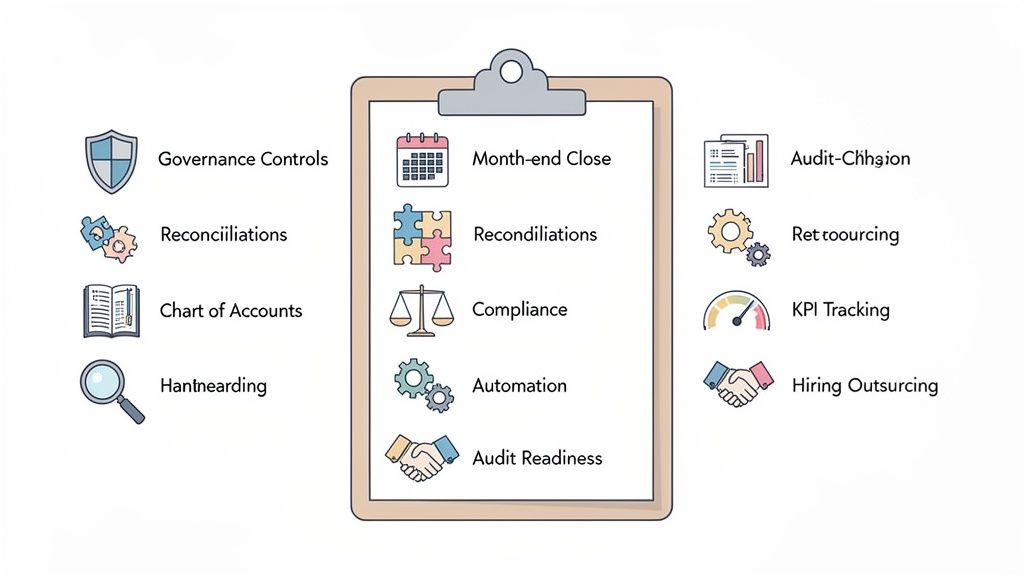
Let's be blunt. Your first financial report was probably a mess. A beautiful, chaotic blend of hope, panic, and maybe a few expense reports for 'client meetings' that sounded suspiciously like a karaoke bar. I’ve been there. I’ve tried to raise money with a balance sheet that looked like a Picasso painting after three martinis. Spoiler alert: it doesn’t work.
The truth is, mastering financial reporting isn’t about pleasing your accountant. It’s the difference between limping along and sprinting toward your goals. Without a rock-solid handle on your numbers, you’re not making decisions; you’re just guessing. You can’t forecast, manage cash, or confidently tell an investor you know what you’re doing without secretly crossing your fingers.
After years of trial and error (heavy on the error), I’ve landed on a set of non-negotiable financial reporting best practices. This isn’t some dry, textbook theory. This is the playbook forged in the trenches of startup finance. It's the stuff that actually works and saves you from having to mortgage the office ping-pong table to make payroll.
This guide will walk you through building a financial reporting system that gives you clarity, control, and the confidence to grow. Ready to finally get your books in order? Let's dive in.
Still chained to a desktop version of QuickBooks from 2009? It’s time for an intervention. Modern financial reporting best practices start and end with the cloud. Cloud-based accounting platforms aren't a convenience; they're the central nervous system for a scalable business. They give you real-time data, automate mind-numbing tasks, and let your team collaborate from anywhere—the office, home, or a beach in Tulum (we can dream, right?).
This isn't about just moving your ledger online. It's about creating a single source of truth that slashes the manual errors that haunt your late-night reconciliation sessions. Forget emailing massive, outdated spreadsheets back and forth. Cloud systems give you instant financial visibility, turning your data from a historical record into a live, decision-making tool.

Moving to the cloud is non-negotiable. It shifts accounting from a reactive, historical chore to a proactive, strategic weapon. Instead of waiting until after month-end to see how you performed, you can track cash flow daily. This agility lets you pivot faster, spend smarter, and give investors the up-to-the-minute reports they actually want.
Think of your Chart of Accounts (COA) as the DNA of your company’s finances. If it’s a jumbled mess, good luck figuring out what’s going on. A well-organized COA is the foundation of financial reporting best practices; it logically categorizes every transaction, turning your financial data from a chaotic junk drawer into a neatly labeled filing cabinet.
This isn't just an organizational exercise for your accountant’s benefit. It’s a strategic framework that dictates the quality of every single report you run. A clean COA means you can quickly see exactly where your money is going, how each department is performing, and which revenue streams are most profitable. It’s the difference between guessing and knowing.
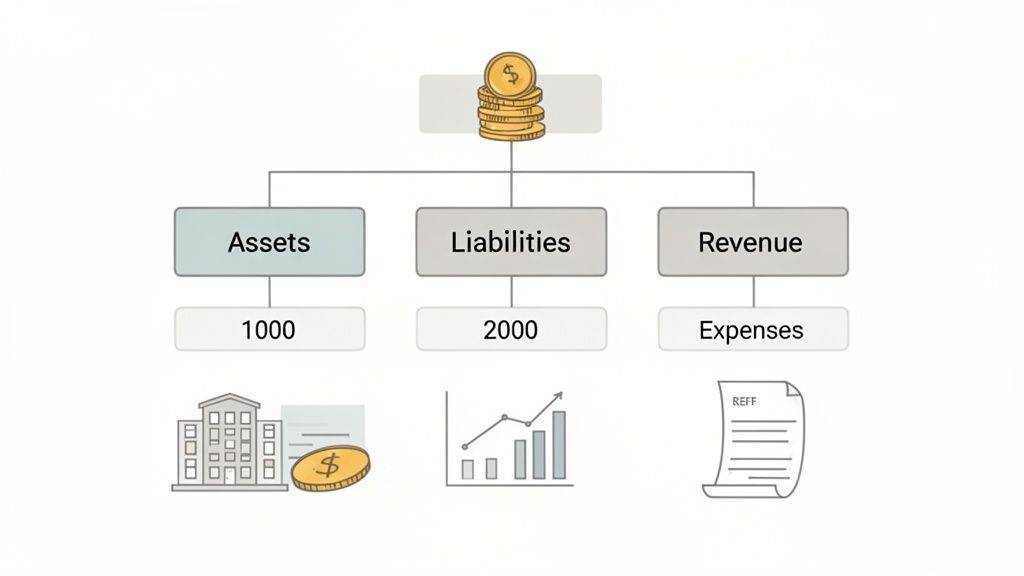
A sloppy COA makes accurate reporting impossible. You can't compare performance month-over-month if marketing expenses are sometimes coded to "Advertising," sometimes to "Promotions," and other times to "Miscellaneous." A structured COA ensures consistency, which is critical for generating meaningful insights, simplifying tax prep, and making your business easily auditable. It’s a life-saver.
Are your finance experts still manually keying in invoices or chasing down receipts like digital detectives? If so, you're not just wasting time; you're burning cash. One of the most crucial financial reporting best practices is to automate every repetitive, soul-crushing task you can. Automation isn't about replacing people; it's about upgrading them from data entry clerk to strategic analyst.
Modern tools can handle bank reconciliation, expense categorization, and invoice processing with minimal human oversight. This means fewer late-night sessions hunting for a rounding error and faster, more accurate month-end closes. For a growing business, this isn't a luxury—it's a survival mechanism.
Automation tackles the biggest bottlenecks in accounting: human error and speed. By setting up rules and workflows, you create a system that operates consistently, 24/7, without getting tired or making typos. Your finance function starts spending less time on clerical work and more time analyzing performance, identifying trends, and shaping business strategy. It’s a beautiful thing.
Think of your monthly close as a mandatory pit stop in the race to scale. Skipping it is like trying to drive from New York to LA without checking your fuel or tire pressure. A disciplined monthly close, including bank reconciliations and accrual adjustments, is how you ensure your financial data is an accurate, compliant snapshot of reality.
This isn’t just about tidying up the books. It's a critical diagnostic tool. A smooth, predictable close process identifies cash flow issues, spots fraud, and surfaces operational problems before they become catastrophic. It turns your finance function from a historical scorekeeper into a proactive guardian of the company’s health, making audits or due diligence a non-event instead of an all-hands-on-deck fire drill.
A routine, timely close is one of the most powerful financial reporting best practices for establishing trust with investors, lenders, and your own leadership team. It demonstrates operational maturity. For SaaS companies, it means accurately tracking ARR. For e-commerce businesses, it means catching costly fee discrepancies early. This isn't tedious paperwork; it's high-stakes business intelligence.
If your financial records are a tangled mess of “why did we do this?” and “who approved that?” you’re building on a foundation of sand. Solid documentation isn't about bureaucratic box-ticking. It’s the bulletproof vest for your company’s financials, creating an unassailable audit trail that proves every number has a backstory.

Think of it this way: every transaction is a claim, and your documentation is the evidence. Without it, you’re just making stuff up. This practice ensures every adjustment, approval, and journal entry is recorded and justified. It’s non-negotiable for audit readiness, investor due diligence, and internal accountability.
Proper documentation transforms your finance function from a black box into a transparent, defensible operation. When an auditor asks why you capitalized a certain expense, you’ll have the answer in minutes, not days. This isn't just one of the financial reporting best practices; it's the bedrock of financial integrity that separates amateur-hour startups from professionally run businesses.
YYYY-MM_VendorName_Invoice#) and make it mandatory. The goal is for anyone to find anything without a search party.Think your startup is too small for fraud? Think again. The most devastating financial missteps happen when one person holds all the keys to the kingdom. This is where segregation of duties comes in—a core tenet of financial reporting best practices. It’s the simple, non-negotiable principle that no single individual should control a financial transaction from start to finish.
This isn’t about mistrusting your team; it’s about building a system that protects the company and your employees from errors and temptation. By separating authorization, recording, and custody of assets, you create a natural system of checks and balances. The person who enters vendor bills shouldn't be the person who approves and schedules the payment. It’s foundational.
Internal controls move your financial operations from a fragile, personality-driven process to a resilient, system-driven one. It drastically reduces the risk of both accidental errors and intentional fraud. Proper controls give investors and auditors confidence that your numbers are reliable.
More importantly, it forces operational discipline. It creates clearer workflows and accountability. This structure is essential for scaling, ensuring that as you add people and complexity, your financial house remains in impeccable order. The roles of a CFO versus a Controller, for instance, are naturally built around this separation of strategic oversight and tactical execution.
Think your custom, back-of-the-napkin accounting method is a stroke of genius? The IRS and your investors will politely disagree. Adhering to standards like GAAP (Generally Accepted Accounting Principles) isn't just about following rules; it's about speaking the universal language of business. Compliance ensures your financial statements are credible, comparable, and won’t get you into hot water.
This is where the rubber meets the road. It means correctly applying complex rules like ASC 606 for subscription revenue, capitalizing assets properly, and accurately calculating your tax provisions. Skipping this step is like building a skyscraper on a foundation of sand. It might look fine for a while, but it’s destined to collapse under scrutiny.
Proper compliance is the bedrock of trust. Investors and lenders need to know your numbers are reliable. For a SaaS startup, this means recognizing revenue ratably over a contract term, not just when the cash hits the bank. For an e-commerce brand, it means correctly handling sales tax complexities. Getting this right from the start prevents costly restatements and builds a bulletproof financial history.
Are your financial statements just a big pile of numbers you glance at before filing them away? If so, you're flying blind. Financial reporting best practices demand that you translate raw data into actionable intelligence. KPIs and financial ratios are the vital signs of your business, turning your income statement and balance sheet into a strategic roadmap.
This isn't about creating more charts to impress your board. It's about distilling complexity into a handful of metrics that tell you what’s working, what's broken, and where the hidden opportunities are. For an e-commerce company, this means obsessively tracking gross margin. For a SaaS startup, it’s all about the delicate dance between Customer Acquisition Cost (CAC) and Lifetime Value (LTV).
Focusing on the right KPIs shifts your perspective from simply recording history to actively managing the future. Instead of asking "Did we make a profit?" you start asking "How efficiently are we generating that profit?" This level of analysis helps you pinpoint operational weaknesses, manage working capital, and make data-driven decisions. It’s the difference between driving by looking in the rearview mirror and driving with a real-time GPS.
Flying blind with your finances is a recipe for disaster. An annual budget isn't just a stuffy corporate exercise; it's your company's financial roadmap. Effective budgeting and forecasting translate your ambitious strategy into cold, hard numbers, giving you a baseline to measure your actual performance against. Without it, you’re just winging it.
This is about more than setting a spending limit. It's about aligning every department toward a common financial goal. It forces you to have tough conversations about resource allocation before you’re in a cash crunch. A solid forecast, updated regularly, helps you see around corners and make data-driven decisions instead of gut-feel gambles.
A well-executed budget and forecast transform your financial reports from a historical document into a strategic tool. It's the difference between asking "What happened?" and "What's next?" For startups, a rolling 13-week cash forecast is non-negotiable for survival. For scaling companies, it’s how you model growth scenarios and confidently pull the trigger on big investments.
This process builds accountability. When teams have clear financial targets, they own their performance. If you find yourself constantly drowning in this process, it might be time to bring in strategic help; a fractional CFO can build these models and drive the process for you.
Think your job is done once the numbers are crunched? Wrong again. The most pristine financials are useless if they aren't understood. One of the most overlooked financial reporting best practices is weaving your numbers into a clear narrative while nurturing the culture of the team that creates them. This means delivering tailored reports to stakeholders and fostering an environment built on collaboration and continuous improvement.
It’s about transforming your finance function from a black box of spreadsheets into a communications hub. A strong team culture ensures accuracy, while clear reporting gives leadership the confidence to make critical decisions. Forget just dropping a P&L in an email; this is about providing context and explaining the "why" behind the numbers.
Numbers without a story are just noise. A company that nails reporting and team culture operates with a strategic advantage. Investors get the transparency they need. Boards receive clear, concise packages that guide governance, not confuse it. Most importantly, a supported, engaged finance team makes fewer errors, proactively identifies risks, and sticks around, saving you the nightmare of recruiting.
| Item | Implementation complexity | Resource requirements | Expected outcomes | Ideal use cases | Key advantages |
|---|---|---|---|---|---|
| Implement Cloud-Based Accounting Systems | Medium — setup, integrations, user training | Internet, subscription fees, security measures, integration effort | Real-time financial visibility, fewer manual entries, scalable platform | Distributed teams, SMBs, rapid onboarding of remote accountants | Automation, collaboration, lower IT overhead |
| Establish Clear Chart of Accounts Structure | Low–Medium — requires planning and design | Accounting expertise, documentation, occasional consultant time | Consistent reporting, simplified audits, faster onboarding | Any company needing clear reporting or multi-entity consolidation | Standardization, clearer analysis, audit readiness |
| Automate Routine Accounting Tasks | Medium–High — tool selection, integration, rule tuning | Automation/RPA tools, ML features, ongoing maintenance and training | Reduced manual work, faster close cycles, fewer processing errors | High-volume transactions, e-commerce, scaling finance teams | Efficiency, accuracy, frees staff for analysis |
| Conduct Monthly Reconciliations and Close Procedures | Medium — process design and disciplined execution | Staff time, close checklists, reconciliation tools | Accurate financials, early issue detection, audit preparedness | Companies needing timely monthly reporting or preparing for audits | Control, timeliness, documented accountability |
| Maintain Detailed Documentation and Audit Trails | Low–Medium — systems and cultural adoption | Document management system, storage, security, user discipline | Easier audits, fraud deterrence, knowledge transfer | Regulated businesses, remote teams, audit-prone organizations | Transparency, compliance, reduced audit cost |
| Separate Duties and Implement Internal Controls | Medium — role definition and workflow enforcement | Role staffing, access controls, monitoring and testing | Reduced fraud and errors, stronger compliance | Firms with cash flows, high-risk transactions, growth-stage companies | Risk mitigation, accountability, audit readiness |
| Ensure Compliance with Accounting Standards and Tax Regulations | High — complex rules, ongoing updates | Skilled accountants, tax advisors, training, compliance tools | Legally compliant, auditable financials, reduced penalty risk | Fundraising, public reporting, cross-jurisdiction operations | Credibility with investors/regulators, lower legal risk |
| Use Financial Ratios and KPIs for Performance Analysis | Low–Medium — metric selection and dashboarding | BI/dashboard tools, consistent data, analyst time | Actionable insights, trend detection, benchmarking | Management reporting, investor updates, performance improvement efforts | Focused insight, performance monitoring, data-driven decisions |
| Implement Effective Budgeting and Forecasting Processes | Medium–High — modeling and cross-functional coordination | FP&A tools, departmental input, modeling expertise | Aligned targets, better cash planning, scenario readiness | Growth planning, cash-constrained startups, scaling companies | Planning discipline, resource allocation, scenario testing |
| Financial Reporting, Communication, and Finance Team Culture | Medium — reporting cadence plus people development | Reporting tools, templates, training, time for culture building | Clear stakeholder updates, higher team engagement, improved decisions | Companies with investors/boards and distributed finance teams | Credibility, retention, improved cross-team alignment |
Alright, you made it. That was a masterclass on financial reporting best practices. Reading it was the easy part. Now comes the moment of truth.
Let's be blunt. Knowledge without action is just expensive trivia. The gap between knowing you need a clean, automated month-end close and actually having one is where most startups die a slow death. It’s easy to look at this list and feel overwhelmed. "Implement internal controls? Automate tasks? Get audit-ready? Who has the time?"
The $500 Hello to Reality. You don’t need to boil the ocean. The goal isn't textbook perfection overnight; it's tangible, incremental progress.
If you walk away with nothing else, burn these principles into your brain:
These financial reporting best practices aren't just about keeping the IRS happy. They are about building the central nervous system of your company. Your financials tell the unfiltered story of what's working, what’s broken, and where the real opportunities lie. They transform gut feelings into data-backed decisions. Flying blind might feel exciting, but it’s a terrible way to run a business.
So, what's next? Don't try to tackle all ten points by Friday. That’s a recipe for burnout. Pick one. Just one.
Is your Chart of Accounts a relic from your company’s garage phase? Start there. Are your bank reconciliations a quarterly scramble fueled by caffeine and regret? Focus on building a disciplined monthly close. Choose the area causing the most pain and fix it.
Let's be honest, most founders are not secret CPAs. And you shouldn't have to be. Your time is better spent on product and sales, not wrestling with journal entries. If you feel like you're drowning, it's a signal that you need help. You're the pilot; you shouldn't also be in the engine room tightening bolts. The good news is, you have options.
The fastest way to implement these financial reporting best practices is to bring in an expert who’s done it a hundred times before. With HireAccountants, you can connect with pre-vetted, English-fluent accountants from Latin America to streamline your books, automate your processes, and deliver the reporting you need, often for a fraction of the cost of a US-based equivalent. Start building a world-class finance function today by visiting HireAccountants.
Let's simplify your finances today!