

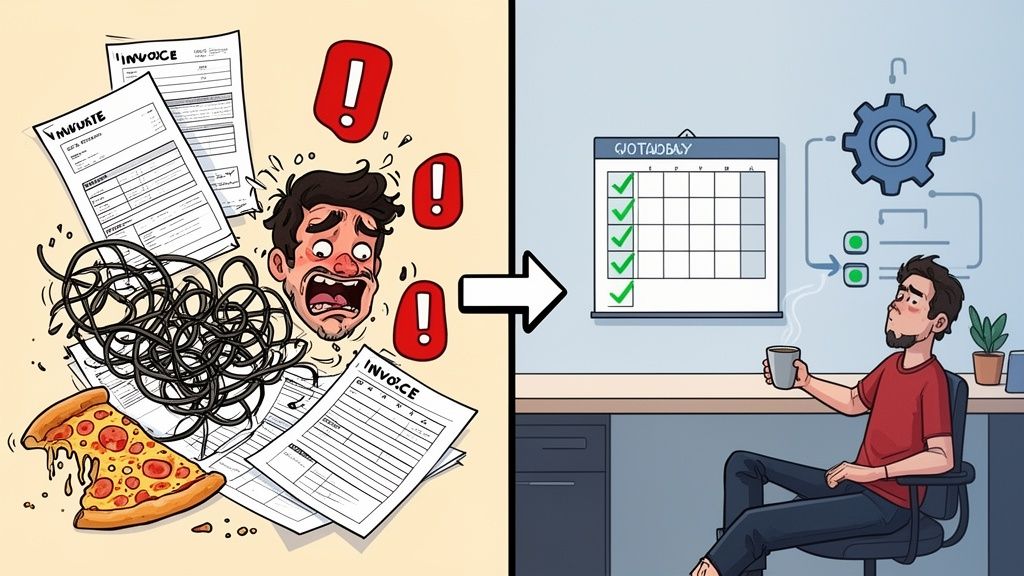
Let's be honest. For most founders, 'month-end close' is code for late nights, cold pizza, and that nagging fear you've missed something huge. You started a company to build something amazing, not to spend the first week of every month chasing down invoices and wrestling with spreadsheets that seem to have a mind of their own. It feels like a no-win scenario: either hire an expensive army of in-house accountants or mortgage the office ping-pong table to afford enterprise software.
Turns out, there’s a third way.
We’ve been in the trenches. We’ve tried it all. We’ve distilled the process down to what actually works. This isn't some generic advice you'll find in a dusty textbook. These are the 10 battle-tested, non-negotiable month end close best practices that will give you back your time, your sanity, and financials you can actually trust to make decisions.
Forget the abstract theory. We're giving you a direct roadmap with actionable checklists, automation tips, and clear protocols for everything from pre-close prep to post-close reviews. Consider this your playbook for transforming a chaotic, caffeine-fueled scramble into a predictable, efficient, and dare we say, smooth process. Ready to reclaim the first week of your month? Let's get into it.
Trying to close the books without a checklist is like assembling IKEA furniture with the instructions folded into a paper airplane. You might get it done, but something will be wobbly, you’ll have leftover screws, and it will take twice as long. A standardized checklist is your non-negotiable roadmap for a sane month-end close.
This isn’t just a to-do list; it’s a detailed, sequential guide that kills ambiguity and prevents that dreaded "oh, I thought you were handling that" moment. For distributed teams, this document becomes the single source of truth, letting accountants in different time zones work without tripping over each other. To do it right, you need to understand the core principles of a good Standard Operating Procedure (SOP). Think of your checklist as the most critical SOP in your finance function.
Manually reconciling bank statements is the accounting equivalent of hand-cranking a car to start it. It gets the job done, but it’s slow, painful, and honestly, a bit embarrassing in this day and age. Automating your reconciliations lets software do the tedious, error-prone work, freeing your team to investigate the exceptions that actually matter.
This isn't just about connecting your bank feed. It's about using intelligent matching rules to automatically clear the vast majority of transactions from bank accounts, credit cards, and payment processors. The right tools can turn a multi-day slog into a few hours of review. This is one of the most impactful month end close best practices for any business drowning in transaction volume.

Why cram 10 days of work into three frantic nights fueled by stale coffee and regret? A pre-close phase is your secret weapon, turning the final week from a chaotic sprint into a predictable, orderly process. This isn’t about starting the close early; it’s about clearing the decks so the actual close can happen smoothly.
The idea is simple: dedicate the last week of the month to proactive prep. This is when you hunt down missing paperwork, ping other departments for outstanding info, and run preliminary checks to spot issues before they become emergencies. This single step shaves days off the close timeline. It’s what separates the serene finance teams from the perpetually stressed-out ones.
Waiting until the end of the month to understand your financial health is like driving with a blindfold and only taking it off once you've arrived. You might get there, but you probably have a few new dents. Real-time dashboards give you the visibility to spot problems as they happen, not three weeks later when they’ve already derailed your forecast.
This means connecting BI tools directly to your accounting system. Instead of manually pulling reports during the close, you have live, visual data on key metrics. This turns the close from a frantic archeological dig into a simple validation exercise. For a lean team, this is one of the most effective month end close best practices you can adopt.

Running a close with documents scattered across desktops, inboxes, and random cloud folders is an accounting scavenger hunt nobody wanted to join. It’s a surefire way to lose critical files, frustrate auditors, and make your team question your sanity. Centralizing all supporting documentation isn't just "nice to have"; it’s the bedrock of a transparent, auditable close.
This means creating a single source of truth for every reconciliation, journal entry, and variance explanation. When every document lives in a designated place, collaboration becomes seamless. Your new accountant in another time zone can find the support for an entry without having to wake you up. This is how you build a complete, defensible audit trail.

AccountName_MMYY_Description. For example, AccruedExpenses_0924_SoftwareLicenses is instantly understandable. final accruals v2 updated.xlsx is not.YYYY > MM_MonthName_Close > 01_Bank_Reconciliations, 02_JE_Support, etc. You can duplicate this structure and its permissions with a single click.Simply closing the books and saying "we're done" is like getting a blood test and never looking at the results. The numbers are just data until you ask them what they mean. Variance analysis is the crucial step that separates a mechanical bookkeeping exercise from a strategic financial close. This is where you dig into the "why" behind the "what," investigating significant differences between your actual results and your expectations.
This disciplined investigation turns financial data into business intelligence. It forces you to question unusual spikes, understand operational drivers, and catch errors before they metastasize. A crucial part of this is effectively understanding your Profit and Loss, as it provides the context for what your variances are truly revealing. This is how you give management genuine insight, not just a data dump.
Skipping a formal accrual and cutoff review is like a chef tasting a dish for salt after it’s been served. It’s too late. Without this step, you’re flying blind, booking entries based on assumptions and hoping they match reality. This process ensures that revenues and expenses are recognized in the correct period, which is the entire point of accrual accounting.
This is your final quality control checkpoint before the books are locked. It prevents the kind of misstatements that distort financials and send auditors into a frenzy. For SaaS companies recognizing multi-year contracts or retail businesses estimating returns, a documented approval system for accruals isn’t just good practice; it's a fundamental control that separates clean books from a ticking time bomb.
Relying on ESP and hope to get through the close is a recipe for disaster. Without structured communication, small queries fester into major roadblocks, dependencies are missed, and everyone ends up working late. Establishing clear protocols isn't about adding more meetings; it's about making the communication that does happen ruthlessly efficient.
Think of it as setting the rules of engagement. Who needs to be in the loop? How are blockers flagged? When do updates happen? For distributed teams, this isn't a nice-to-have, it's the operational glue holding the entire process together. Strong communication turns a chaotic scramble into a coordinated effort.
#month-end-close, where all communication lives. Consider a second channel, #close-blockers, where team members can flag urgent issues and tag specific owners for immediate attention.Finishing the month-end close and immediately moving on is like running a marathon and skipping the recovery. You feel accomplished for a minute, but you're setting yourself up for injury and burnout next time. The close isn't truly done until you’ve performed the post-mortem. A dedicated post-close review is where the real magic happens, turning a reactive process into a proactive, continuously improving system.
This isn't a gripe session. It's a structured debrief scheduled 48-72 hours after the books are closed. This single habit is how finance teams stop fighting the same fires every month and start preventing them. Companies that master this reflective practice often see cumulative close time reductions of 10-15% annually, turning a stressful function into a well-oiled machine.
Most finance teams design their close process for the company they are today. Big mistake. You're building for a snapshot in time, not the rocket ship you’re trying to launch. A scalable close process is designed to absorb 2-3x growth in transactions, entities, or currencies without needing a proportional increase in headcount or close days.
This means building modular workflows and an automation roadmap from day one, not trying to duct-tape solutions onto a process that’s already bursting at the seams. A truly scalable system allows revenue to triple while your close cycle time stays flat or even improves. Your goal is to build a finance machine that anticipates growth, rather than just reacting to it.
| Title | Implementation complexity | Resource requirements | Expected outcomes | Ideal use cases | Key advantages |
|---|---|---|---|---|---|
| Implement a Standardized Close Checklist and Timeline | Low–Medium — process design and periodic updates | Time to document, owner, collaboration tool | Consistent, faster close; fewer missed items (≈20–30% reduction) | Remote/distributed teams; onboarding new accountants | Standardization, role clarity, audit trail |
| Automate Reconciliations and Account Matching | Medium–High — integrations and rules tuning | Automation software, bank integrations, training | Large time savings (≈40–60%), fewer errors, real-time cash view | High transaction volume, multi-entity/multi-currency environments | Accuracy, speed, frees staff for analysis |
| Establish a Pre-Close Preparation Phase (5–10 days prior) | Low — scheduling and discipline | Early team time, coordination with ops | Shorter final close (1–3 days faster), fewer surprises | Companies with recurring outstanding items | Early issue resolution, smoother close week |
| Use Real-Time Financial Dashboards and KPI Monitoring | High — BI integration and data governance | BI tool, data integrations, maintenance, training | Continuous visibility, proactive issue detection, faster reporting | Leadership-heavy decision contexts (SaaS, e‑commerce) | Proactive monitoring, improved forecasts |
| Centralize Supporting Documentation and Schedules | Low–Medium — setup and governance | Cloud repo, naming conventions, training | Faster document retrieval, better collaboration, audit readiness | Distributed teams, audit-intensive firms | Single source of truth, version control |
| Perform Variance Analysis and Trend Investigations | Medium — analytical effort and templates | Analyst time, reporting templates, access to drivers | Error detection, root-cause insights, improved forecasting | Businesses needing management commentary, complex ops | Deeper insights, improved forecast accuracy |
| Implement a Formal Accrual and Cutoff Review Process | Medium — controls and approval workflows | Policy docs, templates, approvers, review time | Fewer misstatements, consistent accruals, audit-ready entries | Companies with complex accruals or regulatory scrutiny | Stronger controls, consistency, reduced audit findings |
| Establish Clear Communication Protocols and Close Meetings | Low — cadence and rules enforcement | Meeting cadence, communication channels, facilitator | Faster issue resolution, fewer bottlenecks, accountability | Distributed or cross-functional close teams | Rapid escalation, alignment, transparency |
| Conduct Post-Close Reviews and Continuous Improvement | Low–Medium — facilitation and follow-up | Post-close meeting time, metrics tracking, owners | Incremental cycle time reductions, fewer repeat issues | Teams committed to process improvement and scaling | Continuous learning, cumulative efficiency gains |
| Develop a Scalable Close Process That Supports Growth | High — strategic design and tooling roadmap | Planning, automation roadmap, flexible resourcing | Stable or improved close times despite growth | Fast-growing, multi-entity, international expansion | Scalability, repeatability, cost-efficient growth |
So there you have it. A roadmap to drag your month-end close out of the chaotic, coffee-fueled frenzy and into a predictable, strategic asset. We've walked through creating a rock-solid checklist, embracing automation, and the critical importance of post-close reviews. Implementing these month-end close best practices isn't just about closing the books faster; it's about building a financial engine you can actually trust.
Think about the real cost of a messy close. It's not just the late nights. It’s the delayed decisions, the missed opportunities hidden in your numbers, and the shaky foundation you're trying to build on. A smooth close process gives you accurate data when it still matters, allowing you to pivot quickly and report to your board with confidence instead of crossed fingers.
But let's be honest. Even the world's greatest checklist is useless without the right people to execute it. And for a growing business, that's often where the real challenge begins.
You need more horsepower, but the obvious answer—hiring—is a trap. Hope you enjoy spending your afternoons fact-checking resumes and running technical interviews, because that’s now your full-time job. You’ll sift through dozens of candidates, pay a premium for US-based talent, and still end up with someone who needs months to ramp up. It’s a slow, expensive distraction from running your business.
There has to be a better way.
Instead of burning time and equity on a lengthy hiring process, what if you could tap into a pool of elite, pre-vetted accountants ready to start now? This is where the model flips. You don't need another full-time headcount with benefits; you need specific skills to execute a world-class close.
Imagine augmenting your team with top-tier finance professionals from Latin America. They operate in your time zone, are fluent in English, and possess the skills to implement the very practices we’ve discussed. They can manage your checklist, oversee reconciliations, and prepare the analysis your leadership team needs. All at a fraction of the cost of a traditional US hire, freeing up capital to invest back into your product.
We’re not saying we’re perfect. Just a much faster, more affordable way to build the finance team your company deserves. You get the benefit of a robust close process without the recruiting grind. That’s not just a smarter way to close the books; it's a smarter way to build your company.
Ready to stop scrambling and start scaling? At HireAccountants, we connect you with pre-vetted, top-tier accountants from Latin America to supercharge your finance team for up to 80% less. Find your next great hire in as little as 24 hours and turn your month-end close into a competitive advantage by visiting HireAccountants.
Let's simplify your finances today!