

Let's cut the corporate jargon. The accounts payable process is how your company pays its bills. Full stop. Think of it as the control valve for all the cash flowing out of your business. When it runs smoothly, you’re a well-oiled machine. But when it’s clogged with manual data entry, lost invoices, and approval chains longer than a CVS receipt? It’s a cash-burning, soul-crushing nightmare.
And trust me, I've lived that nightmare.
Forget the textbook definition. In the trenches, the accounts payable process is the gauntlet an invoice has to run before you pay it. It’s the gatekeeper that’s supposed to ensure every dollar going out is for something real, approved, and properly recorded.
Sounds simple, right? So did starting a business.
If you’ve ever spent an afternoon hunting down a department head for a signature or squinting at a PDF trying to manually key in line items, you know the reality is a mess. What starts as “just paying a few bills” quickly becomes a full-time job that bleeds your company dry through late fees, missed discounts, and—my personal favorite—inviting fraud to walk right in the front door.
This isn’t just back-office drudgery. Your AP process is a core function that dictates your cash flow, vendor relationships, and financial stability. A shoddy AP process is like building a house on a swamp. It's not a question of if it will crumble, but when.
A well-oiled AP system isn’t about just pushing money out the door. It’s about creating a predictable, transparent, and—dare I say—strategic operation. Get this right, and your AP process will:
Look, mastering your accounts payable process means seeing it for what it is: a strategic asset, not an accounting chore. Get it wrong, and you’ll forever be playing defense. Get it right, and you build a financial foundation that lets you focus on what actually matters—like, you know, growing the business.
An invoice lands in your inbox. What happens next? Does it sit there collecting digital dust until a vendor sends a “friendly reminder” that’s anything but friendly? Or does it glide through a system that just works?
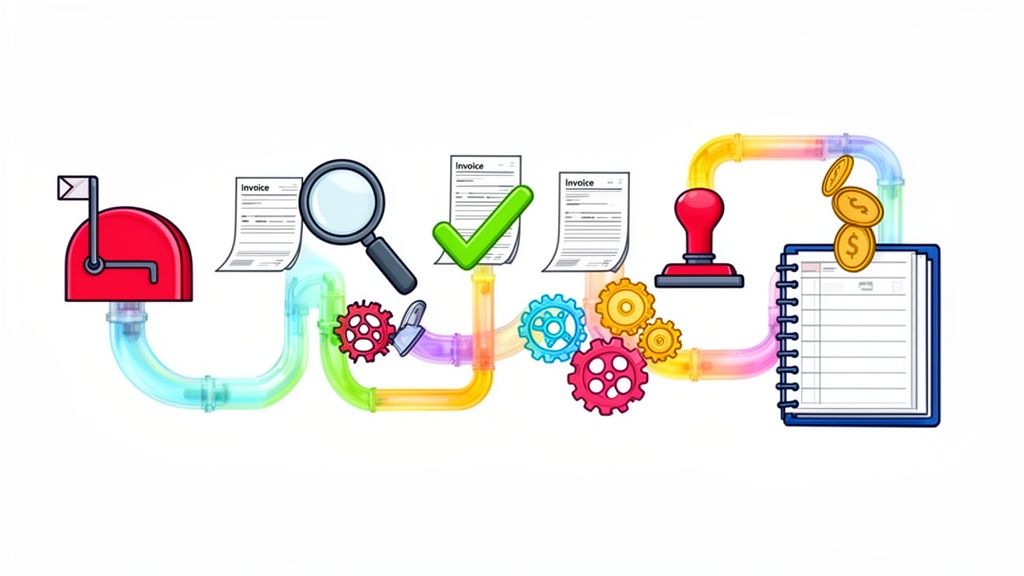
The journey from bill to paid is your accounts payable process. Let’s break it down into five stages. We’ll use a real-world example: a $500 monthly invoice from your CRM software.
This diagram is the simplified, happy-path version.
Now, let's talk about the messy reality of each step.
This is the starting line. Your CRM provider emails the invoice. In a manual world, someone now has to open that email, download the PDF, and start typing. Vendor name, invoice number, amount, due date… all into a spreadsheet or accounting software.
Sound mind-numbing? It is. It’s also where an AP staffer can waste up to 84% of their day. It’s a typo-factory, churning out tiny errors that will cause massive headaches later.
Okay, the data is in. Now what? You have to make sure the bill is legit. This stage is about asking a few dead-simple but mission-critical questions:
This isn't just about dotting i's. This is your front-line defense against fraud and overpayment. Skipping this step is like leaving the keys in the ignition with the doors unlocked.
Once validated, someone with the authority to spend money has to sign off on it. For our $500 CRM bill, that’s probably the head of sales. They give the final nod: “Yep, we use this. Pay it.”
This is where things grind to a halt. Welcome to the approval bottleneck. The invoice gets buried in an inbox for days, maybe weeks. The longer it sits, the closer you get to late fees and awkward phone calls with your vendors.
The invoice is finally approved! Hallelujah. Time to send the money. Whether you’re mailing a paper check (please don’t) or sending an ACH, wire, or card payment, this is when cash leaves your account.
The trick is timing. You want to pay close to the due date to hang onto your cash as long as possible, but not so late you get hit with a penalty. It's a delicate dance.
Payment sent. We’re done, right? Not so fast.
The transaction has to be recorded in your general ledger. This final step closes the loop, officially marking the bill as paid in your books. It moves the liability from accounts payable to a cash expense. Without this, your financial reports are just expensive fiction.
Get that sinking feeling every time an invoice hits your inbox? You’re not alone. If your AP process is a chaotic mess of spreadsheets, email chains, and sticky notes, you’re not just being inefficient—you’re actively lighting money on fire.
Let's be blunt: running a manual AP process today is like trying to navigate with a paper map. It’s slow, you’ll make wrong turns, and you will get lost. The warning signs of a broken system are glaringly obvious once you stop making excuses for them.

Think of these as the check engine lights on your company's financial dashboard. If any of these sound painfully familiar, your process is screaming for help.
Recognizing you have a problem is the first step to recovery. If this is your life, your system isn't just messy; it's a liability. Start by digging into strategies for improving your accounts payable process.
Still not convinced it’s a big deal? Let's talk numbers. A mind-boggling 68% of invoice data is still typed into a computer by a human being.
Worse, 66% of businesses are trying to run this critical function in Excel, and a terrifying 38% are using whiteboards or wishful thinking. This isn’t how you run a serious business.
Here’s the bottom line: every minute your team spends chasing an approval or fixing a typo is a minute they aren't spending on growing the company. Your AP process should be invisible, not a constant source of fires to put out.
It’s tempting to write this off as "the cost of doing business." It's not. It's the cost of clinging to broken processes.
The good news? The fix is out there. You can learn more by checking out these https://hireaccountants.com/accounts-payable-process-best-practices/. Now, let's talk solutions.
If your current AP process feels like you’re trying to bail out a sinking boat with a teaspoon, I get it. Too many founders spend their days chasing approvals and their nights wrestling with spreadsheets, wondering if this is what they signed up for. It’s not.
Now, imagine a world where invoices basically process themselves. That's the promise of AP automation. This isn't some futuristic fantasy; it’s the Roomba for your finances. Think of it as hiring a digital assistant who never gets tired, never makes typos, and is perfectly happy working at 3 AM.

AP automation isn't one tool; it’s a system that takes over the most repetitive, soul-crushing parts of your workflow. Here's what it actually does:
The results are staggering. Companies that go all-in on automation slash their invoice processing costs by up to 78%. More than half their invoices fly through the system with zero human touch. Approval times shrink to just 3.5 days. That’s not an improvement; it’s a revolution.
Let’s be real, "efficiency" is a word consultants use. What we're really talking about is getting your time and sanity back. It’s about killing that nagging voice in your head that wonders if your finances are about to implode.
AP automation isn’t just a tool; it’s a strategy. It slashes fraud risk, catches expensive human errors before they happen, and keeps your vendors happy because they actually get paid on time. It’s not about replacing people. It's about freeing them from robot work so they can do human work.
To see what this looks like in the wild, check out how dedicated accounts payable automation software can completely transform your back office. If you're serious about scaling, you can't have your team buried in paperwork. Dig into our other resources on AP automation to see how to start.
Automation is a beast. Software can catch errors, route invoices, and schedule payments while you’re out selling. But let’s be honest—software doesn’t run itself. At some point, you need a smart human in the driver’s seat.
The real question is when. When do you admit your DIY approach is costing you more than it’s saving? Usually, it's when you realize you're spending more time chasing down invoices than chasing new customers.
So you need help. Now you’re at a fork in the road. Hire a full-time AP specialist or outsource the whole damn thing? I’ve seen founders go both ways, and there’s no right answer—just the right answer for your company right now.
Hiring in-house gets you a dedicated person who lives and breathes your finances. They’re part of the team, focused only on you. The downside? It’s expensive. You’re not just paying a salary; you’re on the hook for benefits, taxes, training, and a desk. Hope you enjoy interviewing!
Outsourcing gives you instant access to a pro without the overhead. You get deep expertise from day one, often for less than the cost of a junior hire. The trade-off is they aren't down the hall, which can feel like a loss of control for some founders.
So, what are the signs it's time to fire yourself from AP? It’s rarely a single moment. It’s a slow, creeping dread that things are spiraling.
Here are the tripwires:
This decision isn't just about managing costs; it's about buying back your time and focus. As a founder, your job is growth, not invoice verification. Hiring help—in-house or outsourced—is an investment in your own sanity.
Getting the right talent is key. You need A-players who won't break the bank. If you're considering bringing someone on, our guide on how to hire a bookkeeper is a good place to start.
Alright, we’ve covered a lot. But I know a few questions are probably still rattling around in your head. Let's hit them directly. No fluff.
Honestly? "Faster than whatever you're doing now."
While the fancy consultants will tell you best-in-class is under five days, that’s not the point. If you’re taking 30 days, aim for 20. Then 15. The goal is a tight, predictable system, not some arbitrary benchmark. Progress over perfection.
Daily. Weekly. Monthly? Wrong question. Reconciliation isn't a task you schedule. It should be continuous. Modern accounting software makes this dead simple.
Leaving reconciliation for month-end is like only checking your oil once a year. By the time you spot a leak, the engine is already dead. You need a constant pulse on your cash.
A continuous process means you catch a duplicate payment or a miscoded invoice in hours, not weeks. This is non-negotiable if you actually want to know how much money you have.
Easy. They treat it like a low-priority chore instead of a strategic function. They pawn it off on an overworked office manager armed with a spreadsheet and then act surprised when cash flow gets messy.
Your what is accounts payable process is a critical part of your company's financial engine. Treat it with the respect—and the resources—it deserves. Neglecting it is how you wake up one day to a cash crisis you never saw coming.
Feeling like this is all a bit much? You don’t have to go it alone. At HireAccountants, we connect founders with pre-vetted, expert accountants who live and breathe this stuff. They can build and run a world-class AP process for you, often for a fraction of the cost of a full-time hire. (Toot, toot!) Find your perfect AP pro in as little as 24 hours.
Let's simplify your finances today!