

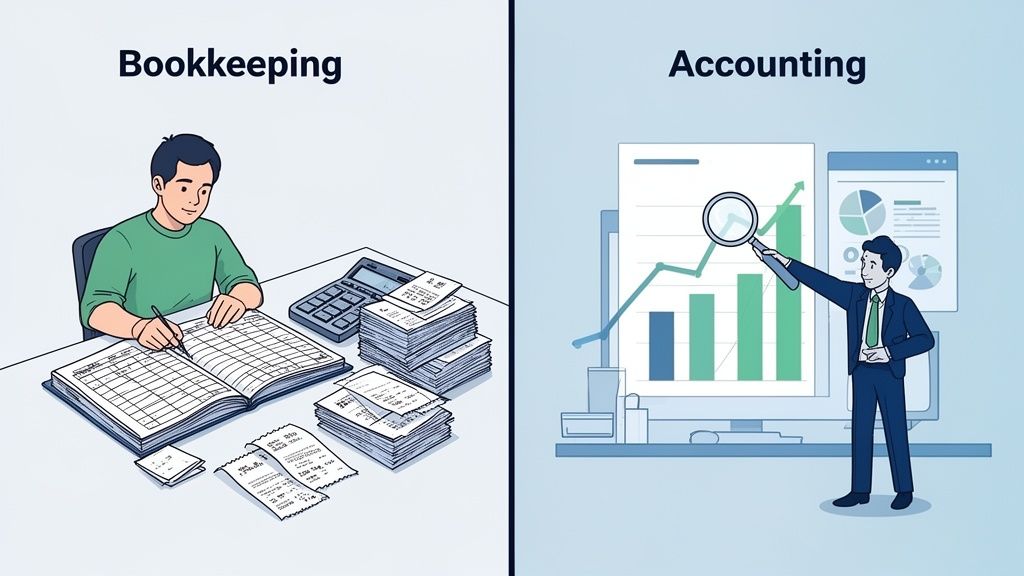
Let's get one thing straight: Bookkeeping is about recording financial history; accounting is about interpreting that history to plan for the future. One role meticulously builds the financial story of your business, day by day. The other reads that story and tells you whether you can afford to mortgage your office ping-pong table for that new espresso machine.
Getting this wrong is a classic, cash-burning mistake many founders make. I’ve seen it happen more times than I can count.

You’ve got a pile of receipts and a vague sense of dread. You know you need someone to handle the numbers, but who? This is where a lot of business owners freeze up. Do you need a bookkeeper? An accountant? Maybe both?
This isn’t just an academic question; it's about making the right hire so you can get back to doing what you’re actually good at. The market size tells the story: the global accounting services market was valued at a cool $666.39 billion in 2023, according to Fortune Business Insights. People are paying for this expertise for a reason.
Think of it like this: your bookkeeper is the diligent librarian, carefully cataloging every single financial event your company experiences. Your accountant is the grizzled detective who studies those records, finds the patterns, and tells you whether that expansion plan is brilliant or a one-way ticket to bankruptcy.
To make the core differences dead simple, let's put them head-to-head.
Here’s a no-fluff breakdown of the two roles. Memorize this, and you'll already be ahead of the game.
| Aspect | Bookkeeper (The Daily Record-Keeper) | Accountant (The Forward-Looking Strategist) |
|---|---|---|
| Primary Focus | Recording past and present transactions with obsessive precision. | Analyzing that data to give you a roadmap for the future. |
| Main Task | Data entry, bank reconciliation, managing payroll, and chasing invoices. | Financial analysis, tax strategy, auditing, and business forecasting. |
| Deliverable | Clean, accurate financial statements (P&L, Balance Sheet, Cash Flow). | Strategic advice, tax returns, audited reports, and business valuations. |
| Frequency | Daily, weekly, or monthly—it's a relentless, ongoing process. | Monthly, quarterly, or annually, usually when big decisions need to be made. |
| The Big Question They Answer | "What did we spend our money on last month?" | "Based on our spending, can we afford to expand next year without eating ramen for dinner?" |
In short, bookkeeping lays the groundwork with accurate data. Accounting uses that foundation to build a strategy for growth, compliance, and not running out of money.
Think of your business's finances like a ship's log. Your bookkeeper is on deck every single day, meticulously recording every detail of the voyage—every knot traveled, every supply loaded, every bit of cargo accounted for. It's not the most glorious job, but without that accurate, daily log, the captain has no idea where they've been, where they are, or where they're going. That's bookkeeping in a nutshell.

This is the tactical, get-your-hands-dirty work that creates the foundation of your financial records. We're not talking about high-level strategic planning here; this is about the consistent, daily discipline of ensuring every dollar is tracked so you aren't left in a cold sweat when tax season rolls around.
Your bookkeeper is essentially the guardian of your general ledger. They're the ones living inside your accounting software day-in and day-out, making sure every transaction hitting your bank accounts is categorized correctly and consistently.
Their core duties usually boil down to these key tasks:
Solid bookkeeping is more than just data entry; it’s a critical defense mechanism. For instance, good practices can help prevent payroll fraud, protecting your company's cash and your sanity.
A great bookkeeper doesn’t just record history; they create a single source of truth. Their work is the bedrock upon which every single financial decision, from hiring to fundraising, is built.
So, what's the end product of all this meticulous recording? Clean, reliable financial statements. The "big three" are your Profit & Loss (P&L) statement, your Balance Sheet, and your Statement of Cash Flows.
These reports aren't just paperwork; they're the vital signs of your business. The bookkeeper is the one taking the pulse. These documents tell you if you're actually profitable, what you own versus what you owe, and whether you have enough cash to keep the lights on. Trying to grow without this information isn't a strategy—it's a gamble.
So, your bookkeeper just handed you a perfect set of books—clean, reconciled, and ready to go. Now what? You could stare at them, nod thoughtfully, and then get back to putting out the day’s hundredth fire. Or, you could hand them over to an accountant who can turn that raw data into a genuine battle plan.
If bookkeeping is about documenting the past, accounting is all about using that past to win the future. Think of it like this: the bookkeeper provides the list of ingredients, but the accountant is the Michelin-star chef who knows how to create a masterpiece from them. They take that historical data and start asking the hard questions.
An accountant’s job isn't to record the day-to-day transactions; it's to interpret what those transactions mean. They are the strategic advisors who look at the story your bookkeeper has written and tell you the moral of that story. Hope you like your profit margins, because your accountant is about to put them under a microscope.
This process involves several key functions that go way beyond simple data entry:
An accountant connects the dots between your financial data and your business goals. They answer the critical 'so what?' question that turns numbers on a page into your next strategic move.
This is where you get the real bang for your buck. They’re the ones who can tell you if your pricing model is sustainable or if you’re about to hit a cash flow cliff in six months. It's a role that demands a completely different skill set, which is why you'll want to be sure you're hiring the right expert. To learn more about what separates top-tier strategic talent, check out our guide on how to hire a CPA for your team.
Ultimately, a good accountant doesn't just manage your finances; they help you build a more resilient and profitable business.
Hiring the wrong financial pro at the wrong time is a classic, money-burning startup mistake. You don’t need a $150/hour CPA to categorize your lunch receipts, and you definitely shouldn't ask a bookkeeper for complex tax advice. Getting this right comes down to one simple question: What's on fire right now?
Are you drowning in uncategorized Shopify transactions and starting to panic about sales tax? That’s a bookkeeping problem. Or are you planning to raise a Series A, make a major capital investment, or figure out how to structure employee stock options? That's squarely in accountant territory.
Most founders wait too long. Their books become a tangled mess that costs way more to fix than it would have to maintain from the get-go. Don't be that founder. The signal to hire is the moment you start spending more than a few hours a week on financial admin instead of, you know, actually growing your business.
Here’s a quick gut check to see which expert you need:
This simple decision tree can help you visualize the hiring path based on your immediate needs.

The path is clear—without clean records (the bookkeeper's job), any strategic financial advice (the accountant's job) is built on a house of cards.
Choosing between a bookkeeper and an accountant isn't just a startup dilemma; it reflects a massive global market. In 2023, there were nearly 1.5 million accounting services businesses worldwide, a huge portion of which focus on bookkeeping for the massive small business sector. With talent shortages pushing more US companies to outsource, understanding this distinction is crucial for your budget.
The biggest mistake is thinking you need a full-time, in-house accountant from day one. For 90% of early-stage businesses, a skilled part-time bookkeeper is the most impactful and cost-effective first financial hire.
If you’re ready to start interviewing, it helps to understand what makes a strong candidate stand out, like knowing how to craft A Winning Personal Statement for Accounting and Finance. But first, you have to be sure of the role you're filling.
To make it even clearer, let's look at some common scenarios.
This table breaks down typical business situations to help you pinpoint the right hire for your current needs.
| Your Current Situation | Your Immediate Need | Recommended Hire |
|---|---|---|
| Pre-revenue or just launched; transactions are minimal and tracked in a spreadsheet. | To get basic financial systems in place and ensure compliance from the start. | Bookkeeper (Part-time or fractional) |
| Revenue is growing, transaction volume is high, and you're spending 5+ hours a week on financial admin. | To accurately categorize all income/expenses, reconcile accounts, and generate basic monthly reports. | Bookkeeper |
| Books are clean, but you need to prepare for a bank loan or an investor pitch. | To prepare audited financial statements, build a financial forecast, and analyze cash flow. | Accountant (CPA) |
| You're considering a merger, acquisition, or a major change in business structure. | To conduct due diligence, provide strategic tax advice, and ensure regulatory compliance. | Accountant (Specialized, like a tax or forensic accountant) |
| Your company is scaling quickly, adding departments, and managing complex payroll. | You need both daily financial management and high-level strategic guidance. | Both. Start with a bookkeeper for the day-to-day, supported by a fractional accountant or CPA for oversight and strategy. |
This matrix should make it painfully obvious that the "right" hire is all about timing and specific needs.
If your business is in those early stages, our guide on how to hire a bookkeeper provides a step-by-step playbook to find the right person for the job you actually need done. Stop guessing and start building a solid financial foundation. You can find the complete guide here: https://hireaccountants.com/how-to-hire-a-bookkeeper/
Let's be real. As a founder, you can't afford a massive in-house finance team, and you definitely don't have time to do it all yourself. So, what’s the move? The modern playbook is a hybrid approach: automate the mundane and outsource the expertise. Forget mortgaging the ping-pong table for a full-time CPA.
This starts with a non-negotiable tech stack. Tools like QuickBooks Online or Xero are the baseline for any serious business. They automate transaction categorization, invoicing, and basic reporting, turning hours of manual bookkeeping into minutes. But automation only gets you so far.

The image above highlights how cloud-based platforms connect businesses with a global talent pool. This is where the real leverage is—tapping into expertise without the traditional overhead.
The smartest founders I know aren't just automating; they're tapping into a global talent pool. We’re not talking about finding the cheapest labor possible. We're talking about finding incredible, pre-vetted, English-fluent professionals from regions like Latin America who can deliver top-tier work for a fraction of US costs.
This isn’t just a theory; it's a core growth strategy. A staggering 95% of accounting practices have already embraced cloud-based software, with 75% of them seeing profit increases as a result. This tech adoption is what makes seamless outsourcing possible, allowing platforms to connect US startups with vetted remote talent and improve client services.
Imagine hiring a world-class bookkeeper who works in your time zone, understands your business, and costs 80% less than a local equivalent. That’s not just saving money—that’s freeing up capital to pour directly back into product development and marketing.
Services now exist that handle the entire vetting, HR, and payroll process. This means you can bypass months of painful recruiting and hire a world-class finance pro in a matter of days. This isn't just about the difference between accounting and bookkeeping; it’s about fundamentally changing how you build your finance function from the ground up.
To explore this strategy further, you might be interested in our guide on the benefits of outsourcing accounting services. It’s a complete game-changer.
You've made it this far, so you're probably wrestling with a few "yeah, but what about…" scenarios. Good. It means you're taking this seriously. Let’s tackle some of the most common questions we hear from founders trying to navigate this financial maze.
Absolutely. But it’s like asking a heart surgeon to put on a band-aid. They're wildly overqualified, and you’ll be massively overpaying for the privilege.
Accountants command higher rates because their real value is in strategic tax planning, financial analysis, and high-level advisory work. Having them spend hours logging transactions isn't just inefficient; it's a colossal waste of your money. They'll hate doing it, and your bank account will hate it even more.
The smart play is to use a dedicated bookkeeper for the daily grind of recording and reconciling. Then, bring in the accountant to review that clean data, build your strategy, and handle the complex tax filings. It’s a specialized approach that’s far more cost-effective.
Both roles practically live inside platforms like QuickBooks Online and Xero, but they use them for entirely different reasons. Think of it like a shared kitchen.
A bookkeeper is the line cook, using the tools every single day for tactical execution—creating invoices, processing bill payments, and running reconciliations. Their job is to ensure every ingredient, every single piece of data, is pristine and perfectly prepped.
An accountant is the executive chef. They come in to review the work, "taste-test" the reports for accuracy, and then often export that data into more advanced tools like Excel for complex financial modeling or specialized tax software to prepare the final dish: your annual return. The bookkeeper builds the foundation; the accountant builds the skyscraper on top of it.
Not always, and this is a tripwire for a lot of early-stage companies. A Certified Public Accountant (CPA) holds a specific license that grants them legal authority to perform certain tasks. You absolutely need one if you're facing an IRS audit, require officially audited financial statements for investors, or need a complex corporate tax strategy.
For everyday financial reporting and standard tax prep, however, a qualified accountant (who isn't a CPA) or an experienced bookkeeper is often more than enough—and much more affordable. Most startups find the ideal setup is a skilled bookkeeper for daily operations and an accountant for monthly reviews and annual tax filings. Don't pay for the CPA designation unless you truly need the firepower that comes with it.
Yesterday. Kidding… mostly.
The real signal is the moment you start spending more than a few hours a week on your books instead of actually growing your business. That’s it. That’s the sign. Too many founders wait until their finances are a complete disaster, which ends up costing them a fortune in clean-up fees down the line.
A good rule of thumb: once you consistently hit 20-30 transactions per month, it’s time to bring in a part-time bookkeeper. You don't need a full-time hire. Outsourcing gives you immediate access to pre-vetted, fractional help so your financials are clean from the start, saving you from a massive headache later on.
Stop drowning in spreadsheets and start building a real financial foundation for your business. HireAccountants connects you with thousands of pre-vetted bookkeepers and accountants from Latin America, ready to work in your time zone for up to 80% less than a US-based hire. Find your perfect match in as little as 24 hours.
Let's simplify your finances today!