


So, what does it actually mean to outsource bookkeeping? It's handing your financial record-keeping to an external pro instead of drowning in it yourself. Think of it as swapping those late-night spreadsheet nightmares for clean, professional financial management.
This isn’t just about offloading a task you hate. It's about getting your books clean, compliant, and ready for an investor's picky eyes, freeing you up to do what you're actually good at: growing the damn business.
Let’s be honest. You didn’t start a company to spend your evenings wrestling with CSV files and hunting down missing receipts. But for many founders, that's exactly where they end up. It's a classic startup story: the point where your DIY accounting system finally gives up the ghost.
It’s usually not a sudden explosion. It’s a slow, painful realization that you're spending more time reconciling bank statements than you are shipping product or talking to customers. Suddenly, you've unofficially been promoted to Chief Reconciliation Officer, and it's a role you never wanted and definitely aren't getting paid for.

This goes way beyond a messy spreadsheet. This is about real business risk piling up while you're playing amateur accountant. You know your books are working against you when:
This is the crossroads nearly every founder hits. The choice becomes painfully clear: keep sacrificing your most precious resource—your time—or find a smarter way.
This is the point where the idea to outsource bookkeeping for startups shifts from a "nice-to-have" to a strategic necessity. It stops being an expense and becomes an investment in your sanity and your company's survival.
Frankly, no investor has ever been wowed by a founder's perfectly color-coded expense spreadsheet. What does impress them are clean, accurate financial reports that prove you're a serious operator who actually understands the numbers. It’s time to get out of the financial weeds and back to building your vision.
Alright, you’ve decided to stop being your startup’s unpaid, overworked bookkeeper. Smart move. Now you face the classic founder’s dilemma: who do you actually trust with your financials? You’re staring down three very different paths, each with its own brand of charm and chaos.
Let’s be clear: this isn’t some bland pros and cons list. I’ve seen all three of these models in action with growing startups, and some are definitely a better fit than others for a company that needs to move fast.

Hiring a freelancer often feels like the easiest first step. You find someone on a marketplace, agree on a rate, and feel like you've checked a box. The appeal is the direct relationship and what seems like a lower cost.
The reality? You’ve just introduced a single point of failure into a critical back-office function. What happens when your freelancer gets sick during payroll week? Or decides to take a two-week vacation right when your lead investor needs updated financials for a follow-on round? You’re not just hiring a person; you’re inheriting their entire life schedule. Good luck with that.
On the other end of the spectrum is the traditional accounting agency. They promise systems, processes, and a whole team of experts. And they deliver… sort of. What you often get is a hefty monthly retainer, an impersonal ticketing system, and a revolving door of junior associates who don't really know your business from a hole in the ground.
Your urgent question about recognizing SaaS revenue gets logged as "Ticket #8675309" and is answered two days later by someone who primarily works with dentists. Agencies are built for stability and volume, not for the scrappy, ambiguous, and ever-changing world of a startup. You’re paying a premium for a service that feels like calling the cable company.
The real kicker? You’re often paying top dollar for a firm that is itself outsourcing the actual work to lower-cost locations. You're just footing the bill for their fancy office and sales team.
This is the Goldilocks zone for most startups—the option that balances cost, expertise, and dedication. Instead of a flighty freelancer or a faceless agency, you get a dedicated, pre-vetted professional who functions like a true member of your team. They learn your business, your tools, and your goals.
This model has been supercharged by the relentless US accounting talent shortage. With the domestic talent pool shrinking by roughly 10% between 2019 and 2024, startups are finding it nearly impossible to hire locally without mortgaging their office ping-pong table. Outsourcing is now the default for scaling finance functions without the soul-crushing hiring grind. You can explore the data and see why the future of accounting is increasingly global.
Hiring nearshore talent—specifically, pros in Latin America—is a game-changer. You get someone in your time zone, fluent in English, and deeply familiar with US business practices, all for a fraction of the cost of a domestic hire. This isn't just about saving money; it’s about getting dedicated, high-caliber talent that’s focused solely on your success.
To make this crystal clear, here’s a quick-glance table comparing how these models stack up in the real world for a startup.
| Model | Best For | Typical Cost | Biggest Risk |
|---|---|---|---|
| Freelancer | Early-stage startups with simple, project-based needs (e.g., a one-time cleanup). | $40 – $120 / hour | Single point of failure. Unpredictable availability, quality, and engagement. |
| Agency | Established companies with large, predictable workloads and a budget to match. | $1,500 – $7,000+ / month | Impersonal service. You're a small fish in a big pond, often dealing with junior staff. |
| Dedicated Nearshore Talent | Growth-stage startups needing a reliable, integrated team member without the high cost. | $2,500 – $5,000 / month | Requires finding a reputable partner to vet and manage the talent. |
For startups that need both expertise and flexibility, the dedicated remote professional model is tough to beat. End of story.
Let's talk numbers. Not the fuzzy, back-of-the-napkin kind, but the cold, hard figures that actually impact your runway. Most founders get stuck comparing an invoice from a service to the "cost" of doing it themselves, which they incorrectly assume is zero.
That’s a catastrophic mistake. It’s like saying the only cost of driving your own car is the gas you put in it, completely ignoring the insurance, maintenance, depreciation, and—most importantly—the fact that you could be doing something far more valuable with your time.
Your DIY bookkeeping has a price tag. It's just hidden.
Let’s get brutally honest about your most valuable asset: your own time. As a founder, every hour you spend categorizing transactions in QuickBooks is an hour you’re not spending on product, sales, or fundraising.
So, what's that worth?
Let's be conservative and say your time is valued at $150 an hour. If you’re spending just 10 hours a month wrestling with your books (and we both know it’s probably more), you're lighting $1,500 on fire. That’s an annual "Founder Time Tax" of $18,000. And for what? A set of books that an expert could do better, faster, and for a fraction of your opportunity cost.
You didn’t raise capital so you could become an amateur bookkeeper. You raised it to build a company. Every minute spent on tasks that don't directly drive growth is a minute wasted.
Okay, so DIY is out. The next logical step for many is hiring a full-time bookkeeper in the US. Let’s run those numbers. The average salary for a decent bookkeeper hovers around $70,000. Add in benefits, payroll taxes, and overhead, and you’re easily pushing $85,000+ per year.
Now, compare that to a dedicated, nearshore professional. You can get a fully vetted expert for less than $3,000 a month. That's a direct, undeniable cash saving of over $45,000 annually. The math isn’t complicated. You get the same (or better) expertise without having to auction off the office Keurig.
Cost savings are, unsurprisingly, the primary driver behind the boom in outsourcing. Businesses routinely see 50-70% reductions in labor costs compared to domestic hires, a trend powering the global finance and accounting outsourcing market toward $110.74 billion by 2030. Platforms like HireAccountants are at the center of this, connecting startups with top-tier talent at rates that provide full-time support for a fraction of a US salary. Explore more insights on outsourced bookkeeping savings.
But the biggest hidden cost isn’t just your time or a bloated salary. It’s the price of ignorance. When your books are a mess, your financial data is a black box. You can’t trust your numbers, so you can't make smart decisions.
When you’re guessing the answers, you’re not running a business; you’re gambling. Clean books turn that black box into a dashboard, giving you the visibility to steer the ship with confidence.
Reframing the decision this way makes it clear: outsourcing isn’t just an expense. It's a high-ROI investment that plugs the leaks and fuels real growth. For more on this, check out our guide on the strategic benefits of outsourcing accounting services.
So, you’re ready to hire someone. Hope you enjoy spending your afternoons fact-checking resumes and running technical interviews—because that’s now your full-time job.
Just kidding. But this is exactly where most founders spin their wheels, wasting weeks on a flawed process only to hire someone who thinks "accrual" is a type of bird. Let’s skip that part. This is your playbook for finding the right fit, fast.
Hiring a bookkeeper isn't like hiring a marketer. There's no room for "good enough." A bad hire won't just create messy reports; they can create real liabilities that cost you thousands in cleanup and missed opportunities.
A certification just means they passed a multiple-choice test. It doesn’t tell you if they understand the chaotic, fast-moving world of a startup. Here’s what actually matters:
The goal isn’t to hire a calculator. It’s to hire a financial translator—someone who turns raw data into clear, actionable insights so you can make smarter decisions about your business.
Spotting the wrong fit early saves everyone a headache. If you see any of these, run for the hills:
Let's be honest, the traditional hiring process is broken for this role. It’s slow, expensive, and you’re often just guessing. It's a massive time suck.
This is where talent platforms completely change the game. Instead of you vetting the world, the world has already been vetted for you. You get access to a curated pool of professionals who are pre-screened for the exact skills we just talked about. It shortcuts the entire painful ordeal. (Toot, toot! Yeah, we're biased, but we're also right.)
You can learn more about what to look for and how to structure your search in our detailed guide on how to hire a bookkeeper. It’s the deep dive you need before making a decision that will directly impact your startup’s financial health. Think of it as your insurance policy against a bad hire.
You did it. You found your person. Now for the hard part: not screwing it up. A sloppy handoff can poison a great hire before they even log in for the first time, leaving them confused and you frustrated.
This isn't just about sending a welcome email and hoping for the best. A great onboarding process is a selfish act—it gets your new bookkeeper effective from hour one, which means you can get back to your real job faster. Think of it as an investment that pays you back in time and clean financials, immediately.
The hiring journey is really just three core phases: sifting through applicants, interviewing the best, and then the crucial onboarding stage.
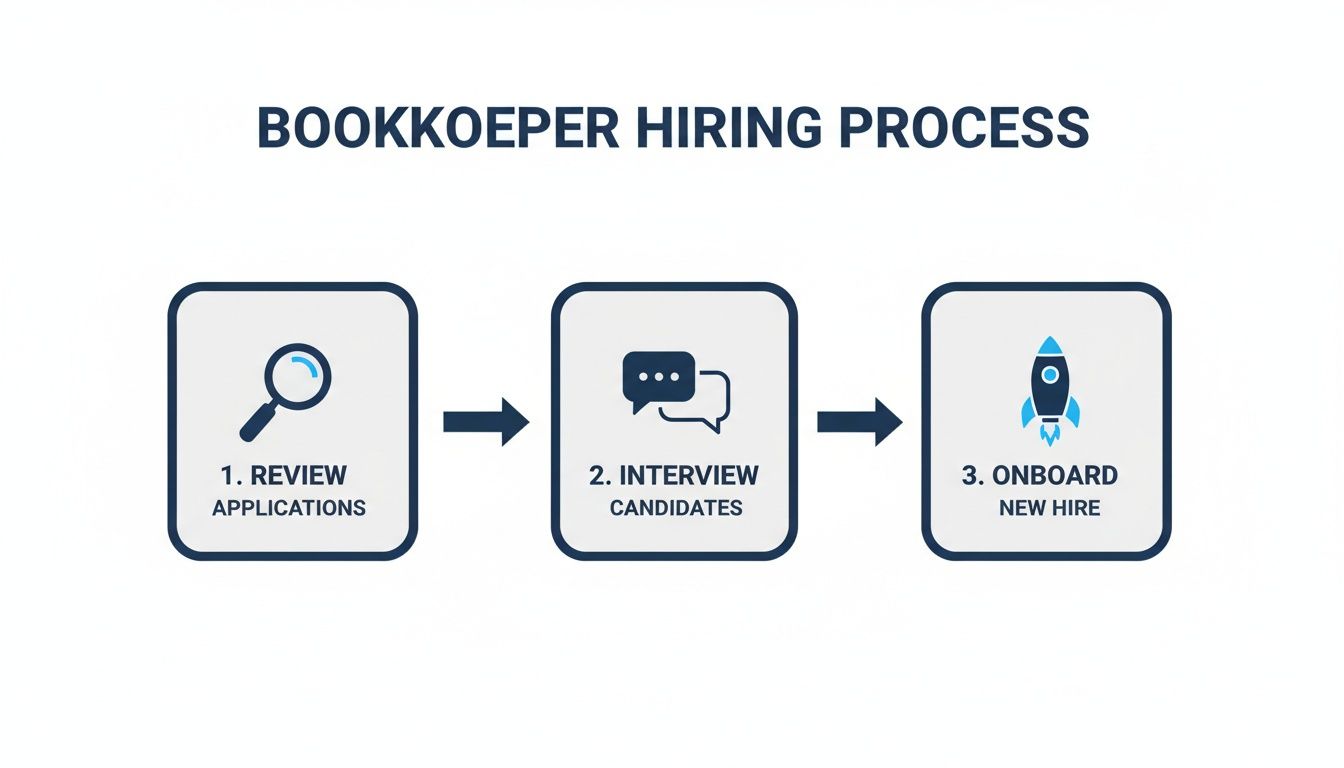
This just goes to show that finding the right person is only the beginning. How you bring them into the fold is what really turns a promising candidate into a productive part of your team.
First things first: access. Your new bookkeeper needs the keys to the kingdom, but you’re not just going to email them your password. The name of the game is security and efficiency. Your goal is to grant just enough access for them to do their job, without giving away control.
Now that they have the keys, they need a map. A 30-day plan prevents them from spinning their wheels and gives you a clear way to measure their progress right out of the gate.
Your bookkeeper's success in the first month isn't about overhauling your financial strategy. It's about one thing: getting your books 100% caught up and closed on time. That's it. That's the win.
Here’s what to nail down in your kickoff call:
This structured approach removes ambiguity and sets them up for success from day one. For a more detailed breakdown, our guide on how to onboard remote employees offers even more tactical advice to ensure a smooth transition.
Alright, let's get into the questions I hear from almost every founder before they take the leap. If you've made it this far, you see the benefits, but a few nagging doubts are probably holding you back.
I get it. Let's tackle them head-on.
This is usually the first question, and for good reason. The short answer is yes, but only if you do it right.
You should never, ever share your primary login credentials. That's a massive security risk. Instead, you use the tools your bank already provides. Grant your bookkeeper ‘read-only’ or ‘accountant-level’ access directly through your bank's online portal.
This lets them view transactions for reconciliation, but it absolutely does not give them the power to move a single dollar. Any reputable pro will also operate under a strict NDA and have their own security protocols. Frankly, it’s much safer than having a spreadsheet of passwords floating around your company's shared drive.
It feels like a paradox, but outsourcing your bookkeeping actually gives you more control, not less.
Think about it. Right now, you're probably making decisions based on financial data that's six weeks out of date, or worse, just a gut feeling. A good outsourced bookkeeper delivers clean, accurate, and up-to-date reports whenever you need them.
Instead of flying blind, you get a clear dashboard of your most important metrics: cash flow, burn rate, and profitability. This is what real control looks like—making sharp, data-driven decisions instead of guessing.
Here's the simplest way I can put it: a bookkeeper builds the car, and an accountant tells you how to drive it.
A bookkeeper is in the trenches every day. They handle the day-to-day grind of recording transactions, reconciling accounts, managing payroll, and chasing invoices. Their job is to make sure the raw data is pristine and organized.
An accountant takes that clean data and uses it for high-level strategy. They prepare official financial statements, offer strategic tax advice, and help guide major financial decisions like fundraising or acquisitions.
You need the bookkeeper first. An accountant working with messy data is just making expensive guesses.
Outsourcing isn't just a convenience anymore; it's a core growth strategy. Recent data shows that 65% of modern companies now outsource their bookkeeping to free up internal teams. For US startups, the savings can be significant. Tapping into talent from cost-effective regions like Latin America can slash payroll expenses by up to 60%, letting founders get back to building the business, not balancing the books. You can learn more about these bookkeeping trends and see how other companies are getting ahead.
Stop wrestling with spreadsheets and start making smarter decisions. At HireAccountants, we connect you with pre-vetted, expert bookkeepers in your time zone, often for under $3,000 a month. Find your perfect match in as little as 24 hours and get back to building your business. Explore top talent on HireAccountants today.
Let's simplify your finances today!