

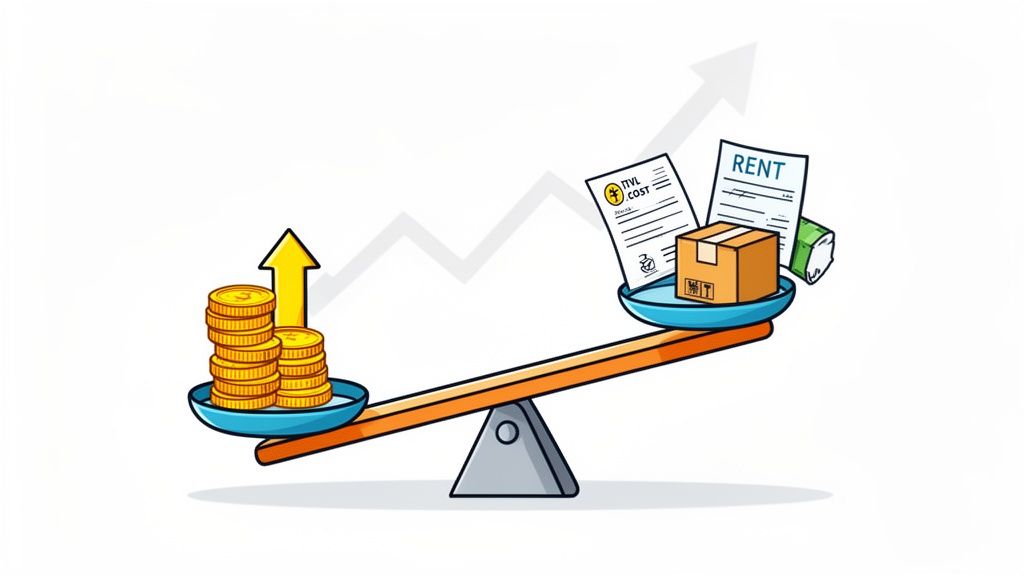
Let's get straight to it. Your break-even point is the most critical number you're probably not tracking. It’s the moment when your total revenue finally catches up to your total costs. At that point, you're no longer losing money. You're not profitable yet, but you've stopped the bleeding.
Everything before that point? You're paying to be in business. Everything after? That's pure profit.

If you can't tell me your break-even point right now, you’re essentially running an expensive hobby, not a business. I say this from painful experience. My first venture was a subscription box service that everyone seemed to love. We had glowing reviews and our subscriber count was climbing, but our bank account was always on life support.
We were so focused on growth and vanity metrics that we were completely blind to a terrifying reality: we were losing a little bit of money on every single box we shipped.
We didn't know our break-even point, so we didn't know we were accelerating straight toward a cliff. It almost destroyed the company.
Think of your break-even calculation as your business’s financial GPS. Flying blind and hoping you’ll accidentally find your way to Profitability Avenue just doesn't work. This single number brings immediate clarity to the most pressing questions you face.
The break-even point isn't just an accounting term. It’s a reality check. It’s the minimum viable pulse for your business, telling you the exact point where you stop bleeding and start breathing.
The good news is that figuring this out isn't nearly as complicated as it sounds. Forget the intimidating jargon for a second. It all boils down to getting a firm grip on three core numbers in your business.
To calculate your break-even point, you need to get brutally honest about these figures:
Fixed Costs are the bills that show up every single month, regardless of whether you sell one item or a million. This is your rent, salaries, software subscriptions, and insurance. They're predictable and, frankly, a bit of a pain.
Variable Costs are the expenses directly tied to producing one more item. For a t-shirt business, it’s the blank shirt, the ink, and the shipping box. For a software company, it might be data processing fees or sales commissions. If you don't sell anything, you don't have these costs.
Price Per Unit is the simplest one: it's how much you charge a customer for one of your products or services.
That's it. Once you have those three pieces of information, you have everything you need. In the rest of this guide, we’ll walk through exactly how to put them together to find that magic number for your own business.

Let's cut through the noise. You don't need a degree in finance to figure out your break-even point. In fact, when you're in the trenches running a business, you only need two core formulas.
One tells you the exact number of units you have to sell. The other gives you the total sales dollars you need to hit. That's it. Let’s make this real.
This is the classic formula every business owner should know. It answers the fundamental question: "How many products, subscriptions, or consulting hours do I need to sell before I actually start making money?"
Here's the formula that has been the bedrock of business planning for decades:
Fixed Costs ÷ (Sales Price per Unit – Variable Cost per Unit)
Let's see this in action with a SaaS company. Imagine their monthly fixed costs (salaries, rent, software licenses) total $50,000. They sell their service for $500 per customer, and the variable costs for each customer (like server usage and sales commissions) come out to $150.
Plugging those numbers in: $50,000 ÷ ($500 – $150) = 125 units.
They need to sign up 125 customers each month just to cover their bills. The 126th customer? That's pure profit.
Pro Tip: The secret weapon in this calculation is the Contribution Margin. It's the profit you make on each sale before accounting for fixed costs. In our example, it's $350 ($500 Price – $150 Variable Cost). Think of this as the money from each sale that directly pays down your fixed expenses.
Sometimes, you're less concerned with the number of units and more interested in the top-line revenue figure. You just want to know the magic number your Stripe dashboard needs to hit before you can breathe a little easier.
For that, we use a slight variation:
Fixed Costs ÷ Contribution Margin Ratio
First, you need the Contribution Margin Ratio, which is simply your Contribution Margin per Unit divided by your Sales Price per Unit.
Sticking with our SaaS example:
Now, we can find the break-even point in sales dollars: $50,000 (Fixed Costs) ÷ 0.70 = $71,428.57.
This means the company needs to generate just over $71,400 in revenue to break even. It's just a different lens to view the same target. One formula gives you a unit goal, the other gives you a revenue goal.
Of course, the price you set is a massive lever in this whole equation. Developing effective pricing strategies is critical to setting a break-even point that’s actually achievable.
Don't overlook your variable costs, either—they represent a huge opportunity for optimization. To dig deeper into what makes up these costs, you can learn more about how to calculate your cost of goods sold.
So, what happens when you sell more than one thing? Most businesses do. Whether you're running an e-commerce store with dozens of products or a service business with tiered packages, that simple single-product formula starts to look a little too basic.
Calculating the break-even point for a multi-product business might seem complicated, but it just adds one crucial layer to the process: finding the weighted average contribution margin. It’s a slightly intimidating term for a very practical idea—blending your products' profitability based on how much of each you actually sell.
This is where many guides get vague, but we’re going to walk through it with a clear, practical example.
Your sales mix is simply the proportion of each product you sell relative to your total sales. For instance, if you sell 100 items in a month—60 t-shirts, 30 hats, and 10 mugs—your sales mix is 60%, 30%, and 10%. It really is that straightforward.
Understanding your sales mix is non-negotiable. Why? A business that primarily sells high-margin products will have a vastly different break-even point than one relying on low-margin, high-volume goods, even if their fixed costs are identical. A simple average just won't cut it; you have to give more "weight" to the products that truly drive your revenue.
Let's imagine you run an online store with three main products. We'll assume your total monthly fixed costs are $10,000. Here’s how you’d find your break-even point in the real world.
The first step is to calculate the contribution margin for each product and then apply the sales mix percentage to find its "weighted" value.
Here's what that looks like in a table format, which makes it much easier to visualize.
| Product | Sales Price per Unit | Variable Cost per Unit | Contribution Margin per Unit | Sales Mix % | Weighted Contribution Margin |
|---|---|---|---|---|---|
| T-Shirt | $30 | $15 | $15 | 60% | $9.00 ($15 x 0.60) |
| Hat | $25 | $10 | $15 | 30% | $4.50 ($15 x 0.30) |
| Mug | $15 | $5 | $10 | 10% | $1.00 ($10 x 0.10) |
To get the final piece of the puzzle, just add up the weighted contribution margins from the last column:
$9.00 (from T-shirts) + $4.50 (from Hats) + $1.00 (from Mugs) = $14.50
This $14.50 is your Weighted Average Contribution Margin per Unit. It’s the powerful, blended number representing the average profit you make from a typical "bundle" of items, sold according to your sales mix.
For any business with a varied product line, the weighted average contribution margin is your most important metric. It distills a complex sales reality into a single, actionable number for planning and forecasting.
With this number in hand, the final calculation is a breeze. We just plug it back into our original break-even formula:
Total Fixed Costs ÷ Weighted Average Contribution Margin = Break-Even Point in Units
$10,000 ÷ $14.50 = 690 units (rounded)
This tells you that you need to sell 690 total products per month, maintaining that 60/30/10 sales mix, just to cover all your costs. Broken down by product, that’s roughly 414 T-Shirts, 207 Hats, and 69 Mugs. Every sale beyond that point is pure profit.
This kind of analysis is fundamental to understanding your company's financial health, similar to how you’d regularly review your profit and loss statement.
Calculating your break-even point is a huge first step, but here's where the real strategic thinking kicks in. That number isn't static. In the real world, costs fluctuate, prices change, and sales ebb and flow. If you treat your break-even number as a fixed target, you’re flying blind.
Think about it. What happens when your key supplier raises prices by 10%? Or when you finally give your team that well-deserved raise, bumping up your fixed costs? Your break-even point shifts right along with them. This is where you move from just calculating a number to actively managing your business's financial health.
This is the core idea behind sensitivity analysis. It’s less about a crystal ball and more about stress-testing your business model. You’re essentially asking a series of "what-if" questions to see how sensitive your profit is to changes in your core assumptions.
Instead of relying on a single break-even figure, you model a few potential futures:
By running these numbers, you get a much more dynamic picture of your financial resilience. You start to see which variables have the most power to help or hurt your bottom line. This kind of modeling is a fundamental part of good financial planning and analysis, helping you anticipate challenges instead of just reacting to them.
For example, your sales mix is a massive variable. If you sell multiple products, your overall break-even point depends heavily on which products are selling the most.

If your most popular item also has the slimmest profit margin, you're more vulnerable than you might think. A dip in its sales, or a rise in its specific costs, could throw your entire forecast off.
Now, let's talk about the number that helps business owners sleep better at night: the Margin of Safety. This metric gives you a clear, simple answer to the question, "How much can my sales drop before I start losing money?" It’s the cushion between your actual sales and your break-even sales.
The formula is straightforward:
Margin of Safety = (Current Sales – Break-Even Sales) / Current Sales
Imagine your current sales are $100,000 a month, and you’ve calculated your break-even point at $70,000.
Plugging those in, you get:
($100,000 – $70,000) / $100,000 = 0.30, or 30%
This 30% is your buffer. It means your sales could fall by nearly a third before you’d be in the red.
A high margin of safety shows your business is resilient. It can absorb a slow month, a price war, or a market downturn. A low margin of safety means you’re walking a financial tightrope, where any small setback could be a major problem.
This single percentage is one of the most powerful health indicators you can track. It cuts through the noise and tells you exactly how much risk you're carrying at any given moment.
When founders are trying to get a handle on their break-even point, they usually obsess over two things: pricing and marketing. But here's a secret from the trenches: the biggest lever you can pull is sitting right on your payroll.
Your staffing decisions are directly tied to your fixed costs, and nothing inflates those costs faster than a traditional, full-time hire.
Think it through. You realize you need expert financial oversight, so you decide to bring on an in-house CPA. That’s a $90,000+ annual salary, not to mention benefits, payroll taxes, and the office ping-pong table. Just like that, your fixed costs have exploded. Your break-even point—the number of units you have to sell just to cover your nut—has skyrocketed right along with it.
Suddenly, you have to sell hundreds, maybe even thousands, more of your product just to pay for that one salary. It's a massive drag on your path to profitability.
But what if you could get that same top-tier financial expertise without the crushing fixed cost? This is where strategic outsourcing completely changes the game. This isn't about chasing cheap labor; it’s about converting a huge, inflexible fixed cost into a much smaller, more manageable operational expense.
Instead of that $90,000 salaried employee, imagine hiring a pre-vetted, expert accountant for $1,500 a month. You've just slashed that specific overhead expense by over 80%.
Let's put it in monthly terms. A $7,500 salary is a massive fixed cost weighing you down every single month. A $1,500 monthly contract with a remote professional, on the other hand, is practically a rounding error in comparison.
Your break-even point is directly proportional to your fixed costs. The fastest way to lower the bar for profitability is to ruthlessly attack your overhead. Smart staffing is your sharpest tool for the job.
This move does more than just save you money. It fundamentally rewrites your company's risk profile. When your fixed costs are lower, you become profitable with far fewer sales. Exploring options for remote jobs can be a fantastic strategy for this, allowing you to reduce overhead and build a more resilient cost structure.
When you need fewer sales to be in the black, a few wonderful things happen:
Let’s be blunt. Hope you enjoy spending your afternoons fact-checking resumes and running technical interviews—because that’s your new job when you hire traditionally. The alternative? You can tap into a pre-vetted talent pool and have an expert accountant working for your business in a matter of days. We’re not saying we’re perfect, just that our approach gets you expert help without forcing you to mortgage the company to do it. (Toot, toot!)
So, you've got the theory down, you've crunched the numbers on a few examples, but now you're staring at your own business's finances. This is where the real questions start to surface. Let's walk through some of the most common sticking points I see with founders.
The simple answer? Probably more often than you are right now.
Think of your break-even point not as a static number you calculate once, but as a living metric that reflects the current state of your business. It's not a "set it and forget it" task.
Anytime one of your core assumptions changes, it's time to rerun the numbers. Did your key supplier just hit you with a price increase? Recalculate. Did you hire a new salesperson or get a better rate on your office lease? Recalculate. That monthly software subscription just went up? You know what to do.
As a rule of thumb, you should be revisiting your break-even analysis at least quarterly, tying it into your regular business review. This keeps you ahead of the curve and prevents you from being blindsided by creeping costs or changing margins.
Absolutely. In fact, if you're running a service business and you think this doesn't apply to you, you're missing a huge opportunity to understand your own profitability. The logic is identical; you just need to adjust your vocabulary.
Instead of "units sold," your key metric might be:
Your variable costs aren't raw materials, but they definitely exist. They could be commissions for your sales team, fees for freelance contractors on a per-project basis, or even the payment processing fees you pay on every single invoice. The break-even formula works just the same.
For service-based founders, the biggest mental block is often just identifying those variable costs. Once you do, it unlocks a much clearer view of your profitability on a per-client or per-project basis.
This one's easy: misclassifying costs. I've seen this single mistake derail more financial forecasts than I can count. Founders either forget costs entirely or, more commonly, just put them in the wrong bucket.
The classic error is lumping everything into fixed costs. You might forget that every single sale has a variable cost attached to it, like the 2.9% + $0.30 Stripe fee. It seems small, but when you multiply it across hundreds or thousands of transactions, it completely throws off your break-even calculation.
My advice? Be ruthless. Get every single business expense into a spreadsheet and force yourself to categorize each one as either fixed or variable. It's a bit tedious upfront, but it's the only way to build a break-even analysis you can actually trust to make decisions.
Getting your costs classified correctly can be a headache. If you want an expert to get it right without adding another massive fixed cost to your payroll, HireAccountants is the answer. We connect you with top-tier, pre-vetted accountants from Latin America at a fraction of the cost of a US-based hire. Find your ideal financial pro in as little as 24 hours at https://hireaccountants.com.
Let's simplify your finances today!