

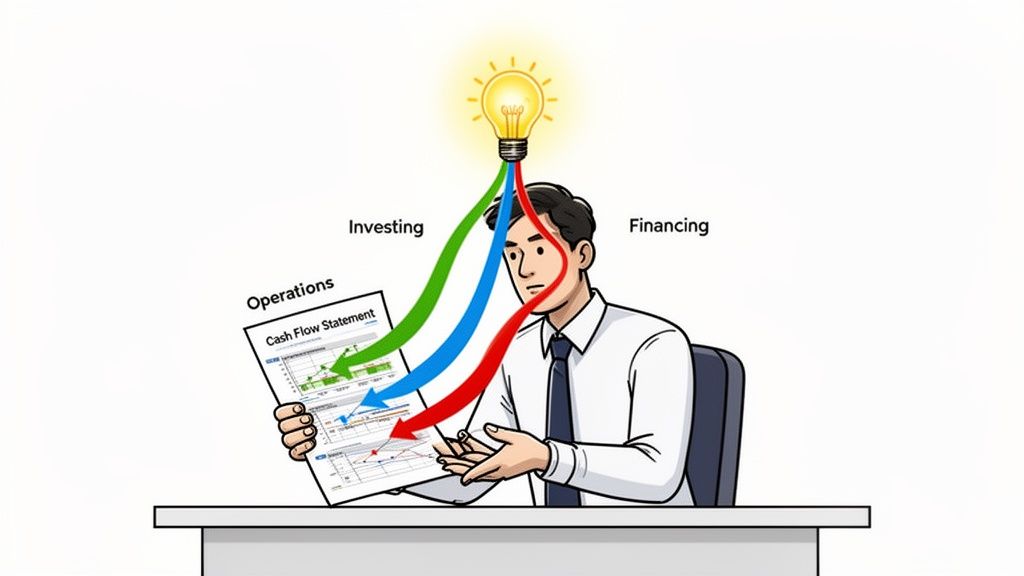
So, you want to read a cash flow statement? Let's break it down into its three main parts: cash from operations, cash from investing, and cash from financing. Together, these sections give you an honest-to-god look at where your money is coming from and where it's going—a truer picture of your company's health than profit alone can ever provide.
Let's be real—staring at a cash flow statement can feel like trying to decipher a secret code. But this isn't some accounting chore your bookkeeper forces on you; it's the heartbeat monitor for your entire business. It tells you the unvarnished truth when other reports are busy blowing smoke.
Think about it: your income statement can lie. It might show a huge "profit" because you just landed a massive new client and sent the invoice. High-fives all around, right? But have they actually paid you? If not, that profit is just a promise, a number on a spreadsheet. The cash flow statement cuts right through those vanity metrics and shows you the hard reality of what’s in your bank account.

Look, this isn't about passing an accounting exam. It’s about making smart moves so you don't become another startup cautionary tale. We’re going to break this document down into its three core components, which is exactly how any finance pro worth their salt starts their own analysis.
The structure itself is actually pretty logical. The big accounting firms, like KPMG, explain that financial standards require categorizing all cash movements into these three buckets. It's the standard way to bridge the gap between your net income and your actual cash position. In fact, over 95% of companies use a method that starts with net income and then works backward to account for all the non-cash items.
At its core, the statement is designed to answer three critical questions about your business:
The cash flow statement is your most honest co-founder. It never gets overly optimistic about a big sale or sugarcoats a bad month. It just tells you if there’s money in the bank.
For a truly deep understanding, learning how to prepare a cash flow statement can be a game-changer. Once you see how it’s built, reading it becomes second nature. It also makes you appreciate why having a pro handle the numbers is so important—garbage in, garbage out.
Getting a handle on these cash movements is the difference between scaling intelligently and accidentally driving your company off a cliff. When you get this right, you can finally stop guessing and start making decisions based on financial reality.
If you’re at the point where these decisions feel overwhelming, it might be time to bring in some part-time expertise. A fractional CFO can help guide these choices without the cost of a full-time hire.
Now, let's dive into that first section.
Alright, let’s get to the good stuff. The Cash Flow from Operating Activities (CFO) section is where the truth lives. Forget the profit numbers your sales team is high-fiving over—this part of the statement tells you if your core business model actually, you know, makes cash.
Your income statement can boast a healthy profit, but if your clients haven’t paid their invoices, that profit is just a number on a spreadsheet. It’s a vanity metric. CFO cuts through the accounting fluff to show you what actually landed in your bank account from selling your product or service.

This is where most founders get tripped up. How can you be "profitable" but have no money? Welcome to the wonderful world of accrual accounting.
Imagine you run a SaaS company. You close a $120,000 annual deal, and your income statement lights up. You book that revenue, your profit looks amazing, and everyone's patting you on the back.
But the client pays you in $10,000 monthly installments. Your operating cash flow for that first month is only $10,000, not $120,000. See the problem?
The CFO section is designed to reconcile this exact difference. It starts with Net Income and then makes a series of adjustments for all the non-cash activity. It’s your reality check.
You'll see a few line items here again and again. Don't gloss over them; they're telling you a story.
Depreciation: This is an accountant’s trick. You bought a $5,000 server last year, but for tax and accounting purposes, you "expense" a piece of its value over time. No actual cash leaves your account for this, so it gets added back to your net income to reflect reality.
Accounts Receivable (AR): When this number goes up, it means more customers owe you money. It’s a cash drain. A big spike in AR while profits soar is a massive red flag. Are your customers slow to pay? Is your collections process broken?
Accounts Payable (AP): This is money you owe your suppliers. When AP increases, you’re holding onto your cash longer, which actually boosts your operating cash flow. But is it a clever cash management strategy or a sign you're struggling to pay your bills? That's the million-dollar question. You can learn more about managing this effectively by reviewing our guide on the accounts payable process.
A savvy founder knows that Net Income is opinion, but Cash Flow is fact. The CFO section is where you separate optimistic projections from the cold, hard cash reality of your operations.
A crucial move for any leader is to compare operating cash flow directly to net income. This simple comparison reveals how efficiently your company turns those paper profits into actual money you can spend.
Let's put this into perspective with a quick comparison that I see play out all the time.
This table breaks down a common scenario: a company that looks great on paper but is heading for a cash crunch, versus one with a solid financial foundation.
| Metric | Company A (High Profit, Low Cash) | Company B (Healthy Cash Flow) | What This Tells a Founder |
|---|---|---|---|
| Net Income | $100,000 | $80,000 | Looks great, but it's not the whole story. |
| Increase in AR | ($70,000) | ($10,000) | A is selling a ton, but nobody is paying. Big problem. |
| Increase in AP | $10,000 | $5,000 | A is delaying payments to suppliers to stay afloat. |
| Depreciation | $5,000 | $5,000 | A standard non-cash add-back for both companies. |
| Cash from Operations | $45,000 | $80,000 | B is in a much healthier position to actually grow. |
Company A is on a collision course with reality. They’re celebrating a $100,000 profit while their bank account is draining. They're technically successful but functionally broke.
Company B, on the other hand, has its operations dialed in. They are efficiently converting sales into cash they can use to hire, invest, and scale. This is the goal.
This is why you can't afford to ignore your cash from operations. It’s the engine room of your business, and if it’s not running smoothly, the whole ship will eventually sink—no matter how nice the view from the captain's chair looks.
Alright, so you’ve got a handle on the cash coming in and out from your day-to-day operations. That’s a massive step. But a business is more than just its daily grind. Now we need to zoom out and look at the strategic moves you're making. Are you building a long-term, sustainable company, or are you just scrambling to survive another quarter?
The Investing and Financing sections of your cash flow statement lay this all out. They tell the story of your long-term vision and the cold, hard cash you're using to make it a reality. This is where we see the big bets.
Let's start with Cash Flow from Investing (CFI). For a company that's serious about growth, seeing a negative number here can actually be a fantastic sign. No, that's not a typo.
A negative CFI means you’re putting cash to work acquiring assets that will generate more cash later. You're buying new equipment to scale production, upgrading your tech stack, or maybe even acquiring a smaller competitor. You're making calculated bets on your future.
Here’s what you’ll typically find in the investing section:
But—and this is a big but—context is everything. A negative CFI can also be a red flag. On the flip side, a big positive number might seem great at a glance, but it could mean you just sold off a core piece of your company to stay afloat. Did you sell a delivery truck just to make payroll? That's not a strategic move; that’s a fire sale. You have to understand the story behind the numbers.
Your investing cash flow shows whether you're planting trees for future shade or chopping down the forest for firewood. One is a long-term strategy; the other is a short-term survival tactic.
When you look at this section, the core question is simple: Is this outflow of cash an investment that will generate more cash down the line? If the answer is yes, then that negative number is something to be proud of.
Next up is Cash Flow from Financing (CFF). This section tracks the movement of cash between your company, its owners, and its lenders. Did you just close a seed round? That pops up here as a big cash inflow. Did you have to take out a loan to get through a slow period? That's here, too.
Conversely, paying back a loan or buying back shares from early investors will show up as a cash outflow. It’s the story of how you're capitalizing your business—whether you’re using equity, debt, or a mix of both.
Here’s a breakdown of the usual suspects in the CFF section:
For an early-stage startup, a big positive CFF is perfectly normal. You need that investor cash to fund your growth, especially when your operations and investments are burning through money. But if you’re a five-year-old business still relying on constant financing just to cover basic operating costs, you've got a serious problem. It’s a sign that the fundamental business model isn't working.
Understanding these patterns is what separates a novice from an expert when reading a cash flow statement. A startup with a positive CFF and a negative CFI is in textbook growth mode. A mature company with a negative CFF might be deleveraging by paying down debt. It’s all about connecting the dots to see the real financial story unfolding.
Theory is great, but let's get our hands dirty. The real insights come from seeing how these numbers dance together on an actual statement. We’re going to walk through a cash flow statement for a fictional e-commerce startup I've cooked up called "WidgetCo."
This isn't just an accounting exercise. It's about connecting the numbers to the tough calls you have to make every day. Can you afford that new hire? Do you need to start chasing down unpaid invoices right now? The cash flow statement holds the answers.
Of course, to do any meaningful analysis, your data has to be clean and accurate. This is where using one of the best accounting software options becomes non-negotiable. It keeps everything organized and ready for a deep dive like this.
Let's set the scene. WidgetCo sells premium, artisanal widgets online. They just closed a decent quarter, and the income statement is glowing—it shows a Net Income of $20,000. The CEO is ready to pop the champagne, but a quick glance at the bank account tells a very different, much less exciting story.
Sound familiar? This happens all the time. Let's find out where the cash went.
Here’s a simplified look at their cash flow statement for the quarter:
| WidgetCo – Statement of Cash Flows | |
|---|---|
| Cash Flow from Operating Activities | |
| Net Income | $20,000 |
| Depreciation | $5,000 |
| Increase in Accounts Receivable | ($15,000) |
| Increase in Inventory | ($50,000) |
| Increase in Accounts Payable | $10,000 |
| Net Cash from Operations | ($30,000) |
| Cash Flow from Investing Activities | |
| Purchase of Equipment | ($10,000) |
| Net Cash from Investing | ($10,000) |
| Cash Flow from Financing Activities | |
| Proceeds from Loan | $100,000 |
| Repayment of Loan | ($5,000) |
| Net Cash from Financing | $95,000 |
| Net Change in Cash | $55,000 |
| Beginning Cash Balance | $25,000 |
| Ending Cash Balance | $80,000 |
Time to dissect this, piece by piece.
The first thing that should make your jaw drop is that big, ugly negative $30,000 from operations. WidgetCo was "profitable" with a $20,000 net income, but its day-to-day business actually burned through $30,000 in cold, hard cash. Ouch.
So, what happened?
This is a classic trap for e-commerce businesses. You have to shell out cash for inventory long before you ever see revenue from it, creating a painful cash flow gap. Here, WidgetCo's profit was completely swallowed by its own inventory.
If the business incinerated $30,000 just by operating, how on earth did their cash balance go up?
First, they spent another $10,000 on new equipment (an investing activity). This cash outflow deepens the hole, bringing their total deficit from core business activities to $40,000.
This is where the Financing section swoops in to save the day.
WidgetCo secured a new $100,000 loan. After paying back $5,000 on an older debt, they were left with a net $95,000 cash injection from financing. This lifeline was more than enough to cover the operational cash burn and the new equipment purchase, leaving them with a $55,000 net increase in cash.
This flow is how many growing companies function—they use outside capital to fund the assets and infrastructure they need to expand.

As the visual shows, you often need financing to make the investments that will hopefully lead to growth down the road.
The lesson here is brutal but simple: WidgetCo only survived this quarter because a bank gave them money. Relying on debt to cover your operational cash burn isn't a strategy; it's a ticking time bomb.
So, what's the real story? To get the unvarnished truth, we need to calculate the Free Cash Flow (FCF). This is the metric that shows how much cash the business actually generates after paying for the big-ticket items it needs to operate and grow.
The formula is straightforward:
FCF = Cash from Operations – Capital Expenditures
For WidgetCo, that looks like this:
FCF = (-$30,000) – $10,000 = -$40,000
This number tells you everything. WidgetCo had a negative Free Cash Flow of $40,000. They didn't generate a single dollar to reinvest, pay down debt, or return to owners. In fact, they had a $40,000 hole they had to fill just to keep the lights on and buy necessary equipment—a gap they plugged entirely with a new loan.
This is the number that tells the CEO they absolutely cannot afford that new marketing hire. Their focus can't be on growth right now; it has to be on survival. The immediate priorities are fixing their cash conversion cycle by collecting receivables faster and getting way smarter about how they manage inventory.
Walking through this example, you can see how the cash flow statement tells a much richer, more honest story than the income statement ever could. It’s not just a boring report; it's the financial narrative of your company, full of plot twists and cliffhangers. The only question is, are you reading it?
Alright, you’ve navigated the three main sections of the cash flow statement and worked through the WidgetCo example. Now for the real-world application: using this knowledge to spot trouble before it spirals into a full-blown crisis. Your cash flow statement is like a breadcrumb trail leading to either a healthy, growing business or a financial cliff. You just need to know how to read the signs.
Forget the endless list of obscure ratios from your college accounting class. We're focusing on the vital few that are genuine predictors of a company's health or its potential collapse. This isn't an academic exercise; it's about survival.

Before diving into specific metrics, let’s talk about the big, flashing warning lights that should immediately grab your attention. If you spot these patterns showing up quarter after quarter, it’s a clear signal to start asking some hard questions.
Consistently Negative Operating Cash Flow: This is the single biggest red flag. If your core business operations can’t generate positive cash flow, you don’t have a sustainable business. You have an expensive hobby funded by investors or lenders. One tough quarter happens. A consistent negative trend is a huge problem.
Relying on Financing to Cover Operations: Remember how WidgetCo used a loan to plug their operational cash gap? Doing that once to, say, fund a massive inventory buy for a new product launch can be a smart, strategic move. But if you see financing activities consistently propping up negative operating cash flow, you’re just borrowing to make payroll. That's a treadmill to nowhere.
Selling Off Assets to Stay Afloat: A big spike in cash from investing can seem positive on the surface. But if you dig deeper and find that cash came from selling off essential machinery or property, it’s a sign of desperation. It’s the business equivalent of pawning your tools to pay rent—you can only do it for so long.
Now, let's get a bit more granular. These are the numbers I personally watch like a hawk on any P&L I review. They cut through the noise and tell you what's really going on.
Cash Conversion Cycle (CCC): In simple terms, how many days does it take from the moment you spend a dollar on inventory to the moment you get that dollar back from a customer sale? The shorter, the better. A long or lengthening CCC means your precious cash is tied up for ages in unsold products and unpaid invoices. For any e-commerce, retail, or manufacturing business, this is a mission-critical metric.
Operating Cash Flow Margin: This ratio reveals how much actual cash your company generates for every single dollar of revenue. You calculate it by dividing your Cash from Operations by your total Revenue. A 15% margin means for every $100 in sales, you are actually adding $15 of cold, hard cash to your bank account. A low or shrinking margin is a major warning that your profitability is weak or, more likely, you have serious problems collecting cash from customers.
Cash Burn Rate: For any pre-profit startup, this is everything. It’s simply the rate at which you’re spending your cash reserves, almost always measured on a monthly basis. If you have $500,000 in the bank and your monthly burn rate is $50,000, you have 10 months of runway. Knowing this number isn't just useful; it dictates your fundraising timeline and can be the difference between a strategic, well-planned fundraise and a desperate, last-ditch effort.
Think of these metrics as your business's vital signs. A bad reading on one of them is like a troubling symptom—you don't ignore it. You investigate it immediately.
To make this even more practical, here's a quick cheat sheet covering the essentials. This table can help you quickly gauge the health of any business, including your own.
| Ratio Name | Simple Calculation | What to Look For (Good vs. Bad) |
|---|---|---|
| Cash Conversion Cycle | Days Inventory Outstanding + Days Sales Outstanding – Days Payable Outstanding | Good: A low or negative number (you get paid before you pay suppliers). Bad: A high number that's getting longer each quarter. |
| Operating Cash Flow Margin | (Cash from Operations / Revenue) x 100 | Good: Consistently positive and ideally above 10-15%. Bad: Low single digits, negative, or steadily declining. |
| Cash Burn Rate | (Starting Cash – Ending Cash) / # of Months | Good: A predictable, controlled burn that aligns with your runway. Bad: An accelerating burn with no clear path to profitability. |
Learning to read a cash flow statement isn't just an accounting skill; for a founder or leader, it's a superpower. It lets you see what’s coming around the corner, giving you just enough time to sidestep the landmines and guide your company toward stable ground. If you ignore these signs, you’re flying blind—and hope is not a strategy.
So, you can now look at a cash flow statement without breaking into a cold sweat. Great. But let’s be honest—insight without action is just trivia. The real work starts now.
This is where you turn that hard-won knowledge into smarter, faster business decisions. You've identified the leaks in your financial boat; now it's time to actually start patching them.
Think of your cash flow statement as a diagnostic report from the doctor. A weak operating cash flow isn't just a number; it's a symptom. The real question is, what's the underlying disease? Are your payment terms far too generous? Is your collections process a polite email you send out once a month, hoping for the best?
If your operating cash flow is weak, here are a few levers you can pull today:
On the other hand, if you're burning through cash faster than you'd like, you need a forecast that isn’t a work of fiction. A good forecast forces you to justify every dollar, separating the “nice-to-haves” from the “we-die-without-this” expenses. For a deeper dive, understanding the fundamentals of financial planning and analysis is non-negotiable.
This brings us to the big question: When do you stop trying to be a part-time accountant and finally hire a professional? I’ve seen too many founders try to DIY this for way too long, usually because they think they can't afford the help. It’s a classic case of being penny-wise and pound-foolish.
You're a founder, a CEO, a product visionary. You are not a bookkeeper. Every hour you spend wrestling with spreadsheets is an hour you’re not spending on sales, product, or strategy—the things that actually grow your business.
You know it’s time to hire help when you spend more time looking backward at historical financials than you do looking forward at strategic opportunities. Your job is to drive the car, not stare at the gas gauge.
Here are the tell-tale signs that it's time to bring in a pro, without having to mortgage the office ping-pong table:
The goal here is to make your financial statements a tool for proactive strategy, not a source of reactive panic. Reading them is the first step. The next is having an expert who can prepare them flawlessly and help you act on what they reveal. That's how you build a business that doesn't just survive—it thrives.
When you’re ready to get an expert in your corner, HireAccountants connects you with top-tier, pre-vetted finance professionals you can hire in as little as 24 hours. Stop guessing and start making data-driven decisions.
Let's simplify your finances today!