

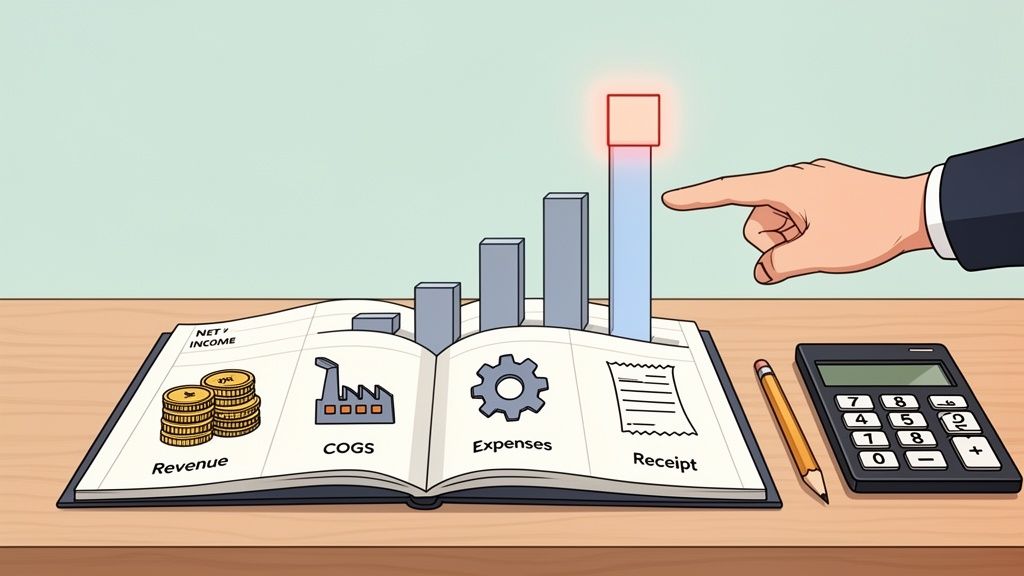
Let's be real. The phrase “prepare income statement” makes your eyes glaze over. It sounds like a chore you’d rather pawn off on someone else so you can get back to what you actually do—running your business. But what if I told you it's the one document that answers the only question that really matters: Is my business actually making money?
The whole point is to start with your total sales, subtract every single cost, and see what’s left. That final number is your net income, and it's the ultimate reality check. No fluff, no vanity metrics. Just the cold, hard truth.

Forget the complicated accounting jargon for a second. An income statement, often called a Profit & Loss (P&L) statement, tells a simple story. It says, ‘Here's all the money you brought in. Here's what you had to spend to make that happen. And here's what you got to keep.’
It's the difference between feeling successful because you're busy and knowing you're profitable because the numbers say so.
That final number, your net income, is what keeps founders up at night—and it's the same number that gets investors to finally write a check. The income statement isn't just bookkeeping busywork; it's the dashboard for your entire business.
With a clear P&L, you can:
Think of it as the ultimate reality check for your brilliant idea. It’s the difference between feeling successful and knowing you are.
This kind of clarity is non-negotiable, especially now. Global wealth grew by 4.6% in 2024, and the US alone saw over 379,000 new millionaires. You can read the full report on global wealth trends from UBS if you're into that sort of thing. The point is, investors are flush with cash, but they’re not writing checks based on good vibes. They want proof of profitability. Your income statement is your ticket to that conversation.
Ultimately, getting comfortable with your P&L is a core part of smart financial management. For a broader look at how this fits into your overall strategy, you can explore our guide on financial planning and analysis.
Alright, let's get our hands dirty. Before you can build anything, you need to gather your raw materials. This isn't like assembling IKEA furniture where you can wing it with an Allen key and a prayer. Get this part wrong, and your final numbers will be a complete work of fiction.
The goal is simple: pull together a complete record of every transaction for the period. And no, you absolutely cannot use a shoebox full of crumpled receipts. If that's your current "system," we need to have a serious talk.
You're really looking for three main categories of data. Think of them as the only ingredients that matter for this financial recipe.
Revenue Data: This is every sale, every invoice, every subscription payment. Pull this from your sales platforms (Shopify, Stripe), bank deposits, and whatever invoicing software you’re using. Simple.
Cost of Goods Sold (COGS): These are the direct costs of delivering what you sold. Raw materials, direct labor, shipping costs. For a software company, it’s server costs or third-party API fees directly tied to a customer.
Operating Expenses (OpEx): This is everything else it takes to keep the lights on. Rent, salaries for your non-production team, marketing spend, and that surprisingly expensive software subscription you forgot about. Your best friends here are your business credit card and bank statements.
Want to make this whole process less of a headache? Check out What Is Cloud Accounting?. It’s 2026. Stop fighting with spreadsheets and let modern systems do the heavy lifting.
Okay, pay attention, because this is a choice I see most founders get wrong by default. It dramatically changes what your financial picture looks like. Should you use cash or accrual accounting?
It sounds technical, but it's not. Cash accounting recognizes money only when it hits or leaves your bank. Accrual accounting recognizes money when the transaction happens—when you send an invoice or get a bill, regardless of when the cash moves.
Choosing the right method isn't about following rules; it's about getting an honest look at your business's health. Cash tells you what's in the bank today. Accrual tells you what your business is actually earning (or burning).
So, which one is for you? Let's make this simple.
This is a quick-and-dirty comparison to help you choose.
| Factor | Cash Method | Accrual Method | Who It's For |
|---|---|---|---|
| Timing | Records money when it's received or paid. Simple. | Records money when it's earned or owed. More complex. | Cash: Freelancers, brand-new startups, or tiny side hustles. Accrual: Any business with inventory, invoices, or plans to get investors. |
| Accuracy | Shows your bank balance, but can be misleading. | Gives a true picture of profitability for the period. | Cash: Easy, but hides upcoming bills and unpaid invoices. Accrual: The only way to get a real performance metric. |
| Best Use | Good for managing day-to-day cash flow. | Essential for strategic planning and fundraising. | Cash: If your business is dead simple, this is fine for now. Accrual: If you're serious about scaling, you need to be on accrual. No exceptions. |
My take? Unless you’re a solo freelancer selling services with zero expenses, just start with the accrual method. I’ve seen firsthand how much of a pain it is to switch over later. It forces you to confront the true financial reality of your business—not just the temporary illusion of a healthy bank account.
You’ve got your numbers. Now for the fun part: putting the puzzle together. We're going to assemble this thing line by line, just like a seasoned accountant would. No magic, just simple subtraction.
This visual shows the basic flow for getting your financial data ready before you start constructing the statement.

It really is that straightforward in concept: add up revenue, track all expenses, and stick to one accounting method. Getting this foundation right is non-negotiable if you want a statement you can trust.
We always start at the top with Total Revenue. This is the big, impressive number that represents every single dollar your business earned. It’s the sum of all sales before a single expense is taken out. Think of it as your business's total firepower.
Let's use a fictional SaaS startup, "SyncUp," to walk through this. They just closed out a strong first quarter.
This number sets the stage. Every other line item just explains how effectively SyncUp turned that $150,000 into actual profit.
Right away, we subtract the Cost of Goods Sold (COGS). This is a critical step. COGS includes only the direct costs tied to delivering your product or service.
For a software company like SyncUp, this isn't physical inventory. It's things like:
Let's say SyncUp's COGS for the quarter was $25,000. Now we calculate our first major subtotal:
Gross Profit = Revenue – COGS
$125,000 = $150,000 – $25,000
This $125,000 is SyncUp's gross profit. It shows how much money the company makes from its core product before overhead. A healthy gross profit is the first sign of a viable business model. If this number is weak, you have a product problem or a pricing problem. Period.
Now we get into the nitty-gritty: Operating Expenses (OpEx). This is all the other money you burned to keep the business running. Think of it as the cost of keeping the lights on and the engine humming.
For SyncUp, the OpEx breakdown for the quarter looks like this:
Subtracting this from gross profit gives you your operating income, a true measure of how efficient your business is.
Operating Income = Gross Profit – Operating Expenses
$45,000 = $125,000 – $80,000
This $45,000 is SyncUp's operating income. It reveals the profit generated purely from the company's main business. For many investors, this is the most important number because it shows if the core business actually works.
Knowing these figures isn't just an accounting chore; it's a massive strategic advantage. The world's top firms, like PwC—whose advisory revenues climbed 4.5% to help generate US$56.9 billion in total revenue—use this exact analysis. With global growth forecasted around 3.2%, your ability to dissect your own performance is what will set you apart. You can learn more from PwC's global annual review.

You’re in the home stretch. Now it's time to handle everything that falls outside your day-to-day operations.
These are your non-operating items. Think interest income from a savings account or, more likely, the interest expense you’re paying on a loan. These get their own section just below operating income.
Once those are tallied up, you face the final hurdle: taxes.
Estimating your income tax provision is critical. This isn’t a wild guess; it’s a forecast of what you’ll owe on the profits you’ve generated. Getting this wrong leads to seriously unpleasant surprises from the IRS.
After subtracting your estimated taxes, you finally arrive at Net Income. This is it—the bottom line. The number that tells you whether you're winning or if you need to go back to the drawing board. For investors, it's often the first number they look for.
A clean, credible income statement isn't just a "nice to have"—it’s your shield in a tough market. A sloppy one is an open invitation for investors to walk away.
With global foreign direct investment dropping by 11% in 2024, investors are more cautious than ever. You can read the grim details in the latest findings on global investment from UNCTAD. They want undeniable proof of profitability before they'll even consider opening their wallets. A pristine income statement provides that proof.
Before you pop the champagne, let's talk about the landmines I've seen blow up countless founders' financials. A pristine income statement is a credible one. Here’s how to sidestep the blunders.
Nailing these details is the bedrock of solid financial reporting. To build a more reliable system, take a look at our guide on financial reporting best practices. The habits you build now will pay for themselves.
So, you did it. You wrestled your numbers into submission and built a solid income statement. High five. But now for the real question: Should you be the one doing this every month?
As a founder, your time is your single most valuable asset. If you’re spending entire days trapped in spreadsheets instead of talking to customers or closing deals, you haven't optimized a process—you’ve just created a new, low-wage job for yourself.
It's time for a frank discussion about when to hand over the financial keys.
There are a few clear signs that the DIY approach is costing you more than it saves. This isn't about giving up control; it's about gaining leverage so you can get back to building your business.
Do any of these sound familiar?
The moment you start making excuses to avoid preparing your income statement is the exact moment you should stop doing it yourself. It’s a signal that the task has outgrown your bandwidth and your interest.
Making the leap to outsourcing isn't admitting defeat; it’s a strategic promotion. You're promoting yourself from Head of Spreadsheets back to CEO. If you're curious about what that looks like, our guide on how to outsource bookkeeping for startups offers a practical roadmap.
You've made it through the guide, but your head might still be spinning with terms like COGS, OpEx, and accruals. That's normal. Let's cut through the noise and get you the straight answers, founder-to-founder.
Bare minimum? Quarterly. But quarterly is for businesses comfortable moving at a snail's pace. For any startup or small business serious about growth, monthly is the only real answer.
Why? A month is just long enough for trends to emerge but short enough for you to react before a small problem becomes a five-alarm fire. Waiting 90 days to discover your margins are in a nosedive is just bad business.
This one trips up a lot of new founders. I like to explain it this way:
The income statement tells you if you're winning the game. The balance sheet shows you the score at halftime. You need both, but they answer very different questions.
One tracks profitability; the other reveals stability. They aren't interchangeable.
Yes, you can start with a template. It’s a smart way to get your bearings. But please, don't just download a generic spreadsheet and call it a day. That’s like trying to navigate San Francisco with a map of New York—the details are what actually matter.
Every business is different. A generic template won't know that your SaaS company needs to track "Customer Acquisition Cost" or that your e-commerce store should separate shipping from product costs within COGS.
A template is a great starting point, but you have to customize it until it accurately reflects the levers that drive your business. Otherwise, you’re just doing paperwork. And as a founder, your time is far too valuable for that.
Tired of playing the DIY accountant and ready to get back to actually running your business? HireAccountants connects you with pre-vetted, expert accountants who can deliver flawless financial statements so you can focus on growth. Find top talent in as little as 24 hours.
Let's simplify your finances today!