

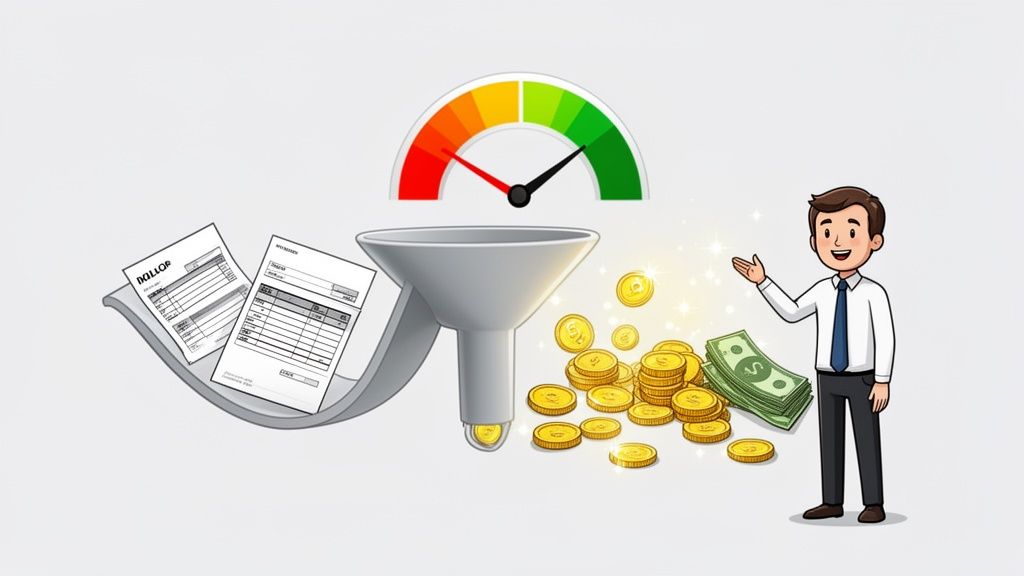
Let's be honest. Your revenue looks great on paper, but your bank account tells a different story. The accounts receivable turnover ratio is a fancy term for a simple, brutal truth: how fast you’re actually getting paid. A higher ratio is your best friend; a lower one is a blaring red flag that your cash is trapped in a mountain of unpaid invoices. For a more textbook take, check out this guide on the accounts receivable turnover definition from Consero.
Ever felt like you’re running two businesses? There’s the one that makes sales, closes deals, and posts impressive revenue numbers. Then there’s the other one—the amateur debt collection agency you never signed up for.
You’re sitting on a growing pile of ‘I’ll pay you next week’ promises, and it’s quietly strangling your company. This is where the Accounts Receivable (AR) Turnover Ratio comes in. Forget dusty accounting terms; think of it as your cash flow speedometer.
Obsessing over sales alone is a rookie mistake that leads to mortgaging the office ping-pong table to make payroll. I’ve seen it happen. This single number is often a better predictor of survival than your flashy revenue chart. Why? Because revenue is a promise, but cash in the bank pays the bills.
Ignoring your AR turnover is like driving down the highway with your eyes closed, hoping you don’t hit anything. Sooner or later, you will.
This isn't just another vanity metric for your dashboard. It’s a health check on the lifeblood of your company—cash. Specifically, it reveals:
Ultimately, this ratio is a core component of your financial health, directly impacting your ability to manage day-to-day operations. For a deeper dive into how this all connects, check out our guide on how to read a cash flow statement. Understanding it is non-negotiable for any founder who wants to stay in business.
Ready to look under the hood of your cash flow? Don't worry, we're not diving into complex calculus. This is the straightforward division that shines a light on how efficiently you’re collecting money, and you don’t need to be a CPA to figure it out.
But first, a word of caution: this formula is only as good as your data. If your books are a mess, your results will be, too. Garbage in, garbage out. It’s always a good idea to have a solid grasp of the fundamentals, like the difference between bookkeeping and accounting.
With that in mind, the formula itself is simple:
AR Turnover Ratio = Net Credit Sales / Average Accounts Receivable
Let's unpack what those terms actually mean in the real world.
First up is Net Credit Sales. This is a crucial number. It’s not your total revenue. It’s only the sales you made on credit—in other words, the sales where you invoiced a customer and are now waiting to get paid.
You'll find this figure on your income statement. If your accounting system lumps all your cash and credit sales together, you’ve got a problem. Separating them is essential for this calculation to be meaningful.
Next, we need your Average Accounts Receivable. This gives you a balanced look at how much money is owed to you over a specific period. Just grabbing the AR balance from the last day of the year is a rookie mistake; a single day's number can be skewed by a large payment or a big new invoice.
Here’s how to get a much more accurate average:
That's it. You now have a reliable average to work with.
This process—from sending an invoice to finally seeing the cash in your bank account—is exactly what the turnover ratio helps you measure and manage.

For a growing business, mastering this cycle is everything. The AR turnover ratio is your compass.
Just knowing your ratio isn't enough. Telling your investors "our AR turnover is 8" doesn't mean much on its own. The real insight comes when you translate that ratio into the number of days it takes you to get paid.
This is called your Days Sales Outstanding (DSO), and the calculation is just as simple:
DSO = 365 / Accounts Receivable Turnover Ratio
This formula gives you a number you can actually use. For instance, if a company has a turnover ratio of 8, it's collecting its receivables, on average, every 45 days (365 / 8). Another business with a higher ratio of 11.25 is getting paid much faster, in about 32 days (365 / 11.25).
Now that's a conversation starter. Walking into a meeting and saying, "On average, it's taking us 45 days to get paid," is a powerful statement that immediately highlights a problem or an opportunity. This is the practical, no-fluff math that truly helps you run your business.
Okay, you've crunched the numbers and have your accounts receivable turnover ratio. Now comes the real question every founder asks: Is it good, bad, or time to panic?
The most honest answer I can give you, after years of seeing this firsthand, is: it depends. Calculating the ratio is the easy part. The real work is figuring out what that number means for your business, not some hypothetical company in a textbook.
What’s considered a healthy ratio for a construction company working on 90-day payment terms would be a full-blown crisis for a SaaS business billing customers monthly. Without context, your AR turnover ratio is just a meaningless number on a spreadsheet.
Before you go Googling "average AR turnover for [your industry]," stop. Comparing your startup to a massive, established corporation is an exercise in frustration. The DNA of your business model is what truly dictates a healthy ratio.
Think about it this way:
Your goal isn't to hit some generic industry average. It's to set a realistic target based on how you operate, and then work relentlessly to improve from there.
It can be tempting to see how you stack up against the big public companies, but you have to look at the data carefully. A quick glance shows just how much these ratios can swing, even within the same broad sector.
For instance, within the hospitality world, Marriott International once reported an AR turnover ratio of 8.86. In that same general industry, Denny's clocked in at 23.58 and Papa John's hit 20.48. Meanwhile, a media giant like Charter Communications sat at 16.96. You can dig into more of these figures by exploring public company efficiency data on CSIMarket.
What this really tells you is that the business model is king. Marriott is juggling huge corporate accounts and massive event bookings with longer payment terms. Papa John's is taking your credit card payment before the pizza is even out of the oven. They aren't playing the same game.
Think of benchmarking as a compass, not a map. It gives you a general direction, but you still need to navigate the actual terrain of your own business.
Ultimately, the most important benchmark you have is your own historical performance. Are you collecting cash faster or slower than you were last quarter? Or last year? If your ratio is trending downward, that's a red flag, no matter what anyone else's numbers look like. That trend line is your source of truth.
Time for some tough love. If your accounts receivable turnover ratio is in the gutter, it’s easy to point fingers at slow-paying clients or a tough economy. But the real culprit might be staring back at you in the mirror.
Founders, especially in the early days, are masters of unintentionally wrecking their own cash flow. It doesn't come from a bad place—it's usually a mix of trying to be the "cool" client partner, fearing confrontation, or just dealing with the pure chaos of a growing business.
But these seemingly minor habits create a system where getting paid is an afterthought, not a core business function. Before you know it, you’re spending your afternoons chasing down payments instead of building your company.

Let's get specific. See if any of these self-inflicted wounds that bleed cash sound painfully familiar.
The "Whenever I Get to It" Invoicing Method
You wrap up a project, celebrate a job well done, and then the invoice sits in your drafts for a week. Or two. Every single day you wait to send that invoice is another day you’ve essentially given the client a free, unrequested loan. You’re pushing back the payment finish line before the race has even started.
The Vague Payment Terms
Your invoice says “Due upon receipt.” Honestly, what does that even mean? Tomorrow? Next week? Whenever the client’s AP department gets around to it? This kind of ambiguity is a wide-open invitation for delays. Using clear terms like “Net 30” isn’t rude; it’s professional.
These bad habits compound. A vague invoice sent late becomes a payment that’s even later, and suddenly your healthy accounts receivable turnover ratio is in the gutter.
The Friendly Reminder That Never Gets Sent
You don’t want to be pushy. You know your client is busy. You’ll just give them a few more days. This is a classic, well-intentioned founder mistake. But being “too nice” to follow up on money that is rightfully yours is a fast track to a cash crunch. Your clients have a system for paying their bills; your job is to make sure your invoice is a priority within that system.
The Invoice Lost in an Email Chain from Hell
You’re pretty sure you sent the invoice. It was in a reply to that email thread with the subject line "Re: Re: Fwd: Project Updates." Good luck finding that again. When you don't have a clear, centralized invoicing process, your payment requests get buried, ignored, or legitimately lost in the digital shuffle. Each of these slip-ups directly torpedoes your accounts receivable turnover ratio, stretching out the time it takes to convert your hard work into actual cash.
Alright, you’ve run the numbers and diagnosed the issue. You know your cash flow is lagging, and you have the accounts receivable turnover ratio to prove it. Now for the important part: actually fixing it.
Let's shift from theory to action. These are the practical steps you can take right now to stop playing amateur debt collector and get back to what you do best—running your business. We're not just listing tips; we're building a reliable system that ensures you get paid on time.
It all starts with being crystal clear from the very beginning.

Your invoicing process shouldn't be a casual affair; it needs to run like a well-oiled machine. If you’re sending out invoices "whenever you get around to it," you’re tripping over your own feet before the race even starts.
Create a rigid system. For instance, invoices go out within 24 hours of project completion or on a set recurring date—no exceptions. Every single invoice should include:
Are you still manually sending "just a friendly reminder" emails? If so, I want you to stop. Right now. It’s an inefficient use of your valuable time, and it's far too easy for follow-ups to fall through the cracks.
Set up automated reminders through your accounting software. This isn't being pushy; it's being professional. A simple, unemotional sequence can work wonders:
This automated persistence is far more effective than sporadic, emotional check-ins. You can dive deeper into creating these systems in our guide to effective cash flow management strategies.
What’s the plan when an invoice hits 30 days past due? If your answer is, "Uh, I'm not sure," you’ve found a major weak point in your process. You need a clear, pre-defined escalation path that you follow religiously. This takes the emotion and hesitation out of the equation.
A plan you don't follow is worse than no plan at all. It teaches clients that your deadlines are merely suggestions.
Here’s what a straightforward escalation plan might look like:
This isn’t about being aggressive; it's about having a professional process that you respect. Consistently following your own rules sends a powerful message: you take your business—and getting paid—seriously.
Let’s be honest. As a founder, you’re used to wearing every hat—CEO, head of sales, chief coffee maker, and, yes, the amateur accountant chasing down late payments. It’s part of the grind. But there comes a point when you have to ask a tough question: is being the company bookkeeper really the best use of your time?
You're the one who built the product and won over the first customers. But clinging to every single financial task isn't a badge of honor; it's a bottleneck. If your accounts receivable turnover ratio is slipping every quarter no matter what you try, that’s not just a metric on a spreadsheet. It’s a bright, flashing warning sign that your DIY approach is actively costing you cash.
Running a growing business based on a ‘gut feeling’ about your bank account balance simply isn't sustainable. It’s time for a reality check if you find yourself:
Hiring an expert isn't an expense; it's an investment in getting your time and your focus back. You can't be the visionary for your company when you're stuck in the weeds of financial admin.
Bringing in a professional puts your collections process on a solid, predictable footing. An expert can implement robust strategies for collecting payments and set up the systems we’ve been talking about, finally turning that messy AR into a reliable cash flow engine. They can also open up new possibilities you might not have considered, like finding the right partner for invoice factoring for your small business.
At the end of the day, a dedicated accountant or bookkeeper does far more than just crunch the numbers. They free you up to do the one thing no one else can: lead. Handing off the financial grunt work is the most logical next step for any founder who is truly serious about scaling their business the right way.
Even with the formula down, a few common questions always seem to pop up when we talk about receivables. Let's tackle the most frequent ones with some straight-up, practical answers.
Think of them as two ways of telling the same story. The accounts receivable turnover ratio is the "how often" metric. It tells you that, for example, you collect your entire accounts receivable balance 12 times per year.
On the other hand, Days Sales Outstanding (DSO) is the "how long" metric. It translates that ratio into the average number of days it takes to get paid—in this case, 30 days.
Honestly, in any boardroom or investor meeting, DSO is the number that lands. "Our AR turnover is 12" is an abstract accounting figure. "It takes us 30 days to get our cash" is a story everyone immediately understands.
Absolutely, and it's a classic case of winning the battle but losing the war. A sky-high AR turnover ratio might feel like a victory, but it usually means your credit and payment terms are so strict that you're strangling sales.
If you’re only extending credit to customers with perfect histories or forcing aggressive terms like Net 10 on everyone, you are almost certainly leaving money on the table by scaring away good, credit-worthy customers.
An extremely high AR turnover ratio isn't a badge of honor for efficiency. It’s a red flag that your credit policies might be choking your growth.
The goal isn't the highest number possible; it's finding a healthy balance that keeps cash flowing without sacrificing sales.
If you’re only looking at this once a year, you’re flying blind. At a bare minimum, you should be calculating your AR turnover ratio quarterly to catch major trends.
But for a startup or any business where cash is tight? Calculating it monthly is non-negotiable.
Monthly tracking gives you the agility to act before a small collections lag turns into a full-blown cash crisis. Spotting a dip for two months straight gives you a signal to dig in and fix an emerging problem now—not a quarter later when that cash gap has become a much more painful and expensive hole to climb out of.
Tired of spending your nights and weekends wrestling with spreadsheets and chasing down late payments? HireAccountants can connect you with pre-vetted, expert accountants who will get your collections process dialed in, improve your cash flow, and give you back your time. With pros available starting at just $10/hour, you can stop doing it all yourself. Get the affordable expertise you need to scale by visiting HireAccountants today.
Let's simplify your finances today!