


You've just signed a lease for a new warehouse, approved a facility buildout, or started a custom data-center project. The invoices are arriving faster than the coffee, and your bookkeeper is asking where to put the contractor bills, permits, materials, and labor. Expensing everything makes this quarter look sick. Dumping everything into a regular fixed-asset account creates a different mess.
That's where a construction in progress account, usually called CIP, earns its keep. It gives unfinished capital projects a temporary home inside property, plant, and equipment, preserves a clean audit trail, and prevents you from starting depreciation before the asset can do its job. The accounting is straightforward when the project moves as planned. The trouble starts when completion dates slide, scopes change, or everyone forgets to transfer the balance.
CIP is a temporary long-term asset account that accumulates capitalized costs for a fixed asset before the asset is placed into service. Common costs include materials, labor, overhead that directly relates to construction, permits, and eligible interest during construction. While the project remains in CIP, the balance isn't depreciated. Depreciation begins when the project is substantially complete and ready for its intended use, as explained in this overview of CIP accounting.
That distinction matters the moment your project crosses a reporting period. A warehouse under construction isn't producing the same operating benefit as a warehouse ready for use. Recording all project spending as an immediate expense can distort current earnings, while moving incomplete work into “Buildings” or “Equipment” too early can start depreciation before the asset is capable of operating.
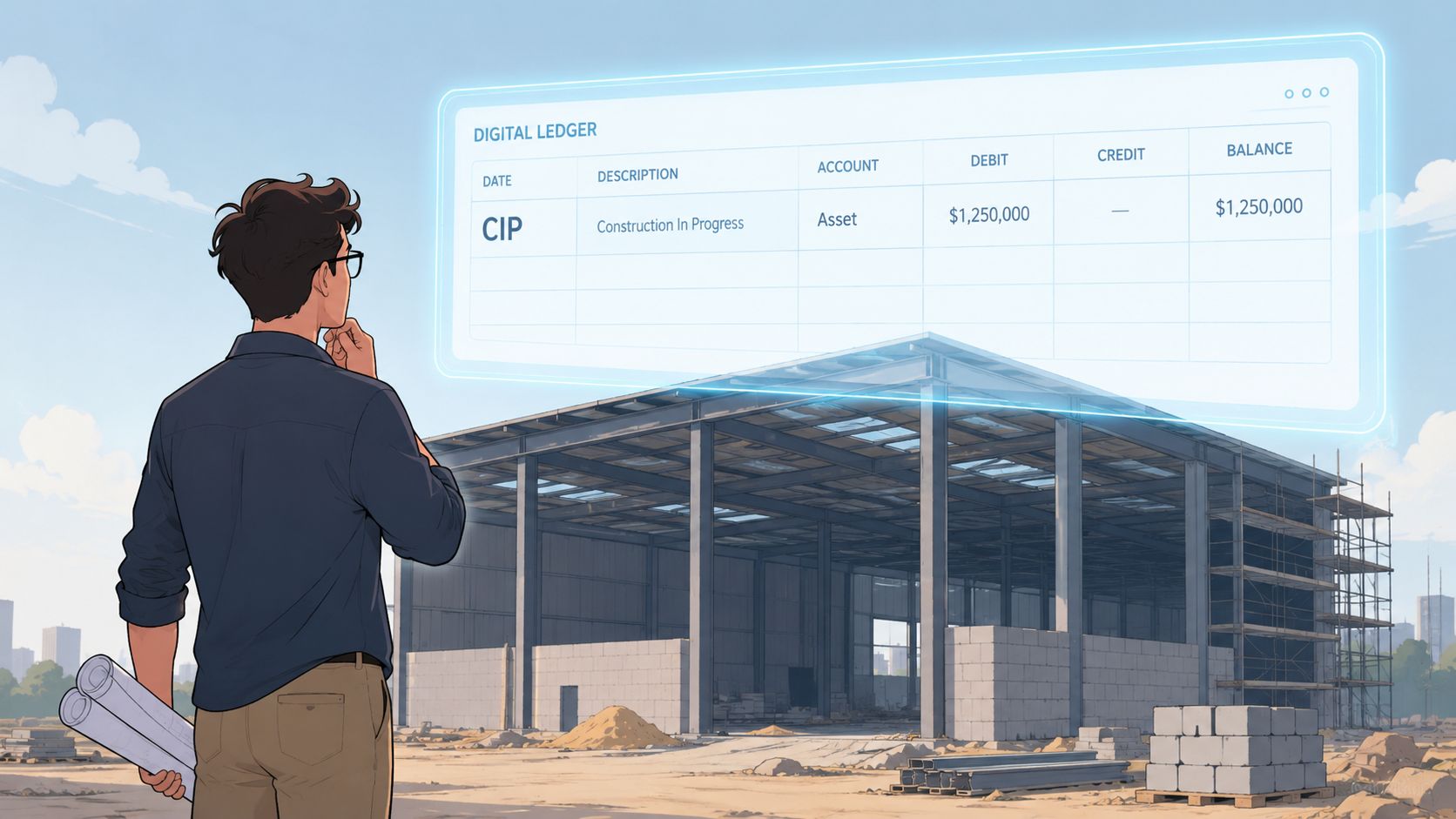
Set up a separate project code or subaccount before the first meaningful invoice arrives. Every qualifying cost should point back to a defined project, contract, scope, and approval record. That lets your finance team answer the questions auditors ask: What was built? Which costs belong to it? Who approved them? When was it ready for use?
Practical rule: If you can't explain why a cost is necessary to create the asset, don't casually capitalize it.
A dedicated CIP balance also protects cash-flow visibility. The cash has already left, but the income statement shouldn't absorb every capital-project cost immediately when those costs create a future-use asset. CIP keeps the balance sheet honest while giving management a clear view of capital committed, remaining work, and unresolved project decisions.
CIP shouldn't become a comfortable parking spot. Once the project is substantially complete and capable of its intended use, transfer the accumulated balance to the appropriate fixed-asset account. That transfer, not the invoice date, is the switch that starts depreciation, according to this CIP capitalization guidance.
Founders usually get into trouble in one of two ways. They expense capital spending because the project feels “too messy” to track, or they leave completed assets in CIP because nobody wants to choose a placed-in-service date. Both choices create avoidable reporting problems. Open the account early, document the rules, review it regularly, and force a decision when the asset is ready.
Think of CIP as a financial construction site. The project has a budget, workers, deliveries, inspections, and a growing pile of costs. The account holds the spending that creates or prepares a long-lived asset until the asset can operate as management intends.
The core test is simple: Does this cost directly create, install, or prepare the asset for future use? If yes, it may belong in CIP. If it merely supports the business or follows completion, it usually belongs in expense.
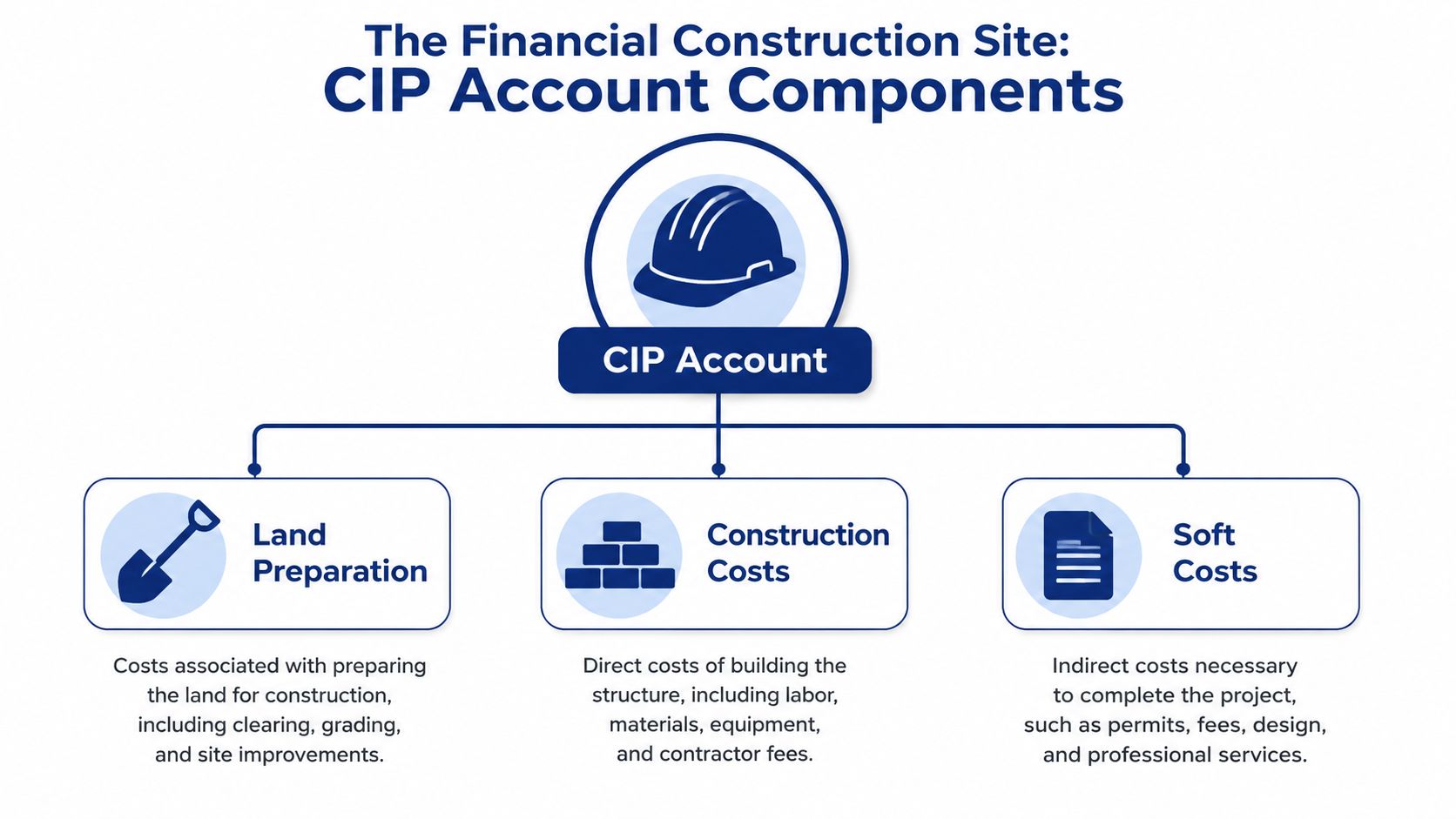
The usual candidates are direct and necessary:
Construction contracts also deserve more attention than a quick invoice approval. Change orders, allowances, retainage, and contingency provisions can alter the cost profile or the expected benefit of the project. A practical resource on managing uncertainty in subcontracted work is this contingency guide for subcontractors. Use it to improve project documentation, not as an excuse to capitalize every unpleasant surprise.
General administrative overhead, routine maintenance, repairs, staff training, and costs incurred after the asset is ready for use generally don't belong in CIP. Neither does abnormal waste or avoidable rework just because it happened on a construction site. The location of the invoice doesn't determine its accounting treatment.
Ask three questions before posting an ambiguous line item:
If the answer fails that test, expense the item or send it for technical-accounting review. A written policy is far better than relying on the instincts of whichever person happens to process invoices that week. For a related explanation of work-in-process accounting and how it differs from CIP, see this guide to WIP in accounting.
The biggest classification mistake is treating “project-related” as synonymous with “capitalizable.” It isn't. A training session can support a new facility without forming part of the facility's cost. A repair can occur during construction without creating a new asset. Keep the mental model tight, and the account stays useful.
The accounting framework matters, especially when your startup has international investors, foreign subsidiaries, or a financing process that brings multiple reporting teams into the room. US GAAP and IFRS both use the basic idea of accumulating construction-stage costs and transferring the asset when it's ready, but the technical requirements and documentation expectations aren't interchangeable.
Under IFRS, IAS 16 paragraph 74(b) specifically requires entities to disclose expenditures recognized in the carrying amount of property, plant, and equipment that remains under construction. The issued IAS 16 standard makes that disclosure requirement explicit. In practice, this means an international reporting team needs a separately tracked, supportable view of construction-stage spending.
Interest is another area where casual accounting creates expensive cleanup. Under US GAAP, teams look to ASC 835-20 for capitalization of interest associated with qualifying construction. Under IFRS, IAS 23 governs borrowing costs that qualify for capitalization. Don't let the labels fool you. Your controller still needs a documented method, a clear qualifying period, and support for why capitalization began and ended.
| Criteria | US GAAP | IFRS |
|---|---|---|
| Construction-stage classification | CIP is tracked within PP&E until the asset is ready for use. | IAS 16 requires tracking and disclosure of expenditures for PP&E still under construction. |
| Interest | Apply the requirements of ASC 835-20 to qualifying construction activity. | Apply IAS 23 to qualifying borrowing costs. |
| Depreciation start | Begin when the asset is substantially complete and ready for intended use. | Begin when the asset is in the condition necessary to operate as management intends. |
| Disclosure focus | Support the balance, transfers, capitalization judgments, and depreciation timing. | Separately disclose construction-stage expenditures under IAS 16 paragraph 74(b). |
| Impairment response | Assess under the relevant US GAAP impairment model, including ASC 360 where applicable. | Assess under IAS 36 when impairment indicators exist. |
Auditors won't be impressed by a project manager's confident estimate that “we're basically done.” They'll want objective evidence, such as operational readiness, approvals, testing, and a documented determination of the date the asset became capable of its intended use.
Cost overruns also need judgment. An overrun isn't automatically an impairment, but it can signal that expected benefits have weakened. Scope changes may require you to revisit previously capitalized costs, particularly when the original work no longer contributes to the revised asset.
Depreciation doesn't begin because the company spent money. It begins because the asset can operate as intended.
That principle is especially clear in IFRS guidance on assets under construction. A partly finished factory remains in CIP while it can't perform its intended function, as described in this IFRS agenda decision material. The same operational discipline should guide your US GAAP documentation, even where the wording differs.
The cleanest way to understand CIP is to follow the money. Consider a startup building a server room with $80,000 of materials and $100,000 of contractor work. Those amounts are provided in the project lifecycle visual below, and the entries show how the balance moves without inventing complexity.
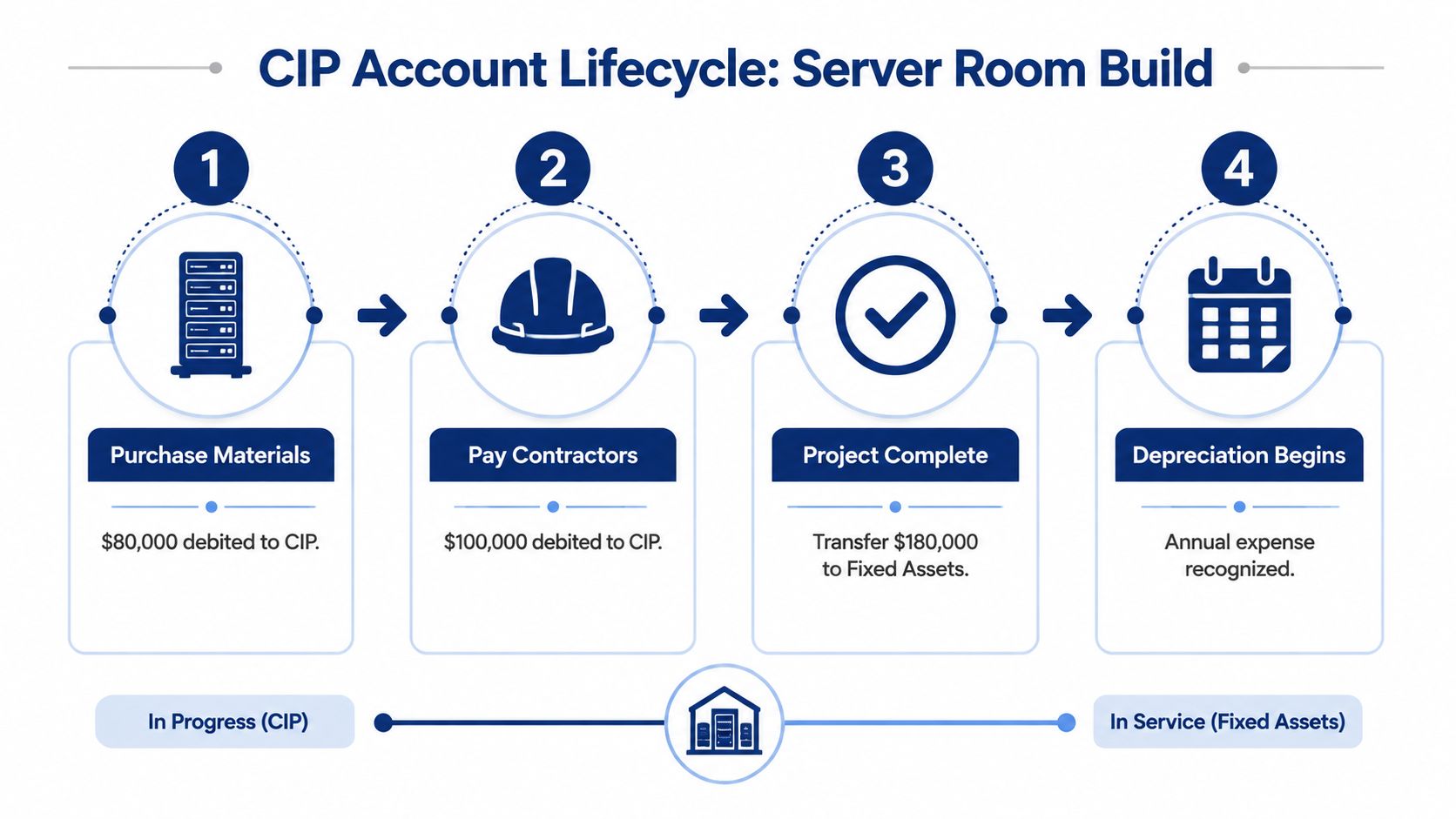
When the startup purchases qualifying materials on credit:
| Account | Debit | Credit |
|---|---|---|
| Construction in Progress | $80,000 | |
| Accounts Payable | $80,000 |
The debit increases the CIP asset balance. The credit records the obligation to the supplier. When the invoice is paid, debit Accounts Payable and credit Cash. Payment changes the liability and cash position, not the project's capitalized cost.
For contractor work:
| Account | Debit | Credit |
|---|---|---|
| Construction in Progress | $100,000 | |
| Accounts Payable | $100,000 |
You may use separate CIP subaccounts for materials, labor, permits, engineering, and interest. That detail makes review faster and exposes unusual charges before they become part of a large, muddy balance. For additional practice with debit and credit mechanics, use these journal entry examples.
If eligible interest applies, debit CIP and credit Interest Payable or Interest Expense, depending on the accounting treatment and the amount that qualifies. Don't capitalize interest merely because the company borrowed money. The borrowing, project activity, and qualifying construction period need to align under the applicable framework.
The same caution applies to overruns. If the project needs more work that still creates the intended asset, qualifying costs may continue entering CIP. If the overrun reflects avoidable waste, abandoned scope, or a project whose expected benefits no longer support its carrying value, the entry may need to go to expense or impairment instead.
Once the server room is substantially complete and ready for intended use, transfer the accumulated balance:
| Account | Debit | Credit |
|---|---|---|
| Fixed Assets, Server Room | $180,000 | |
| Construction in Progress | $180,000 |
This entry removes the balance from CIP and places it in the permanent fixed-asset category. Depreciation starts at that readiness point, using the company's approved depreciation policy and useful-life assessment. Don't wait for every cosmetic punch-list item if the asset can already perform its intended function, but don't rush the transfer because the project manager wants the ledger closed.
If a portion of the build is abandoned, debit an abandonment expense or impairment loss and credit CIP for the amount that no longer provides recoverable benefit. The exact measurement depends on the applicable accounting framework and the facts. The important operational rule is to remove dead project costs promptly, rather than letting them pose as a healthy asset.
A stalled CIP balance isn't harmless just because it isn't depreciated. No depreciation doesn't mean no accounting responsibility. If a project is abandoned, materially delayed, hit by serious cost overruns, made obsolete by technology, or undermined by regulatory or market changes, management needs to assess whether the carrying amount remains recoverable.
The guidance on abandoned projects and CIP write-offs highlights the issue many basic CIP guides skip. A project can begin as a valid capital investment and later become an impairment problem. The original invoices don't protect the balance sheet once the expected benefit has changed.
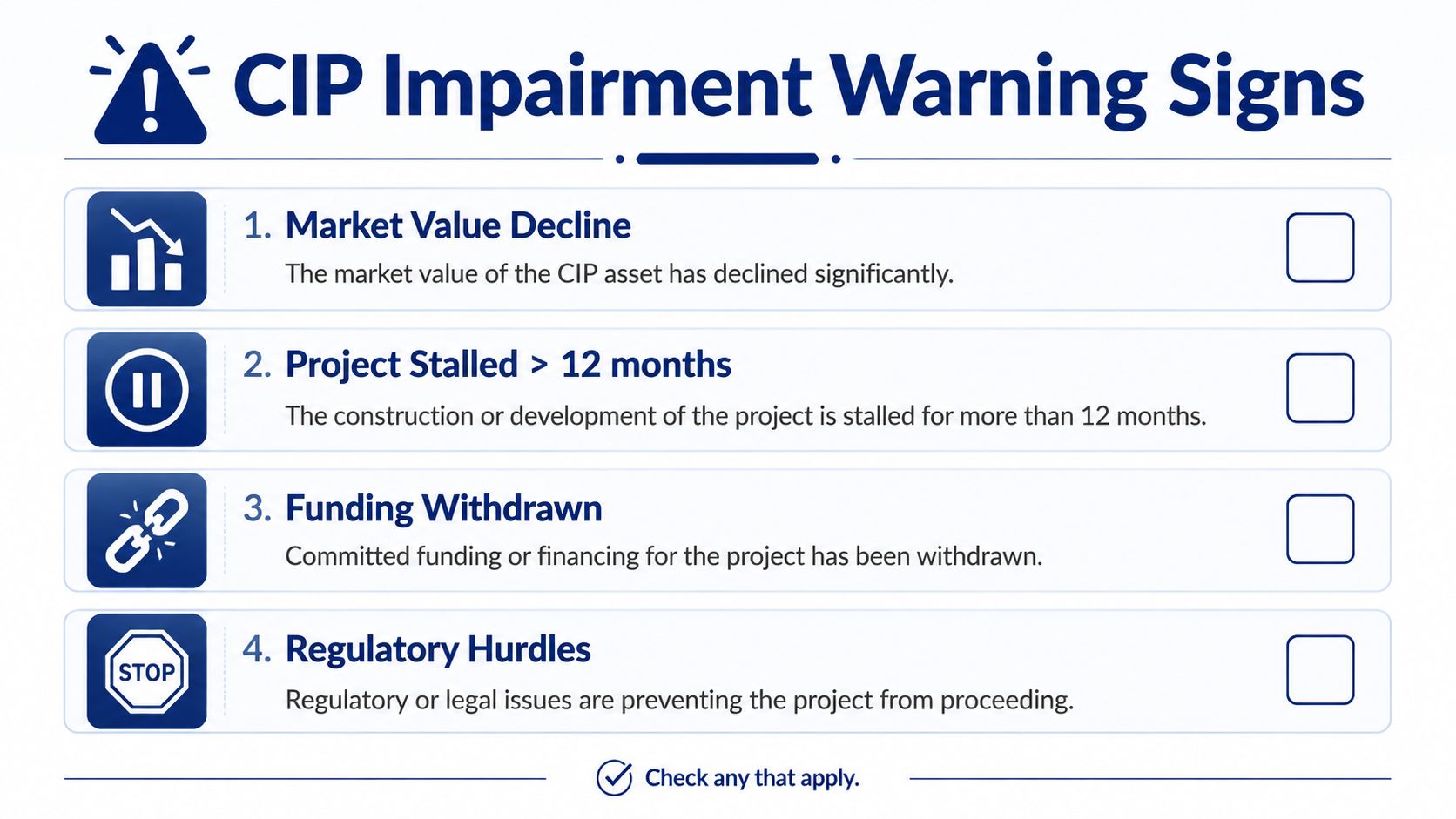
Use a project-level review, not a vague “looks fine” conversation:
Under US GAAP, the relevant impairment analysis may involve ASC 360. Under IFRS, teams apply IAS 36. The mechanics differ, but the management discipline is the same: identify indicators, estimate recoverability or recoverable amount as required, document assumptions, and recognize the loss when the carrying value can't be supported.
A project can remain in CIP for years without depreciation only if it still meets the accounting requirements and remains supportable. “It's delayed” isn't a permanent exemption. Reassess at each reporting date when impairment indicators exist, and connect the accounting conclusion to current budgets, approvals, technical feasibility, funding, and expected use.
A project that no longer deserves funding probably doesn't deserve an untouched asset balance either.
Create an impairment memo when the facts are serious. State what changed, who approved the revised plan, what costs remain recoverable, and why the chosen treatment reflects the relevant standard. Auditors can work with an uncomfortable conclusion. They struggle with silence.
CIP accounting fails operationally before it fails technically. A contractor submits an invoice, a project manager approves it, Accounts Payable posts it, and nobody checks whether the work belongs to the project or whether the project is still viable. By year-end, the balance looks precise because spreadsheets are excellent at displaying questionable information with confidence.
Build controls around ownership, evidence, and timing. The project manager should confirm physical progress and scope. Accounting should assess classification and record the entry. No single person should approve the purchase, confirm completion, and release the capitalization decision without review.
A CIP balance affects more than one line on the balance sheet. It can influence reported earnings through capitalization and depreciation timing, alter asset-based covenant calculations, affect investor reporting, and change the basis used for future depreciation. Tax treatment also needs coordination with your tax advisor because book capitalization, placed-in-service timing, depreciation schedules, bonus depreciation eligibility, and Section 179 treatment can follow different rules.
For construction businesses that also report contract performance and work in process, these WIP reporting tips for contractors offer useful process ideas. Don't mix WIP and CIP casually, though. They answer different accounting questions and belong in different parts of the reporting system.
The practical dashboard should show each project's opening balance, additions, transfers, abandoned scope, impairment charges, and ending balance. Add a short narrative for stalled projects and unexplained budget changes. Your board, lender, and auditor don't need theatrical precision. They need a balance that matches reality and a team that can explain it.
Don't hand a multi-phase capital project to a generalist bookkeeper who's never managed CIP. That's how founders end up with a tidy ledger and a nasty audit conversation.
Hire someone who can demonstrate experience with:
Interview candidates with a real invoice sample and ask them to classify it. Then ask what evidence they'd request before transferring the balance. A candidate who only talks about debits and credits isn't ready to own the risk.
Use a fractional controller or outsourced specialist when the project is temporary, but give the role clear authority and access. For a broader hiring framework, review this guide on how to find a good accountant. Hire before the first major invoice, not after the auditor finds the problem.
HireAccountants connects US companies with pre-vetted accountants and finance professionals who can handle CIP classification, project reconciliations, transfer timing, and impairment reviews. Visit HireAccountants to find specialized accounting support quickly, whether you need a fractional controller, a project accountant, or ongoing bookkeeping help.
Let's simplify your finances today!