


You're staring at a bank dashboard, refreshing it like the payment might appear out of pity. Three invoices are approaching their Net 60 deadlines, payroll is due Friday, and the customer's “we process payments every Tuesday” message suddenly feels less comforting than it did when you signed the contract.
That's the trap. Net 60 is a date on paper, not a promise that cash will be usable in 60 days. Weekends, holidays, approval queues, early-payment discounts, partial payments, and plain old buyer delay can all change the cash story. A good net 60 calculator should handle the date arithmetic, but a useful finance workflow must also show when money is likely to land and what waiting costs you.
Tuesday morning started with a harmless bank check. Then the numbers lined up badly.
Three Net 60 invoices, worth $48,000 altogether, had aged past day 55. Rent was due. Contractor invoices were waiting. Payroll needed $22,000 by Friday. The business was profitable on paper, but the bank balance didn't care about paper. It cared about settlement dates.
The founder opened the largest invoice. Net 60. Nothing complicated. The buyer technically had until the stated due date, but the accounts-payable team still needed to approve the invoice, schedule the payment, and let the bank move it. “Due in 60 days” had become “maybe available after the next payment run.”
Practical rule: Treat the contractual due date as the deadline, not the expected arrival date.
That distinction matters for every business that sells to larger customers. The UK government's payment-practice reporting shows that 60 days remains the longest standard payment period observed in multiple published supplier reports, while actual payment timing can vary widely. One report shows 53% paid within 30 days, 36% in 31 to 60 days, and 11% in 61 days or more, a useful reminder that a nominal Net 60 term sits inside a messier real-world distribution.
The founder pulled up a spreadsheet and added four columns: contractual due date, operational payment date, cash required before payment, and financing fallback. That was the moment the panic became a workflow. A resource on previsioni flusso cassa AI PMI can also help owners think about forecasting as an ongoing operating process rather than a last-minute spreadsheet rescue.
A net 60 calculator is still the right starting point. It tells you when the invoice becomes due. The rest of the system tells you whether your business can survive until then.
Net 60 means the buyer owes the full invoice balance 60 calendar days after the invoice date, unless the contract clearly defines a different starting point or counts business days. The clock usually starts on the invoice date, not the delivery date, receipt date, or the day someone in procurement finally opens the PDF. Ramp's explanation of Net 60 terms uses the same core model and notes that weekends and holidays are included in the count.
The basic formula is simple:
Due date = invoice date + 60 days
That's why “two months later” is a lousy substitute. Net terms count days, not calendar months. A calculator for Net 60 typically adds 60 days directly, rather than guessing what “two months” means for a particular calendar, as explained by this Net terms calculator guidance.
Take an invoice dated March 5. Add 60 calendar days. The nominal due date is May 4. If May 4 falls on a Saturday, your contract and local payment rules determine the treatment. Many finance teams roll the operational deadline to the next business day, which would be May 6 in this example, but don't rewrite the contract. Record both dates if the agreement doesn't spell out the adjustment.
A separate business-day convention produces a different result, so your calculator needs a term setting, not just a number field. Calendar days and business days are not interchangeable.
| Invoice Date | Net 60 Calendar | Net 60 Business Days | Adjusted for Weekend | Final Due Date |
|---|---|---|---|---|
| March 5 | May 4 | Contract dependent | May 6 if May 4 is Saturday | Contract dependent |
| July 10 | September 8 | Contract dependent | Contract dependent | September 8 if no rollover applies |
A straightforward Net terms calculator applies the formula invoice date plus net days and supports common choices such as Net 15, Net 30, Net 45, Net 60, and Net 90. Use it for the arithmetic, then check the agreement for business-day language, holidays, end-of-month rules, receipt-of-goods clauses, and payment-run requirements.
For a deeper look at how unpaid invoices move through aging buckets, see this guide to accounts receivable aging. The date is only useful if your bookkeeping system knows what to do with it.
A basic calculator answers one question: when is the invoice due? A finance-grade version answers four more: what does early payment cost, what happens after the deadline, how do non-business days work, and how do credits or partial payments change the balance?
The classic structure is 2/10 Net 60. The buyer can deduct 2% by paying within 10 days, otherwise the full balance is due under Net 60. A 2% discount for 50 days of accelerated use works out to roughly 36% annualized, based on the standard simple annualization method. That's why the buyer should treat the discount like a return opportunity, not a courtesy.
For example, on a $10,000 invoice, paying early means collecting $9,800 instead of $10,000. The calculator should show the discount amount, the last discount date, and the implied annualized return. If the buyer has cheaper cash available, taking the discount is usually the obvious move.
Late-fee rules belong in the contract and must comply with applicable law. A common structure is 1.5% per month, or the maximum permitted under the relevant state rule, but the calculator shouldn't apply either automatically without checking the agreement.
On a $10,000 overdue balance, 1.5% produces $150 for the first monthly charge. If the contract compounds interest, the system needs a compounding schedule. If it doesn't, use simple interest. Don't let a spreadsheet invent a fee that your contract can't support.
A due date that lands on a holiday can create a silly but expensive dispute. If a nominal due date falls on July 4, and the contract rolls payment to the next business day, the operational date could move to July 7 when July 4 is a Thursday and the intervening days are non-business days.
Store the nominal date and adjusted date separately. Collections should reference the contractual deadline, while treasury should forecast the date when funds can settle.
Suppose a customer pays 40% on day 45. The remaining balance is 60% of the original invoice, but the accounting treatment still needs care. The system should record the payment against the invoice, recalculate the outstanding balance, preserve the original due date unless the contract says otherwise, and identify which amount enters the late-fee calculation.
A credit memo can produce a similar headache. Apply it to the correct invoice, retain the audit trail, and don't let the aging report show a full balance after the customer has already paid part of it.
If you're building credit for a new business, compare the invoice-term mechanics with practical guidance on net 30 account setup. The term itself is only useful when your records, reminders, and payment assumptions agree.
The same Net 60 label can produce three different bank outcomes. Here are three illustrative invoices, using the stated payment behavior as the point of comparison.
A SaaS vendor invoices on March 1 for implementation work and a recurring subscription. The contract says Net 60, but automated ACH clears on day 47 after the customer's approval workflow finishes. On day 61, the money is already in the bank, and the invoice is closed.
The vendor didn't win because the term was short. It won because the customer's process was predictable and electronic. The calendar said Net 60. The operating reality was earlier.
A wholesale apparel supplier invoices on April 15 for finished goods and freight. The nominal Net 60 date is June 14, but that date is a Sunday. The buyer's payment run and the surrounding holiday schedule push actual receipt to day 68.
The supplier has to fund inventory, shipping, and labor while waiting. Nothing in the phrase Net 60 tells you that the cash may arrive eight days later than the nominal count.
A government-style purchase order includes a Net 60 clause, but a Prompt Payment Act provision changes the practical result. The buyer pays on day 30 after the invoice clears the required checks.
That invoice is a useful warning against treating contract language as the whole forecast. Statutory payment rules, buyer systems, approval status, and payment rails can matter more than the headline term.
| Invoice Scenario | Invoice Date | Promised Due Date | Actual Pay Date | Days of Float |
|---|---|---|---|---|
| SaaS contract | March 1 | April 30 | Day 47 | 47 |
| Wholesale apparel order | April 15 | June 14 nominally | Day 68 | 68 |
| Government-style purchase order | Contract date | Net 60 clause | Day 30 | 30 |
The invoice term describes the agreement. The payment workflow determines the cash.
A cash flow calculator can help connect invoice timing to the wider operating picture. That's the useful move: stop asking only when an invoice is due, and start asking what expenses arrive before the customer pays.
Net 60 gives the buyer 30 more days of float than Net 30. For the seller, that extra time is working capital trapped in accounts receivable. If a business invoices $50,000 monthly, accepting that extra period can leave roughly $50,000 perpetually tied up in receivables, assuming a steady invoicing pattern. This is the cash the founder can't use for payroll, inventory, hiring, or the occasional office chair that doesn't wobble.
A line of credit replacing that float at 8% to 10% APR creates a real financing cost, as described in the payment-term statistics benchmark. The same source notes that actual payment can stretch to 75 to 85 days when Net 60 is specified, creating a 15 to 25 day gap beyond the stated term. That isn't a rounding error. It's a funding decision wearing an accounts-payable costume.
Take a $50,000 invoice with 2/10 Net 60 terms. Paying on day 10 costs a 2% discount, or $1,000, and frees the seller from waiting through the remaining payment window. Annualized, that discount is roughly 36%, using the conventional simple calculation. For the buyer with available cash, taking the discount is expensive only if the alternative cash return is higher, which is rare.
For the seller, the question is different. Offering the discount may be cheaper than financing the receivable. A seller who refuses discounts and borrows at 12% APR keeps the full invoice value but pays interest while waiting. The right answer depends on the actual collection date, borrowing availability, customer reliability, and whether the discount changes payment behavior or merely rewards buyers who would've paid early anyway.
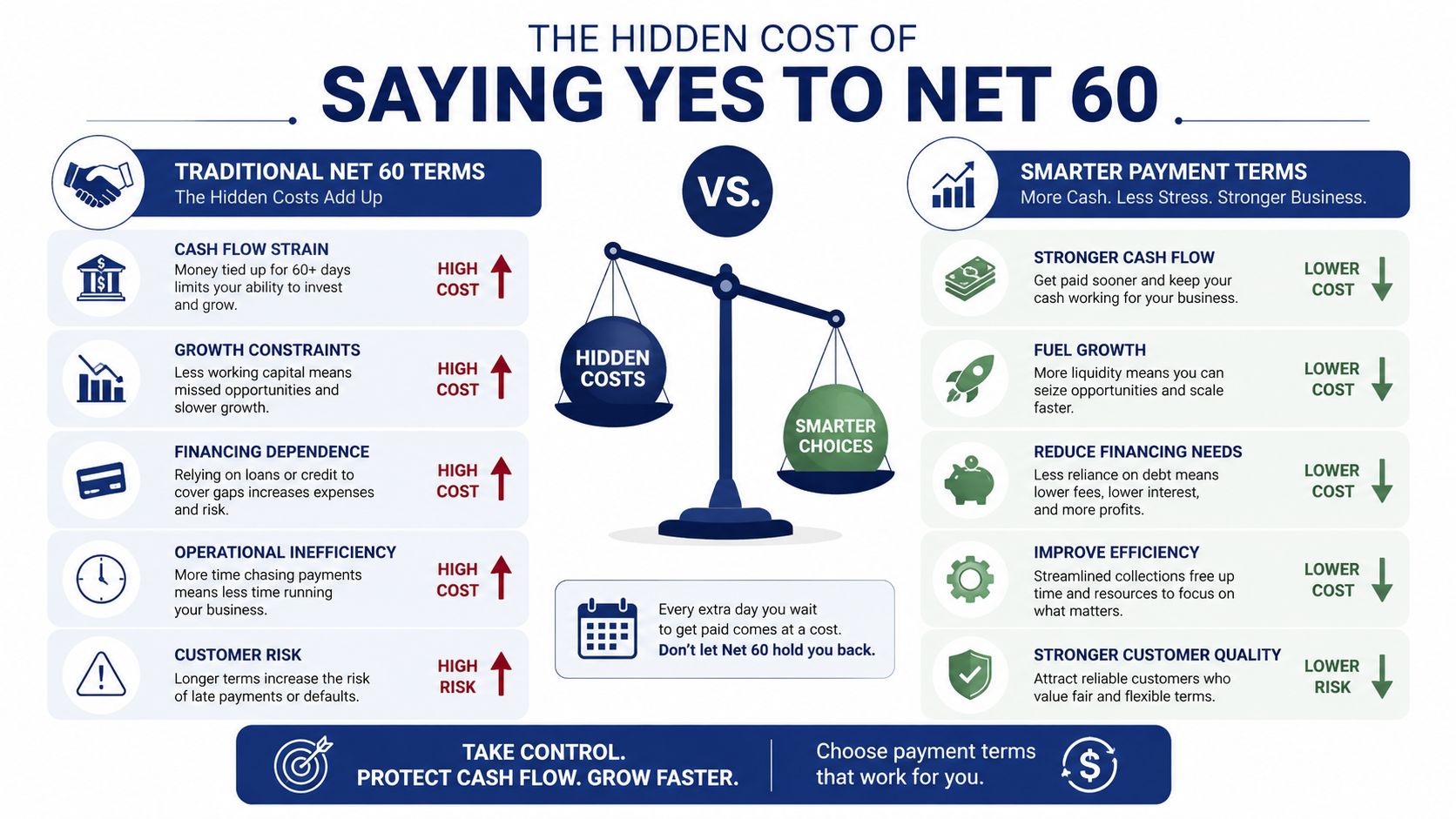
The correct choice isn't “discount or no discount.” It's which party funds the waiting period, and at what price.
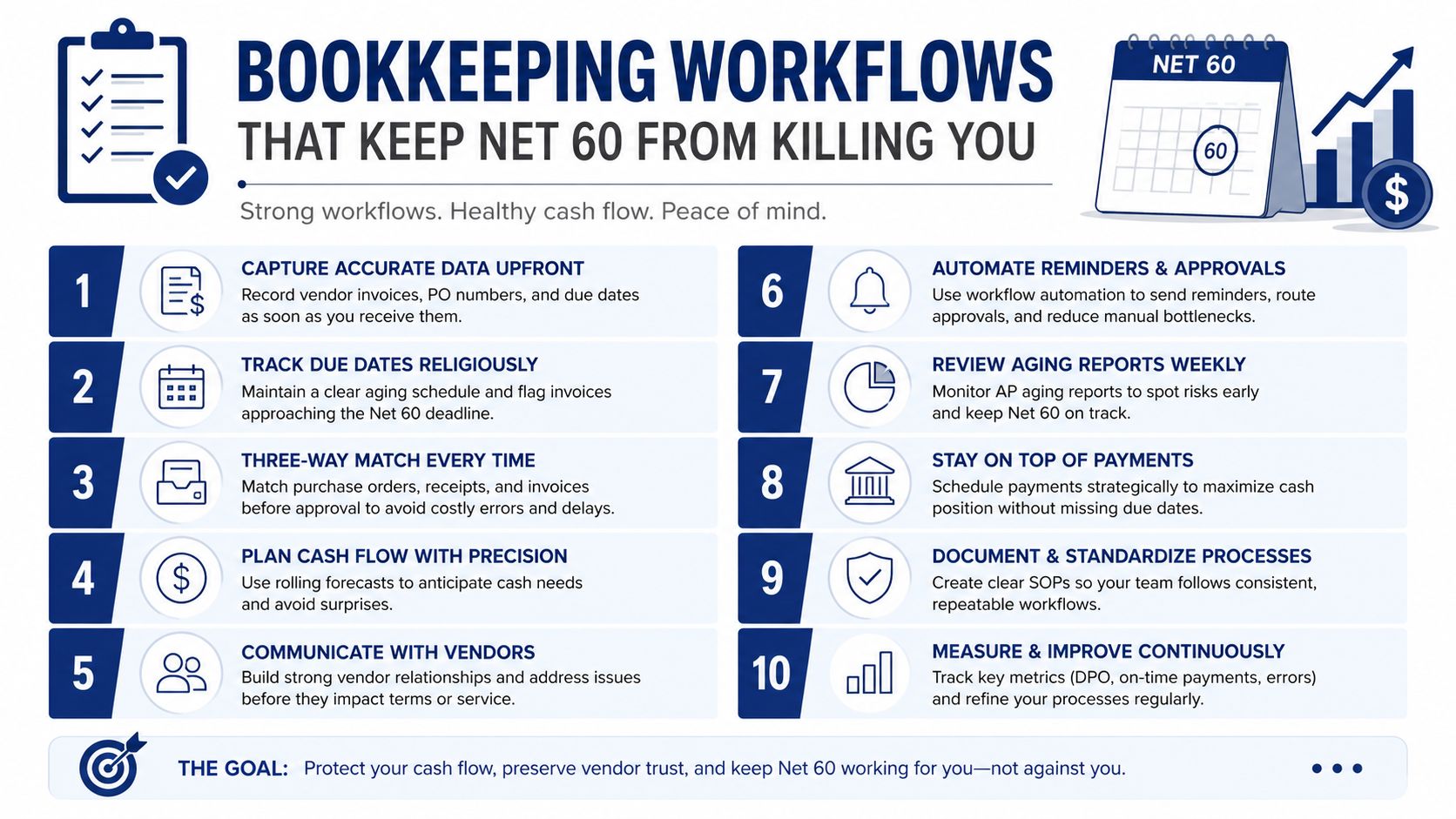
The calculator belongs inside the bookkeeping system, not in a lonely browser tab. At invoice entry, capture the fields that let someone else understand the receivable without interrogating you on a Friday afternoon.
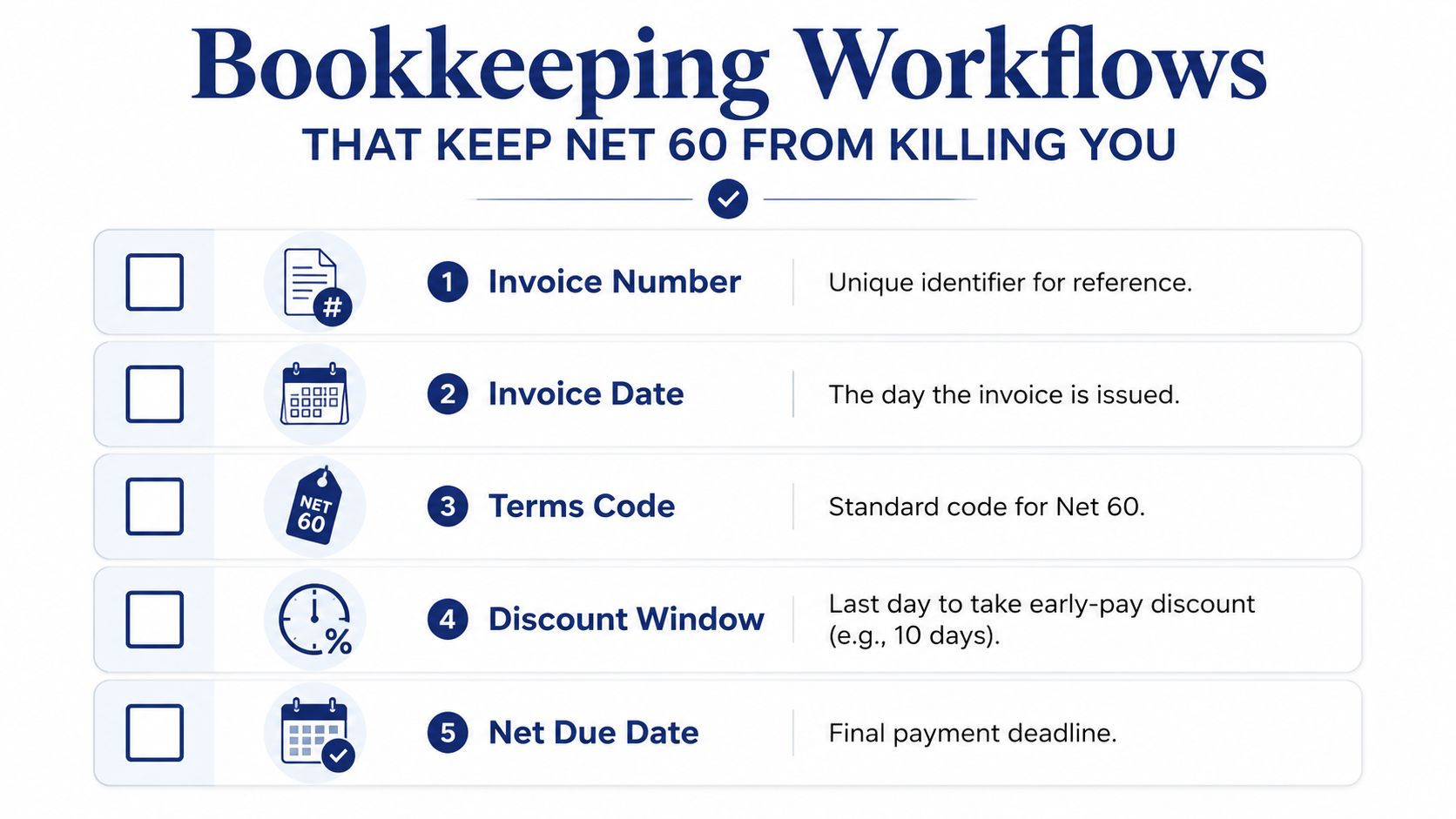
Record the invoice number, invoice date, terms code, discount window, net due date, customer purchase order, and AR aging bucket. Add the nominal due date and adjusted operational due date when weekends or holidays apply. If a customer's contract starts the clock on receipt of goods, store that trigger explicitly instead of forcing every invoice into invoice-date logic.
The terms code should be standardized. “N60,” “Net 60,” and “sixty days” shouldn't create three different reports. Your system needs one consistent code so the aging report can group exposure correctly.
Don't wait until day 60 to discover that the buyer has a missing purchase-order number.
The tone should become more precise, not more emotional. “Just checking in” is weak. “Please confirm the scheduled payment date for invoice 1048, due on June 14” gives the recipient something they can answer.
Slice the AR aging report into 0 to 30, 31 to 60, and 61 to 90 days. Net 60 exposure should stand out before it becomes a cash emergency. Code early-pay discounts as discounts taken, not unexplained revenue leakage, and apply partial payments to the correct invoice in QuickBooks or Xero.
For a more complete receivables process, use this practical guide to manage accounts receivable effectively. The objective isn't more bookkeeping. It's fewer surprises.
You don't need a controller to improve Net 60 this week. You need a short operating checklist and the discipline to use it every time.
Do this before Friday:
Pair every action with a don't. Don't extend Net 60 to a new customer without a credit check. Don't bury the due date in the footer. Don't treat late fees as optional revenue, because inconsistent enforcement teaches customers that your terms are decorative.
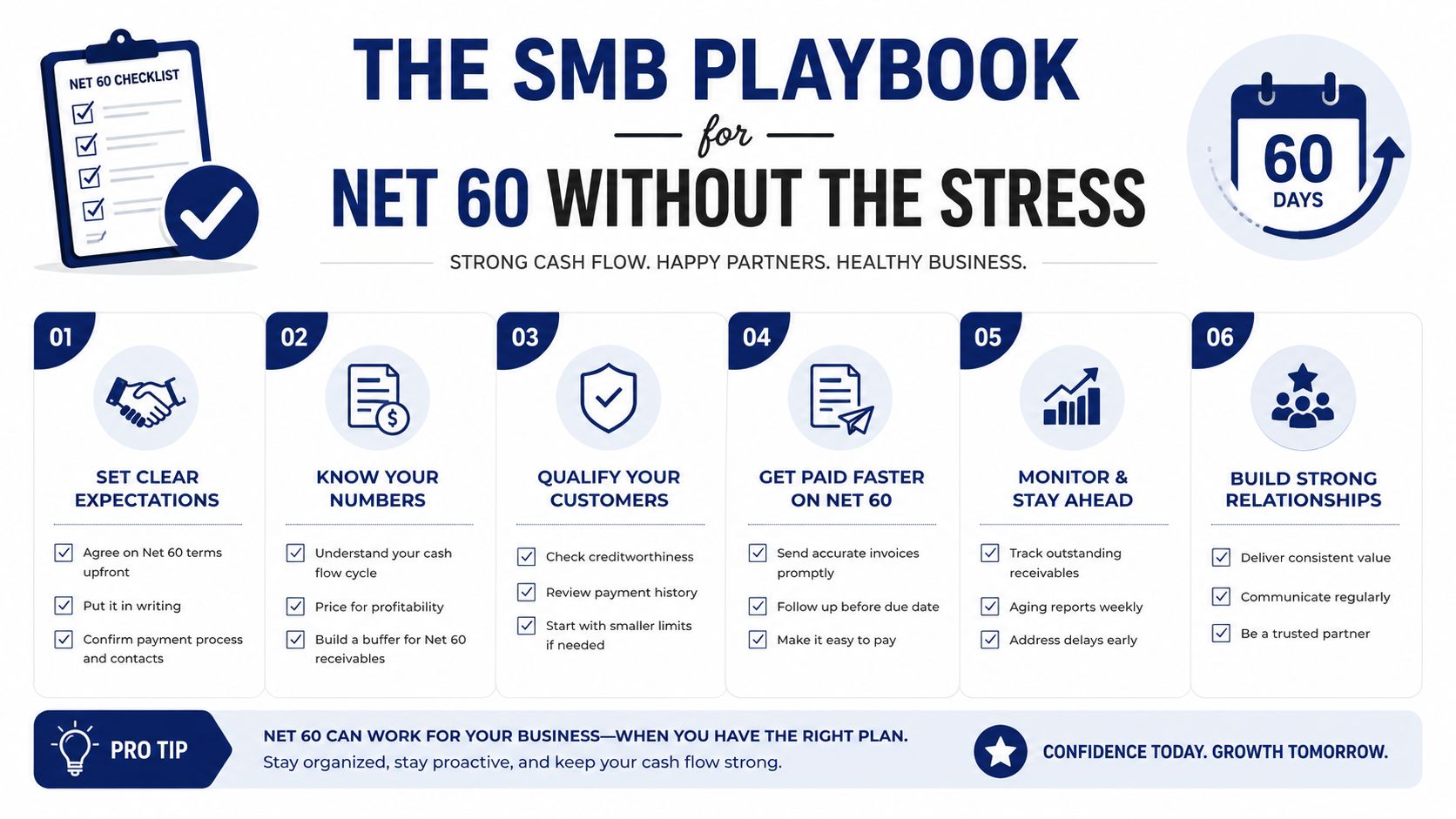
One rule keeps the risk visible: if a single Net 60 receivable exceeds 10% of monthly revenue, escalate the payment terms or require a deposit. Don't let one customer turn your cash forecast into a hostage situation.
If Net 60 tracking is eating your evenings, HireAccountants can connect you with pre-vetted bookkeepers and finance professionals who can manage invoice entry, AR aging, payment reminders, and cash-flow reporting. Visit the platform, describe your workflow, and find support before the next overdue invoice becomes a payroll problem.
Let's simplify your finances today!