


The popular advice is technically correct and practically incomplete. A raise doesn't push all your income into a higher tax bracket, so turning down a promotion because “you'll lose money” is usually nonsense. The United States taxes income progressively, which means only the slice above a threshold receives the higher rate.
But founders rarely make decisions with salary alone. They stack wages, bonuses, equity vesting, payroll taxes, credits, benefits, and state taxes into the same year, then act surprised when the cash result looks nothing like the headline compensation. The bracket is only one input. The marginal effective tax rate, the amount lost from the next dollar after the full tax and benefit system reacts, is the number that affects hiring, salary bands, and whether a paper gain is worth triggering now.
You'll leave with four practical tools: how brackets work, how to calculate them yourself, why your marginal rate hides your effective rate, and how to use both before approving the next hire or changing compensation.
The myth goes like this: an employee earns more, crosses a bracket threshold, and suddenly every dollar gets taxed at the higher rate. Therefore, the employee should reject the raise.
That's not how the federal system works. A tax bracket applies a rate to a specific range of taxable income, not to the entire paycheck. The United States uses seven marginal federal rates for tax year 2026, and only the incremental income entering a new bracket receives that new rate (Tax Foundation's 2026 tax bracket data lays out the structure and thresholds).
So yes, take the raise. The higher rate applies only to the dollars above the relevant threshold. Your existing income doesn't get retroactively repriced because your latest compensation decision annoyed the tax code.
The practical rule: A higher bracket can reduce the value of extra income. It doesn't normally make extra income worthless.
That textbook explanation still creates bad founder decisions because it stops too early. A founder might earn a salary, receive a bonus, exercise options, and vest equity in one calendar year. Each item can change taxable income and alter the rate applied to the next dollar. Payroll taxes and state taxes may also apply outside the federal bracket calculation, while credits and benefits can phase out as household income changes.
The result is a gap between the clean statutory answer and the messy cash answer. The employee may technically be in a particular federal bracket, but the company and worker care about how much of the next dollar survives.
A bonus paid in December can land on top of eleven months of salary. Equity vesting can arrive without the same cash liquidity as wages. A founder who plans each item in isolation can accidentally create a concentrated income year, then discover that the after-tax proceeds don't support the original plan.
That's why understanding tax brackets is only the starting point. You need to calculate the bracket stack, identify the marginal rate, then test payroll taxes, credits, benefits, and household status before treating a raise or vest as a win.
A tax bracket is a range of taxable income assigned to a particular tax rate. The critical word is taxable. The brackets don't apply directly to gross salary, revenue, or the number printed at the top of a compensation offer. They apply after the relevant adjustments and deductions determine taxable income.
For 2026, the federal government keeps seven marginal rates: 10%, 12%, 22%, 24%, 32%, 35%, and 37% (Tax Foundation). The thresholds differ by filing status, and the table below shows the ranges in a usable format.
| Rate | Single Filer Range | Married Filing Jointly Range |
|---|---|---|
| 10% | Up to $12,400 | Up to $24,800 |
| 12% | $12,401 to $50,400 | $24,801 to $100,800 |
| 22% | $50,401 to $105,700 | $100,801 to $211,400 |
| 24% | $105,701 to $201,775 | $211,401 to $403,550 |
| 32% | $201,776 to $256,225 | $403,551 to $512,450 |
| 35% | $256,226 to $640,600 | $512,451 to $768,700 |
| 37% | Above $640,600 | Above $768,700 |
The 37% top rate begins above $640,600 for single filers and above $768,700 for married couples filing jointly. The lowest 10% bracket reaches $12,400 for single filers and $24,800 for joint filers. Those thresholds are adjusted for inflation while the rate structure remains the same (Tax Foundation).
Your marginal rate is the rate on your next dollar of taxable income. Your effective rate is your total federal income tax divided by taxable income. Because lower slices use lower rates, your effective federal rate is generally below your top marginal rate.
Do not confuse that federal calculation with your complete burden. State income tax brackets stack on top of the federal system, and state thresholds don't line up neatly with federal thresholds. If you have unresolved state obligations, a specialist resource on how to resolve unpaid SC taxes can help separate state compliance from federal bracket planning.
The IRS federal income tax rates and brackets also illustrates the stepwise design using historical thresholds. The point survives every spreadsheet: the government taxes each layer separately, not your entire income at the highest rate you touch.
A $150,000 taxable-income single filer does not owe 24% on every dollar. The bracket schedule applies rates in layers, starting with the lowest slice and moving upward. Use taxable income, not gross pay, because deductions and adjustments determine what enters the schedule.
The first $11,925 is taxed at 10%. The next $36,550 is taxed at 12%. The next $53,475 is taxed at 22%. The remaining $48,050 is taxed at 24%. The resulting federal income tax is approximately $25,785.
| Bracket Slice | Income in Slice | Rate | Tax on Slice |
|---|---|---|---|
| First slice | $11,925 | 10% | $1,192.50 |
| Second slice | $36,550 | 12% | $4,386.00 |
| Third slice | $53,475 | 22% | $11,764.50 |
| Fourth slice | $48,050 | 24% | $11,532.00 |
| Total | $150,000 | Approximately $25,785 |
The mechanics matter more than the headline rate. Saying “I'm in the 24% bracket, so I lose 24% of everything” uses the wrong denominator and the wrong model. The marginal rate applies only to the next slice. The calculation above produces an effective federal income-tax rate below 24%.
A married couple filing jointly with $300,000 of taxable income moves through wider joint thresholds. Under the supplied 2026 thresholds, the couple passes through the 10%, 12%, 22%, and 24% layers, with a top marginal rate of 24% rather than 32% (Tax Foundation).
That comparison still uses taxable income, not gross income. If the single filer earns $150,000 before deductions, or the couple earns $300,000 before deductions, the standard deduction and other adjustments reduce the amount entering the bracket schedule. Calculate taxable income first, then apply each bracket slice.
For a real planning decision, pull the W-2 or K-1 and place every income item in a spreadsheet. Recreate the stack with the IRS bracket tables, calculate total federal income tax, and divide it by taxable income. Then add payroll taxes, benefits, credits, and state taxes before deciding whether a salary band or next hire works. The headline bracket is a starting point, not the marginal effective rate that determines the cash cost.
Your federal marginal bracket answers one narrow question: what rate applies to the next slice of taxable income? It does not tell you what the next dollar of labor costs the company or how much reaches the employee. For founders, that broader calculation drives hiring decisions, salary bands, and whether paper gains from a Series A justify a move.
The OECD's tax wedge includes taxes and social contributions that affect labor costs. Its 2025 findings show that the marginal tax wedge on an additional unit of labor income can absorb roughly 25% to 55% of the increase in labor costs in many cases, depending on household and country conditions (OECD Taxing Wages 2025). A bracket explainer that stops at income tax leaves out the number that often matters to the business.
Federal income tax is one line in the model. The next dollar can also interact with:
A worker's federal bracket therefore cannot stand in for the company's all-in marginal cost. A payroll-heavy SMB can approve compensation using a 24% federal rate and still underestimate the cash required to deliver the package.
The tax bracket gives you the label. The tax wedge shows what the transaction costs.
Use a PEO payroll tax estimator to organize employer-side costs before approving a compensation change. Then map the resulting obligation clearly. Tax liabilities cover more than the federal income-tax line, and your model should show each component.
Household type, income level, family composition, credits, and benefits can materially change the result. An engineer in San Francisco and a remote controller in Texas may face different state, payroll, and benefit interactions even when their federal marginal brackets match.
Do not assign either employee a made-up all-in percentage. The answer requires payroll data, location, filing status, compensation mix, and benefit elections. The useful conclusion is clear: statutory marginal rate and real marginal cost are different measurements.
| Component | Federal Marginal Rate Example | All-In Marginal Effective Rate |
|---|---|---|
| Federal income tax | The rate on the next taxable-income slice | Must be modeled with payroll and household inputs |
| Payroll taxes | Separate from federal brackets | Varies with wage base and Medicare rules |
| State taxes | State-specific and not federally aligned | Depends on residence and work location |
| Benefits | Usually outside the bracket table | Can increase employer cost or change take-home pay |
| Credits and phaseouts | Can reduce or limit tax benefits | May change the value of the next dollar |
Founders should stop negotiating compensation with one number. The useful decision variable is the marginal effective rate, which captures what happens to the next dollar after income tax, payroll charges, benefits, and relevant credits.
Consider a senior engineer offer moving from a $240,000 base to a $260,000 base. The higher base may cross a federal or state threshold, alter payroll interactions, or affect benefits and credits. Don't call the extra compensation “worth” its gross amount until the employee sees the modeled take-home result and the company sees the fully loaded cost.
A year-end bonus creates a different problem. Supplemental withholding can make the bonus check look unusually light, while the final tax liability depends on the employee's full-year income and filing details. A bonus that arrives after payroll thresholds reset can also behave differently from a bonus paid earlier in the year. Model the timing instead of trusting the paystub.
Equity requires even more discipline. A vest or exercise can stack with wages and bonuses, creating taxable income without a matching cash payment. For founders, the choice between an S-corporation distribution and W-2 wages can move the same economic dollar through different tax and payroll treatment, but reasonable compensation and entity rules still matter. Don't turn a simplistic “distribution equals cheaper” slogan into a compliance problem.
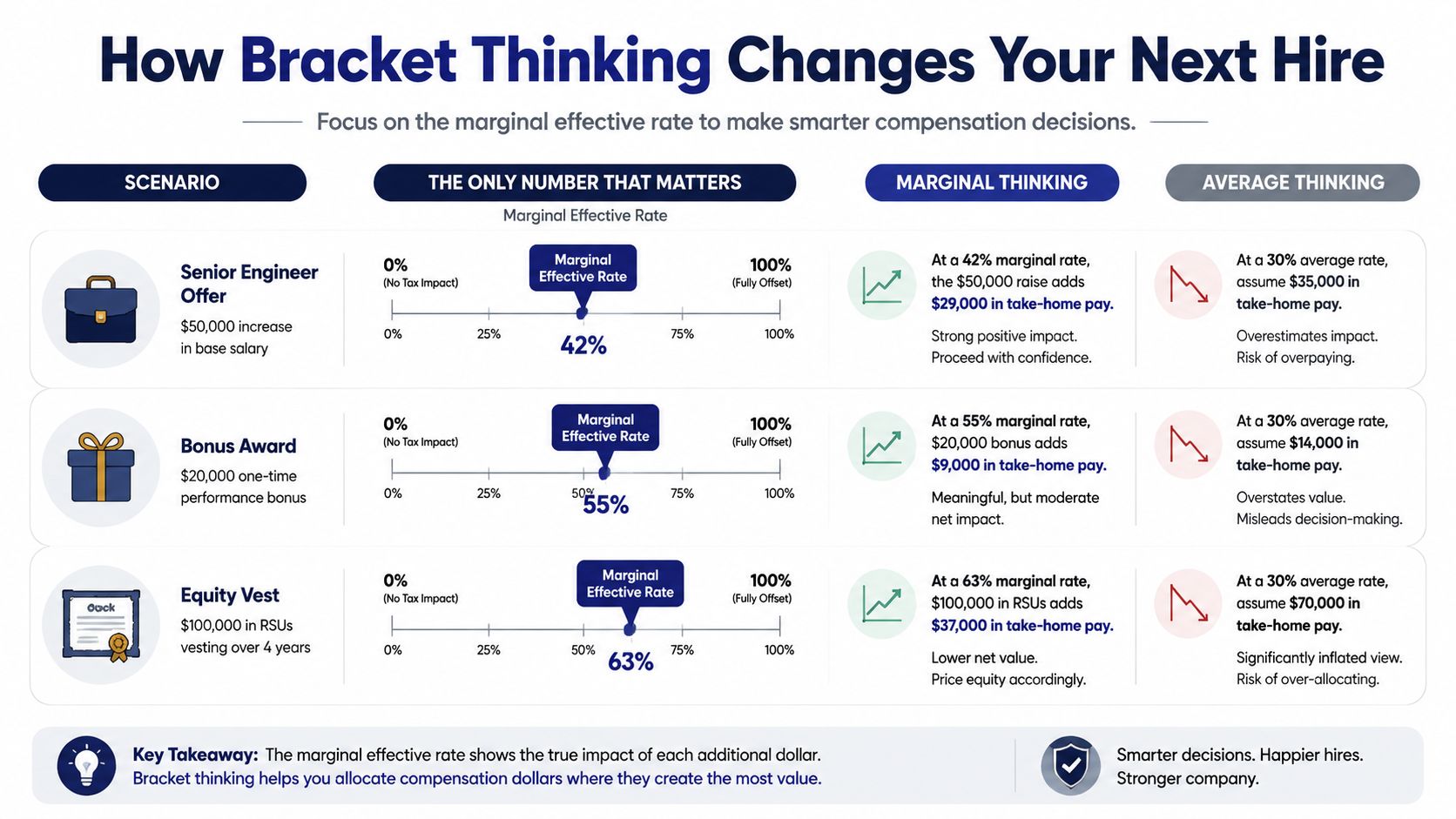
Before approving a package, ask three questions:
The same logic applies to salary bands, retention bonuses, and equity refreshes. Average thinking says, “This employee earns a lot, so the package is expensive.” Bracket thinking says, “What does the next dollar cost, and what does the employee keep?”
My rule: Never negotiate compensation without knowing both the bracket and the wedge.
A clean year-end review beats a heroic tax project. Open the payroll register first, then test decisions against actual wages, bonuses, equity, benefits, and state details. Your next hire, salary band, or bonus should reflect the marginal effective cost, not the federal bracket alone.
Then test entity and location decisions. An S-corporation owner should review reasonable compensation and distributions with a tax professional, rather than copy another founder's salary. A remote hire also needs a state review before the offer goes out. Work location can affect withholding, registration, and state tax exposure.
Review possible R&D credit opportunities, retirement-related credits, child-related credits, and deductions with supporting records in hand. Credits and deductions follow different rules. Give your CPA the contribution dates, claimed items, and the payroll or income-tax line each one affects. Sequence them around cash needs and compensation timing, not around a generic year-end checklist.
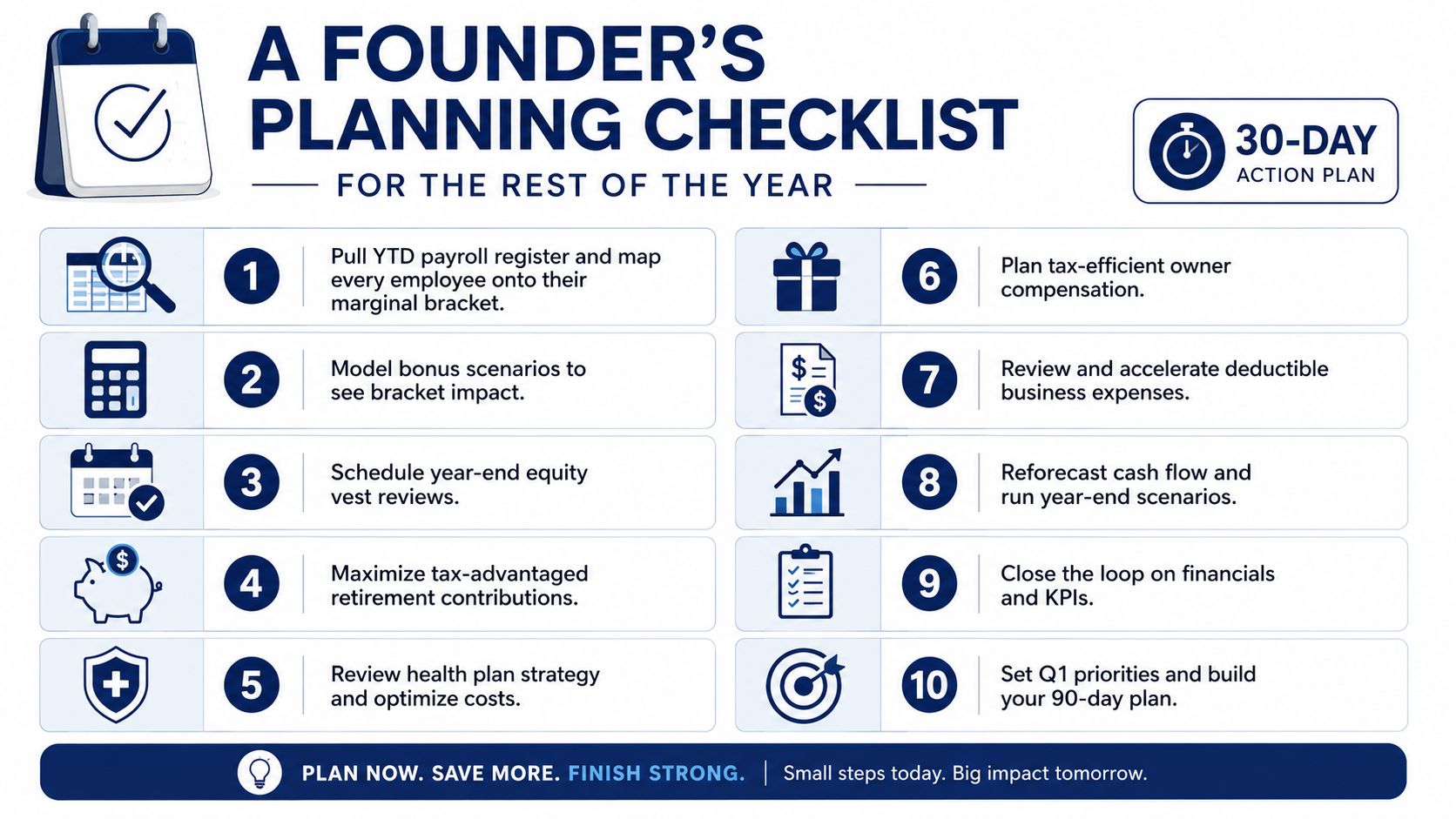
Use your small-business tax deductions guide as a document checklist. Bring the payroll register, cap table, vesting schedule, entity documents, state list, and forecast to the CPA call. Missing data turns a tax plan into a confident guess wearing a blazer.
The raise itself isn't automatically swallowed by a higher federal bracket. The problem is the combination of the next marginal slice, payroll taxes, state taxes, benefit changes, and credit phaseouts. Those pieces can reduce the employee's take-home increase far below the gross raise.
Bring the latest paystub, year-to-date payroll register, benefit elections, filing status, and a household-income estimate to the CPA.
Employers often use supplemental withholding rules for bonuses. Withholding is a payment toward the liability, not the final return calculation, so it can overstate or understate what the household ultimately owes after all income, deductions, credits, and payroll details are included.
Bring the bonus statement, year-to-date wages, current withholding form, and a full-year income forecast.
Start with the income already scheduled for the year, then model the vest or exercise against the relevant bracket thresholds and available cash for tax. Qualified Small Business Stock planning can involve QSBS stacking rules, holding-period requirements, entity details, and limitations, so don't treat a vesting calendar as a tax strategy by itself.
Bring the cap table, grant agreement, vesting schedule, exercise records, valuation materials, and a year-by-year income projection.
R&D, retirement savers, and child-related credits can affect the final tax result, but eligibility and ordering depend on the taxpayer and the underlying records. Sequence payroll, retirement contributions, credit calculations, and equity events together instead of asking your accountant to bolt credits onto a finished return.
Bring payroll records, qualified R&D expense support, retirement-plan documents, dependent information, and the projected tax calculation. The tax accountant role guide can also clarify which preparation, compliance, and planning work should be assigned before the call.
HireAccountants connects US companies with pre-vetted accountants and finance professionals for bookkeeping, tax preparation, payroll support, and financial analysis, with marketplace and recruiting options for full-time or part-time needs. Visit HireAccountants to find finance support that can turn bracket calculations, payroll data, and year-end planning into an operating process instead of a last-minute scramble.
Let's simplify your finances today!