


Have you ever typed “too busy or to busy”, paused, and realized the phrase looks suspicious either way? You're not alone. I've caught this typo in my own writing more times than I'd like to admit, usually while moving too quickly and mentally jumping ahead to the verb.
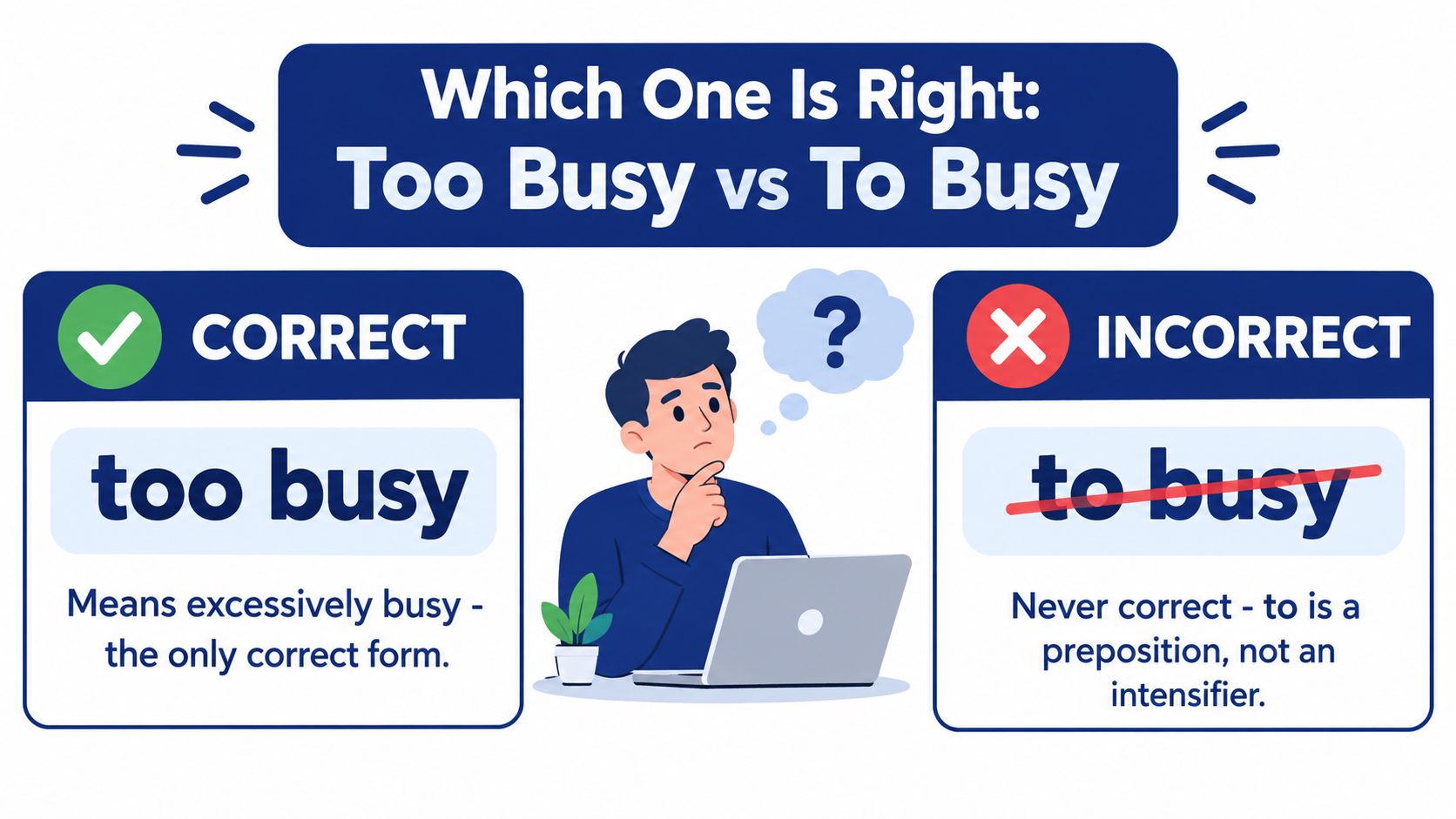
The answer is simple: “too busy” is correct, and “to busy” is wrong when you mean “so occupied that something else can't happen.” But the useful lesson isn't just swapping one small word for another. Too busy carries a grammatical threshold and, in real conversation, can also carry a social message about priorities, availability, and polite refusal.
You're writing an email: “I'm ___ busy to call.” Your cursor blinks. The sentence feels familiar, but the spelling suddenly looks like a trap.
Use too busy:
“To busy” is always wrong in this construction. The adjective busy means having a lot to do or not being free to do something, as Cambridge Dictionary's entry for busy explains. It can describe a person, a period, a phone line, or even a design with too much detail, but none of those meanings turns to busy into a grammatical phrase.
Why does the mistake feel natural? Speed. The word to often appears immediately before a verb, as in “to call,” “to study,” or “to finish.” Your brain sees the upcoming infinitive and reaches for to too early:
I'm to busy to call.
The first to has no job. The second one does. That's the whole problem.
Busy is an adjective, and adjectives can be modified by degree words. We say very busy, quite busy, and too busy. We don't place the infinitive marker to directly in front of an adjective to intensify it.
If you write professionally, this tiny error is worth fixing before it reaches a client, candidate, manager, or hiring page. A freelance copywriter working on a careers article, for example, can use HireAccountants' freelance copywriter resource to think about clear business writing, but the basic rule remains the same everywhere: too modifies busy.
The rest of the rule becomes much easier once you separate the jobs of too, to, and two.
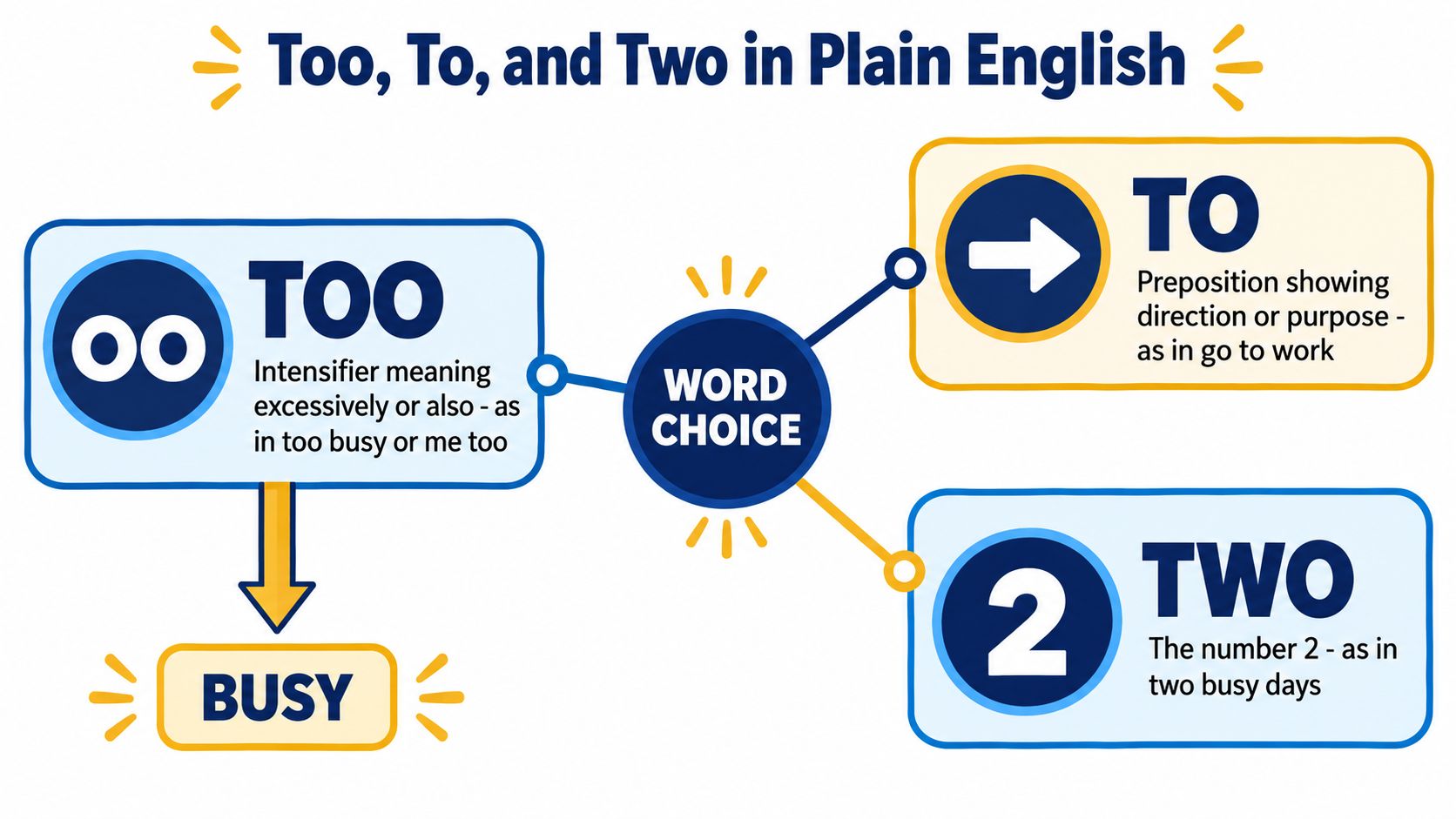
These three words sound alike in many varieties of English, but they don't do the same work. Spelling becomes easier when you identify the job each word is performing.
Too is an intensifier when it means “excessively”:
It can also mean “also”:
That double-o spelling gives you a useful visual cue. Think of the extra o as extra amount. Too busy means busy beyond the point where another action is practical, possible, or reasonable.
To works as a preposition when it shows direction, destination, or relationship:
It also introduces an infinitive:
That's why to appears later in the correct phrase:
The first word, too, describes the degree of busyness. The second word, to, introduces the action that won't happen.
Two refers to the number 2:
So the quick comparison looks like this:
| Word | Main job | Example |
|---|---|---|
| too | Excessively or also | too busy, me too |
| to | Direction, relationship, or infinitive marker | to work, to study |
| two | The number 2 | two meetings |
Only too can modify the adjective busy. You can say too tired, too expensive, and too complicated for the same reason. You can say to the office or to finish the report, but not to busy.
The most common slip happens when a writer notices a verb later in the sentence and types to before checking what comes immediately after it. Train yourself to inspect the word after the blank. If that word is an adjective such as busy, tired, or late, you probably need a degree word, not an infinitive marker.
The phrase too busy to + verb has a tidy structure. Too is an adverb modifying the adjective busy. The second to introduces the verb in its infinitive form.
The grammar reference Ludwig's examples for “I was too busy” identifies too busy as a predicate-adjective structure. In practical terms, the subject is busy to a degree that crosses a contextual limit. It's not merely “very busy.” The workload prevents another action.
| Word | Part of speech | Function |
|---|---|---|
| too | Adverb | Modifies the degree of busy |
| busy | Adjective | Describes the subject's availability or workload |
| to | Infinitive marker | Introduces the blocked action |
| cook, answer, notice | Base-form verbs | Name the action that can't be completed |
That cause-and-effect relationship matters. The commitments or workload cause the problem. The infinitive names the action that's blocked. English Stack Exchange's grammar discussion distinguishes I was too busy to study, where studying couldn't happen, from I was busy studying, where studying caused the busyness.
Practical rule: “Too busy to” means the first condition gets in the way of the second action.
Compare the degree options:
The infinitive can disappear when the context is obvious:
The meaning remains tied to availability, even without an explicit verb.
Punctuation can shift the emphasis too:
If your sentence contains several competing demands, clearer writing also depends on reducing mental friction. Resources on cognitive load management from Acheloa Wellness can help writers and teams organize information before they turn a crowded thought into a crowded sentence.
These two patterns look close enough to cause trouble, but they answer different questions.
Busy doing tells us what occupies someone's time. Too busy to do tells us what that person can't do because of the competing workload.
| Construction | Verb form | Example | What it means |
|---|---|---|---|
| busy doing | Gerund, verb ending in -ing | She is busy writing the report. | Writing the report occupies her |
| too busy to do | Infinitive, to + base verb | She is too busy to write the report. | Her workload prevents her from writing it |
The difference becomes clearer in paired examples.
He's busy answering customer emails. Answering emails is his current activity.
He's too busy to answer customer emails. Other demands prevent him from answering them.
Maya is busy helping her children with homework. Parenting tasks occupy her attention.
Maya is too busy to help with the school project. Her schedule leaves no practical room for that project.
I was busy preparing for the exam. Exam preparation filled my time.
I was too busy to study for the exam. Other obligations stopped me from studying.
They're busy planning the event. Event planning is underway.
They're too busy to attend the event. Their workload prevents attendance.
We were busy fixing the books. Fixing the accounts occupied the team.
We were too busy to review the new proposal. The team couldn't take on the review.
The English in Korean explanation of busy and too busy uses the same practical contrast: too busy to study describes a blocked action, while busy studying describes the activity causing the busyness.
What about busy to do? In this meaning, it reads as broken because busy doesn't normally connect directly to an infinitive without the degree marker too. Write I'm busy reviewing the contract if the review is happening. Write I'm too busy to review the contract if something else prevents it.
Busy doing answers “What are you occupied with?” Too busy to do answers “What can't you take on?”
That distinction saves more than grammar points. It stops readers from confusing active work with unavailable capacity.
Small words around too busy can make the sentence stronger, more specific, or more diplomatic. They're not decorative. They tell the reader how much excess you mean and what kind of relationship the workload has to the next noun or activity.
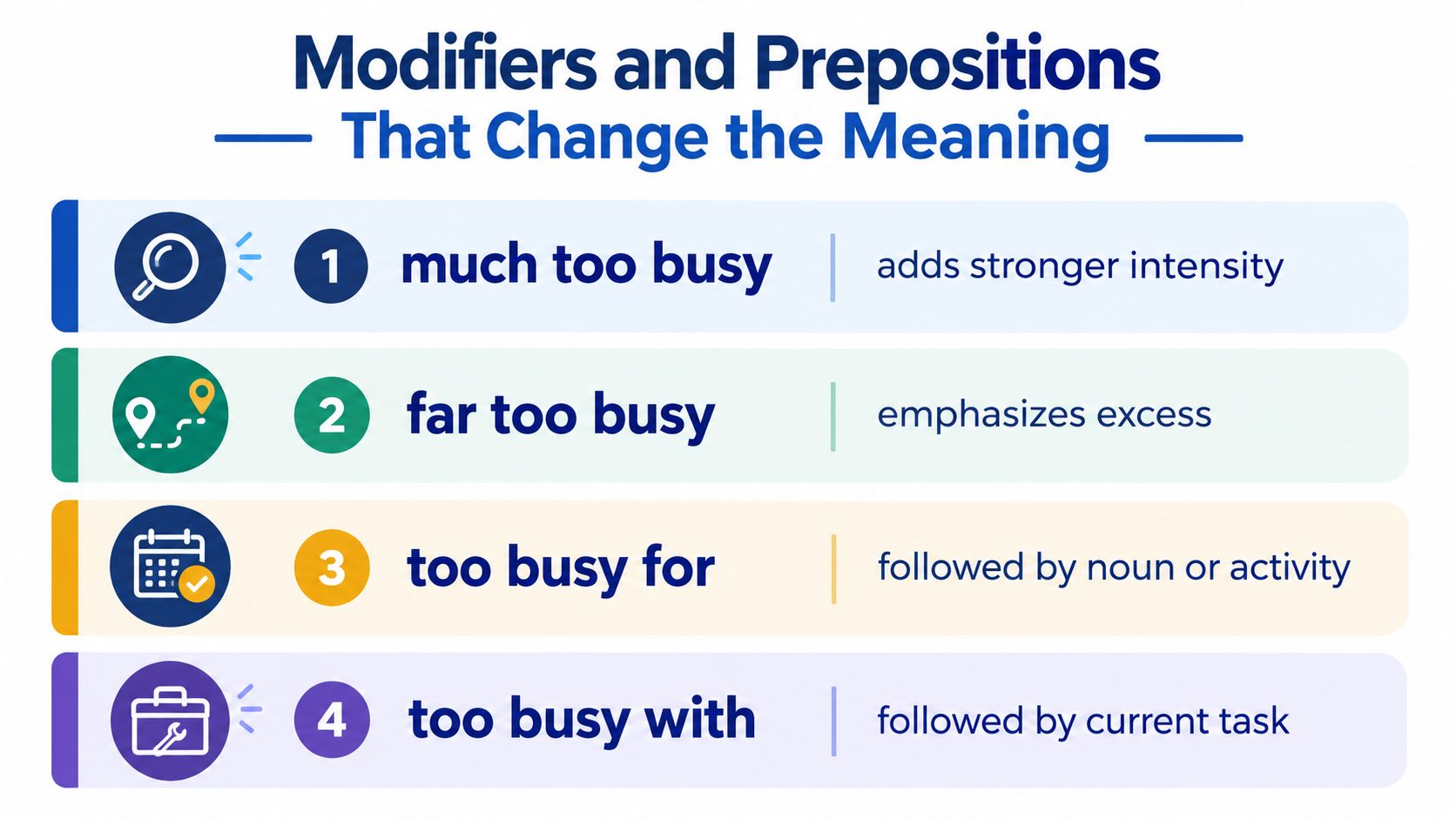
Both much too busy and far too busy are correct written forms, and Ludwig's examples for “much too busy” show how these modifiers increase the degree of overload.
Plain too busy states the limit. Much too busy adds force. Far too busy emphasizes that the gap between available capacity and the requested task is substantial.
Avoid very too busy. Very and too are both degree modifiers, so placing them together creates an awkward combination. Choose very busy when you mean high intensity without necessarily implying blockage. Choose too busy when you mean the workload prevents something else.
Use too busy for before a noun or an activity treated as a noun:
With a gerund, the activity follows for:
That sentence is grammatical in some contexts, but too busy to take on extra reporting usually sounds cleaner when you mean an action he can't perform. For a noun, for is the natural fit. For a direct action, use to + verb.
Use too busy with to identify the task, project, or responsibility consuming someone's time:
The phrase too busy for now is more informal and often softer:
One phrase deserves special attention: too busy to bother.
Sometimes this means genuine overload. Often it softens a refusal while revealing that the speaker doesn't consider the task worth the effort. Grammar can be correct while the tone throws a chair across the room.
“I'm too busy” doesn't always mean the calendar is full. Sometimes it means, “That request isn't high enough on my priority list.”
That reading appears in ordinary refusals:
The speaker might be genuinely overwhelmed. A new parent, a student during exams, or a team during a product launch may be describing a real capacity limit. But the same phrase can let someone decline a casual favor without saying, “I don't want to spend time on that.”
This ambiguity is useful when you want a soft refusal, but it's risky when the other person needs a clear commitment. If a manager asks whether the financial statements will be ready, “I'm too busy” doesn't explain whether the work is impossible, delayed, or below other priorities.
A casual request can tolerate a broad answer:
“I'm too busy this week, but I appreciate you asking.”
A serious obligation needs more information:
These alternatives protect trust because they separate lack of time from choice of priority. Usage discussions distinguish busy with as the work occupying time from busy for as a phrase that can imply availability or priority, a nuance also discussed in Speak's explanation of too busy and so busy.
The phrase can also signal healthy boundaries. Someone protecting uninterrupted work may be unavailable because they're concentrating, not because every minute is booked. A practical introduction to the science of deep focus helps clarify why “busy” can describe deliberate concentration rather than frantic motion.
For businesses, outsourcing repetitive finance work can make the sentence more accurate. A startup founder who says, “I'm too busy to reconcile transactions,” might use outsourcing to a virtual assistant as one route for moving recurring administrative work away from the founder's desk.
The honest rewrite is usually better than the vague one:
No one needs your complete life story. They do need a usable answer.
Start with the two Os test. The double o in too can remind you of also or excessively:
If either replacement works, use too.
The second test checks what comes next. To goes before a verb. Too goes before an adjective. That rhyme is simple, slightly corny, and annoyingly effective.
Use this quick checklist before publishing:
And two busy? That only works if two modifies a separate noun, as in “two busy days.” It doesn't describe one person's workload.
Keep HireAccountants' blog bookmarked if you're building clearer business processes and communications. Good writing starts with small decisions, and this one takes seconds once the pattern is familiar.
If finance work is eating the time you need for customers, hiring, or growth, HireAccountants connects US companies with pre-vetted remote accountants and finance professionals for bookkeeping, accounting, and related support. Visit the platform to compare available talent and find help that turns “too busy to handle the books” into a problem you can remove.
Let's simplify your finances today!