


You're staring at a bank feed that never quite clears, a payroll deadline breathing down your neck, and a month-end close that has somehow become a founder's personal hobby. The books technically exist, but getting a straight answer from them requires spreadsheet archaeology, three Slack messages, and a small sacrifice to the accounting gods.
That's usually when someone asks how to outsource accounting services. The instinct is to hand over everything and move on. That's how messy transitions, vague accountability, and expensive surprises enter through the front door.
The smarter question is narrower: what should you outsource first, what should stay close, and what earns the right to move later?
A founder once handed an outside firm the entire finance function in one dramatic move. Bookkeeping, payroll, reporting, and cash planning all changed hands at once. The provider had capable accountants. The business still stumbled because nobody had agreed on payment approvals, priority reports, or the process for escalating exceptions.
The failure came from sequencing, not accounting skill. The scope outran the company's operating habits, so every routine question became a decision meeting. That is how outsourcing starts to feel risky.

Outsourcing is a sequencing decision before it is a vendor decision. Begin with transactional work that follows clear rules and produces visible outputs. Once the data and review rhythm are reliable, add controller support, cash planning, or FP&A. Hand over judgment-heavy work too early and you outsource confusion. Keep everything internal too long and your team becomes the bottleneck.
The market supports a layered approach. Finance and accounting outsourcing was estimated at USD 43.1 billion in 2022, with a projected 6% CAGR through 2030. Another estimate places the market at USD 54.79 billion in 2025, USD 59.05 billion in 2026, and USD 85.92 billion by 2031 (Mordor Intelligence's finance and accounting outsourcing market research). The figures reflect a shift from occasional bookkeeping help toward broader support across AP, FP&A, and controller work.
That range of services gives startups and SMBs room to choose. You can transfer one recurring workflow, build a hybrid team, or add an external finance bench as the company grows. The right model removes work your internal team should not still own while keeping approvals, context, and decision rights clear. Review the benefits of outsourcing accounting services with that boundary in mind.
Adoption research points in the same direction. Businesses report 40% to 60% labor cost savings through accounting outsourcing, and 96% of CFOs rely on at least one third-party finance and accounting provider, according to accounting outsourcing research from Insignia Resource. Those findings support deliberate delegation, not a blanket handoff.
The opportunity is real. So is the trap.
The right provider with the wrong scope still produces the wrong outcome.
If the books are behind, do not begin with strategic forecasting. If AP is undocumented, do not transfer payment approvals and hope the process sorts itself out. Start with repeatable work, document the handoff, measure the outputs, then expand when the evidence supports it. That sequence protects control while the business grows.
Before you compare providers, make a complete list of the work your finance team performs. Include the awkward jobs, such as chasing missing receipts, fixing duplicate vendors, answering tax questions, and explaining why the balance sheet doesn't balance.
Then sort each task by repeatability, judgment, risk, and dependency. This turns a vague outsourcing ambition into a scope someone can deliver.
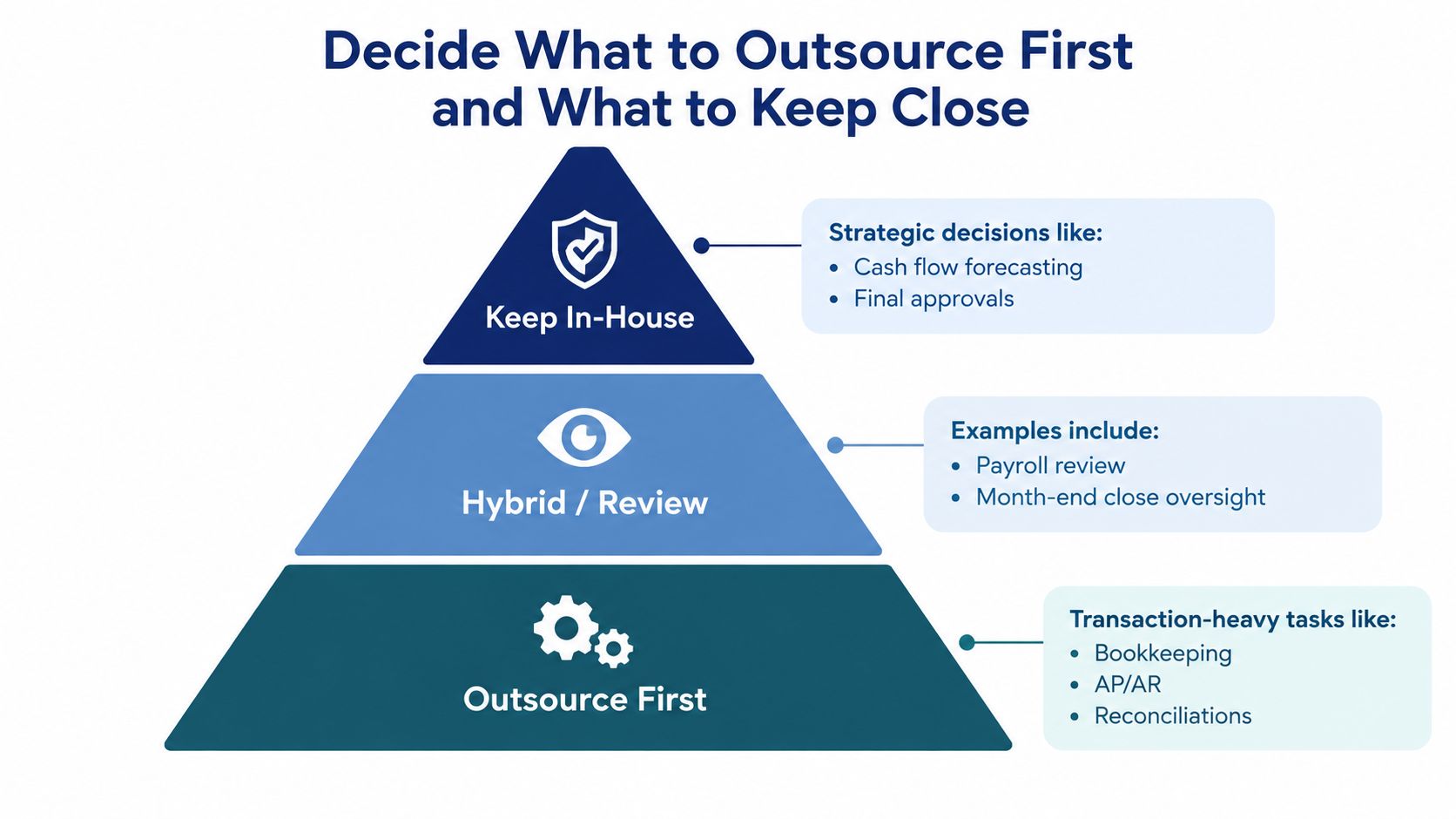
Outsource-first tasks usually have clear inputs, defined rules, and an observable finish line:
These workflows are structured enough to transfer without turning every decision into a daily founder meeting. One industry analysis reports that outsourced finance and accounting programs can reach 98.7% to 99.2% accuracy in structured processing, nearly matching in-house performance (finance and accounting outsourcing accuracy research).
That doesn't mean you should let an external team release every payment without review. It means transaction-heavy work gives you the cleanest place to begin.
Forecasting, strategic analysis, cash allocation, final payment approval, fundraising models, and board-level interpretation require context that may not exist in a provider's first month. Keep those decisions internal until the provider understands your business and your reporting foundation is stable.
A hybrid setup works well here. The provider prepares the schedules and reports, while an internal owner reviews exceptions and signs off on decisions. That creates useful support without pretending the external team knows your priorities before you've explained them.
If your company handles a large volume of non-billable administrative work, the same discipline applies beyond finance. A practical guide on how to free up attorney time with outsourcing can help legal teams separate routine support from work that needs licensed judgment.
Move from bookkeeping into monthly close, management reporting, or controller-level work when three conditions are true:
The sequence I recommend is simple: bookkeeping, AP and AR, payroll support, monthly close, controller support, then FP&A. Don't outsource FP&A to compensate for unreliable books. That's like commissioning a weather forecast from a broken thermometer.
Once the scope is clear, choose the delivery model. Founders often compare only hourly rates and accidentally turn communication, oversight, and replacement risk into invisible costs.
You have three practical paths. An in-house hire gives you maximum day-to-day proximity, a talent marketplace gives you flexible access to individual professionals, and an accounting agency gives you a managed team with broader process coverage.
| Criteria | In-House Hire | Talent Marketplace | Accounting Agency |
|---|---|---|---|
| Speed | Slower, because recruiting and onboarding sit with you | Faster, especially when candidates are pre-vetted | Fast if the agency has immediate capacity |
| Cost structure | Salary, benefits, equipment, and employment overhead | Hourly or ongoing engagement based on scope | Usually a service fee or retainer |
| Control | High daily control | High working control with flexible staffing | Control comes through contracts, SLAs, and reviews |
| Vetting effort | Heavy, you own the search and interviews | Shared, the platform supports matching and screening | Lower candidate burden, higher provider due diligence |
| Best fit | Core finance leadership and sensitive decisions | Transaction work, part-time support, or a scalable hybrid team | Fully managed close and broader accounting operations |
| Main risk | One person becomes a single point of failure | You still need an internal owner | Scope opacity and communication gaps |
An in-house hire makes sense when finance is central to your operating model and you need someone embedded in every commercial decision. It's also the model with the most recruiting drag. Hope you enjoy spending your afternoons fact-checking resumes and running accounting interviews, because that can become your new full-time job.
A marketplace is more attractive when you need reliable accounting capacity without building an entire department. A platform such as HireAccountants matches US companies with pre-vetted finance professionals, including bookkeepers, CPAs, auditors, tax accountants, financial analysts, and accounting managers. It also supports part-time and full-time arrangements, which suits a company that needs help now but hasn't earned a full finance org chart yet.
An agency earns its fee when you need a managed process rather than an individual contributor. If you want one accountable team to own the close, maintain coverage during absences, and provide controller-level oversight, an agency may be worth the premium. You'll still need to ask who performs the work after the sales call.
Choose the model that matches your management capacity, not just your budget.
Time-zone alignment deserves its own decision. Nearshore talent working in US time zones can make live collaboration easier than a lower-cost team that operates while your office sleeps. That matters when a payment exception needs an answer before lunch, not tomorrow morning.
For a broader view of how outsourced specialists can support adjacent business needs, resources covering financial advisor legal topics can help clarify where specialist work belongs in a wider external-support strategy. Keep the principle consistent: outsource execution, retain ownership of critical decisions.
A cheap quote becomes expensive when your team spends mornings correcting entries, rebuilding reports, and chasing missing documentation. Price is only the first filter. Inspect the operating model behind it before comparing providers.
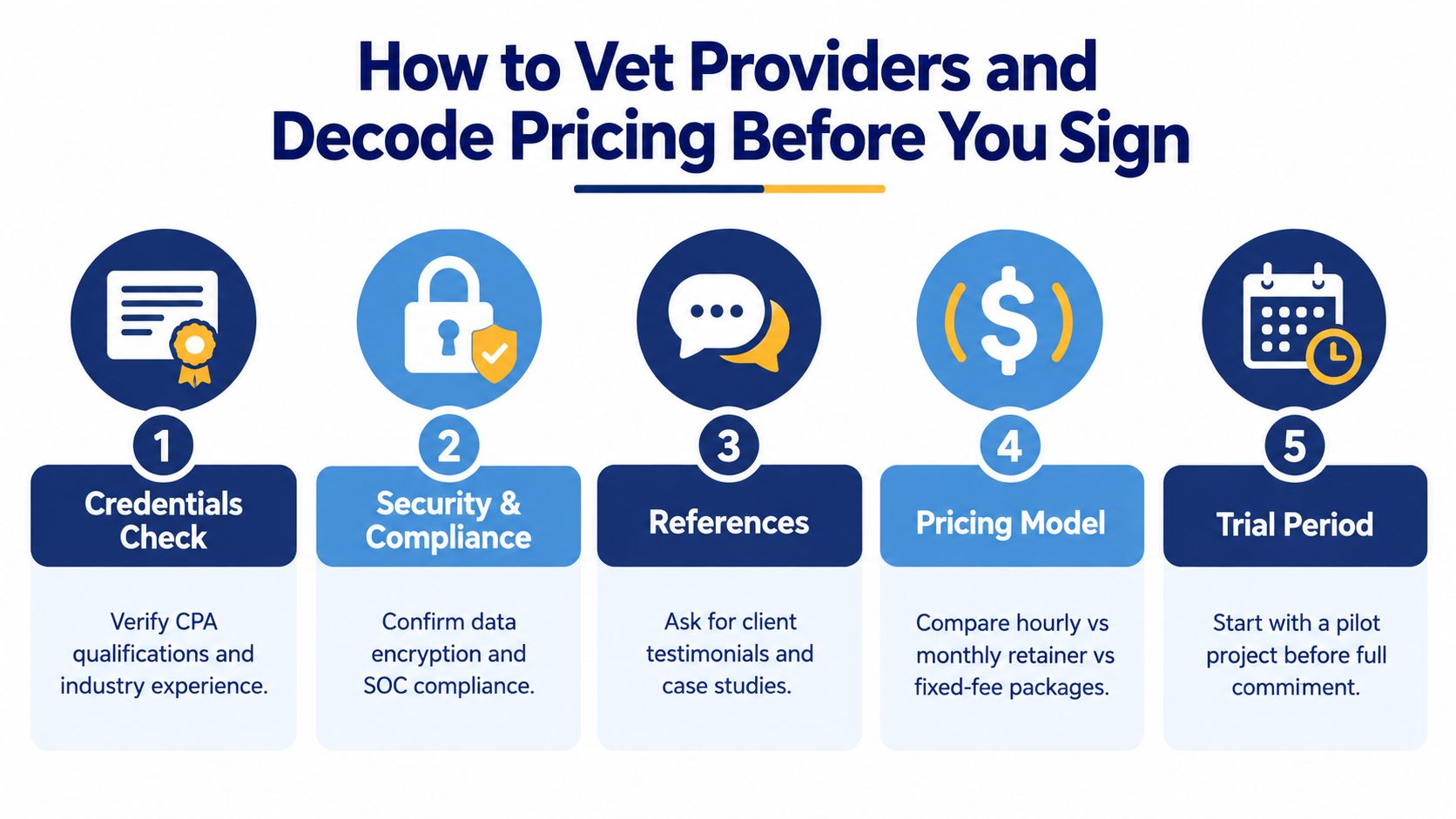
Hourly support suits cleanup, overflow, and workloads that are still hard to predict. It preserves flexibility, but the bill can move every month and reward logged activity instead of completed outcomes.
Monthly retainers fit recurring bookkeeping, AP, AR, payroll support, and close work. Require the agreement to state transaction volume, deliverables, deadlines, meeting cadence, response expectations, and the events that trigger an out-of-scope charge.
Dedicated full-time support provides continuity when one person needs to work in your accounting system daily. Require coverage for holidays and turnover, plus access to specialized help when the assigned accountant reaches a question outside their expertise.
Pricing benchmarks give you a starting point for negotiations. Offshore bookkeeping commonly runs $8 to $25 per hour, with reported savings of 40% to 70% versus domestic rates. A comparable full-time US bookkeeper can cost $55,000 to $75,000 including benefits and overhead (CDH's accounting outsourcing cost guide).
Those ranges do not justify choosing offshore automatically. They tell you to ask what the quote includes, who reviews the work, and which tasks sit outside the stated price.
Use one written scorecard for every candidate. I would assess:
If you are comparing routes for sourcing remote accounting talent, apply the same scorecard to every candidate and provider. Consistent questions expose trade-offs that a polished sales call can hide.
The handoff deserves the same scrutiny as the price. A survey found 64% of organizations had difficulty finding outside accounting support, with 50% citing rising costs, 31% citing inability to support requests, 30% citing lack of expertise, and 33% reporting cross-time-zone communication problems (Capterra's outsourced accounting research). Treat those findings as a prompt to test communication, coverage, and expertise before granting access to your books.
Before signing, request a sample close checklist, a data migration plan, a named account lead, and a draft SLA. A provider that stays vague during evaluation will not become clearer after onboarding.
For CPA-specific needs, use this guide on how to hire a CPA to separate credential requirements from routine bookkeeping. Pay for CPA judgment when the work requires it. Keep transactional work with the appropriate level of support, then add controller or FP&A depth as your reporting needs mature.
A signed agreement doesn't create an operating system. It only gives you something to point at when the operating system fails.
Your contract should define the exact scope, deadlines, communication expectations, data responsibilities, security obligations, ownership of workpapers, pricing for changes, and termination assistance. If you can't tell whether a task is included by reading the agreement, assume it will become a negotiation later.
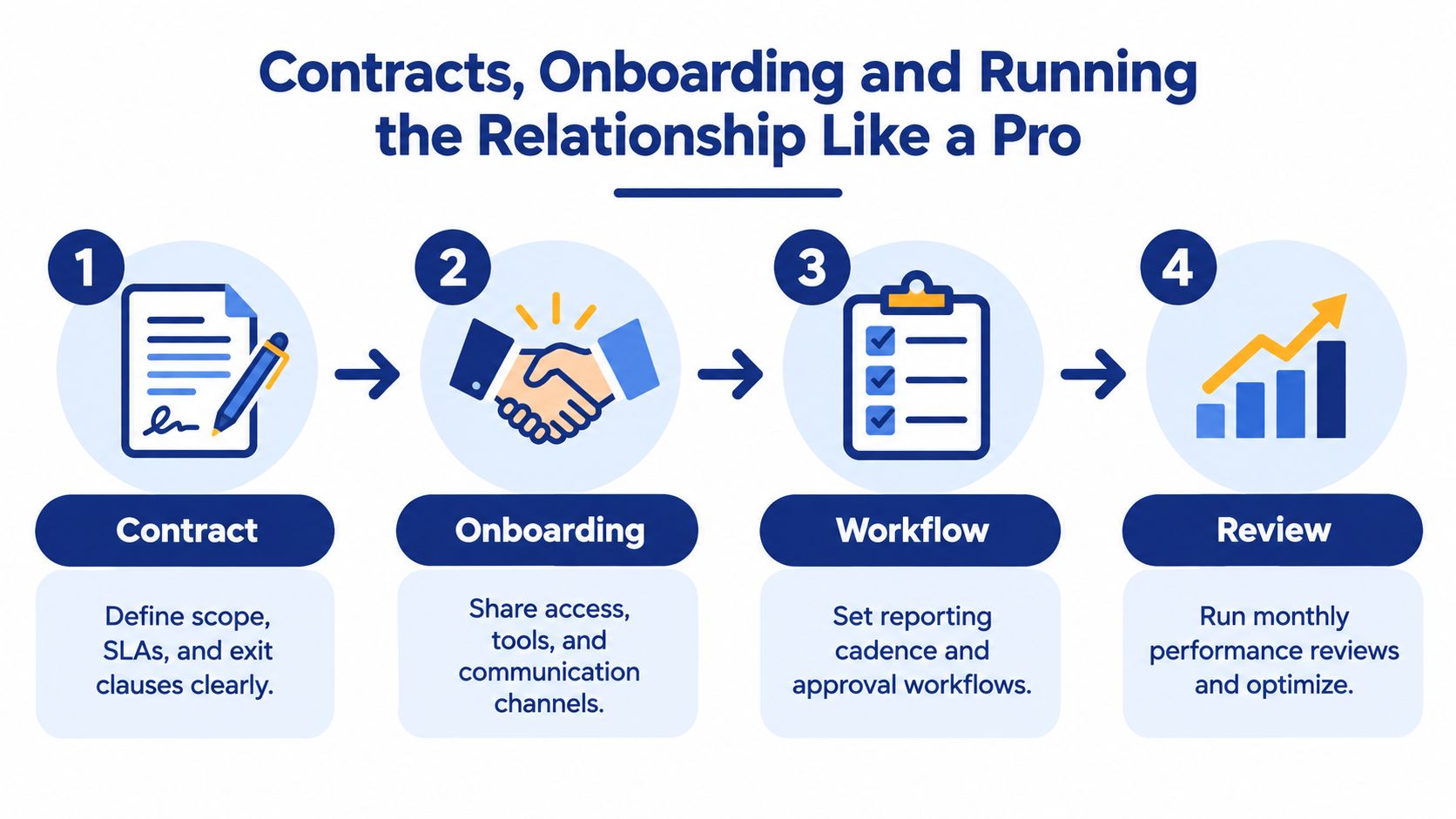
First, map the data. List every accounting system, bank connection, payroll platform, payment tool, spreadsheet, and shared folder involved in the workflow. Give the provider only the access needed for its assigned responsibilities, and keep a current internal record of who can see what.
Next, document the process. Record how transactions enter the system, how vendors are approved, how customer payments are applied, how reconciliations are reviewed, and what happens when information is missing. A short screen recording can be more useful than a beautiful but neglected manual.
Then, transfer controls. Separate preparation from approval wherever possible. Make the internal owner responsible for final decisions, even when the provider prepares the supporting schedules.
Finally, define exceptions. “We'll reach out if something looks unusual” isn't a process. Specify the communication channel, response expectations, escalation path, and required information.
A practical onboarding sequence looks like this:
Use a 30-60-90 day rhythm for management. The first 30 days should focus on access, documentation, and data mapping. The next 30 should test the close and exception process. By 90 days, you should know whether reports arrive on time, issues are surfaced early, and the provider can work without constant rescue missions.
For broader remote-team onboarding practices, this guide on how to onboard remote employees offers useful operational context. Accounting deserves extra rigor because a casual access decision can expose sensitive financial records.
Run weekly exception reviews while the process is new, monthly close reviews once the workflow settles, and quarterly scope reviews as the business changes. The provider should earn expanded responsibility through consistent execution, not through a persuasive upsell.
Most outsourcing headaches come from predictable mistakes:
The broader market data shows why buyers need a sequencing plan. The projected finance and accounting outsourcing market reaches USD 85.92 billion by 2031, while the SME segment is projected to grow at an 8.93% CAGR and nearshore deployment at 9.66% CAGR (Forvis Mazars' 2025 small-to-midsize business report). More companies have access to outsourced capacity, but access alone doesn't tell you what to hand over.
My recommendation is blunt. Start with transaction-heavy work, keep approvals and strategic judgment close, and expand only when the provider has earned more scope through clean documentation and dependable communication. That approach captures the economics without turning your finance function into a black box.
You don't need a grand outsourcing announcement. You need a clean task list, a named internal owner, a realistic provider scorecard, and one workflow worth handing off first.
HireAccountants connects US companies with pre-vetted accounting and finance professionals for part-time or full-time support across bookkeeping, AP, AR, payroll, close, and related finance work. Visit HireAccountants to review talent options and start building an outsourced accounting setup with control over scope, access, and the pace of expansion.
Let's simplify your finances today!