


Most advice on AI candidate matching starts with the wrong question. People obsess over whether the system can "read resumes" well enough, as if hiring accountants were a seventh-grade comprehension test. It isn't. The hard part isn't extracting text from a PDF. The hard part is deciding whether this senior accountant, with this comp expectation, in this time zone, with this industry background, should sit above that CPA candidate on your shortlist.
That's why so many teams buy shiny matching tools and still end up with weird results. The parser works. The shortlist doesn't. Different problem.
Accounting hiring exposes this nonsense faster than tech recruiting does. A keyword hit on QuickBooks can describe a bookkeeper, an accounting manager, or a fractional CFO cleaning up someone else's mess. If your tool treats those as roughly the same creature, congratulations, you've bought expensive autocomplete.
Teams buying matching software usually make the same mistake. They judge the tool by how neatly it reads a resume instead of how reliably it shapes a hiring workflow for a specific accounting search.
That mistake gets expensive fast.
Accounting hiring is full of edge cases that generic matching demos hide. A candidate with "controller" on paper might have owned cash management and close in one company, then spent another stint approving invoices with little real authority. Someone who lists NetSuite may have led a multi-entity implementation, or may have touched one dashboard during cleanup. If your process cannot separate those cases before the recruiter wastes time, the model is not your main problem. Your workflow is.
Resume parsing matters. It gives the system titles, employers, certifications, dates, software names, and fragments of scope. Good. You still have not solved matching.
What matters in practice is what happens after extraction. Does the system push a candidate up because they have a CPA, even when the role is a revenue accountant opening where ASC 606 experience matters more? Does it bury a strong senior accountant because their title was weak but their month-end ownership was strong? Does it screen out a solid candidate because comp, shift coverage, or industry context never made it into the decision rules?
Those are workflow design choices. They decide whether your team gets a useful shortlist or a pile of plausible resumes.
A lot of matching failures start before any model scores a candidate. Bad field mapping, sloppy req intake, missing compensation ranges, and vague must-haves poison the process upstream. If you want a practical reference for how candidate data moves through the system, this applicant tracking system guide is worth reviewing.
For accountant hiring, the product is not extraction. The product is ranked tradeoffs.
Ask harder questions:
If the answer to any of those is no, the tool will create false confidence.
Role context changes everything. A staff accountant search should not rank like a controller search. A tax role during peak season should not rank like a stable GL role. An outsourced bookkeeping hire should not be judged by the same logic as a private equity portfolio company that needs someone battle-tested in ugly closes.
That is why I prefer skills-first process design over pedigree worship. The skills-first career quiz HiredBySkill points in the right direction. Labels are noisy. Capability is what you need to measure.
For finance hiring, even the funnel mechanics differ from generic recruiting. If you want a grounded view of those differences, review this guide to recruitment of accountants. The failure pattern is predictable. Teams buy an AI tool, leave the workflow vague, then blame the ranking when the inputs were never defined well enough to support a good shortlist.
A working matching engine isn't one score pulled from resume fairy dust. It combines several input layers, then applies weights. If the vendor can't tell you what those layers are, run.
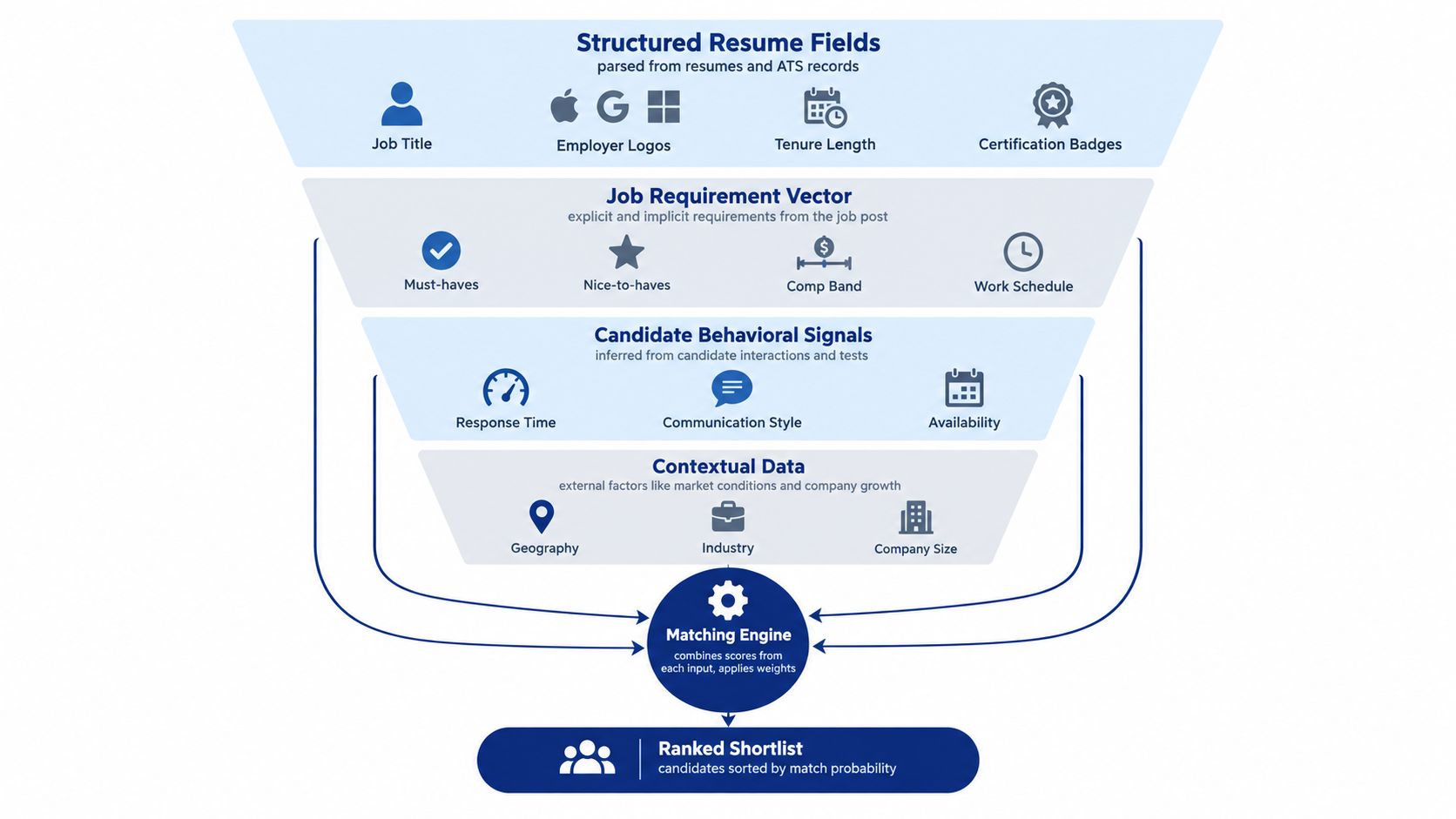
For accounting roles, I want to see four buckets.
That last one gets ignored a lot. It shouldn't. A candidate can be excellent and still wrong for a messy startup close process or a PE-backed environment that wants someone who has survived month-end with zero hand-holding.
Generic AI matching falls on its face here. In accounting, some details aren't "nice metadata." They're central.
For example:
If you want a sanity check on how role expectations differ even within one title family, look at a grounded breakdown of what a staff accountant does. Plenty of matching systems collapse those nuances into one mushy "accounting experience" signal. That's lazy product design.
The smartest engines also learn from outcomes. Who got hired? Who stayed? Who earned trust? Who flamed out after three months of reconciliations and polite panic?
That doesn't mean "copy the last hire forever." It means historical decisions become one more input, not gospel.
A 2026 narrative review argued that AI hiring systems have shifted from simple profile-pair ranking toward multi-stage workflows that retrieve evidence, compare candidates, and support hiring actions (arXiv review). That's the right framing. Modern AI candidate matching isn't a smarter keyword search. It's workflow machinery.
If your matching product still behaves like a glorified keyword search, it's bringing a butter knife to a data fight.
Let's kill the "AI magic" pitch. Most candidate matching systems do some version of semantic similarity scoring plus learned ranking from historical labels. In plain English, the system turns the job and the candidate into mathematical representations, compares them, then re-orders results based on patterns that looked successful before.
For accountant hiring, that's fine. Better than fine. But only when the model respects constraints that humans care about.
Classical lexical matching isn't good enough for real shortlists. The strongest evidence for that comes from a benchmark built around recruiter-submitted candidates, not open-web resume junk. In the RecruitBench benchmark, which includes 1,594 resume-job pairs across 18 startup roles, the best screening method reached 0.685 AUC-ROC for predicting interview progression, while classical lexical baselines performed near chance (RecruitBench benchmark).
That result matters because these weren't random applicants. They were already screened by professional recruiters. In other words, the hard problem isn't finding obvious mismatches. It's ranking plausible candidates against each other.
Accounting searches behave the same way. Once you've filtered out the nonsense, you're left comparing "good enough on paper" people whose differences are subtle.
Research on resume matching backs up what most operators already suspect. One study reported 82% average accuracy for TF-IDF plus cosine similarity, while transformer-based embeddings such as BERT reached 89% accuracy and reduced false matches by 25% relative to keyword-based ATS-style matching (resume matching study).
A separate screening study found a BERT-plus-SVM model reached 94% accuracy, with the authors stating that it better captures semantic and contextual relationships in job descriptions and titles (semantic screening research).
Good. That's real progress. Not magic. Progress.
The lesson isn't "buy any transformer model and go home early." The lesson is that meaning beats vocabulary. "Month-end close," "general ledger ownership," and "financial reporting" often tell you more than exact title overlap.
For accountants, the best setup is usually hybrid:
| Method | Typical Top-1 Accuracy | Strengths | Weaknesses |
|---|---|---|---|
| Keyword or lexical matching | Near chance on hard screening tasks in RecruitBench | Fast, transparent, easy to configure | Misses context, overweights exact wording, weak on nuanced ranking |
| TF-IDF plus cosine similarity | 82% average accuracy in one resume-matching study | Cheap, simple, decent baseline | Brittle with synonyms, weak on context, can overrate keyword stuffing |
| Transformer embeddings | 89% accuracy in one study | Better semantic understanding, fewer false matches, stronger ranking | Needs cleaner data and smarter tuning |
| BERT plus downstream classifier | 94% accuracy in one screening study | Strong contextual matching, better role interpretation | Can become a black box if the vendor hides the logic |
| Hybrid semantic ranking plus hard filters | Qualitatively strongest for accounting workflows | Balances intelligence with operational reality | More setup work, requires thoughtful role design |
For accounting, hard filters still matter. CPA required. No relocation needed. US time-zone overlap. Specific ERP exposure. The model should not "creatively" bypass those.
A matching engine should be smart about ambiguity and dumb about hard constraints. That's a compliment.
AI candidate matching is excellent at some accounting tasks and hilariously overconfident at others. The right move is to use it where it has a clean lane, then force human review where nuance still matters.
The biggest win is speed in the screening layer. A peer-reviewed style analysis of AI in recruitment reported that AI screening can shrink shortlisting from weeks to hours and improved alignment between applicant qualifications and job requirements during resume screening and candidate-role alignment (recruitment analysis).
That tracks with real-world accounting workflows. Good systems are especially useful for:
One marketplace-plus-matching setup can help here. For example, HireAccountants uses an AI matching engine inside its hiring workflow to shortlist accounting candidates against role requirements. That's useful if you want matching tied directly to a finance-specific talent pool instead of a generic HR stack.
And if you're pairing matching with interview support, tools offering real-time interview answers can help recruiters stay sharp during structured screens. Just don't confuse interview assistance with candidate evaluation. Different layer. Different job.
The weak spots are consistent:
Here's the accounting version of the truth table buyers need:
| Accounting Role | AI Match Reliability | Watch Out For | Human-in-the-Loop Needed |
|---|---|---|---|
| Bookkeeper | High | Inflated software claims, weak process ownership detail | Light review |
| AP or AR Specialist | High | Repetitive title overlap hiding low complexity work | Light review |
| Staff Accountant | Medium to high | Close experience depth, ownership versus support | Moderate review |
| Senior Accountant | Medium | Title inflation, variance in month-end complexity | Strong review |
| Tax Accountant | Medium | Recency of tax work, seasonality fit, jurisdiction nuance | Strong review |
| Auditor | Medium | Public versus internal audit nuance, scope ambiguity | Strong review |
| Controller | Low to medium | Leadership scope, systems ownership, strategic judgment | Heavy review |
The model should draft the shortlist. The recruiter or hiring manager should own judgment.
Research on human and AI interaction in hiring found people can mirror AI bias rather than correct it, and a later study reported the fairest candidate lists came from a human-plus-AI workflow where recruiters reviewed AI-ranked slates first and then searched manually (University of Washington coverage).
That's the design principle. Not "replace recruiters." Not "ignore the model." Use the machine to narrow. Use humans to challenge.
Most rollouts fail for boring reasons. Dirty job data. Vague reqs. Recruiters who think the tool is coming for their job. Hiring managers who keep changing the target after the model has already ranked against version three of the req.
None of this is glamorous. All of it matters.
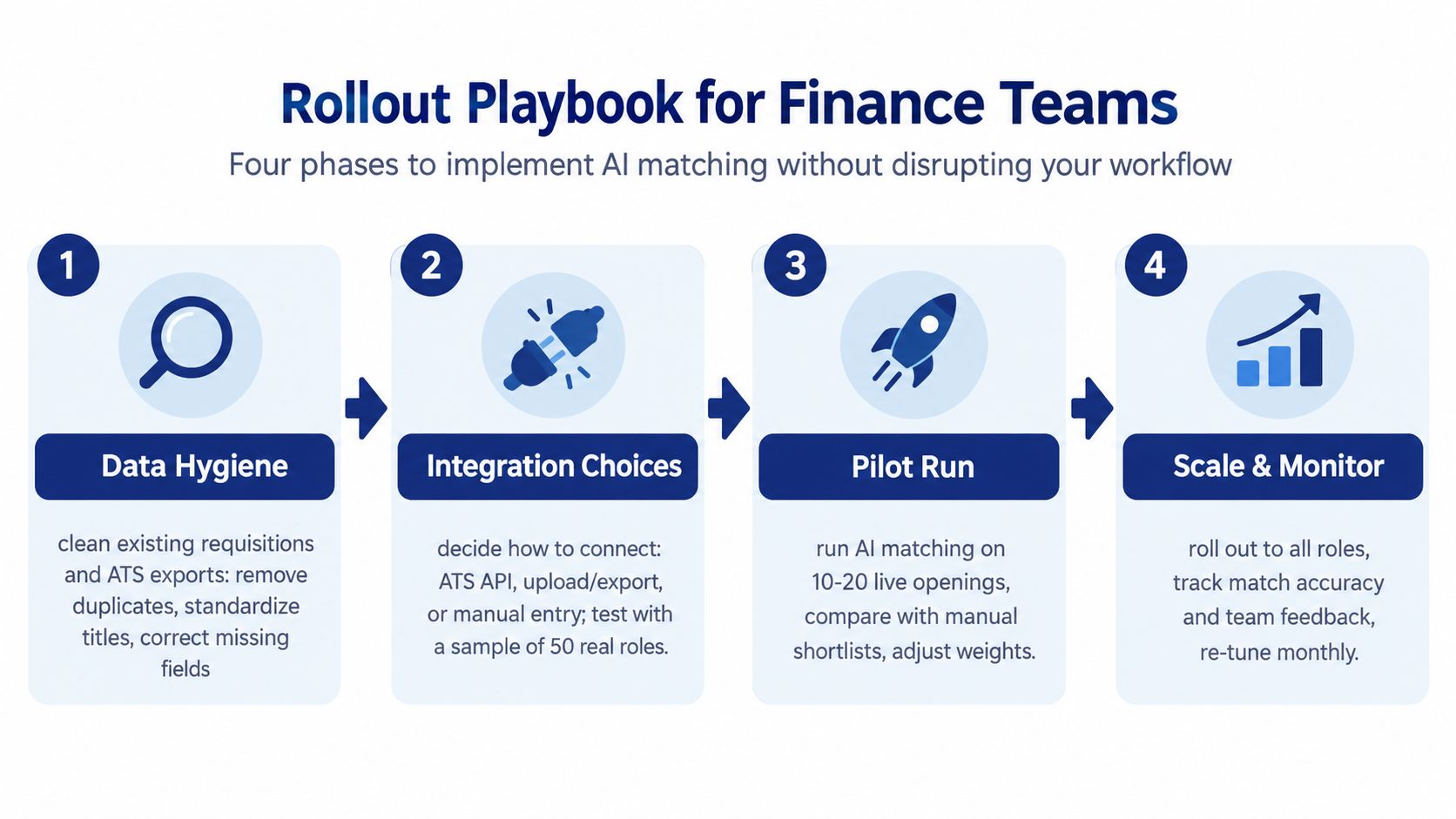
Start with data hygiene. Not eventually. First.
Then choose the integration path. ATS-native scoring is convenient, but standalone matching tools can be better if your ATS is clunky or your accounting workflows are weird. Test with a small export of real roles and real resumes before anyone starts giving TED Talks about transformation.
Pick one or two roles. Senior accountant and staff accountant is a good test pair because they look similar on paper and differ a lot in the details.
A sane rollout usually follows this shape:
I wouldn't call anything "working" until recruiters trust it enough to use it without muttering under their breath.
This part gets ignored because it's less fun than watching dashboards animate.
By 2025, 43% of organizations were using AI for HR tasks, up from 26% in 2024, according to industry reporting that also cited broader market estimates showing rapid investment growth in AI for HR and recruitment (AI recruitment statistics). Adoption is moving fast. Trust is not.
So tell your team the truth. The tool should remove screening drudgery, not replace accounting recruiters or finance leaders. If recruiters don't understand why a candidate ranked highly, they won't use it. And they shouldn't.
Operator note: The fastest way to poison adoption is turning the model on before fixing your job descriptions. Garbage reqs create garbage rankings with fancier branding.
Vendors love saying AI makes hiring fairer. Cute slogan. Not enough.
Accounting hiring has a specific bias problem that gets less attention than gender or race because it hides behind "professional standards." The industry loves pedigree. Big Four logos. Name-brand schools. Four-year accounting degrees. Familiar firm names that make everyone feel safe and entirely unremarkable.
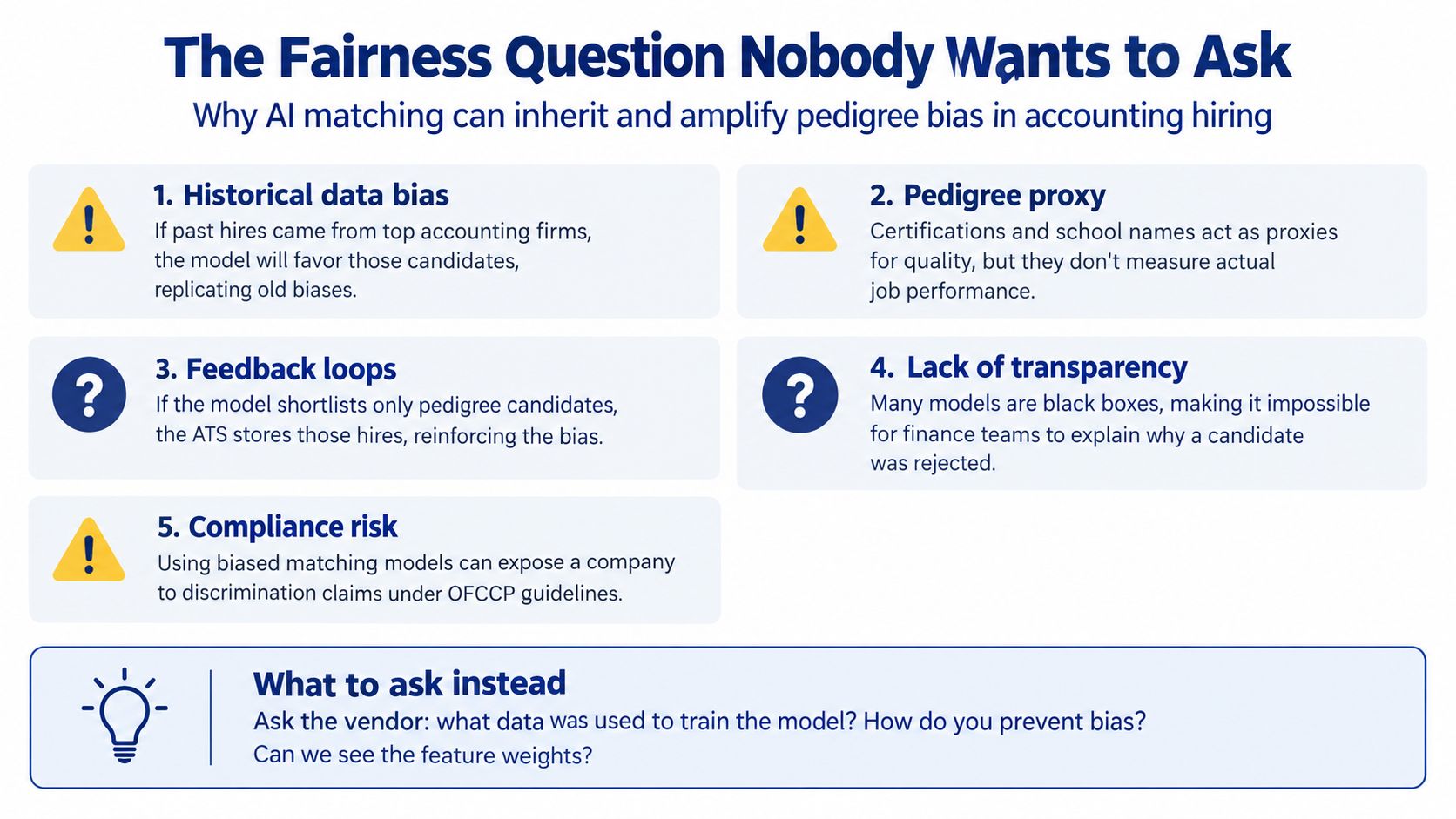
A 2025 NAACL industry paper found that newer models reduced bias on explicit attributes like gender and race, yet still showed strong implicit bias tied to educational background (NAACL paper).
That should make finance leaders uncomfortable. In accounting, educational background often acts as a proxy for perceived competence. So do firm names. So does "traditional" career sequencing.
Who gets punished by that?
The ugly part is that the model can look neutral while still baking in pedigree preference through perfectly respectable-looking features.
You don't need a philosophy seminar. You need tests.
A fairness-focused thesis on AI-based candidate-job matching notes that these systems can be evaluated using Statistical Parity Difference, Equal Opportunity Difference, and Disparate Impact Ratio (fairness evaluation thesis). Good. Ask for that level of rigor.
Minimum audit requirements:
Ask the vendor a simple question: if two candidates can both do the job, why does the one with shinier logos rank higher?
One-time testing isn't enough either. Matching systems learn from hiring outcomes, and that creates feedback loops. If the model keeps surfacing pedigree-heavy slates, your ATS fills with pedigree-heavy hires, and the next round gets even narrower. That's not intelligence. That's automation of old habits.
Most vendor demos are stage plays. Beautiful UI. Glowing match scores. Vague claims about intelligence. Then you ask one hard question and suddenly everyone needs to "circle back with the product team."
Skip the theater. Score the vendor.
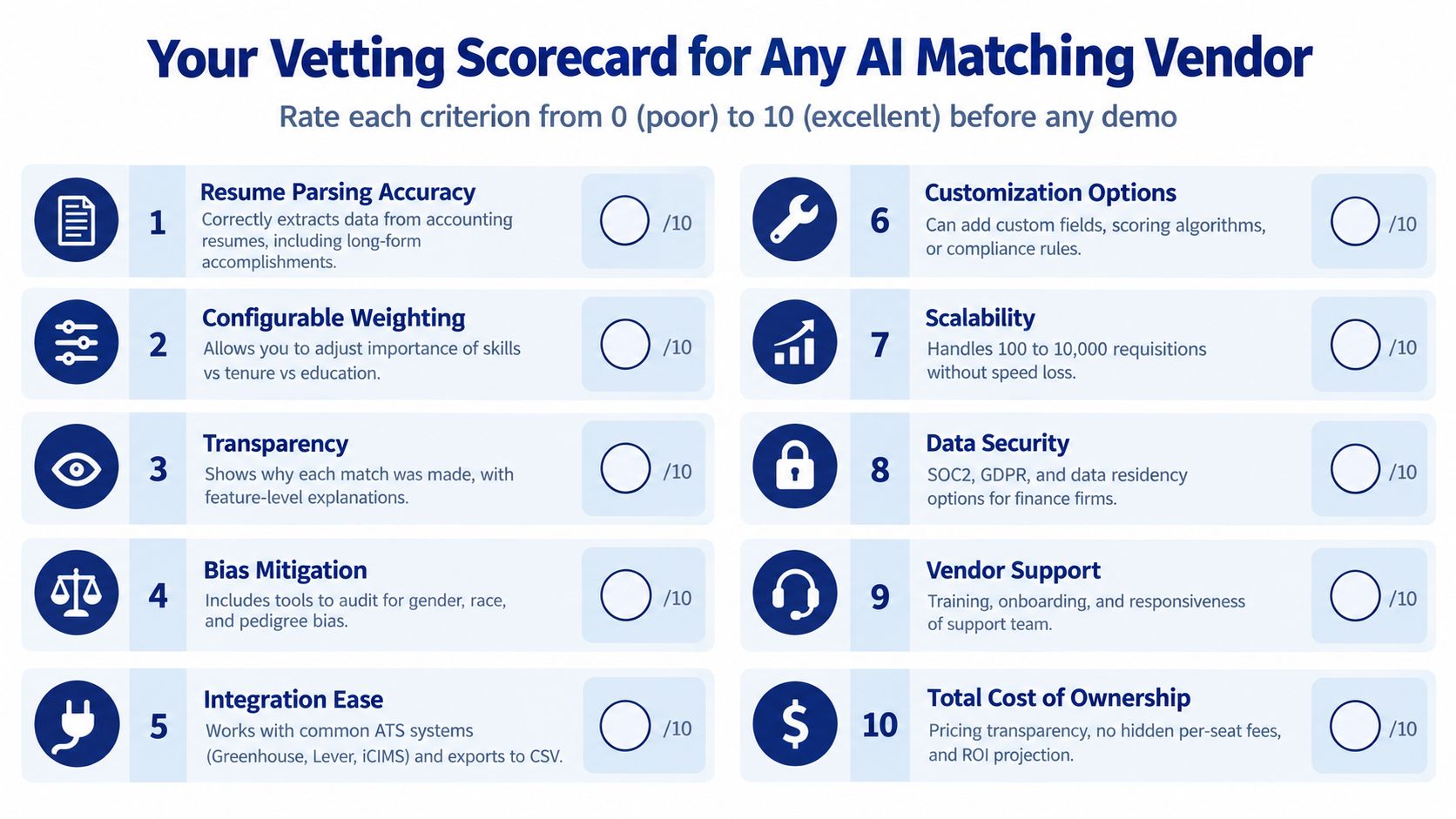
Rate each item from 0 to 10. Double-weight the must-haves.
| Criterion | What to look for |
|---|---|
| Resume parsing accuracy | Handles messy accounting resumes and extracts real chronology clearly |
| Configurable weighting | Lets you tune CPA status, tenure, ERP exposure, industry, and compensation |
| Explainability | Shows why candidate A ranked above candidate B |
| Bias audit support | Provides adverse impact analysis and fairness review capability |
| ATS integration | Connects cleanly to your current stack without making recruiters do copy-paste aerobics |
| Time-to-shortlist improvement | Demonstrates faster review without turning quality into soup |
| Candidate controls | Supports opt-out, retention rules, and practical privacy controls |
| Retraining cadence | Can explain how and when the model is updated |
| Finance hiring relevance | Has experience with accounting or finance workflows specifically |
| Total contract cost | Makes sense relative to recruiter time reclaimed and shortlist quality gained |
My hard filters are simple. If the vendor scores poorly on parsing accuracy for accounting resumes, forget it. If they score poorly on explainability, also forget it. You can't defend rankings you can't understand.
For teams tightening their process around structured evaluation, it also helps to standardize what happens after matching. A solid bank of accounting interview questions keeps the handoff from algorithm to interviewer from turning into improv night.
Use these in the demo:
If the answer to every question is "our AI considers many signals," you've learned something important. Mostly that you're still in the sales pitch.
HireAccountants helps companies hire pre-vetted accountants and finance professionals through a marketplace, recruiting support, and an AI matching engine built around finance roles rather than generic hiring noise. If you want faster shortlists without pretending software should replace judgment, visit HireAccountants and see how the workflow holds up on real accounting hires.
Let's simplify your finances today!