


A subledger is the detailed transaction-level record that feeds summarized balances into the general ledger, so you can trace every GL dollar back to its source. The GL shows the tidy total, while the subledger keeps the invoices, bills, payments, and asset movements that explain how you got there.
You're probably dealing with this already, even if nobody on your team uses the word “subledger.” Close arrives, the general ledger says one thing, the accounts payable report says another, and someone starts searching spreadsheets for the missing invoice while pretending the situation is completely under control. At 9 p.m., even a harmless timing difference begins to look like an accounting conspiracy.
A subledger is the transaction-level source of truth behind a general ledger control account. The general ledger, or GL, stores the summarized balance. The subledger preserves the line-item detail behind that balance, such as individual invoices, supplier bills, customer payments, or asset movements. Oracle's guidance on account reconciliation and subledgers describes how subledger transactions are imported, accounted for, and posted to the GL so the related balance updates.
That separation gives finance teams a clean cause-and-effect chain. An operational event creates a detailed transaction, the subledger accounts for it, and the resulting summary reaches the relevant GL control account. If the two no longer agree, you've found a control break, not a philosophical disagreement between two spreadsheets.
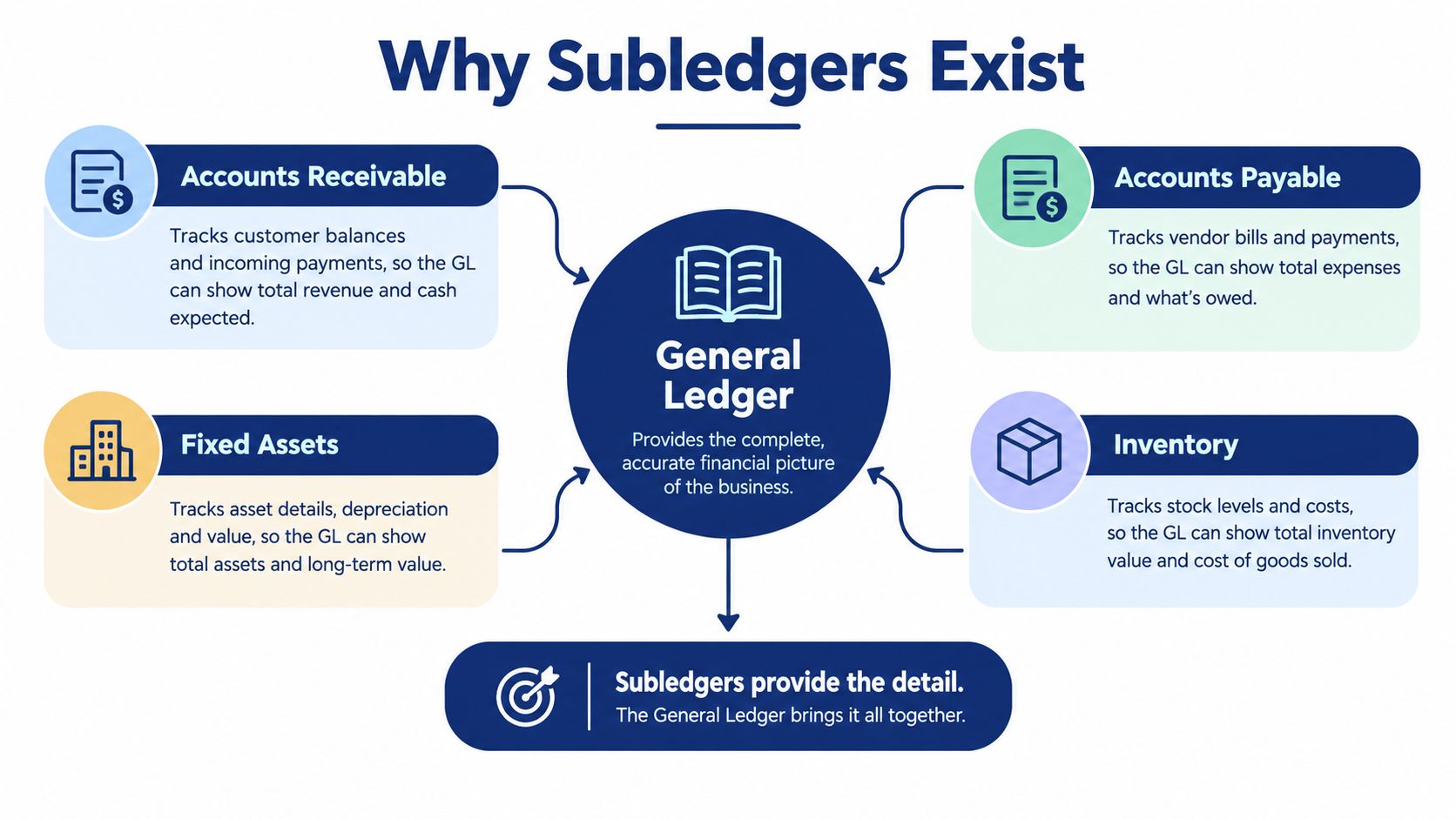
Consider accounts payable. The GL might show one summarized accounts payable balance. The AP subledger can show which supplier bills created that balance, which payments reduced it, and which items remain open. During reconciliation, the accountant compares the open payable balance with the related GL account for the same period, then traces any variance back to individual entries.
That's why the subledger matters beyond audit language. When a discrepancy appears, the detail helps isolate a missing, duplicated, delayed, or misposted transaction. Without it, the GL tells you that something is wrong but not where to start looking.
Practical rule: If your team can't explain a control-account balance by tracing it to transaction-level records, the accounting system is giving you a number, not reliable control.
Common subledgers cover accounts receivable, accounts payable, inventory, fixed assets, and payroll. The exact design varies by ERP and business model, but the principle stays the same: operational detail belongs close to the transaction, while financial reporting needs a controlled summary.
Your chart of accounts gives the GL its structure, but the subledger supplies the evidence behind the balances. Teams that want a refresher on that structure can review this guide to what a chart of accounts does.
A small company can sometimes manage detailed accounting through an ERP's built-in modules without thinking about subledger architecture. The trouble starts when transactions arrive from several systems, posting happens on different schedules, or finance needs to explain balances by customer, supplier, asset, product, or provider.
At that point, a subledger stops being a technical nicety. It becomes the control layer that keeps operational events, accounting rules, and the GL connected. You don't add one because the term sounds impressive. You add one because close has become detective work.
The flow is easier to understand with an accounts payable invoice.
A supplier bill enters the AP module with its supplier, amount, invoice date, due date, coding, and supporting documentation. The subledger records the transaction and applies the accounting rules. Once accounted, the resulting journal entry posts to the GL, where the relevant control account reflects the summarized effect.
Oracle describes Subledger Accounting as a rule-based engine and an intermediate step between subledger applications and the general ledger. Its documentation says the engine stores a complete and balanced subledger journal entry in a common data model for each business event that requires accounting. In plain English, it's the accounting rules layer that standardizes the entry before it reaches the GL, as explained in Oracle's Subledger Accounting documentation.
Suppose an approved supplier invoice relates to an operating expense. The accounting result might look like this:
| Account | Debit | Credit |
|---|---|---|
| Operating expense | Invoice amount | |
| Accounts payable control | Invoice amount |
The exact account mapping depends on the organization's policies, but the logic is consistent. The AP subledger retains the invoice-level record. The GL receives the accounting impact, summarized into the relevant expense and accounts payable accounts.
The same pattern applies elsewhere. A customer invoice generally increases receivables and revenue. A payment reduces receivables and increases cash. An asset purchase increases the asset record and reduces cash or increases a payable. The subledger keeps the business context that the GL doesn't need to display on every report.
The handoff can fail in predictable ways:
A general ledger provides the summarized record used for reporting. A general ledger overview can help clarify that role, but don't confuse the GL with the transaction system behind it. The GL is where the summary lands. The subledger is where you investigate when the summary looks suspicious.
A clean posting flow isn't one where nothing ever goes wrong. It's one where every exception has an identifiable source, a defined owner, and a documented correction path.
Many finance leaders ask a reasonable question: If the ERP already has AP, AR, inventory, and fixed asset modules, why add a separate subledger?
Often, you shouldn't. Modern platforms such as Microsoft Dynamics 365 and Oracle embed detailed transactions in specialized modules before posting them to the ledger. Microsoft's ledger and subledger documentation describes this relationship across areas such as payables, receivables, inventory, fixed assets, and tax.
The confusion comes from terminology. An ERP module can function as a subledger even when nobody labels it that way. The practical issue isn't whether a subledger exists in theory. It's whether your current architecture gives finance enough traceability, reconciliation control, and separation between transaction detail and reporting summary.
Built-in ERP accounting usually wins on simplicity. Your AP, AR, inventory, and GL processes live in one environment, mappings are easier to govern, and the implementation team has fewer interfaces to maintain.
That's usually the right answer for a startup or SMB with a straightforward operating model. If the ERP captures the detail you need, preserves an audit trail, and reconciles cleanly to the GL, a separate subledger may just create another system to administer.
The downside appears when the ERP module becomes a black box. If the business relies on several payment providers, operational databases, billing tools, or legal entities, the module may not preserve the business-level detail needed to explain balances across those systems. Exporting data into spreadsheets is not a subledger strategy. It's a cry for help wearing a pivot-table costume.
A dedicated subledger can make sense when the business needs a clear accounting checkpoint between operational systems and the enterprise GL. That layer can normalize data from different providers, apply consistent posting rules, preserve transaction history, and expose a reconciliation surface that finance and engineering can both understand.
The trade-off is real. You now own another integration boundary, another data model, another set of controls, and another system that must be tested during close. A standalone subledger isn't automatically more controlled. Poorly designed architecture gives your errors a new address.
Use these criteria to decide:
| Question | Built-in ERP module may be enough | Dedicated subledger deserves consideration |
|---|---|---|
| Transaction sources | Most activity stays inside the ERP | Activity arrives from several systems |
| Detail requirements | Standard invoice and payment detail works | You need provider, entity, product, or event-level traceability |
| Reconciliation | Exceptions are visible and manageable | Teams rely on manual extracts and spreadsheet matching |
| Auditability | The ERP preserves the required history | Operational changes are difficult to reconstruct |
| Scaling complexity | Posting rules remain stable | Timing, mapping, and lifecycle states keep multiplying |
A growing company should resist vendor hype in both directions. Don't buy a separate layer because “modern finance” sounds expensive without one. Don't keep forcing everything through an ERP module after the team has built shadow ledgers to compensate.
Reconciliation is where subledger design earns its keep, or exposes its weaknesses.
The basic task is straightforward. For a defined period, compare the summarized subledger balance with the related GL control account, identify the variance, trace it to transactions, correct the underlying issue, and retain evidence of the resolution. The work becomes painful when teams compare mismatched periods, rely on delayed files, or treat unexplained differences as harmless timing.
Sage's discussion of subledger and general ledger reconciliation identifies common causes of difficulty, including delayed posting, inconsistent standards, missing documentation, and disconnected systems. Those are not exotic edge cases. They're the usual suspects.
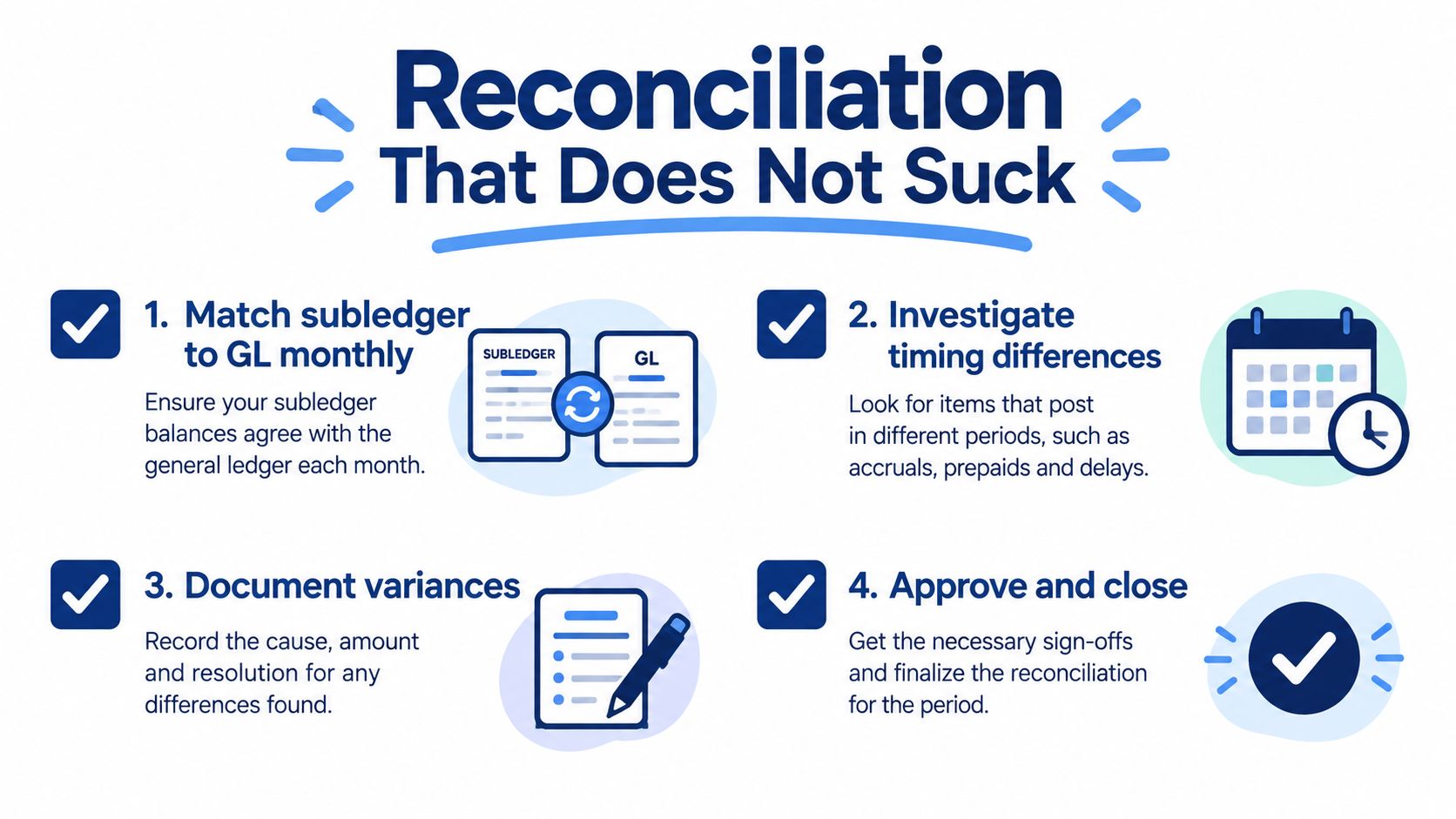
Define the period and population. Confirm the reporting dates, posting status, entity, currency, and control account. A comparison is useless if the reports describe different slices of activity.
Match the balances. Compare the subledger total with the GL control account. For receivables, review open customer balances. For payables, review open supplier items. For inventory or fixed assets, use the detailed movement and valuation records that support the relevant account.
Classify the variance. Separate timing differences from actual errors. A delayed posting may resolve after the approved batch runs. A duplicate, wrong mapping, or missing document requires correction and explanation.
Correct and rerun. Post the approved adjustment or complete the missing process, then repeat the comparison. Don't close the account because the variance feels small. Close it when the remaining difference is understood, supported, and accepted under policy.
The useful standard: Every variance should have a cause, an owner, an action, and evidence. “Probably timing” is not documentation.
Manual reconciliation struggles when systems disagree about dates, statuses, currencies, or transaction identifiers. A payment provider may report activity on one schedule, the ERP may post it on another, and the supporting documentation may live somewhere else entirely.
Automation helps with repetitive matching, recurring imports, exception flags, and approval routing. It doesn't decide whether a revenue rule is correct or whether an unexplained adjustment deserves escalation. A rules engine can match bad data very efficiently, which is a polished way to make the wrong answer harder to notice.
Use a structured general ledger reconciliation process to assign ownership and document the work. Then improve the workflow before shopping for another tool. Better matching software can't repair unclear cutoffs, inconsistent account mappings, or disconnected source systems.
Automate the work that repeats. Keep judgment with people who understand the books, controls, and operating reality.
Before buying reconciliation software, assign exception ownership, identify the authoritative source, and define the evidence required for corrections. Otherwise, automation only produces a faster queue of unresolved items.
Automate stable, testable rules such as:
Finance staff should decide how to treat unusual transactions, interpret policy, assess cutoffs, design controls, and resolve disputes with operations. Those decisions depend on context that rarely fits in an exception_reason field.
A growing company may need an experienced accounting operator before it needs another platform. Someone must review unmatched items, improve close procedures, test mappings, and explain why the AP subledger and GL disagree. The role can be internal, fractional, outsourced, or filled through a specialist talent platform.
HireAccountants connects US companies with pre-vetted accountants and finance professionals, including bookkeepers, auditors, tax accountants, financial analysts, and accounting managers. The service offers a self-service marketplace, recruiting support, candidate matching, and full-time or part-time arrangements.
Good operating model: Automate predictable work, hire for exceptions, and assign one person control ownership.
Build versus buy versus hire depends on the failure point. Buy software when transaction volume and repeatable matching rules justify it. Build when your workflows are distinctive and the team can maintain the controls. Hire when exception volume, close pressure, or technical accounting judgment exceeds internal capacity.
Stabilize the process first, define reconciliation rules second, and automate only after the team can explain the output. Otherwise, you may own an expensive system that nobody is qualified to challenge.
A close stalls when the AP subledger and GL disagree, nobody can explain the variance, and the spreadsheet owner is unavailable. Prevent that situation by mapping the process before buying software.
Trace each major transaction source into the subledger or ERP module, through accounting rules, into the GL control account, and onto the close checklist. Mark manual exports, spreadsheet adjustments, approval queues, and delayed feeds. Those weak points show where control work is needed.
Pull subledger and GL reports for a representative period. Confirm that both use the same entity, dates, currency, posting status, and account scope. Record each variance and classify it as timing, mapping, duplication, missing data, or unresolved.
Fix small control failures before automating. Assign owners to posting queues, document corrections, standardize transaction identifiers, and remove unnecessary spreadsheet handoffs. If nobody can explain who approves a correction, the process is not ready for automation.
Test whether the ERP modules provide enough detail and control. Keep the built-in approach when it preserves traceability and reconciles without heroic effort. Consider a dedicated subledger when multiple systems, complex transaction lifecycles, or operational detail exceed the ERP module's records.
Base the staffing decision on the work, not the software demo. If finance staff still spend close time chasing exceptions, add accounting capacity with authority to improve mappings, document controls, and own reconciliation. HireAccountants can provide access to accountants and finance professionals for bookkeeping, reconciliation, close support, and broader finance work. More software will not approve its own exceptions or explain a strange balance to the CFO.
A subledger becomes necessary when operational transaction detail must support dependable financial reporting. Build only when the workflow is distinctive and the team can maintain its controls. Buy when repeatable rules justify the system. Hire when exception volume or accounting judgment exceeds internal capacity. Keep the bridge traceable, and treat automation as a control aid, not a substitute for accountability.
Let's simplify your finances today!