


You're staring at a blank document, searching for “auditor job description,” and the first template you find looks harmless. Copy the duties, add “strong attention to detail,” mention teamwork, publish it, and wait.
Then the applications arrive. Hundreds of them. Bookkeepers, junior accountants, compliance coordinators, and candidates who think an audit means ticking boxes. The one person who can challenge a CFO, test a broken control, and explain the risk in plain English is nowhere to be found.
That's not a candidate problem. It's a hiring document problem.
The default auditor job description fails because it tries to describe everything and filter for nothing. “Review financial statements, perform reconciliations, ensure compliance, support management, prepare reports, and complete other duties as assigned” sounds professional. It also tells a serious auditor almost nothing about the work, authority, or risk exposure.
Small and midsize businesses make this worse by blending different jobs together. They confuse internal audit with external audit, auditing with bookkeeping, and independent assurance with general finance support. Then they wonder why qualified candidates skip the posting while generic applicants flood the inbox.
The fix is simple. Treat the job description as a hiring decision document, not an HR formality. It should tell candidates:
Practical rule: If a candidate can't understand the risk scope and reporting line from the first page, your JD is unfinished.
The advisor recruitment compliance tips from Advisor Momentum are useful for the same reason. Strong hiring documents clarify responsibilities and expectations before interviews begin. Apply that discipline here, then cut every duty that belongs to a different role.
A good auditor job description should repel the wrong applicants before they apply. That's not bad employer branding. That's quality control.
An auditor evaluates work, evidence, systems, and decisions made by other people. They don't create the underlying accounting records as their primary responsibility. That distinction matters because many companies accidentally advertise for a bookkeeper and call the position an auditor.
The U.S. Bureau of Labor Statistics description of accountants and auditors anchors the role in examining financial records, checking compliance, identifying risk and opportunity, evaluating accounting systems, and making recommendations to management. The Institute of Internal Auditors adds the risk-based perspective, with audit work covering planning, evidence, findings, recommendations, and communication throughout the engagement cycle in its Global Internal Audit Standards.
Translate that into hiring language and you get three core functions:
Here's the useful filter. A candidate who can recite accounting rules but can't explain how they'd investigate an unusual transaction isn't ready. A candidate who finds an exception but can't identify the control failure behind it won't create much value. A candidate who produces a technically correct report that nobody understands has completed paperwork, not an effective audit.
| Source | What It Actually Means at an SMB |
|---|---|
| BLS | Examine records, systems, and statements. Look for errors, noncompliance, inefficiency, and fraud risk. |
| BLS | Recommend changes involving costs, revenues, profits, controls, or reporting processes. |
| IIA | Plan work around organizational risk instead of checking random items from a recurring list. |
| IIA | Obtain sufficient evidence, document working papers, develop findings, and communicate with management. |
| IIA | Preserve objectivity while providing assurance or carefully defined consulting support. |
The UN auditor job standards reinforce the practical details that often disappear from modern job posts: reviewing internal controls, checking compliance with financial rules, recommending corrective action, drafting reports, and maintaining working papers.
That's the role. Not “look at numbers.” Evaluate evidence, find risk, and make the business harder to fool.
A strong auditor job description follows the audit lifecycle. Dumping twenty duties into one list hides the work and makes every applicant look equally qualified.
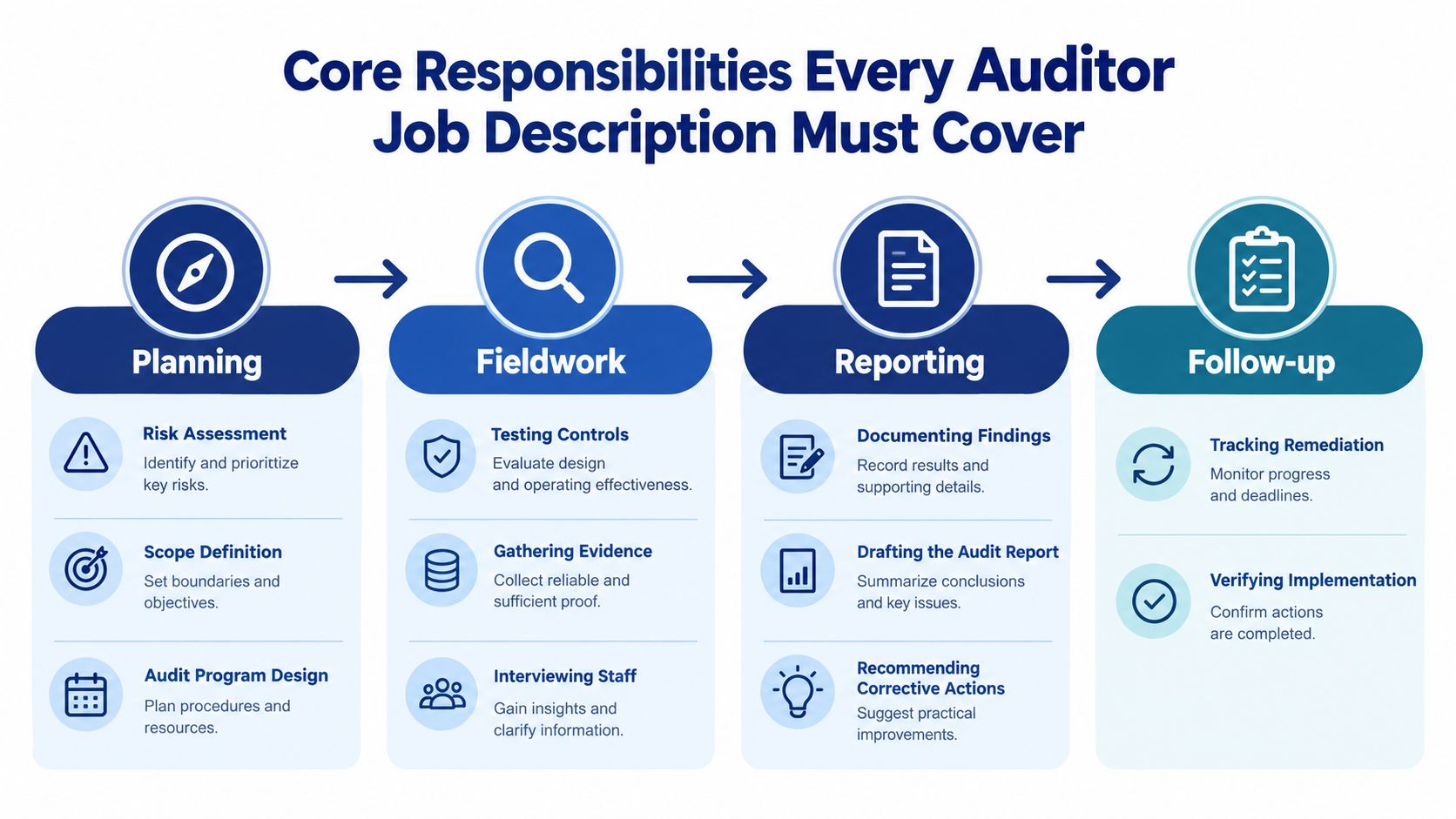
The auditor assesses risk, defines scope, sets objectives, and designs the audit program. Your JD should name the areas they'll prioritize and the evidence they're expected to obtain.
A useful task example is: “Develop an engagement plan for vendor payments, including risk assessment, control objectives, sampling approach, interviews, evidence requirements, and reporting milestones.”
Internal auditors usually plan work against the company's risk profile and audit charter. External or outsourced auditors plan against the agreed engagement scope, applicable standards, and client deliverables. Don't blur those mandates.
Fieldwork means testing controls, selecting samples, gathering evidence, analyzing data, and interviewing the people who operate the process. It's where professional skepticism earns its keep.
Write a concrete expectation such as: “Test purchase-to-pay controls, inspect approval evidence, analyze duplicate or unusual transactions, and document exceptions in working papers.”
Specify whether the auditor will use spreadsheets, ERP exports, audit management software, ACL, IDEA, TeamMate, or another system. Tool fluency doesn't replace judgment, but vague technology expectations attract candidates who have never worked with your evidence environment.
A finding should explain the condition, the relevant criteria, the cause, the risk, and the recommended corrective action. Senior auditors distinguish between a symptom and the process failure underneath it.
Your JD can say: “Draft concise reports that connect control exceptions to business impact, identify root causes, assign practical remediation owners, and present findings to management.”
Communication is the seniority separator. Junior auditors gather and document evidence. Stronger auditors explain why the evidence matters, challenge weak responses, and write recommendations a CEO can act on.
The audit isn't complete when the report is issued. The auditor tracks management responses, checks whether corrective actions were implemented, and validates whether the original risk has been addressed.
Use a task such as: “Maintain an issue log, track agreed deadlines, review remediation evidence, and close findings only after implementation is verified.”
The right split is clear. An internal auditor may own recurring follow-up across the organization. An external auditor may report unresolved matters to the engagement sponsor or audit committee. An outsourced auditor may provide the tracking mechanism while management owns implementation.
The best auditor JDs describe the evidence trail from risk assessment to verified closure.
Most founders write a qualification list that looks like a ransom note from every certification body in accounting. CPA, CIA, CISA, SOX, GAAP, IFRS, ERP expertise, analytics, cybersecurity, industry experience, presentation skills, and “a passion for excellence.” Then they reject the candidate who has done the work but missed one badge.
Separate must-haves from preferred qualifications. Required means you'll test it in the first interview. Preferred means it strengthens the application and may justify a stronger offer. If you won't test a requirement, it isn't required.
| Category | Required, Must-Have | Preferred, Nice-to-Have |
|---|---|---|
| Education | Degree or equivalent practical background in accounting, finance, business, or a related discipline | Graduate study in accounting, finance, risk, or information systems |
| Audit experience | Direct experience planning, testing, documenting, or reporting on audits relevant to the role | Experience owning complex engagements or mentoring other auditors |
| Standards | Working knowledge of applicable accounting, audit, internal control, and compliance requirements | Exposure to multiple frameworks or regulated industries |
| Technology | Demonstrated use of an audit management, analytics, ERP, or evidence-review tool | Experience with ACL, IDEA, TeamMate, advanced analytics, or automated testing |
| Communication | Clear working papers, findings, and conversations with process owners | Board, audit committee, or executive presentation experience |
| Credentials | Only credentials required by the engagement, client, or law | CPA, CIA, CISA, SOX exposure, and deeper systems expertise |
The job post should state which standard matters. A financial reporting role may need GAAP or IFRS fluency. An internal technology audit role may need systems and control experience. An outsourced engagement may need evidence that the candidate can enter a new environment, ask good questions, and produce useful work without hand-holding.
The IIA attribute standards provide the right foundation for independence, objectivity, conflicts of interest, standards fluency, and clear documentation. Put those expectations in the JD instead of hiding them under “professionalism.”
Don't make every certificate mandatory. You'll filter out practical operators, increase the compensation pressure on the role, and still fail to test whether candidates can make sound judgments.
Choose the engagement profile before writing the duties. Otherwise you'll advertise for an internal auditor, expect an external audit opinion, and price the role like a part-time accountant. That recipe produces confusion with a calendar invite.
| Profile | Typical US Cost | Best Fit Scenario |
|---|---|---|
| Internal auditor | Salary, benefits, tools, and management overhead. Cost varies by seniority and location. | Continuous risk coverage, recurring operational audits, control ownership review, and close partnership with leadership |
| External auditor | Hourly or engagement-based professional fees | Statutory financial statement work, independent opinions, SOC reporting, and formal external assurance |
| Remote or outsourced auditor | Engagement-based or hourly pricing, shaped by scope and access requirements | Startups, pre-audit preparation, fractional assurance, seasonal capacity, and targeted control reviews |
Internal auditors live inside the organization's operating context. They can build institutional knowledge, observe changes over time, and develop relationships with process owners. That proximity creates value, but the JD must protect independence. The auditor shouldn't be responsible for designing or operating the controls they later evaluate.
External auditors answer to the engagement mandate and maintain independence from the company under audit. The audit committee has direct responsibility for appointing, compensating, retaining, and overseeing the external auditor, and it must pre-approve audit and permitted non-audit services before work begins, as described in this external auditor oversight guidance from PwC.
Remote and outsourced auditors split the difference. They can bring specialist capacity without creating a permanent seat, but your JD must define access to systems, availability of process owners, evidence-sharing procedures, and who owns remediation.
The choice isn't about which profile sounds most impressive. It's about whether you need continuous risk coverage, independent external assurance, or flexible expertise for a defined problem.
Use this structure and force every sentence to earn its place.
Write the exact title, manager, board or committee relationship, and any dotted-line reporting. “Reports to the CFO and has direct access to the audit committee” is useful. “Reports to leadership” is fog.
State the organization, audit scope, independence expectation, engagement purpose, and the decisions the auditor will influence. Skip “rockstar,” “ninja,” and similar verbal confetti.
Group duties under planning, fieldwork, reporting, and follow-up. Name the systems, risk areas, stakeholders, and deliverables. Don't hide the work under “other duties as assigned.” That phrase is where precise accountability goes to die.
List the capabilities you'll test. Separate required credentials from preferred credentials, and identify the equivalent experience you'll accept.
Name the outputs and measurement sources. An auditor shouldn't be judged solely on the number of findings. Useful work can reduce uncertainty, improve control quality, and move management toward verified remediation.
State full-time, part-time, contract, outsourced, remote, hybrid, travel expectations, working hours, and access requirements. “Remote” doesn't mean “available whenever someone remembers to send the evidence.”
Give a range or explain the compensation structure. Skipping pay doesn't create trust. It creates a negotiation problem after both sides have invested time.
For a helpful comparison, the same discipline applies when building a VP Sales JD. Define the decision rights, success measures, reporting structure, and working model instead of collecting impressive-sounding responsibilities.
End with a screening question:
“Describe a control failure you identified, the evidence you used, how management responded, and what you did to verify remediation.”
Candidates who read the JD will answer specifically. Everyone else will send a résumé and hope “detail-oriented” does the heavy lifting.
“Ensures audit quality” isn't a KPI. It's a wish wearing a tie.
Tie each metric to an audit phase, define the measurement window, and identify the data source. The candidate should know how performance will be judged without guessing which executive's mood counts as the official scorecard.
| Audit Phase | KPI | Target | Data Source |
|---|---|---|---|
| Planning | Time from approved request to engagement plan | Within the agreed planning window | Audit plan and engagement tracker |
| Fieldwork | Coverage of in-scope controls and procedures | Meets the published engagement scope | Workpapers and testing log |
| Fieldwork | Evidence quality and exception documentation | Complete, traceable, and review-ready | Workpapers and review notes |
| Reporting | Time from fieldwork completion to draft report | Within the agreed reporting window | Engagement tracker and report log |
| Reporting | Findings linked to cause, risk, owner, and action | Every accepted finding contains the required fields | Audit report and issue register |
| Follow-up | Management response turnaround | Within the agreed response window | Issue log or GRC tool |
| Follow-up | Remediation closure validation | Closed only after evidence confirms implementation | Remediation log and supporting evidence |
| Overall | Audits completed against the approved plan | Delivery against the published charter or engagement schedule | Audit plan and committee reporting |
For a new internal audit function, add cycle-time improvement and completion against the internal audit charter timeline. Don't set arbitrary numbers just to make the table look impressive. Use a baseline, agree the standard with leadership, and change it only when the risk profile or scope changes.
Every KPI should be measurable within 90 days without buying new software. That 90-day measurement rule is a hiring recommendation, not a market statistic. Workpapers, ERP logs, issue trackers, and existing spreadsheets are usually enough to establish a useful baseline.
Use the accounting key performance indicators guide when you need to connect audit measures with broader finance performance. Keep “attention to detail” in the skills section. It doesn't belong in the KPI block.
“Walk me through a financial statement audit” tests memory. It doesn't tell you whether the candidate can recognize risk, defend independence, or write a finding that a busy CEO will understand.
Use scenarios instead. Ask the same core questions to every finalist, then score the answers against evidence, judgment, and communication.
You find several payments just below an approval threshold. What do you do first?
A strong answer doesn't leap straight to “fraud.” It describes expanding the analysis, understanding the approval control, checking related vendors and users, preserving evidence, and escalating based on risk.
A CFO says your finding is technically correct but not worth fixing. How do you respond?
Look for calm independence. The candidate should explain the risk, evidence, business impact, and possible remediation options without turning the conversation into a duel.
A process owner gives you a policy document but no evidence that staff follow it. What goes in the report?
A capable auditor separates control design from operating effectiveness. They won't treat a beautifully formatted policy as proof that the control works.
You have limited time and several possible audit areas. How do you choose?
Strong candidates rank risk by potential impact, likelihood, change, control maturity, management concern, and available evidence. They should explain what they won't test and why.
Write the executive summary for a failed access review. What would leadership need to know?
Listen for a concise description of the condition, root cause, affected risk, owner, recommendation, and deadline. If the answer reads like a working-paper dump, keep interviewing.
If a candidate can't answer three of these cleanly, you don't have an auditor. You have someone who has encountered audit vocabulary.
Candidates can use AI-powered interview coaching to practice communicating clearly, but your panel should still test original judgment with follow-up questions. For more accounting-specific prompts, use these accounting interview questions as a starting point, then adapt them to your control environment.
There isn't one correct hiring model. There is only a model that matches your audit volume, risk, access requirements, and management capacity.
A full-time internal auditor makes sense when the company has sustained work across financial, operational, vendor, technology, or compliance risks. The role needs enough recurring scope to justify the seat, and leadership must be prepared to act on findings. Hiring an auditor before you have an audit plan usually creates a highly paid observer with no mandate.
A part-time or contract auditor works better for cyclical needs, pre-audit preparation, control remediation, or a defined investigation. You gain flexibility and specialist access, but you lose some institutional memory. The JD should compensate by requiring disciplined documentation and a clear handoff process.
An outsourced remote engagement can provide a fractional chief audit executive, a virtual audit team, or targeted testing. It trades some in-person visibility for speed and flexible capacity. That can work well when system access is reliable, process owners respond promptly, and someone inside the company owns remediation.
| Engagement Model | Annual Cost, US | Control Level | Speed to Start | Best Fit |
|---|---|---|---|---|
| Full-time internal | Fixed salary, benefits, tooling, and management overhead | Highest day-to-day context | Slower hiring and onboarding | Sustained audit volume and continuous risk coverage |
| Part-time or contract | Variable spend tied to hours or engagements | Strong within agreed scope | Faster for defined work | Cyclical audits, investigations, and remediation |
| Outsourced remote | Variable monthly or project spend | Strong through documented access and reporting | Fast when scope and evidence are ready | Startups, lean finance teams, and specialist support |
Remote work doesn't remove the need for control. It makes access, evidence handling, communication cadence, and escalation rules more important. Put those requirements in the JD.
For companies comparing flexible finance staffing options, cloud accountant staffing offers useful context on remote engagement design. HireAccountants is one option that connects US companies with pre-vetted remote accounting and finance professionals, including auditor profiles, through marketplace and recruiting support.
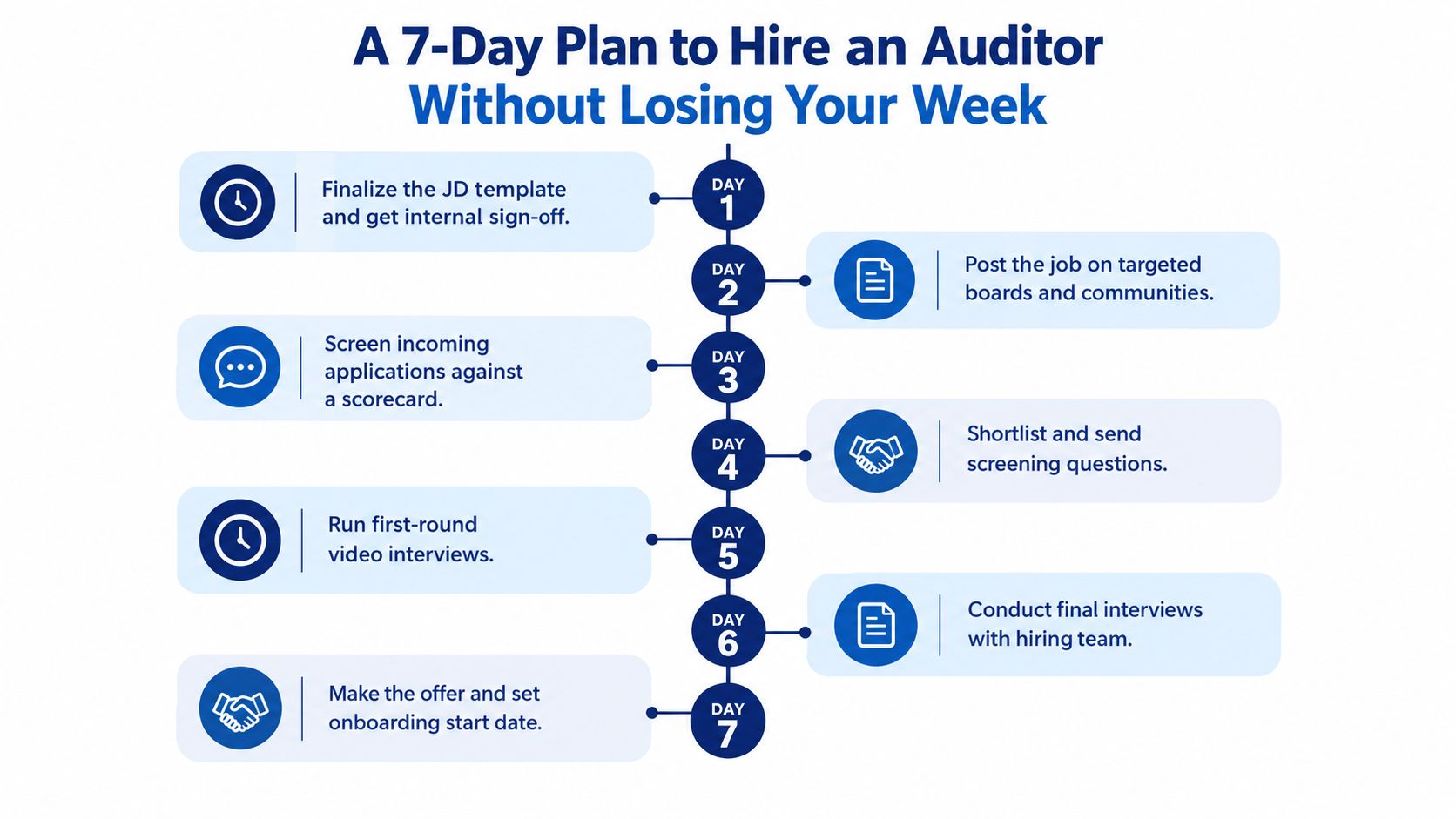
A focused hiring sprint beats a month of “we're still aligning internally.” Assign one decision-maker and make the scorecard visible.
Founders with lean teams can outsource the first two days to a fractional HR partner or recruiting marketplace, then keep evaluation and interviews in-house. Don't build a panel for a role that needs one accountable owner. Panels add scheduling friction and often produce polite disagreement instead of a decision.
Pay should reflect scope, independence, credentials, location, and whether the person owns engagements or supports someone else's plan. Remote status changes the cost structure, but it shouldn't become an excuse for vague scope or below-market expectations. Cheap hiring often attracts candidates who can produce checklists, not defensible findings.
Not automatically. A CPA matters when the role requires financial statement expertise, attest-related knowledge, or a credential demanded by clients or regulators. A CIA can signal internal audit specialization. Equivalent operational finance, controls, systems, and reporting experience may be more useful for a role focused on process risk, provided the candidate demonstrates objectivity and sound judgment.
Many documentation, access, approval, reconciliation, and transaction-testing activities can be performed remotely when the auditor receives reliable system evidence and timely cooperation. Physical inventory observation, facility walkthroughs, and certain asset checks may require an on-site observer, video-supported procedures, third-party confirmation, or a clearly documented alternative. Put the access limitation in the JD before you hire.
A full-time hire offers deeper institutional memory, more continuous availability, and greater control over prioritization. A remote firm can start with a defined scope, bring specialized capacity, and scale the work without creating a permanent position. The right comparison isn't just price. Compare control over scope, depth of findings, response time, evidence access, and who owns follow-up.
The IIA defines internal audit as an independent, objective assurance and consulting activity designed to add value and improve operations. Its standards also require the chief audit executive to confirm organizational independence to the board at least annually, including impairments and safeguards, as stated in the condensed Global Internal Audit Standards. Put that principle into the JD, or the title will promise more independence than the reporting structure can support.
If your auditor job description needs to attract qualified remote or in-house finance talent without turning your week into résumé triage, visit HireAccountants to review pre-vetted accounting and audit professionals. Define the scope, choose the engagement model, and start with candidates who already match the work you need done.
Let's simplify your finances today!