


A fractional CFO engagement typically costs $3,000 to $15,000 per month, while a full-time CFO can cost $250,000 to $500,000 or more annually, before benefits and other hiring costs (C-Suite Support market report). That gap is exactly why Custom One CFO exists, a West Des Moines-based outsourced accounting and fractional CFO firm founded in 2004.
You're staring at a P&L that no longer fits neatly in a spreadsheet. Cash is moving in ways you can't explain quickly, your lender wants cleaner reporting, and the board meeting is approaching like a dentist appointment you scheduled yourself. You need CFO-level thinking, but hiring a full-time executive at the top of the market would mean mortgaging the office ping-pong table.
I've hired two full-time CFOs and a half-dozen fractional ones. My opinion is simple: most companies hire the full-time version too early, then spend months paying for an executive who's still learning where the bodies are buried. A strong fractional team can give a growing business better coverage, faster, with less fixed overhead.
Custom One CFO & Controllers was founded in 2004 in West Des Moines, Iowa, to help entrepreneurs and closely held family businesses manage growth. Independent company information describes a privately held firm serving Des Moines and Central Iowa, with roughly 11 to 50 employees (company profile).
That operating history matters. Outsourced finance is not a software trend dressed up in a pitch deck. CustomOne has spent more than two decades delivering outsourced accounting and fractional CFO services, where client trust, continuity, and reliable recurring work matter more than clever positioning.
The firm's own site reports a 2023 Des Moines People's Choice Award for Best Accounting Firm. A separate public listing also places CustomOne in the 2025 Des Moines Business Record Book of Lists among Central Iowa providers of outsourced accounting, CFO, and financial consulting services. Recognition does not guarantee a perfect engagement. It does show that CustomOne is an established regional operation, not a solo consultant who bought a blazer for sales calls.
The business case is straightforward. A growth-stage company may need stronger forecasting, reporting, cash management, and decision support before it needs one executive occupying the CFO role every business day.
CustomOne's public team information describes CFO leaders supported by 10 to 15 additional controllers and staff accountants (CustomOne CFO team). Clients can access senior financial judgment while recurring accounting and finance work is assigned across people with distinct responsibilities. That division matters because forecasting, close management, reporting, and strategic advice rarely belong with one person forever.
I have hired two full-time CFOs and a half-dozen fractional ones. My recommendation is blunt: judge the work required before choosing the title. Ask which CFO responsibilities you need, how often you need them, and who will own the work underneath them. Custom One CFO offers a useful lens because its team model shows how an outsourced finance function can provide executive guidance without forcing a growing company to build the entire department in-house.
A fractional CFO is a part-time senior finance leader. They help management understand what the numbers mean, decide what deserves attention, and prepare the company for decisions involving lenders, investors, owners, or a board.
That can include cash forecasting, management reporting, fundraising preparation, pricing analysis, financial planning, and conversations with bankers or investors. The title doesn't mean “bookkeeper with better Excel skills.” It means someone is expected to interpret the business, challenge assumptions, and turn financial information into decisions.
If you need the plain-English version, this fractional CFO definition is a useful starting point. The important distinction is ownership. A bookkeeper records transactions. A controller makes sure the accounting process and close are reliable. A CFO uses that information to help the company choose what to do next.
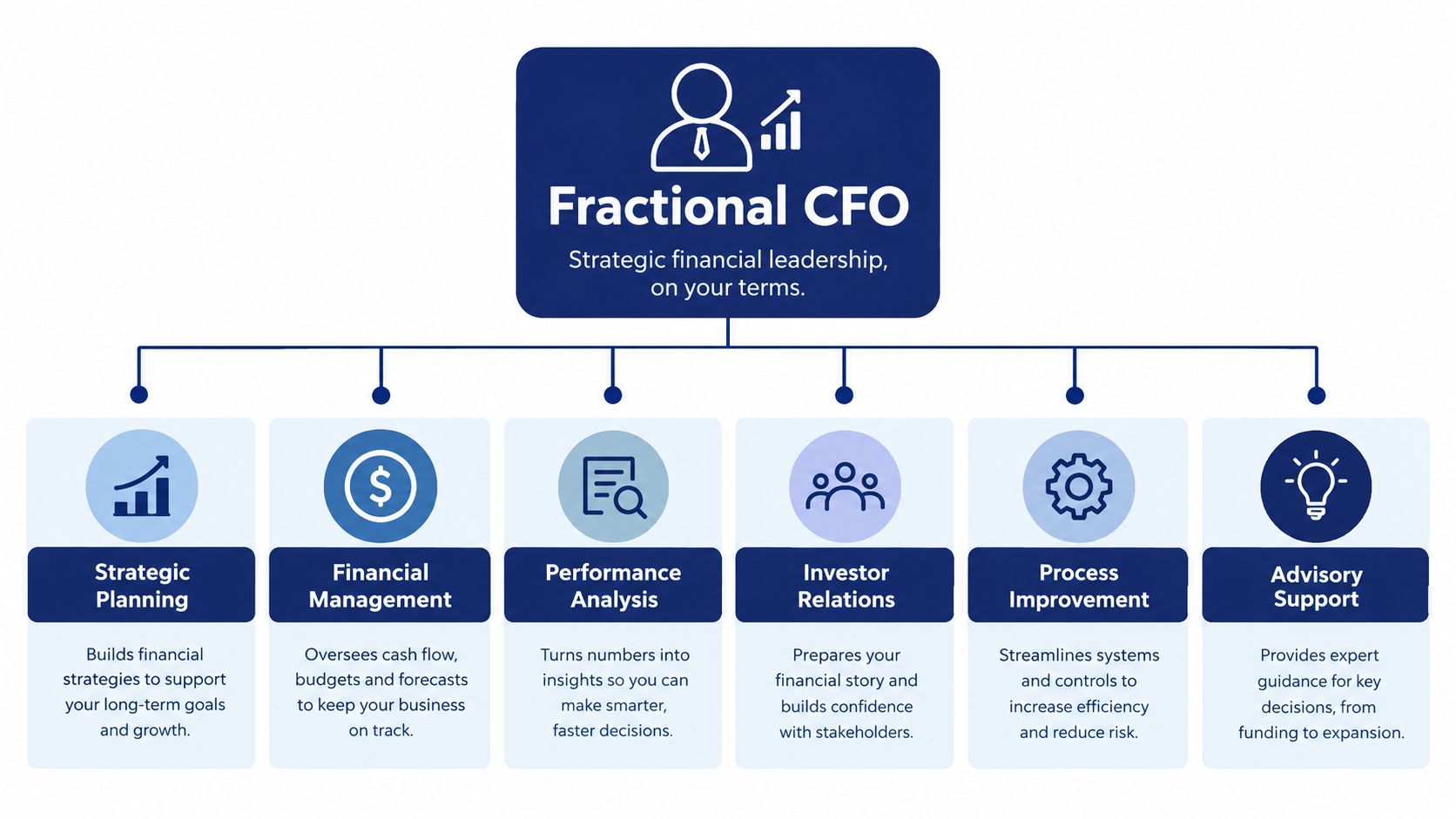
A solo fractional CFO may be excellent. I've worked with several. The limitation is obvious, though. One person can't simultaneously clean up the close, build a forecast, prepare a board package, investigate a revenue-recognition issue, and respond to every operational question without something slipping.
CustomOne's model layers a CFO leader over controllers and staff accountants. That resembles how a mature internal finance department works, just without asking the company to build the whole department immediately. The controller handles recurring accounting discipline, analysts can support planning and analysis, and the CFO focuses on judgment and communication.
Practical rule: If the person selling the engagement is also expected to do every transaction-level task, every analysis, and every executive conversation, ask what will be dropped when the workload spikes.
A fractional CFO isn't a temporary executive parachuted in to make the books look respectable for one meeting. They also aren't a substitute for a CPA handling tax compliance, and they shouldn't be treated as an expensive bookkeeper. The best engagement connects clean accounting to better operating decisions.
Buyers often underestimate what they're purchasing. “CFO support” can mean a monthly call and a spreadsheet, or it can mean a functioning finance layer with recurring reporting, cash visibility, planning, and technical guidance.
CustomOne describes capabilities across outsourced accounting, financial reporting, treasury and cash flow management, FP&A, and technical consultation (CustomOne company profile). That mix is important because finance problems rarely arrive one at a time. A forecast built on unreliable books is fiction with formatting.
A properly scoped engagement may include:
CustomOne also presents outsourced controllership as a distinct capability. That creates a sensible entry point for a business whose books need discipline before its leadership team needs a full strategic CFO relationship.
| Service Layer | Typical Deliverable | Best For |
|---|---|---|
| Close and controllership | Reviewed monthly close and reconciliations | Companies whose numbers arrive late or unreliably |
| Reporting | Management statements, variance analysis, KPI dashboards | Owners and operators who need a shared view of performance |
| Cash management | Forecasts, collections visibility, payment planning | Businesses managing tight or uneven cash flow |
| FP&A | Budgets, scenarios, unit economics, rolling forecasts | Teams making pricing, hiring, or investment decisions |
| Executive advisory | Board, investor, lender, and fundraising support | Companies facing external scrutiny or major decisions |
| Technical finance | Accounting consultation for complex situations | Businesses handling transactions or non-routine issues |
The deliverables matter, but the soft skill matters more. A great fractional CFO won't merely package your assumptions in a nicer deck. They'll ask why gross margin changed, why receivables are aging, and whether the growth plan depends on customers paying faster than they historically have.
The price gap is large. One public market report places fractional CFO engagements at $3,000 to $15,000 per month, while a full-time CFO can cost $250,000 to $500,000 or more annually after salary and the broader employment package are included (fractional CFO market report).
The right choice depends on the workload, not the prestige of the title. Paying for executive capacity you will not use is an expensive way to make a company look more mature than it is. CustomOne CFO & Controllers offers a useful lens here: buy the finance capacity your business needs now, then increase it when the workload earns that investment.
Use four questions to assess the economics. For a practical companion framework on cutting business costs effectively, apply them to the actual work rather than debating labels:
The cost of a fractional CFO by the hour is only one input. Scope, response time, systems ownership, and the people assigned to the work matter just as much. A low hourly rate can become expensive if the provider produces reports without owning the decisions those reports should support.
| Factor | Fractional CFO, such as Custom One CFO | Full-Time CFO |
|---|---|---|
| Cost structure | Recurring engagement priced at a stated monthly range or scope | Salary and broader employment costs |
| Speed to value | Can bring an existing process and team | Requires recruiting and internal onboarding |
| Flexibility | Capacity can be adjusted around major finance events | Capacity is largely fixed |
| Coverage | May include CFO, controller, and accounting support | Usually starts with one executive |
| Best fit | Companies needing senior judgment without daily executive coverage | Companies needing dedicated finance leadership every day |
The economics usually favor a full-time hire when finance needs a permanent leader every day, investors expect one named executive in the role, or the company has enough complexity to keep that person fully occupied. Hire the executive when the workload supports the role. Until then, a well-scoped CustomOne engagement can provide senior judgment without carrying a permanent executive cost.
The trigger usually isn't a particular line on the income statement. It's the moment your finance function stops helping you make decisions and starts forcing you to guess.
That said, the planning brief for this market commonly points founders in the $1 million to $10 million revenue range toward fractional support. Those figures also appear in the required visual below, but they shouldn't be treated as an automatic buying rule. A company at that stage can still need only bookkeeping and tax support, while a smaller company may face a financing or cash problem that requires senior judgment.
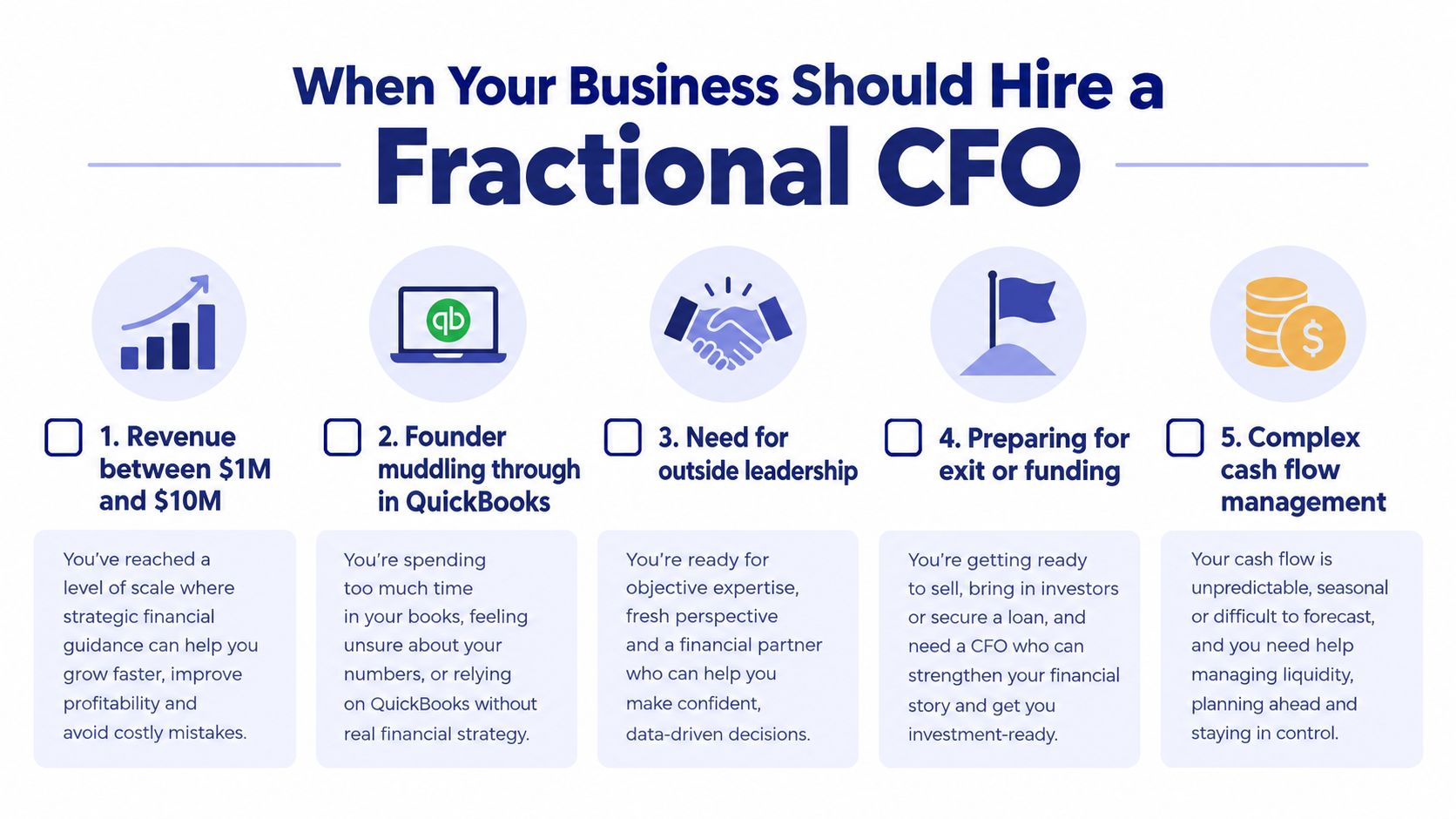
CustomOne's CFO-plus-controller structure makes sense when several of these symptoms appear together. The controller layer can stabilize recurring finance operations, while the CFO brings judgment to cash, planning, financing, and communication.
Waiting for the perfect full-time hire is a costly form of procrastination. Companies burn time, miss financing windows, and make avoidable decisions while the job description gathers dust.
Start with the decision that hurts most. If cash is the problem, scope cash visibility first. If fundraising is imminent, prioritize clean reporting and a forecast that survives questions. Don't buy a grand finance transformation when what you need is a reliable answer by Friday.
A polished pitch deck can hide a thin delivery team. CustomOne CFO & Controllers is a useful reference point because its layered staffing model shows how an outsourced finance firm can combine CFO judgment with controller support. It is not a free pass, though. Apply the same scrutiny to CustomOne, an independent operator, or any other provider.
The fractional CFO market remains fragmented. One industry report estimates that the top ten providers hold about 22% of the broader North American fractional CFO market (fractional CFO market report). Buyers therefore face plenty of choice, and plenty of uneven execution.
Require a sample monthly financial package for a comparable client, with confidential information removed. Decorative charts are cheap. Clarity is the test. A non-financial executive should be able to see what changed, why it changed, and which decision follows.
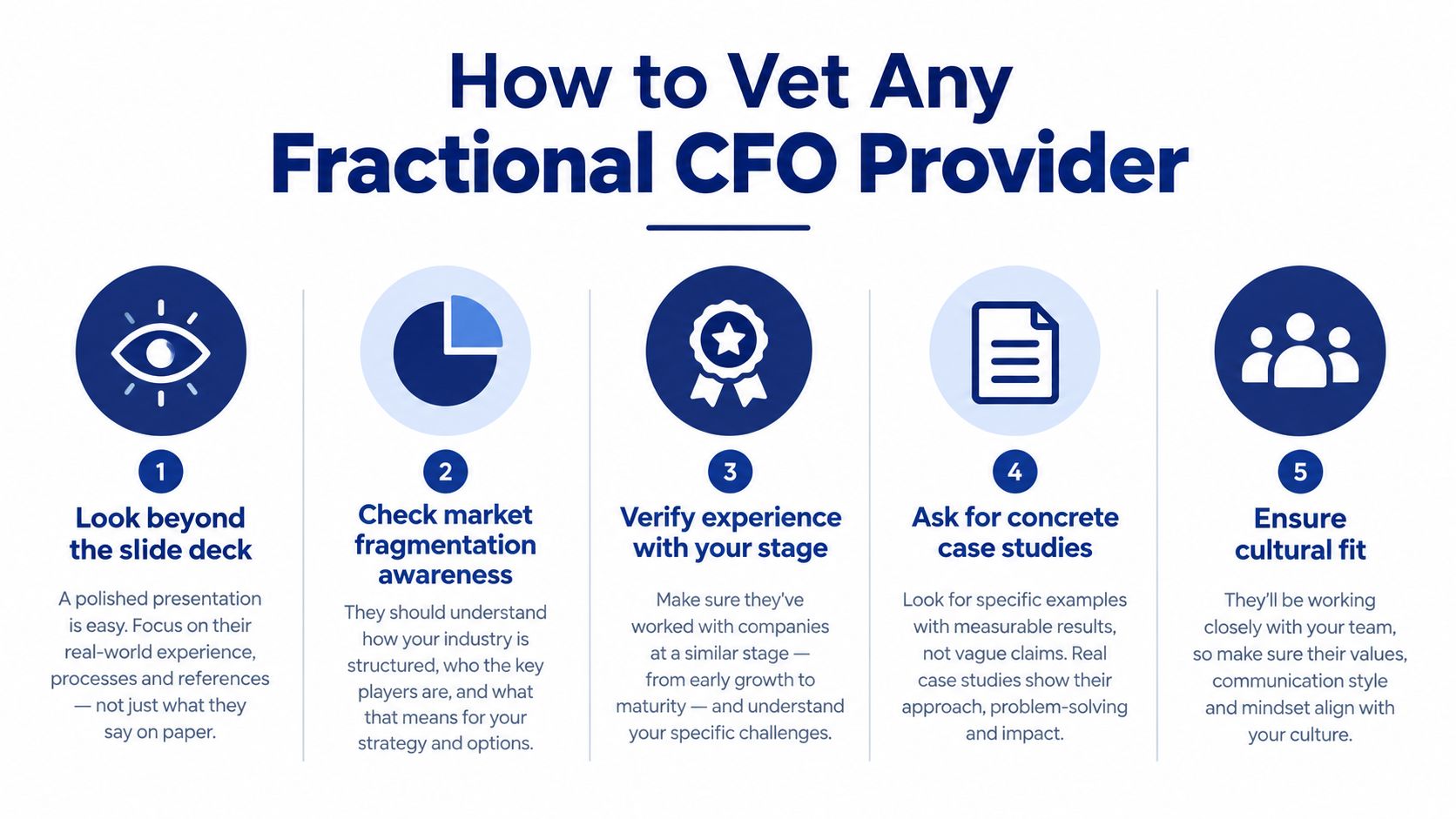
Ask how the provider works when the books are messy, the founder rejects the forecast, or several urgent requests arrive together. Track record beats presentation polish. HireAccountants can help source finance professionals, but the same diligence still applies to whoever you hire. Choose the provider that can explain its process, name its operators, and show what good work looks like.
Custom One CFO sells an outsourced finance service. A marketplace such as HireAccountants solves a different problem by helping companies source pre-vetted accounting and finance professionals for in-house roles.
That distinction matters. With a firm model, the provider typically assigns a team and owns a packaged scope around your finance function. With a marketplace model, you can hire a controller, senior accountant, finance manager, or CFO to work inside the company as part of the operating team. You gain continuity with one person, but you also take on more responsibility for management, systems, and coverage.
An in-house hire makes more sense when someone needs to live inside the company's daily rhythm. Think recurring close ownership, constant coordination with sales and operations, documentation, process improvement, and the institutional knowledge that builds through repetition.
It can also make sense when a fractional CFO has already diagnosed the core issue: the books are too messy for strategic advice to be reliable. In that case, hiring more advisory hours is like asking a navigator to steer through fog while refusing to fix the headlights.
A firm like CustomOne is the better fit when you need executive judgment without committing to one permanent hire, when a financing process is approaching, or when the company needs controller support and CFO oversight at the same time. It's also useful for specialized work that would be hard to keep fully occupied as a standalone internal role.
The strongest combination is often hybrid. Keep a fractional CFO for fundraising narrative, board reporting, and high-stakes planning, then hire an in-house controller or senior accountant to keep the daily numbers clean. One person owns the operating detail. The other makes sure the company understands what that detail means.
That setup avoids two common mistakes: asking an internal accountant to pretend to be a strategic CFO, and asking an external CFO to spend every month chasing missing receipts.
The best finance setup changes as the company changes. A founder who hires a CFO too early creates unnecessary fixed cost. A founder who waits too long turns every important decision into an emergency. Neither is a badge of honor.
Most companies at this stage need reliable bookkeeping, clean account reconciliations, and a CPA for tax work. A fractional CFO can be useful for a specific financing question or planning exercise, but recurring executive finance support is usually premature.
Get the basics right first. If your books are unreliable, senior advice will be built on sand, no matter how impressive the advisor's résumé looks.
Fractional CFO support often earns its keep right here. The company may need better cash decisions, pricing clarity, fundraising preparation, and a forecast that operating leaders can use. A provider with both CFO and controller capability is particularly useful because strategic advice depends on dependable underlying numbers.
You don't need a ceremonial executive. You need someone who will explain the tradeoffs, challenge your assumptions, and make the finance cadence stick.
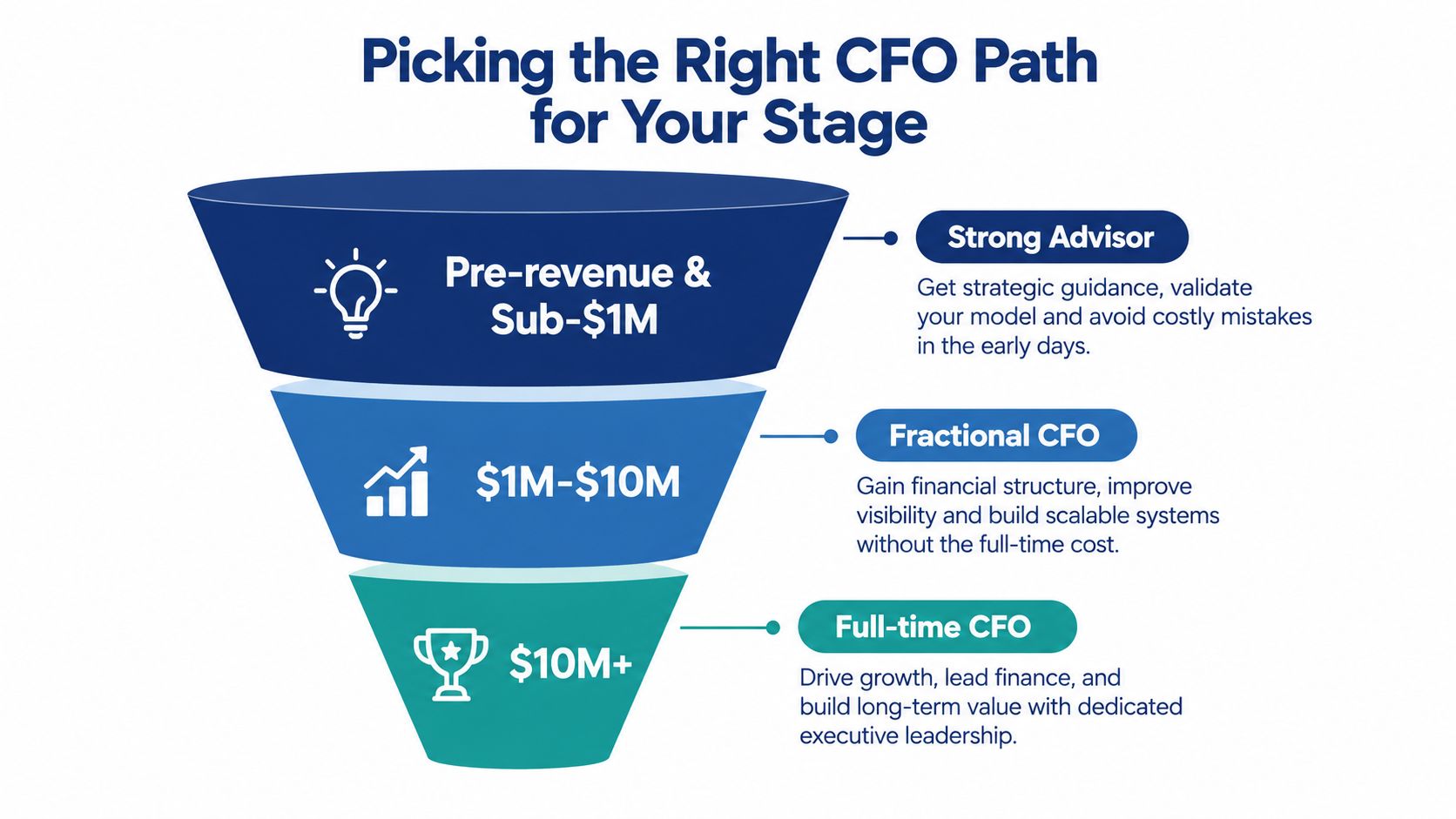
At this stage, the case for a full-time CFO or a dedicated controller-plus-CFO structure gets stronger. The finance leader may need to participate in executive decisions every day, build internal controls, manage a growing team, and represent the company with investors, lenders, and other stakeholders.
A full-time hire isn't automatically right. A company can still use an outsourced firm for overflow, technical accounting, financing support, or specialized projects. The right structure depends on whether the business needs one permanent operator, a broader finance bench, or both.
The cheapest CFO is the one whose advice your team actually uses.
Choose the model your company will follow, not the one that looks most impressive on an organizational chart. If you need flexible senior judgment, start fractional. If daily finance leadership has become a permanent operating requirement, build in-house. If the books need ownership and the strategy needs altitude, combine the two.
HireAccountants helps companies source pre-vetted accountants and finance professionals for in-house and flexible finance roles, including controllers, analysts, and CFO-level talent. If Custom One CFO has clarified what your finance function needs next, visit HireAccountants to build a shortlist and bring the right person into the day-to-day work.
Let's simplify your finances today!