


You've got a two-year-old LLC, a Stripe dashboard full of activity, and a personal credit card doing unpaid overtime. Revenue looks healthy until someone asks a simple question: what was profit, what was an owner draw, and which expenses can the tax return legitimately support?
That's when bookkeeping and taxes stop being back-office housekeeping and become a cash-flow problem. The fix isn't another heroic weekend of downloading statements. It's a continuous control system that classifies transactions, preserves evidence, reconciles accounts, forecasts tax, and hands a clean file to the preparer. The practical target is not perfect books. It's books that remain explainable under pressure.
The founder in this story started sensibly enough. The company had a business bank account, Stripe handled customer payments, and a personal credit card covered “temporary” software subscriptions, travel, and contractor bills. Temporary lasted two years.
A quarterly estimated payment was missed. The first notice looked manageable, a $500 penalty, followed by a demand for reconciled books and payment within 30 days. The penalty was irritating. The reconstruction was brutal.
Someone had to download old bank statements, match Stripe settlements to deposits, separate processing fees from revenue, identify personal charges, chase missing contractor documentation, and work out whether equipment purchases belonged on the profit-and-loss statement or the balance sheet. The founder lost deductions because receipts had vanished, and the company's cash reserve suddenly had two jobs: fund payroll and answer the IRS.
The expensive part of a tax problem is often not the penalty. It's the forensic bookkeeping required to explain what happened.
That's the reframe. Bookkeeping and taxes are one operating system, not two annual chores performed by unrelated people. The books create the evidence. The tax work interprets that evidence. If the first system is sloppy, the second system becomes an expensive guessing exercise.
This guide focuses on the parts most small-business content skips: pass-through reporting, estimated-tax traps, accounting-method changes, the handoff between bookkeeper and tax preparer, and a practical 90-day plan for getting control back. You'll find workflows rather than motivational posters. Cheerful chaos is still chaos.
Double-entry bookkeeping has survived because it forces clarity. Luca Pacioli's 1494 work gave the first widely recognized printed explanation of Venetian-style double-entry bookkeeping, building on methods already used in parts of Italy by roughly 1300, as described in this history of Pacioli and double-entry accounting.
Every transaction affects at least two accounts, and total debits must equal total credits. That structure captures timing, classification, ownership, and economic purpose, the same facts a tax preparer needs to determine how income, deductions, assets, liabilities, and owner activity belong on a return.
Consider a Stripe deposit. It can contain sales, refunds, sales tax collected, reserves, and processing fees. A founder transfer may be a distribution, payroll, loan repayment, or personal withdrawal. A laptop reduces cash immediately, while its tax treatment may follow an asset schedule. Software can post entries; only a deliberate chart of accounts makes those entries defensible.
QuickBooks and Xero reduce data entry. They do not supply accounting judgment. Bank feeds import transactions, yet they rarely know whether a payment represents a contractor fee, owner distribution, loan repayment, or personal expense.
A defensible workflow connects each transaction to a general-ledger account, supporting evidence, and a stated business purpose. The IRS recordkeeping guidance explains that books summarize income, deductions, and credits, while documents such as invoices, receipts, deposit slips, paid bills, and canceled checks support those figures.
The tax connection becomes more demanding for pass-through businesses. The entity's profit flows to owners, so weak classifications can affect both business reporting and the owner's personal tax position. Estimated payments add another pressure point. A profitable quarter can create a tax obligation before cash is set aside, especially when the books lag behind actual activity.
The operational handoff matters just as much. A bookkeeper should flag unusual transactions, owner activity, open reconciliations, and method questions before the tax preparer receives the file. A tax preparer needs a clean trial balance, reconciliations, fixed-asset information, and explanations for judgment calls. A practical The Owner's Shortlist tax guide can support planning questions, but the conclusions must be reflected in the books and source documents.
Use this control sequence:
A dashboard helps you see the operation. Double-entry discipline gives those numbers credibility.
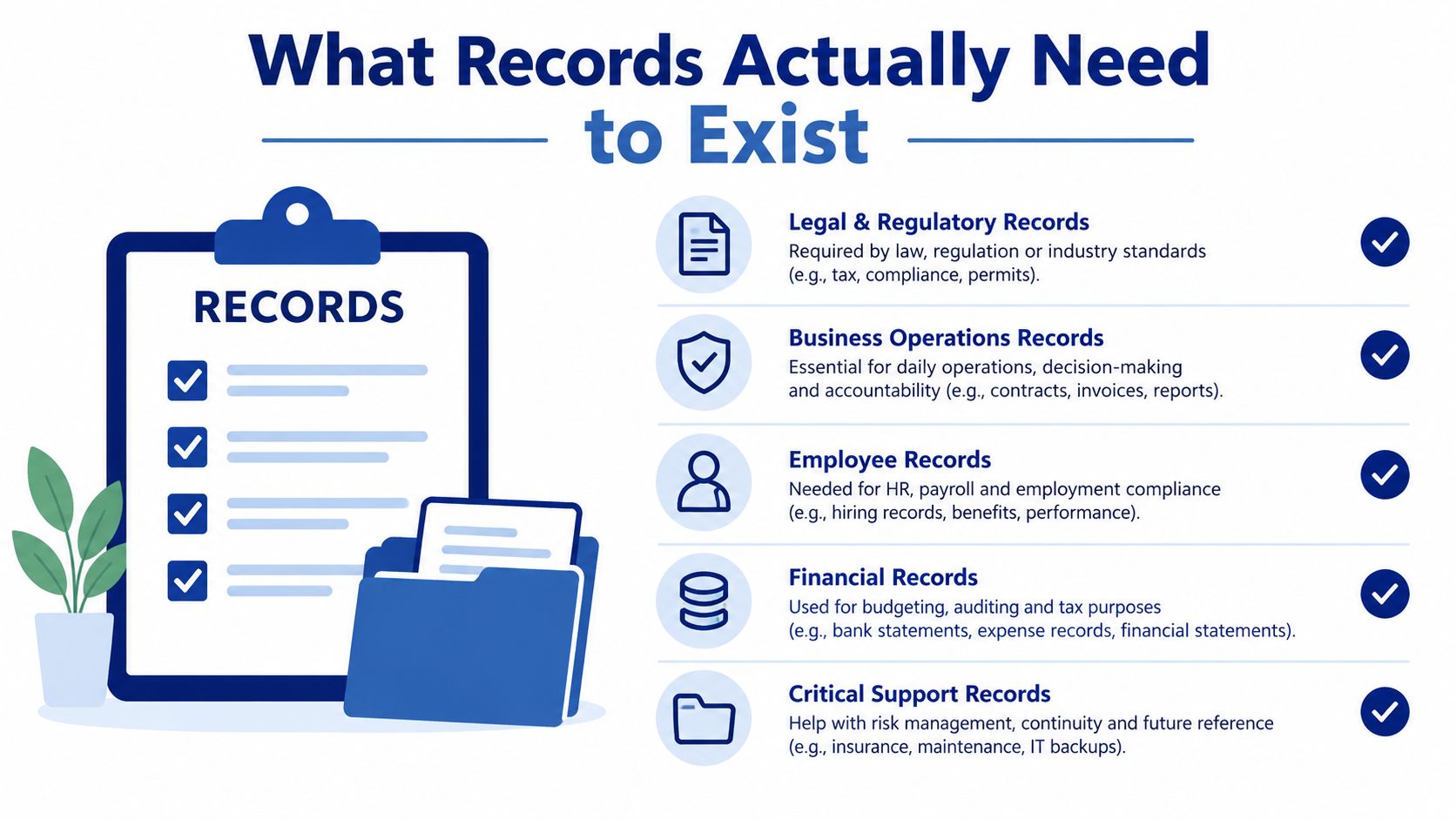
Tax-ready records form a connected trail from transaction to account to document to return, created throughout the year rather than assembled during filing season. If a payment reaches the bank feed with no receipt, invoice, or business-purpose note, the trail breaks before the tax return is even prepared.
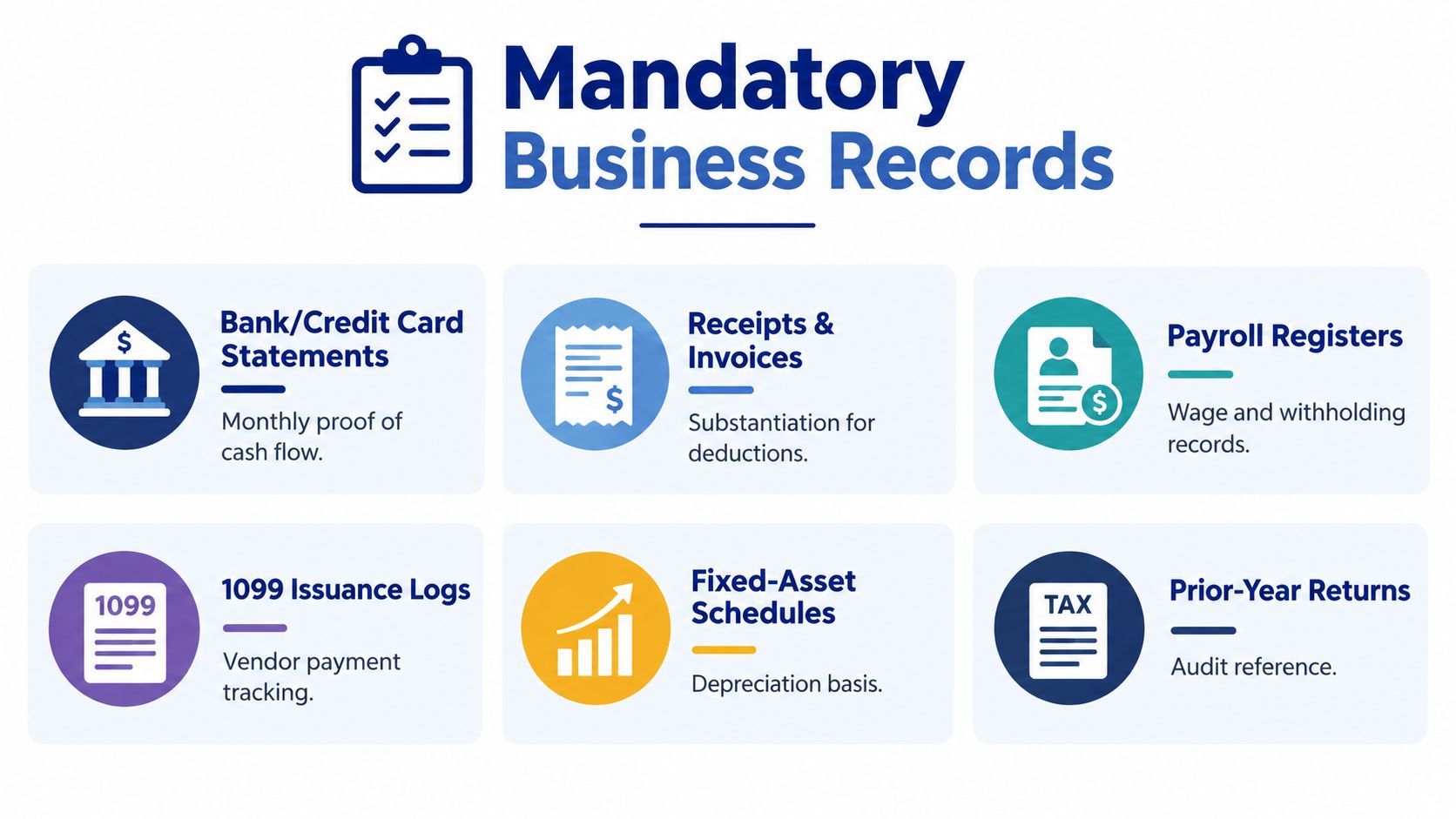
Maintain bank and credit-card statements, receipts, customer invoices, vendor bills, deposit records, payroll registers, contractor payment records, fixed-asset schedules, depreciation support, mileage logs, and entity documents. Keep prior-year returns available for comparison. Formation papers, operating agreements, ownership records, loan documents, and contribution records also belong in the file. Tax treatment can depend on who owns an asset, who borrowed the money, or how cash moved between the owner and the business.
Books summarize transactions. Source documents support the income, deductions, and credits reported. Each recorded amount should connect to evidence that explains what happened, why it served the business, and where the money moved. The IRS's recordkeeping guidance supports this basic division, while its guidance on how long to keep tax records addresses retention considerations.
A monthly close should answer five questions:
A practical explanation of how a budget ledger works can help connect planned spending with actual activity. Receipt capture needs an owner and a deadline. Documents should enter the accounting system when payment occurs, while the transaction is still familiar, rather than during a deadline sprint. This guide to receipts for tax purposes provides a useful reference for setting up that workflow.
Records generally need to remain available through the applicable tax-return limitation period. Keep asset records longer when they support basis, depreciation, improvements, or disposal. Keep formation and ownership documents indefinitely. A year-end export is not a sufficient archive if the supporting invoices and transaction history have vanished.
The strongest evidence is created while the transaction is fresh. A receipt uploaded with a business-purpose note beats a blurry image rediscovered during filing week. Audit support is built one transaction at a time, usually on an ordinary Tuesday.
Pass-through taxation moves business income to the owners. It doesn't move responsibility for the books to the owners' tax preparer. Partnerships, S corporations, and many LLCs may report business activity through owner-level filings, including K-1 information, which means an entity-level bookkeeping error can become a personal tax problem.
83% of small businesses are pass-through entities, according to the NSBA small-business tax survey. The owner sees the result on a personal return, but the source of that result is the company's ledger.
Owner draws, guaranteed payments, payroll, reimbursements, and loans are not interchangeable. A draw reduces equity. A guaranteed payment may have a different reporting treatment. A salary requires payroll processing and withholding. A reimbursement needs a business expense and supporting documentation. Posting all four to “owner expense” is not bookkeeping. It's hiding the question.
Contractor payments create another failure point. The business needs a vendor record, payment history, classification review, and a process for determining whether information reporting applies. Recent IRS guidance raises the reporting threshold for reportable payments made after 2025 to $2,000, as discussed in the NSBA coverage linked above. That change belongs in the bookkeeping workflow, not in a last-minute email to the tax preparer.
Accounting methods create a second trap. A company that begins on the cash method may later add inventory, deferred revenue, employees, or outside investors. Switching methods can require IRS approval and may require Form 3115, so the change needs a documented plan rather than a software toggle. The IRS explains that businesses generally need approval before changing an accounting method.
Consider a two-member LLC whose books show a strong year. If owner withdrawals are coded as expenses, profit is understated. If customer deposits are treated inconsistently, income timing becomes unreliable. If equipment is expensed without an asset review, depreciation and basis records may be incomplete. The owners may still receive a polished K-1, but polished is not the same as correct.
| Bookkeeping Failure | Tax Consequence | Typical Dollar Impact |
|---|---|---|
| Owner draws coded as expenses | Business profit is understated and owner basis may be misstated | Variable, depending on the ledger error |
| Contractor payments lack vendor records | Information reporting and deduction support become harder to defend | Variable, depending on payments and classification |
| Payroll liabilities are unreconciled | Owner compensation and employment-tax reporting may not agree | Variable, depending on payroll activity |
| Asset purchases are expensed without review | Basis and depreciation support may be incomplete | Variable, depending on the asset |
| Cash-to-accrual change is undocumented | Income and expense timing may be inconsistent | Variable, depending on the method change |
A clean pass-through return starts with an entity ledger that understands the owner's money.
Cash accounting answers a practical question: when did money move? Accrual accounting asks when the business earned revenue or incurred an obligation. Neither method is a universal winner. The right choice depends on the company's transactions, tax requirements, reporting needs, and ability to maintain the records consistently.
Cash basis can make early-stage reporting easier and may align tax recognition with collections. It can also create distorted management reports when customers pay late or vendors are paid in batches. Accrual reporting gives a clearer view of earned revenue, unpaid bills, receivables, and obligations, but it demands better processes.
Inventory is where casual preferences often meet harder rules. A business that buys and sells goods may need inventory records and a method that properly reflects cost of sales. Software can track quantities and payments, but it won't decide whether the accounting method matches the company's tax position.
For a solo founder, QuickBooks or Xero can work when the business has straightforward revenue, limited vendors, and one entity. The essentials are reliable bank feeds, receipt capture, a usable chart of accounts, and accountant access.
A growing company with payroll needs payroll-liability reconciliation, contractor workflows, sales-tax tracking, accounts payable, accounts receivable, and a month-end close that another person can review. A multi-entity operation needs clean entity separation, intercompany controls, consolidated reporting, and permissions that prevent one company's cash from funding another.
The mistake is choosing software because the dashboard looks friendly. A beautiful interface won't reconcile merchant settlements or explain an owner transfer. Before adopting a tool, test the tax workflow with real transactions.
A mid-year migration needs discipline:
For a practical comparison of the underlying methods, see this guide to cash and accrual accounting methods. The software should serve the accounting method and tax workflow, not bully the business into whichever setup requires fewer clicks.
An extension gives you more time to file paperwork. It doesn't give you permission to delay the money. The IRS filing calendar separates return deadlines, payment obligations, extension dates, payroll deposits, and information returns for a reason.
Individuals, including sole proprietors, partners, and S corporation shareholders, generally need estimated payments when they expect to owe at least $1,000 at filing. Corporations generally face a $500 threshold, according to the IRS estimated-tax guidance.
For individuals, the usual quarterly dates are April 15, June 15, September 15, and January 15 of the following year, with the next business day applying when a deadline lands on a weekend or legal holiday. The general safe-harbor benchmarks are 90% of current-year tax or 100% of prior-year tax, whichever is smaller. For higher-income taxpayers, the prior-year benchmark can rise to 110%, depending on adjusted gross income.
A business can file an extension and still owe the estimated balance by the original due date. If it files late without a timely extension, failure-to-file penalties and interest can apply. Missing estimated payments can also create an underpayment penalty, even if the annual return eventually produces a refund.
The monthly close should feed a tax estimate. Use year-to-date profit, owner compensation, distributions, payroll taxes, withholding, prior-year liability, and expected changes in revenue or expenses. Don't wait for the tax preparer to discover in filing season that the company has been mortgaging its cash flow to Uncle Sam.
A useful quarterly tax filing workflow starts with the close, not the deadline. The bookkeeper updates the forecast, the owner approves the cash reserve, and the CPA reviews unusual items or method questions. That rhythm makes estimated tax boring, which is exactly what you want.
The founder can handle bookkeeping when transactions are simple, the chart of accounts is understood, and the founder closes the books. That last condition eliminates a surprising number of “DIY” systems. If reconciliations are perpetually postponed, the founder isn't saving money. The founder is financing a future cleanup.
An in-house bookkeeper adds continuity and daily context. That works well when transaction volume, payroll, customer billing, and vendor activity justify a dedicated operator. The risk is narrow expertise. A capable bookkeeper may close the books beautifully but miss an accounting-method issue, pass-through planning question, or unusual tax position.
A fractional CPA brings higher-level review without requiring a full finance department. A full-service accounting firm can coordinate bookkeeping, tax, payroll, and planning, but may cost more than an early company needs and can introduce handoff friction if the person preparing the return never sees the monthly detail.
Watch for these inflection points:
The cheapest arrangement usually becomes expensive when tax complexity arrives. The opposite mistake is hiring a finance department before the company has finance work. A sensible hybrid often works: a bookkeeper owns transaction processing and close, while a CPA reviews tax positions and estimated-tax forecasts.
| Stage | Who Handles Books | Monthly Cost Range | Tax Readiness | Watch For |
|---|---|---|---|---|
| Simple solo operation | Founder or part-time bookkeeper | Depends on scope and transaction volume | Basic, if reconciled consistently | Personal spending and missing receipts |
| Growing small business | In-house or outsourced bookkeeper with CPA review | Depends on payroll, vendors, and reporting needs | Stronger when the reviewer sees monthly detail | Payroll liabilities and contractor records |
| Complex or multi-entity business | Finance lead, fractional CPA, or accounting firm | Depends on entities, systems, and risk | Requires documented controls and review | Intercompany activity, inventory, sales tax, and method changes |
The operational handoff matters more than most hiring guides admit. Whoever closes the books should provide the tax reviewer with explanations for unusual transactions, not just an exported trial balance. Context evaporates between separate providers.
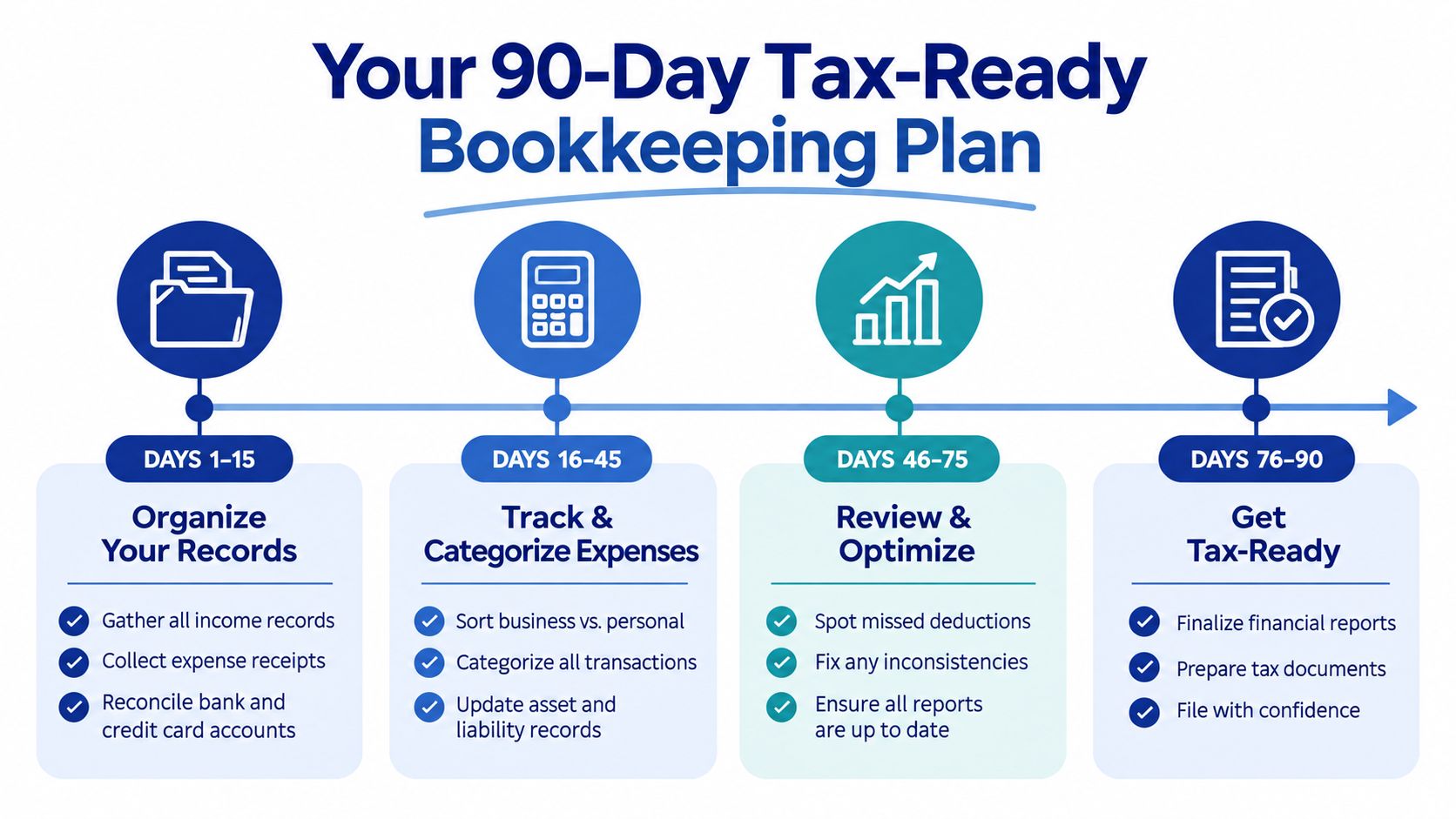
The next 90 days should produce rhythm, not theatrical perfection. Start with the oldest unresolved transaction and work forward. A clean current month is useful, but it won't explain an opening balance built on two years of guesses.
Clean the chart of accounts. Remove duplicate categories, separate owner activity, identify loans, and create clear accounts for payment-processor fees, payroll liabilities, fixed assets, and sales tax where relevant.
Connect every business bank and credit-card account. Reconcile available history, then request missing statements until you have 12 months of source records. Save receipts and invoices against transactions rather than dropping them into an unsearchable folder.
By the end of the first month, produce a reviewed profit-and-loss statement and balance sheet. Flag uncertain items for the CPA instead of burying them in miscellaneous expense.
Move to a close cycle of five business days after month-end. Reconcile every account by the 5th, clear uncoded transactions, review receivables and payables, reconcile payroll liabilities, and update fixed-asset records.
Lock down receipt capture at the moment of payment. Review the vendor list by the 10th for contractor reporting, missing tax forms, and duplicate vendors. The person reviewing should compare payment-processor settlements to deposits, not merely accept the bank feed's suggestion.
If the company is considering a cash-to-accrual change, pause and obtain tax advice before changing settings. A software conversion is not an accounting-method strategy.
Build the tax-ready reporting package: reconciled trial balance, profit and loss, balance sheet, general ledger, bank reconciliations, payroll reports, contractor list, fixed-asset schedule, debt schedule, and owner-activity summary.
Create a calendar that distinguishes filing dates from payment dates. Add estimated-tax reviews to the monthly close and set an explicit CPA review trigger for new entities, inventory, deferred revenue, ownership changes, major asset purchases, or method questions.
Resources on SME tax reliefs and compliance can broaden planning awareness, but relief claims still require records that support eligibility. The books should tell the tax professional what happened before the tax professional asks.
Hand this closing checklist to the person responsible:
That's the system. Not glamorous, not viral, and far cheaper than reconstructing two years of financial history under a deadline.
HireAccountants can connect you with pre-vetted bookkeepers, tax accountants, and other finance professionals who handle reconciliations, monthly close, financial records, and tax workflows. If your books need a dependable owner before the next filing deadline, visit HireAccountants and find support that fits your stage, systems, and risk profile.
Let's simplify your finances today!