


A small-business bookkeeper records daily transactions, reconciles bank and credit-card statements, manages payroll records, and produces monthly financial reports. That work keeps the business ready for IRS scrutiny and gives the founder a usable view of cash runway.
You know the scene. A founder opens the accounting software, finds a pile of uncategorized Stripe payouts, a credit-card balance that doesn't match the ledger, and receipts scattered across email, paper, and one suspiciously optimistic spreadsheet. Sales look healthy, yet nobody can explain why cash keeps disappearing.
What does a bookkeeper do for a small business? They turn that mess into a complete, traceable financial history. The job isn't glorified data entry, and software won't rescue sloppy judgment. A bookkeeper records what happened, preserves why it happened, checks whether the numbers agree, and turns the result into reports you can use.
I once watched a founder try to reconstruct several weeks of business activity from bank notifications, payment-processor emails, and memory. The founder knew the company had made sales. They couldn't tell which deposits belonged to which invoices, whether a vendor bill had been paid, or whether a personal purchase had wandered into the company card.
That isn't bookkeeping. That's financial archaeology.
A professional bookkeeper starts with the evidence. Sales invoices, receipts, deposit records, paid bills, canceled checks, payroll records, and bank or credit-card statements become entries in the transaction ledger. Each entry needs the right date, amount, account, payee, payment evidence, and business purpose.
The IRS doesn't require most businesses to use one specific bookkeeping system. It does require a method that clearly shows income and expenses, whether that system is a spreadsheet, journal, ledger, or accounting software such as QuickBooks or Xero. The IRS recordkeeping guidance explains why those records matter for financial statements and tax-return support.
A competent bookkeeper doesn't blindly accept every automated bank feed. They classify transactions, review descriptions, and connect the ledger back to supporting documents. A Stripe payout may include several customer payments and processing fees. A vendor charge may belong to software, inventory, advertising, or a fixed asset. The software imports the activity. A human decides what it means.
Practical rule: If you can't trace a ledger entry back to evidence and a business purpose, you don't have a reliable book.
The daily work also includes recording sales, purchases, payroll, deposits, payments, deductions, and credits. For businesses handling regular cash receipts, daily or periodic summaries help connect what was collected with what reached the bank.
Owner spending deserves a hard boundary. Personal expenses shouldn't sit inside operating costs because the founder used the company card for convenience. Separating owner transactions from business expenses keeps reports meaningful and gives the tax preparer defensible information instead of guesses.
The bookkeeper also maintains documents such as invoices, receipts, deposit slips, canceled checks, sales records, and electronic-payment evidence. The IRS says businesses should retain records long enough to substantiate income and deductions, and it generally suggests retaining records for 3 years. Employment-tax records generally require at least 4 years of retention, subject to the applicable rule and filing timeline, as described in the IRS small-business recordkeeping guidance.
The payoff is simple. Clean daily records support tax compliance, cash monitoring, hiring decisions, pricing decisions, and spending decisions. Without them, every management conversation starts with, “I think the numbers are…”
Your bank balance is not automatically your true financial position. A monthly close proves whether the accounting records agree with the outside world and gives you a dependable basis for decisions.
A strong close follows a repeatable rhythm:
Reconciliation catches timing differences, duplicate payments, omitted deposits, unauthorized transactions, and posting errors. The IRS recordkeeping resource also identifies good records as a foundation for monitoring progress, preparing financial statements, identifying income sources, and tracking deductible expenses.
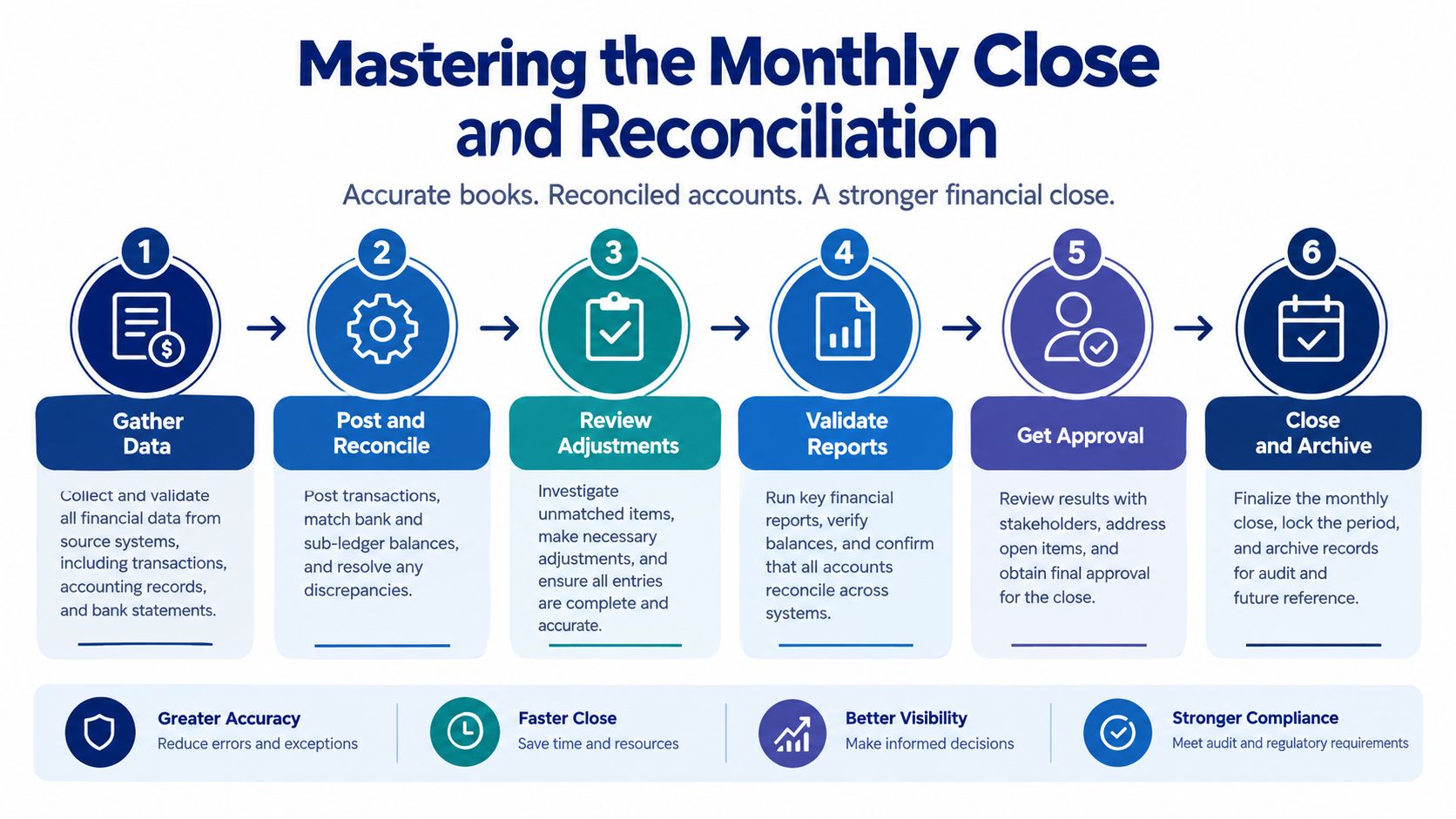
The bookkeeper should perform the reconciliation. The owner or manager should review unusual results, unexplained withdrawals, vendor changes, and unexpected trends. One person shouldn't enter transactions and be the only person deciding that every transaction looks reasonable.
That division matters most in a startup, where one employee may handle invoices, payments, payroll, and bookkeeping. AICPA example materials describe monthly account reconciliation by the bookkeeper and owner review as a practical control. This isn't corporate theater. It catches the small leaks that eventually require mortgaging the office ping-pong table.
For a practical explanation of how reconciliation supports financial clarity, Suby's guide to financial clarity is a useful companion. Founders who want a more detailed explanation of the ledger-matching process can also review general ledger reconciliation guidance.
A close should leave you able to discuss revenue, expenses, assets, liabilities, profit or loss, gross margin, overdue receivables, upcoming payables, and available cash without opening six browser tabs and making a wish.
Payroll bookkeeping is where casual processes become expensive problems. Calculating net pay is only one piece. The bookkeeper must preserve the evidence connecting employee compensation to tax deposits, filings, benefits, reimbursements, and reported information.
Employment-tax records generally must be retained for at least 4 years after the fourth-quarter filing for the year, according to the IRS employment-tax recordkeeping requirements. The file should include:
A bookkeeper may coordinate with a payroll provider, but outsourcing the calculation doesn't eliminate the recordkeeping responsibility. When an employee asks about a year-to-date figure, the answer should come from a coherent payroll history, not a hunt through old email threads. For a plain-language explanation of YTD terminology, HR Management 365 explains YTD offers useful context.
A bookkeeper can maintain payroll records, track contractor payments, connect payroll registers to deposits, and organize filing support. They should also flag missing employee information, inconsistent reimbursements, or a payroll liability that doesn't clear as expected.
That doesn't mean every bookkeeper should make complex employment-tax judgments. Payroll rules vary by jurisdiction, worker classification, benefits, and company structure. Use a payroll specialist or CPA when the issue involves complex tax advice, formal filings requiring professional judgment, or a dispute that could create material exposure.
Clean payroll records help answer employee questions, support employment-tax filings, and give the IRS a usable trail if it reviews the company's payroll. Miss one link and a routine question becomes an archaeological expedition. Nobody wants to excavate a payroll register from an abandoned inbox.
Founders often hire the wrong finance professional because the titles blur together. Then they pay a specialist to perform clerical work or expect a bookkeeper to design a financing strategy. Both mistakes waste money.
| Finance Role | Core Responsibilities | When You Need Them |
|---|---|---|
| Bookkeeper | Records transactions, classifies income and expenses, reconciles accounts, organizes documents, manages invoices, supports payroll records, and prepares recurring financial reports | You need accurate books, a dependable monthly close, and consistent visibility into operating performance |
| CPA | Provides complex tax advice, handles formal attestations and audits, interprets tax positions, and supports specialized compliance work | You face an audit, complex tax planning, formal attestation needs, or tax questions beyond routine bookkeeping |
| Fractional CFO | Builds forward-looking models, evaluates scenarios, supports budgeting, analyzes performance, and advises on capital, hiring, and growth decisions | You need strategic financial leadership, not just historical reporting and transaction control |
The difference between accounting and bookkeeping matters because clean records feed higher-level work. A CPA shouldn't spend their day categorizing Uber receipts when a capable bookkeeper can do it. A bookkeeper shouldn't be asked to provide formal audit opinions or invent a financing model from incomplete records.
A modern bookkeeper's scope can extend beyond transaction processing. The 2026 survey by the Institute of Certified Bookkeepers reported that nearly two-thirds of respondents handle payroll, more than half complete self-assessment tax returns, and over 40% provide planning, budgeting, or performance-analysis services, as summarized by CNBC Select's bookkeeping overview. Those figures show an expanding role, not a license to treat every bookkeeper as a CFO or CPA.
State the expected outputs. Do you need transaction processing, accounts payable, accounts receivable, month-end close, payroll coordination, tax support, cash-flow reporting, budgeting, or forward-looking analysis? Specify the software, reporting cadence, approval responsibilities, and escalation points.
My recommendation is blunt. Hire a bookkeeper for reliable historical records and recurring reporting. Bring in a CPA for complex tax and formal assurance work. Add a fractional CFO when the business needs decisions about the future. Don't pay a $150-per-hour CPA to categorize lunch receipts, and don't ask a bookkeeper to steer a financing round with a spreadsheet held together by hope.
Finance hiring has three familiar traps. A local employee can be expensive before you know whether the workload is full-time. A gig freelancer may disappear when month-end gets busy. A bloated agency may give you a rotating cast of people who never learn how your business works.
Remote, pre-vetted talent offers a more practical middle ground for many startups. Latin American professionals working in US time zones can collaborate during the hours your team is operating, rather than sending questions into a timezone void and waiting until tomorrow.
HireAccountants connects US companies with pre-vetted accountants and finance professionals, including bookkeepers, CPAs, auditors, tax accountants, financial analysts, and accounting managers. Its marketplace and recruiting support offer full-time or part-time arrangements, with bookkeeper pricing of $1,100–$1,999 per month, according to the platform's publisher information.
The platform also describes potential cost savings of 80% to 90% compared with traditional hiring approaches, based on connecting companies with English-fluent Latin American talent in US time zones. Those figures should be treated as a hiring benchmark, not a promise. The sensible comparison is the total cost of a reliable person who can classify transactions correctly, close the books, communicate clearly, and stay in the role.

Remote hiring only works when you test the work. Ask candidates to explain how they'd handle a duplicate bank transaction, an owner expense on a company card, an unreconciled payment-processor deposit, and a missing vendor invoice. You want reasoning, documentation habits, and communication, not just software familiarity.
The right partner should make ownership clear. Who approves vendor changes? Who reviews unusual journal entries? Who handles payroll coordination? Who produces the monthly reports? A structured service can reduce recruiting friction, but it can't replace those decisions.
If you want a separate perspective on evaluating outsourced finance candidates, streamline talent picks provides a useful comparison point. The principle remains the same: pay for dependable execution and clean judgment, not a shiny office address.
A bookkeeper's success depends as much on the operating system around them as on their technical ability. Give someone a vague remit and you'll get vague ownership. Give them clean access, clear outputs, and a review process, and the books have a fighting chance.
Start with deliverables, not personality traits. Your description should state:
Then name the tools. QuickBooks, Xero, Stripe, a payroll platform, expense software, and the bank feed may all sit in the workflow. Candidates should explain how they'd preserve the audit trail across those systems instead of assuming an integration makes every entry correct.
Use the first 30 days to establish a baseline:
The founder should review reconciliations and exceptions. The bookkeeper shouldn't approve their own unusual payment changes without an independent check. AICPA small-entity control examples support this separation, including monthly reconciliation by the bookkeeper followed by owner review.
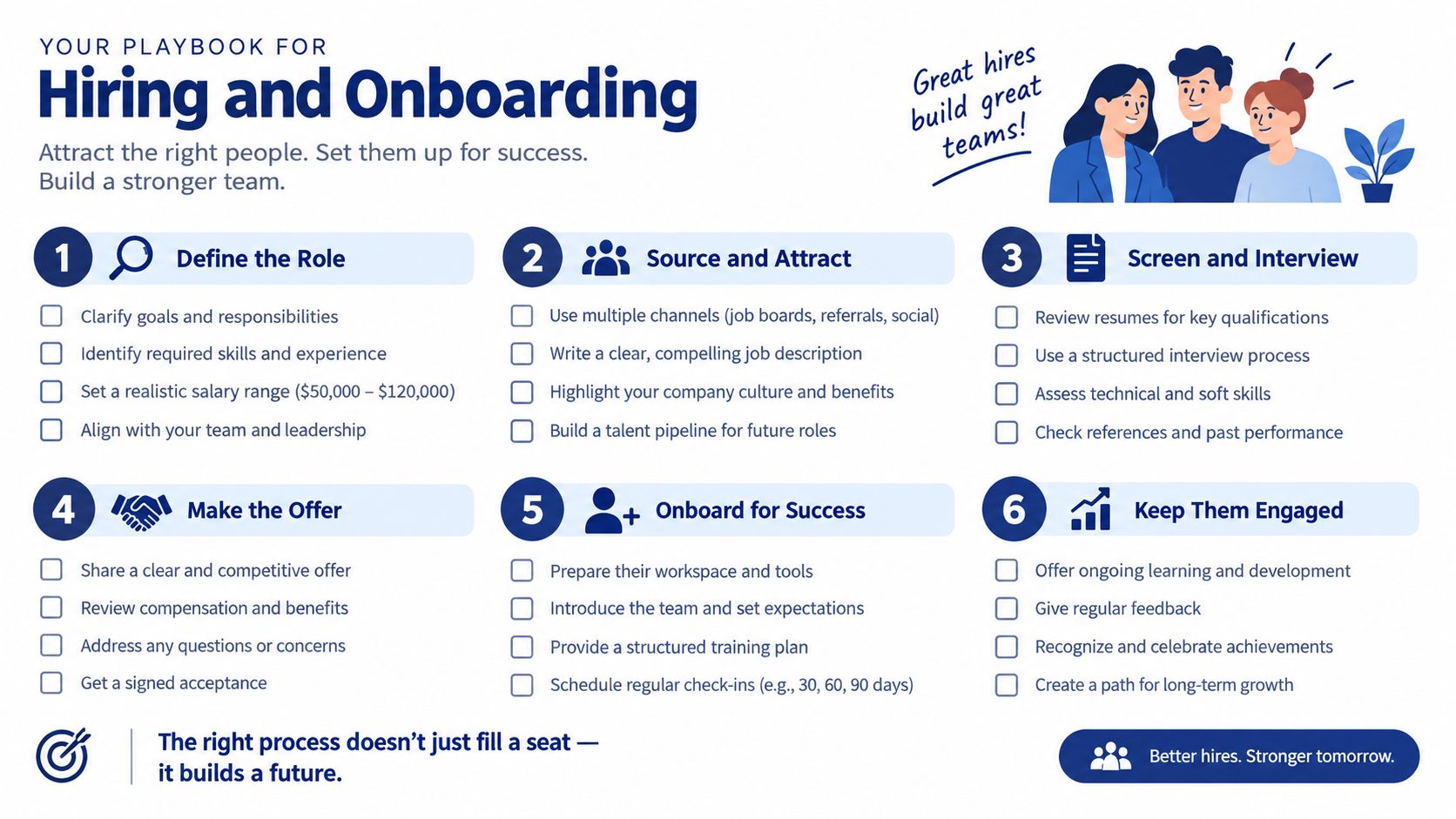
For a practical hiring checklist and role definition, use this guide to hiring a bookkeeper. The best hire isn't the person who promises to “keep an eye on things.” It's the person who can show exactly which accounts they'll reconcile, which reports they'll deliver, and what they'll escalate before the numbers become a fire.
HireAccountants helps US companies hire pre-vetted remote bookkeepers and other finance professionals for transaction processing, reconciliations, payroll support, and recurring reporting. If your books are behind or your job description is trying to cover three different finance roles, visit HireAccountants to find a practical fit for the work you need done.
Let's simplify your finances today!