


A prepaid expense is money paid for a future benefit, recorded on the balance sheet as an asset until the business consumes that benefit. A $12,000 annual insurance premium paid on January 1 would generally become $1,000 of insurance expense each month, not a $12,000 hit to January profit.
You've just wired the insurer, watched cash fall, and opened the profit-and-loss statement expecting a financial crime scene. The cash is gone, but the coverage hasn't been used yet. That apparent mismatch is exactly why accrual accounting treats the payment as a prepaid asset first, then recognizes the expense as the service period passes.
That answer covers the basic definition of what are prepaid expenses in accounting, but founders usually get hurt in the details. The journal entry is simple. Current versus noncurrent classification, book versus tax timing, materiality, and month-end controls are where the close starts growing teeth.
On January 1, a startup pays $12,000 for a 12-month insurance policy. The founder checks the bank account, sees the cash leave, then checks January's income statement and expects the full premium to appear as an expense. If it does, January profit looks artificially weak, while the later months look artificially healthy.
That treatment gets the timing wrong. The company bought coverage for future periods, so the unused coverage represents a future economic benefit. Under accrual accounting, the payment initially sits on the balance sheet as an asset rather than immediately reducing profit. The typical entry is a debit to Prepaid Expense and a credit to Cash or Accounts Payable, as described in the SEC-filed accounting policy on prepaid expenses.
The word “prepaid” doesn't mean the cost disappears. It means the accounting system is waiting for the company to receive what it paid for. Each month, the business consumes another slice of the insurance coverage, and the bookkeeper moves that slice from the balance sheet to the income statement.
The practical rule: Cash tells you when you paid. Accrual accounting asks when you received the benefit.
This is the same logic behind prepaid rent, annual software licenses, service contracts, advertising arrangements, and prepaid subscriptions. For a useful plain-English treatment of subscription commitments specifically, PlatformDTC's guide to prepaid subscriptions offers helpful context.
The distinction also explains why startups need to understand cash and accrual accounting methods. Cash accounting follows the payment. Accrual accounting follows the economic activity. Neither method changes the bank balance, but they can tell very different stories about a month's performance.
The January insurance payment, then, isn't a problem to hide. It's a balance-sheet asset waiting to be used. The work is making sure the asset moves to expense on schedule, lands in the right current or noncurrent category, and doesn't become an abandoned spreadsheet tab.
The mechanics are less mysterious than the terminology. Start by identifying three things: the amount paid, the service period, and the account that will eventually receive the expense.
For the annual insurance policy, the opening entry looks like this:
| Account | Debit | Credit |
|---|---|---|
| Prepaid Insurance | $12,000 | |
| Cash | $12,000 |
The debit creates an asset. The credit records the cash payment. No insurance expense appears yet because the company hasn't consumed the coverage.
At the end of the first month, record the portion used:
| Account | Debit | Credit |
|---|---|---|
| Insurance Expense | $1,000 | |
| Prepaid Insurance | $1,000 |
That recurring entry reduces the asset and recognizes the cost in the period that received the benefit. After the first month, the prepaid balance is $11,000, and the income statement carries $1,000 of insurance expense. The same monthly allocation continues until the policy has been fully recognized.
The initial debit and credit usually happen when Accounts Payable processes the invoice. The recurring adjusting entry is the one that gets missed when everyone is sprinting through close. The result is predictable: prepaid assets stay too high, expenses stay too low, and nobody notices until a reconciliation or audit forces an awkward conversation.
A schedule should show the start date, end date, original amount, monthly allocation, cumulative expense, and remaining balance. The journal entries examples from HireAccountants can help bookkeepers compare the mechanics with other common double-entry patterns.
The matching principle is the common-sense part. If the company receives insurance protection across the year, the expense should follow that protection across the year. Charging the entire premium to January would make January look worse than the service really was, then make the remaining months look better than they really were.
Monthly amortization isn't a religious ceremony for every tiny purchase, though. If an item is immaterial under the company's documented accounting policy, expensing it upfront can be practical. The policy, not personal preference at the keyboard, should determine the treatment.
A prepaid expense affects more than one line on the financial statements. The initial payment reduces cash and increases assets, but it doesn't reduce profit. The monthly adjusting entry then reduces the prepaid asset and increases expense, which lowers profit for that period.
For the $12,000 annual insurance example, the asset begins at $12,000, falls by $1,000 with each monthly entry, and reaches zero after the full coverage period. The income statement receives $1,000 of insurance expense per month. Cash left the business at the start, while profit reflects the steady consumption of coverage.
That distinction matters for founders who use current assets, working capital, or runway metrics to make decisions. A large prepaid balance can make current assets look stronger even though the cash is already gone. The asset represents remaining service, not money waiting in the bank.
Under ASC 340, classification follows when the company expects to consume the benefit, not merely when the invoice was issued or the payment cleared. Amounts used within the normal operating cycle generally belong in current assets, while a benefit extending beyond that period may require a noncurrent portion when material. The ASC 340 reference on prepaid expenses also highlights the need to evaluate assets for impairment at each reporting period.
Consider a SaaS company that pays for an 18-month subscription upfront. The portion expected to be consumed within the current operating period belongs in current assets. The remaining portion may need separate noncurrent presentation. Putting the entire amount in current assets is tidy, but tidy isn't the same as accurate.
A prepaid balance is not a cash balance with a fancy name. It's a claim on future service.
Outside support can earn its keep here. A provider offering CS Outsource accounting support may help maintain schedules and reconciliations, but the company still needs a policy that identifies service periods and flags longer-term benefits.
Impairment deserves attention too. If a contract is canceled, a vendor stops delivering, or the company no longer expects to receive the promised benefit, the remaining asset may not be recoverable. Leaving it untouched because “the schedule says so” is how a harmless-looking prepaid account becomes a financial statement problem.
Book accounting and tax accounting answer different questions. Financial reporting asks when the company consumed the benefit. Tax rules ask when the payment qualifies for deduction under applicable tax provisions.
For books, a benefit covering multiple periods generally gets allocated systematically over those periods. The company records an asset first, then recognizes expense as the service is received. Under the tax 12-month rule, a qualifying short-term prepaid amount may be deductible earlier when the benefit doesn't extend beyond 12 months after the right or benefit begins and doesn't extend beyond the end of the tax year following the payment year. IRS-related training materials summarized by BILL's prepaid-expense guidance describe prepaid expenditures as generally capitalized for tax purposes, subject to that short-term exception.
Take a startup that pays $9,000 in December for an annual software contract. For book purposes, the company may record a prepaid asset in December and recognize the software expense across the service period. If the arrangement qualifies under the tax rule, the business may claim the deduction on the current-year return instead.
The general ledger shouldn't be forced to pretend those two outcomes are identical. Track the difference on a tax-basis schedule or within the tax provision, then reconcile it to the book records.
| Aspect | Book (GAAP) | Tax |
|---|---|---|
| Initial treatment | Record a prepaid asset when the future benefit has not yet been consumed. | Prepaid expenditures are generally capitalized, subject to applicable exceptions. |
| Expense or deduction timing | Recognize expense systematically as the service period passes. | A qualifying short-term prepaid amount may be deducted under the 12-month rule. |
| Key test | When does the company receive the economic benefit? | Does the payment meet the rule's timing and benefit-period conditions? |
| Recordkeeping | Maintain the service period, allocation schedule, and remaining balance. | Maintain tax-basis support and document why the exception applies. |
| Financial statement effect | May show a prepaid asset and recurring book expense. | May produce an earlier tax deduction than book expense recognition. |
The dangerous shortcut is treating the 12-month rule as a GAAP rule. It isn't. A startup can have a book prepaid asset, monthly book expense, and an earlier tax deduction at the same time. That temporary book-tax difference is normal when documented, reconciled, and reviewed.
Not every prepayment deserves a handcrafted amortization schedule. A $47 annual SaaS subscription may technically cover a future period, but tracking twelve tiny monthly entries can cost more attention than the financial statement benefit justifies. That isn't disciplined accounting. It's administrative theater wearing a little green visor.
GAAP doesn't provide one universal dollar cutoff for every business. The sensible approach is to create a written capitalization threshold, apply it consistently, and revisit it when transaction volume, company size, or financial-statement risk changes.
Eastern Michigan University's published policy states that transactions below $10,000 don't have to be recorded as prepaid expenses because they're considered immaterial to its financial reporting, while reserving the right to review the threshold periodically (Eastern Michigan University prepaid-expense policy). That is an organization-specific policy, not a number every startup should copy blindly.
A useful one-page policy should answer practical questions:
A small annual subscription may be expensed immediately. A material multiyear contract should generally be tracked and allocated over the benefit period. The difference isn't special treatment for favored vendors. It's the result of applying a documented materiality policy to different levels of financial-statement risk.
Materiality gives you permission to be practical. It doesn't give you permission to be random.
The threshold should also reflect the company's reporting needs. A venture-backed startup preparing detailed monthly reporting may choose tighter controls than a small owner-managed business. What works is a consistent policy with evidence behind it. What doesn't work is changing the rule whenever someone wants a cleaner month.
Prepaid errors rarely announce themselves with fireworks. They sit in the balance sheet, collecting dust while the close becomes less trustworthy.
Skipping the adjusting entry. The prepaid never amortizes, so assets are overstated and expenses are understated. Fix it by attaching a recurring monthly entry to the schedule and reviewing the balance against the contract.
Leaving everything in current assets. A long-term software or service arrangement gets dumped into one current account. Fix it by documenting the consumption period and separating the current and noncurrent portions when material.
Treating the 12-month rule as GAAP. The tax deduction gets accelerated, and the book expense gets accelerated with it. Fix it by maintaining separate book and tax schedules instead of making the general ledger imitate the tax return.
Ignoring impairment. A canceled contract or unusable service remains on the books because nobody asked whether the benefit still exists. Fix it by adding an impairment question to each reporting-period review.
Hiding a material contract in a generic account. A $50,000 annual insurance policy with no supporting schedule is not a control system. It's a scavenger hunt for the auditor. Fix it by linking the invoice, contract dates, allocation method, and responsible reviewer to the prepaid record.
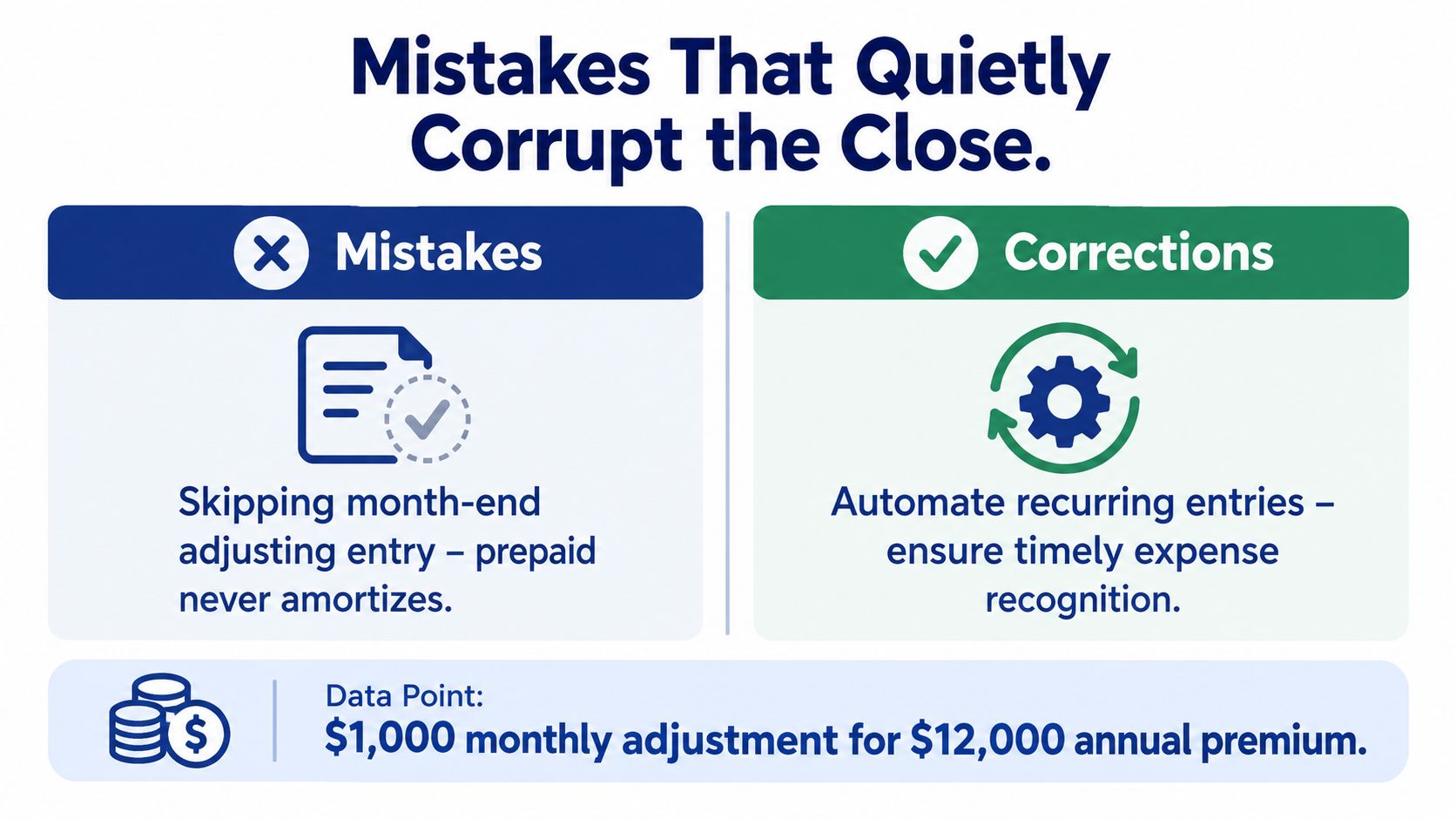
The $1,000 monthly adjustment for the annual insurance example is not difficult. The risk comes from relying on memory, scattered spreadsheets, or a bookkeeper who has to rebuild the schedule during every close.
Use a close checklist that confirms the opening balance, additions, monthly allocations, remaining balance, supporting documents, and current versus noncurrent classification. The month-end close best practices from HireAccountants provide a useful framework for turning that review into a repeatable control.
One more point: automation can post a correct-looking entry based on an incorrect service period. Software reduces keystrokes. It doesn't replace judgment. Someone still needs to read the contract.
Clean prepaid accounting comes from boring habits repeated without drama. Boring is good here. Boring closes beat heroic spreadsheet rescues every time.
Keep these controls in place:
A startup can manage five subscriptions manually. Fifty subscriptions, annual insurance, implementation fees, cloud commitments, and multiyear maintenance contracts create a different workload. At that point, a virtual bookkeeper or controller can own the schedules, reconciliations, and recurring entries while the founder focuses on decisions that require a pulse.
The principle remains simple: record the future benefit as an asset, recognize the expense as the benefit is consumed, and document the judgment behind the treatment. The accounting isn't hard. Letting the prepaid account rot because nobody owns it is hard, expensive, and entirely avoidable.
HireAccountants connects US companies with pre-vetted accountants and finance professionals who can handle prepaid schedules, monthly allocations, reconciliations, and broader month-end close work. If your subscription list is outrunning your bookkeeping process, visit HireAccountants to find accounting support that fits your workload and reporting needs.
Let's simplify your finances today!