


The founder says the group has only three entities. The controller hears three charts of accounts, two currencies, several shared-cost invoices, and an intercompany spreadsheet nobody fully trusts. Month-end arrives, one subsidiary has booked a service charge, another has missed the matching expense, and the consolidated result is suddenly a detective story.
That's the moment multi entity accounting stops being an administrative nuisance and becomes an operating-model problem. Software can calculate eliminations, but it can't decide who owns a mismatch, which entity controls an investee, or whether an invoice carries the right counterparty. Those decisions belong to people, policies, and evidence.
A founder I once knew described the structure as “simple.” There was a US parent, a foreign subsidiary, and a newly acquired operating company. Each had its own books, which sounded sensible. Then the first serious close exposed the actual setup: different account names, inconsistent invoice references, shared payroll costs, and an acquisition whose control assessment lived in somebody's email.
The issue wasn't that the team couldn't add trial balances. The issue was that the group needed to be reported as one economic enterprise while each legal entity still retained its own books for tax, statutory reporting, and audit. That distinction is the foundation of modern consolidation. US standards developed this model through FASB Statement No. 141(R) and Statement No. 160, issued in December 2007 after approximately 25 years of work on business-combination standards. The revised framework required consolidated statements to present 100% of acquired assets and liabilities, rather than only the parent's direct ownership percentage, and gave noncontrolling interests a distinct place in equity. (Journal of Accountancy)
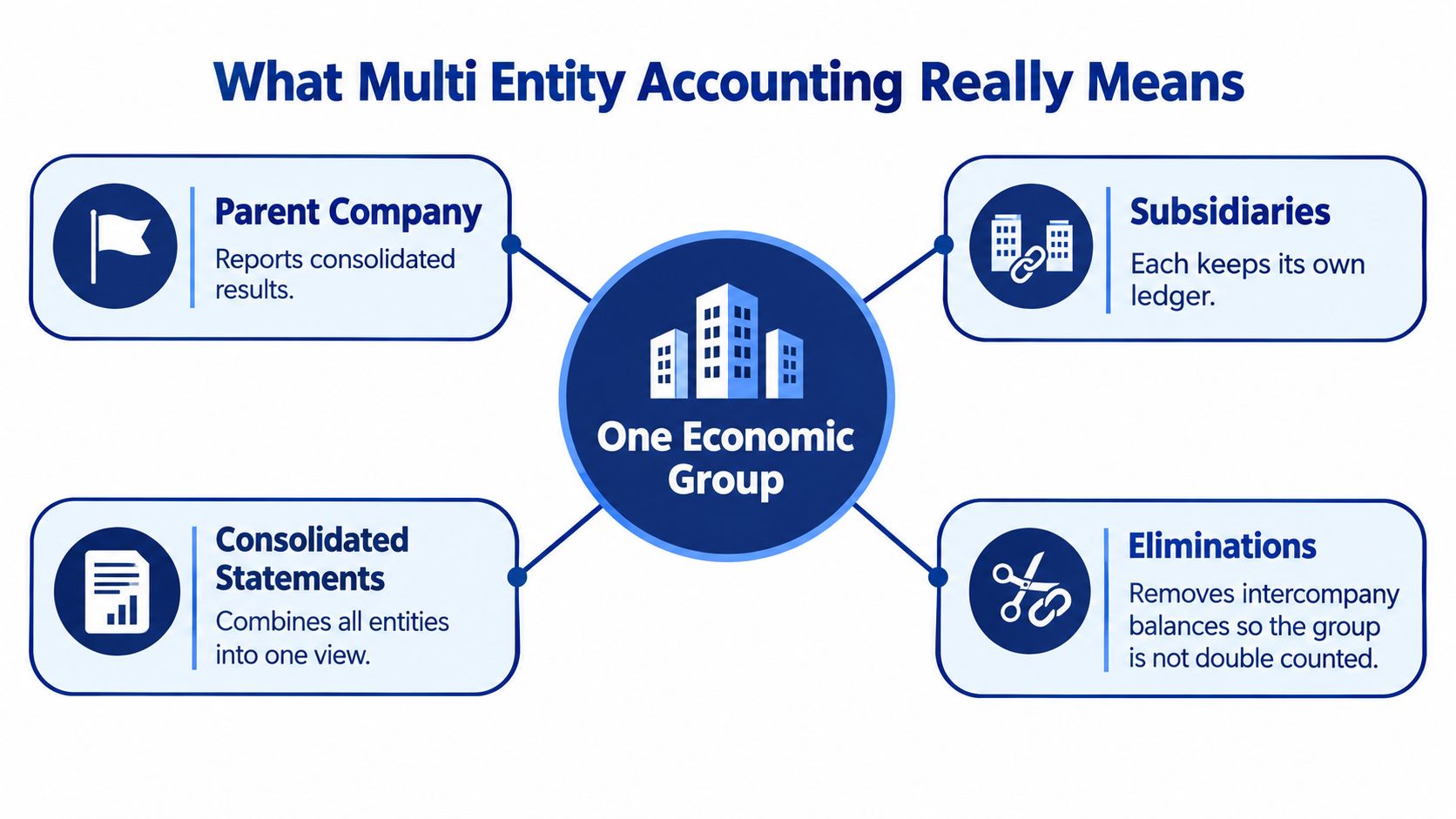
Control comes first. You need to determine which entities belong in the consolidated group, and that answer isn't always found by looking at voting ownership.
The chart of accounts comes next. Each entity can keep its local ledger, but the group needs consistent reporting categories and mappings. “Marketing,” “brand development,” and “customer acquisition” aren't interchangeable just because everyone knows what the business does.
Intercompany activity needs discipline. Internal sales, loans, shared services, interest, dividends, and balances may be valid legal-entity entries, but they aren't external group revenue or expense. They must be matched and removed from the consolidated view.
Currency translation needs rules. A foreign subsidiary's operating currency, transaction currency, and parent presentation currency can all differ. Treating every balance with one convenient exchange rate is a fast route to reconciliation trouble.
Acquisitions make the workload heavier. Under IFRS 3, an acquirer generally measures consideration at fair value, recognizes identifiable acquired assets and assumed liabilities at acquisition-date fair value, recognizes noncontrolling interests, and records the residual as goodwill or, in a bargain purchase, a gain. (IFRS 3 overview)
For a practical look at how this works in service businesses, the guide on multi-entity consolidation for agencies is a useful companion. The promise from here is straightforward: establish control, assign ownership, match counterparties, translate currencies correctly, and choose technology only after the operating model can survive a close.
Legal ownership is a clue. Control is the accounting conclusion. That distinction matters because a parent may control an investee without holding a majority of voting rights, while a substantial ownership interest may not create control.
Under IFRS 10, control requires three conditions: power over relevant activities, exposure or rights to variable returns, and the ability to use that power to affect those returns. The standard defines consolidated statements as presenting the parent and subsidiaries as one economic entity. (IFRS 10)
ASC 810 applies the same practical pressure from a US GAAP perspective. The finance team can't stop at the ownership percentage and call the work finished. Governance agreements, board appointment rights, contractual decision rights, potential voting rights, and the difference between substantive and protective provisions can change the conclusion.

Create an entity-control matrix and treat it as a living control document, not an acquisition-day formality. At minimum, record:
Document the conclusion when the entity enters the group. Reassess it when financing arrangements, governance agreements, board rights, or decision-making authority change. A stale control memo is not evidence of control. It's a souvenir from a previous capital structure.
Practical rule: Preserve each entity's ledger, then layer the consolidation rules above it. Auditability depends on tracing every consolidated balance to the legal entity and the documented control assessment.
This architecture also determines your software configuration. If the system can't retain entity-level source data, control conclusions, ownership details, and elimination logic, it may produce a polished report that nobody can defend. That's not automation. That's decorative risk.
Intercompany accounting is where tidy organizational charts meet messy month-end reality. A parent books a receivable, a subsidiary books a payable, the invoice dates differ, the currencies move, and both teams insist their side is correct. Then someone asks why consolidated revenue includes a sale from one pocket to another.
Under US GAAP consolidation guidance, intra-entity open-account balances, securities, sales, purchases, interest, dividends, and other transactions must be eliminated because the consolidated statements represent a single economic entity. ASC 810 requires elimination in full, even when noncontrolling interests exist. (PwC intercompany guidance)
Intercompany activity can represent a median 50% of journal-entry line items, according to the available benchmarking cited by Intuit. (Intuit multi-entity challenges) That isn't a minor reconciliation chore. It's a core operating process.
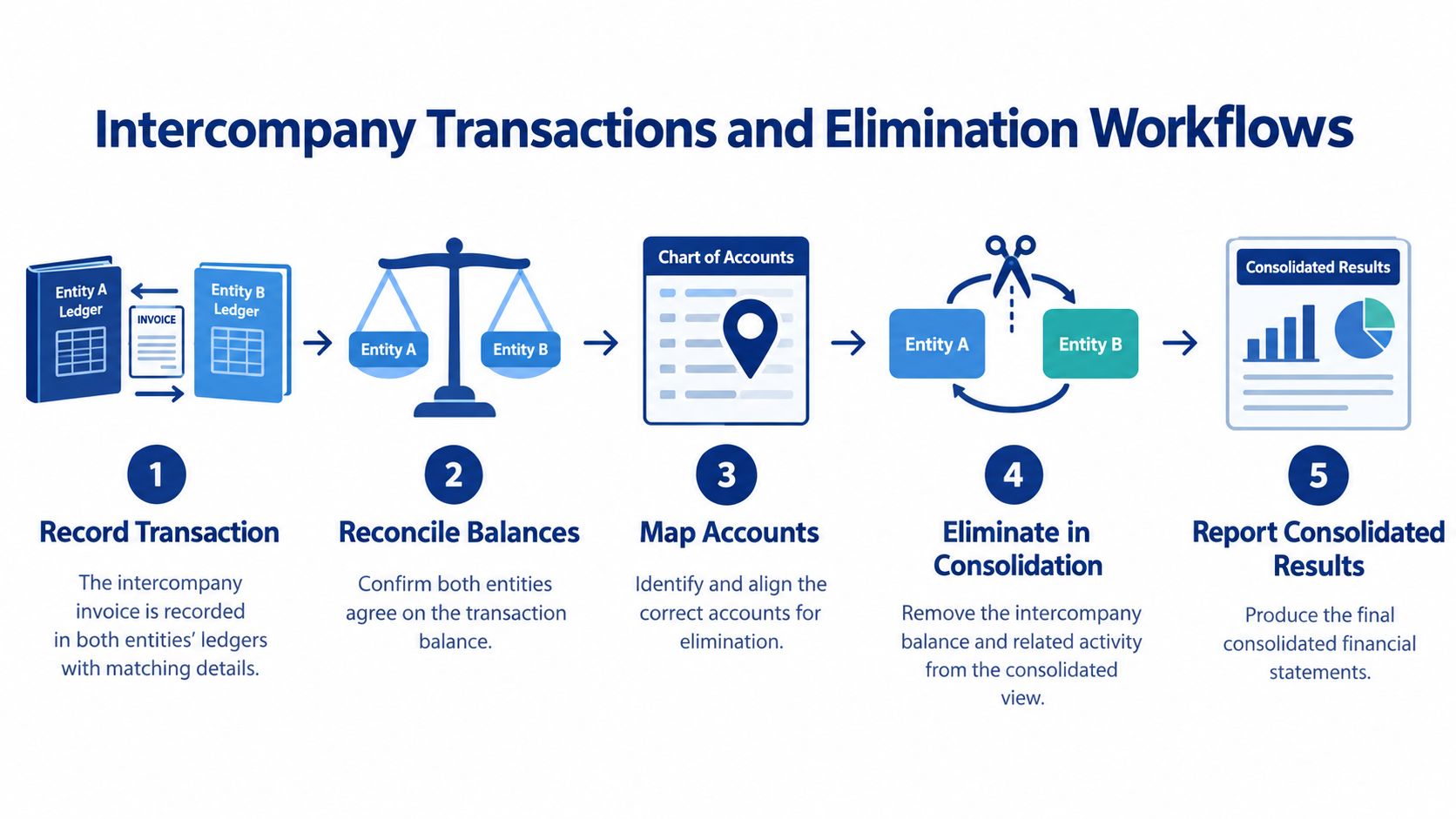
First, match the balances. Every transaction should carry an intercompany ID, counterparty, transaction type, currency, period, and elimination status. The parent receivable and subsidiary payable need to point to the same economic event, not merely have similar descriptions.
Second, eliminate the transaction. Remove the reciprocal balances and internal income and expense from the consolidated result. The same applies to internal loans, interest, dividends, sales, purchases, and related gains or losses.
Third, release deferred profit. If one entity sells inventory or another asset to a group company and profit remains embedded inside the group at period-end, eliminate the unrealized profit. Release it when the asset leaves the group or the relevant economic event occurs.
Ownership must be explicit. Assign one person to the originating side and one to the receiving side. Set a cut-off calendar, define the evidence required, and use a dispute service-level agreement that says when an unmatched item must be resolved or escalated. A pre-close exception dashboard should show stale balances, missing counterparties, currency differences, and transactions lacking approval.
Shared services deserve their own templates. HR, technology, rent, and central marketing charges should use documented allocation drivers, recurring journal rules, and a named reviewer. Transfer pricing also needs local analysis rather than a casual “management fee” label. For groups operating in Ireland, this overview of Irish transfer pricing strategy provides useful context for documenting related-party pricing.
Use a transaction-level reference alongside broader guidance on what intercompany accounting involves. The accounting entry is the output. The operating model is what prevents the entry from becoming a monthly surprise.
Currency problems rarely announce themselves as currency problems. They appear as unexplained margin movement, a balance-sheet fluctuation, or a consolidation difference that someone blames on “the FX file.”
IAS 21 starts with functional currency, the currency of the primary economic environment in which the entity operates, usually where it primarily generates and spends cash. A Mexican subsidiary that earns and spends primarily in pesos doesn't become dollar-functional because its US parent reports in dollars. The parent's presentation currency changes the reporting view, not the subsidiary's underlying economics. (IAS 21)
Ask these questions in order:
The measurement rules then depend on the item. Monetary balances, such as cash, receivables, and payables, use the closing rate at period-end. Nonmonetary items measured at historical cost retain the transaction-date rate. Nonmonetary items measured at fair value use the rate on the date fair value was measured.
“Use one exchange rate for everything” isn't an accounting policy. It's how reconciliation fires start.
Don't change functional currency because exchange rates moved or because the parent wants a cleaner report. IAS 21 permits financial statements to be presented in any currency, but a functional-currency change requires a change in the underlying transactions, events, and conditions. (IAS 21 functional currency requirements)
Your close file should identify the functional currency conclusion, the approved exchange-rate sources, the rate applied to each balance category, and the owner of translation differences. Reconcile translated trial balances back to the foreign entity before investigating consolidated movement.
Forecasting needs the same discipline. Forecast operating drivers in the currency that reflects the economics, then translate the management view into the reporting currency. Treasury may need a separate cash view based on actual bank currencies. One number can serve several audiences only if the underlying currency definitions stay visible.
A consolidation system can't rescue an account structure that means different things in different ledgers. It can map “travel” to “travel,” but it can't decide whether one entity's “contractor expense” belongs with another entity's cost of revenue, research, or general administration.
The right target isn't always an identical local chart. Local statutory requirements, tax reporting, and operational detail may justify entity-specific accounts. The group needs a controlled reporting taxonomy that preserves local detail while making consolidated treatment predictable.
| Strategy | Best Fit | Main Trade-off |
|---|---|---|
| Uniform chart of accounts | Groups with similar operations and centralized finance policies | Simple consolidation, but local teams may lose useful detail |
| Mapped chart of accounts | Acquisitions or entities using different accounting systems | Preserves local ledgers, but mapping maintenance becomes a permanent control |
| Entity-specific extensions | Businesses with materially different products, regulations, or cost structures | Better operating visibility, but group reporting needs stronger dimensional rules |
A uniform chart is attractive when the entities do similar work. Don't force it on a manufacturing subsidiary and a software parent just because matching account numbers feels tidy. A mapped structure usually works better after acquisitions, provided every local account has an approved group destination and an owner reviews new accounts before posting.
Entity-specific extensions can coexist with a common group spine. The group might require standard revenue, payroll, cash, intercompany, and tax categories while allowing local teams to add operational accounts underneath. The rule is simple: local flexibility must not create group-level ambiguity.
Use this practical reference on what a chart of accounts is before redesigning the structure. Then preserve the entity ledger and add dimensions for entity, counterparty, currency, department, project, and reporting category where needed.
CFO rule: Mismatched account names cause more elimination pain than mismatched numbers. If two teams describe the same economic event differently, the close team pays the translation tax.
Review mappings during onboarding, after acquisitions, and whenever a new recurring transaction appears. Give someone authority to reject vague account names. “Other operating expense” is not a strategy. It's a future audit question wearing a cardigan.
Software matters, but it can't compensate for an ownerless close. Buying a consolidation suite before standardizing counterparties is like buying a faster ambulance while leaving the potholes in place.
Spreadsheet stacks with manual journals work when the group is small, transactions are limited, and one experienced person knows every exception. They fail when version control, formula integrity, evidence retention, and timing depend on memory. A spreadsheet can model the answer. It rarely governs the process that produces it.
Mid-market consolidation suites from major ERP vendors can enforce entity structures, mappings, eliminations, approvals, and audit trails. They also demand disciplined implementation. Poorly defined dimensions become expensive, system-enforced confusion.
Outsourced multi-entity teams can provide recurring bookkeeping, reconciliations, AP and AR coordination, and close support without requiring the CFO to build every capability internally. The risk is handoff failure. If the provider doesn't receive clear policies, ownership rules, and evidence standards, the business has outsourced the chaos rather than the work.

Assess the number of entities, currencies, systems, transaction volume, control complexity, and internal appetite for owning the close. A small group may need a structured process and competent operators before it needs a large platform. A growing international group may need system-enforced consolidation, but only after the control matrix and chart mappings are ready.
For currency-heavy groups, Zaro's multi-currency accounting overview is useful when comparing how tools approach exchange-rate handling and reporting. Integration deserves equal attention. The right accounting software integration approach should preserve source transactions, counterparty data, approval evidence, and entity-level traceability.
HireAccountants is one staffing option for companies that want dedicated bookkeeping and accounting support across multi-entity books. The platform connects US companies with pre-vetted remote finance professionals who can support bookkeeping, reconciliations, intercompany work, and FP&A tasks. Treat that as capacity, not a substitute for policy.
Tax consolidation and management consolidation answer different questions. Don't let a tax election decide your management reporting structure, and don't assume a consolidated management view automatically determines tax treatment.
Under US tax rules, an affiliated group generally requires a parent and subsidiaries with at least 80% ownership, measured by both voting power and stock value. Section 1504 uses the 80% test for total voting power and total stock value. Once eligible corporations elect to file a consolidated federal return, profits of one affiliate can generally offset losses of another, while many intercompany transactions are deferred until the relevant transaction occurs with a nonmember. (PwC US group taxation)
The finance team also needs three separate reporting layers:
The planning gap is real. Only 17% of treasurers reportedly have complete near-real-time visibility, while 45% of companies report inadequate reporting and analysis capabilities. (Intuit FP&A challenges) Consolidation latency can therefore distort runway, hiring decisions, pricing analysis, and weekly cash planning. Faster aggregation won't fix inconsistent definitions or stale intercompany balances.
Weekly: review cash by entity and currency, open intercompany exceptions, new accounts, unusual allocations, and ownership changes. Escalate stale items before they become close-day archaeology.
Monthly: lock the transaction cut-off, reconcile reciprocal balances, post approved allocations, run elimination logic, review translation, and preserve the evidence trail. The controller should see the exception dashboard before the consolidated report, not after it.
Quarterly: reassess control conclusions, tax-group eligibility, transfer-pricing documentation, chart mappings, FX policies, and the performance definitions used by FP&A. Add entities to the operating model, not merely to the software.
The objective isn't continuous consolidation for its own sake. It's continuous data availability with clear accountability. A group that knows who owns each balance, which currency measures each operation, and how every elimination ties back to source data can close with confidence. Toot, toot, that is the part that helps the board make decisions.
HireAccountants offers pre-vetted remote bookkeepers and finance professionals who can support multi-entity bookkeeping, intercompany reconciliations, AP, AR, and FP&A workflows. Visit HireAccountants to add close capacity without pretending another spreadsheet will solve an ownership problem.
Let's simplify your finances today!