


Most advice about financial planning and analysis services starts in the wrong place. It tells every startup to buy planning software, build a three-statement model, and hire a strategic finance leader before anyone has reconciled the books. That's how a cash-strapped company ends up with an expensive dashboard answering questions nobody trusts.
FP&A earns its keep in sequence. Clean reporting first. Driver-based cash forecasting next. Decision support after the data deserves confidence. If your founder is squinting at a spreadsheet asking whether the company can afford two more hires, the answer shouldn't require a finance transformation project. It should require a clear view of cash, hiring timing, revenue assumptions, and downside risk.
The function has moved well beyond annual budgeting. In PwC's May 2024 Pulse Survey, 58% of CFO respondents said they were spending more time on FP&A and business-performance management than a year earlier, while 56% named margin improvement a priority for the next 12 months and 44% said greater use of technology to reduce costs was very important. Those findings are a useful reality check for smaller businesses too. FP&A exists to connect financial data with operating decisions, not to produce prettier charts. (PwC survey findings reported by CFO)
A practical explanation of financial analytics services helps clarify the analytical layer, while this guide focuses on how to buy and stage the broader finance function. We'll separate useful deliverables from decorative finance theater, show when outsourcing makes sense, and explain why the right first hire may be an analyst rather than a CFO.
FP&A earns its keep after the budget is approved. A budget records what management expects. FP&A tracks what is happening, explains the gap, and connects the next decision to cash, margin, and operating capacity.
A bookkeeping team can show that payroll increased last month. FP&A investigates whether planned hiring, overtime, commissions, or timing caused the change, then models how each explanation affects runway and profitability. That analysis gives a founder a clearer basis for deciding whether to hire salespeople, increase marketing spend, or protect cash.
A useful FP&A service answers forward-looking questions:
The work depends on accounting records, operating data, explicit assumptions, and someone willing to challenge the explanation behind the numbers. FP&A turns historical performance into a decision system for the months ahead.
A practical guide to financial analytics services explains the analytical layer. The broader finance function should be staged around decisions, not sold as a bundle of disconnected deliverables. Start with reporting that people trust, add driver-based cash forecasting, then build decision support once the underlying data is reliable.
Finance-system modernization can support that sequence. Guidance on how CTOs modernize finance systems is useful when evaluating integrations and workflow improvements. Technology should reduce manual work and improve data access. It cannot decide whether a revenue assumption is credible or whether a hiring plan fits the company's cash position.
Founder-CFO rule: If a report does not change a hiring, pricing, spending, fundraising, or operating decision, it is probably paperwork with a blazer.
Startups and midsize businesses face the same management pressures as larger companies, only with less room for error. Leaders need clearer margin visibility, tighter cost control, credible forecasts, and fast explanations when results miss plan.
Those needs also make flexible staffing sensible. A cash-strapped company rarely needs a full FP&A department on day one. It needs the next usable capability: dependable reporting first, a forecast tied to operating drivers next, and decision support after the numbers have earned confidence.
The smart move is to buy only the analytical capacity the business can use now. That approach keeps finance connected to action instead of turning it into an expensive collection of templates, dashboards, and recurring meetings.
Consider a fictional SaaS company called Northstar. It sells workflow software, has recurring revenue, a sales team, customer support, and a founder who still approves too many expenses personally. Northstar doesn't need five disconnected FP&A products. It needs one connected operating rhythm.
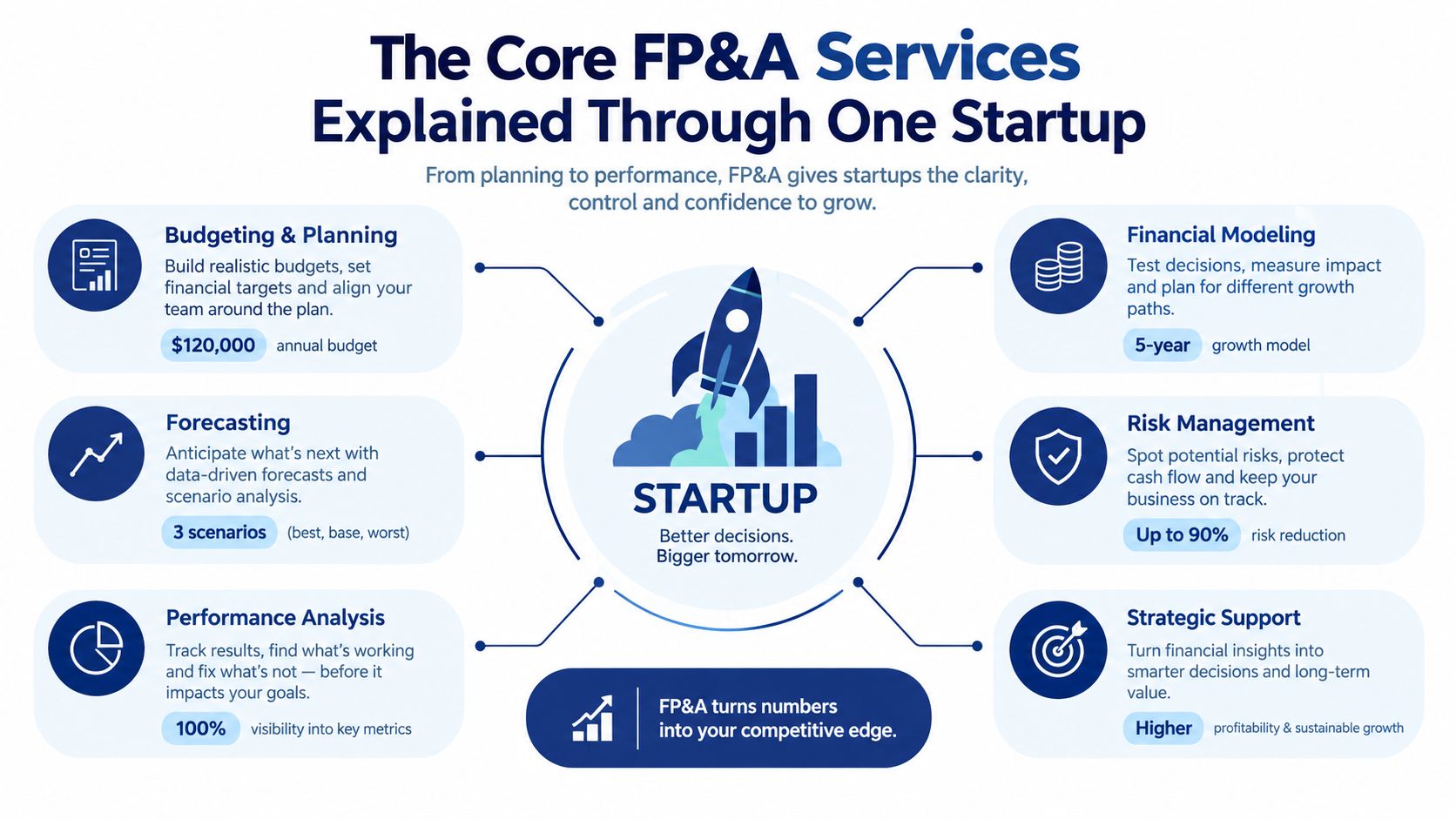
Northstar starts with a budget covering expected revenue, payroll, software, marketing, contractors, and other operating costs. The budget gives department leaders boundaries and makes resource trade-offs visible.
But a budget isn't a prophecy. It's a set of assumptions approved at a point in time. Providers often pad the work with detailed tabs, department templates, and colorful charts that look impressive but don't help management decide anything. A budget is useful only when the assumptions are clear enough to challenge.
The forecast updates the budget using current evidence. If Northstar's sales pipeline weakens, collections slow, or hiring shifts, the forecast changes. It should show the expected path from the current position, not preserve the original plan for sentimental reasons.
A rolling forecast extends the planning window as each period closes. That gives leadership a current view of cash, revenue, expenses, and resource needs instead of forcing everyone to wait for the next annual planning cycle.
Suppose Northstar misses its revenue forecast. “Revenue unfavorable” is not an explanation. The analyst should separate the miss into volume, price, mix, and timing, then identify the owner and response for each driver.
A volume problem may require sales intervention. A pricing problem may require packaging changes. A timing problem may require better deal-stage assumptions. The report earns its keep when it explains what happened and what someone should do about it.
Northstar models a best case, worst case, momentum case, and most likely case. McKinsey recommends separating the momentum case from management's planned initiatives so leaders can see what the business might do on its own before claiming credit for new pricing, hiring, marketing, or product decisions. (McKinsey guidance on scenario planning)
The scenario most teams forget: Model momentum separately from the plan. Otherwise, every forecast quietly assumes management's initiatives work.
Northstar can then ask practical questions. What happens if sales slow? What happens if hiring accelerates? What happens if gross margin compresses? Scenario modeling isn't about guessing the future with theatrical confidence. It's about agreeing in advance on what management will do when conditions cross a threshold.
Northstar doesn't need a dashboard containing every available metric. It needs a small set connected to its model, such as new customers, conversion, average contract value, churn, headcount, gross margin, collections, and cash runway.
A dashboard that doesn't connect operational activity to financial outcomes is decoration. The best version lets the sales leader see how pipeline affects revenue, the customer team see how churn affects growth, and the founder see how hiring affects cash.
A real engagement produces working tools, not a monthly PDF that politely documents the financial equivalent of a small fire. The deliverables should make the company's financial position easier to understand and its next decisions easier to make.
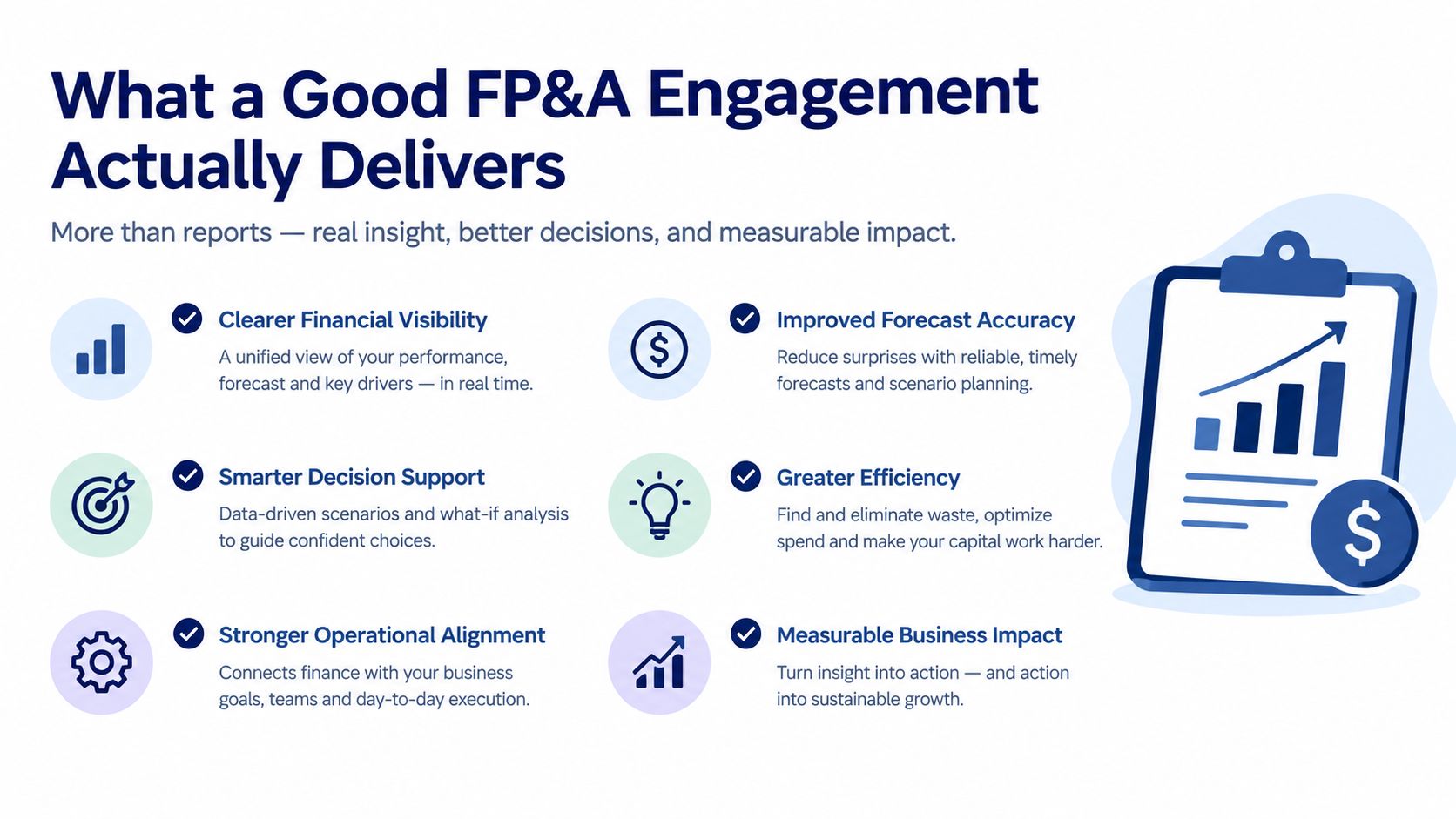
A sensible monthly FP&A package usually includes:
The package should answer five questions quickly: What happened? Why did it happen? What changed in the outlook? What needs attention? Who owns the response?
You don't need a perfect data warehouse to begin. You do need consistent inputs from QuickBooks, the bank, payroll, the CRM, and billing systems. The provider should document which system is authoritative for each field, how often data is updated, and how missing or conflicting records are handled.
FP&A teams still spend 46% of their effort collecting and validating data, leaving only 31% for insight and action, and only 2% of surveyed teams describe themselves as fully effective. (EY FP&A operating-model research)
Those figures explain why data cleanup belongs near the front of the engagement. If an analyst spends the month stitching together inconsistent exports, management pays for data janitorial work and receives very little decision support.
Ask the provider to show a sample reporting calendar, model architecture, variance commentary, and assumption register. Don't judge quality by page count or visual polish. Judge it by whether the leadership team can make a decision faster and defend the reasoning afterward.
A good engagement also separates monthly work from quarterly work. Monthly work should focus on close, reporting, forecast updates, and actions. Quarterly work can revisit the model structure, scenario assumptions, KPI usefulness, and whether the business still measures the right drivers.
Forecast credibility comes from a model tied to operating drivers, clear ownership, a fixed refresh rhythm, and disciplined review of misses. Complexity is optional. Accountability is not.
A driver-based model calculates revenue from measurable inputs such as customers, conversion, average contract value, usage, and churn. It connects expenses to headcount, compensation, vendor rates, transaction volume, and capacity.
That structure gives management specific levers to test. If revenue falls, the analyst can examine lower conversion, weaker volume, slower expansion, or higher churn. If costs rise, the model can test hiring timing, compensation, vendor rates, and activity levels instead of applying a broad percentage adjustment to every line.
A 2025 FP&A survey from FP&A Trends and OneStream found that 77% of organizations using dynamic or fully driver-based models rated their forecasts as good or great, compared with 49% using less dynamic approaches. The survey also found that 20% of organizations with fully or dynamically driver-based models could produce a forecast in under two days, while 38% of teams using static models required more than 10 days.
Every major driver needs four things:
Without ownership, assumptions become group folklore. Without a source, the model becomes a spreadsheet debate. Without variance history, the team repeats the same forecasting errors with impressive consistency.
A stable business may refresh monthly. A company dealing with fast-moving cash, demand, collections, or churn should refresh more often. McKinsey research on rolling forecasts describes rolling forecasts as frequent, predictable updates to key inputs while extending the forecast window, and recommends modifying them at least twice per quarter during volatile periods.
A base case, upside case, downside case, and liquidity-stress case should each connect to an action. If cash collections fall below an agreed threshold, delay discretionary spending. If churn rises beyond the planning assumption, review customer retention initiatives. If hiring demand accelerates, test the payroll and cash impact before approving roles.
Structured scenario planning improves operating discipline. Association for Financial Professionals benchmarking found that organizations with structured scenario-planning processes used rolling forecasts more often, 57% versus 33% among organizations without structured scenario planning. They also tracked forecast accuracy more frequently and completed annual budgets approximately 11% faster, 8.1 weeks versus 9.2 weeks. (Association for Financial Professionals benchmarking data)
Back-test projections against actuals and decompose every meaningful miss into causes. McKinsey guidance on advanced FP&A practices recommends projections-versus-actuals comparisons to reduce future variance, with reviews as frequent as weekly when conditions demand it.
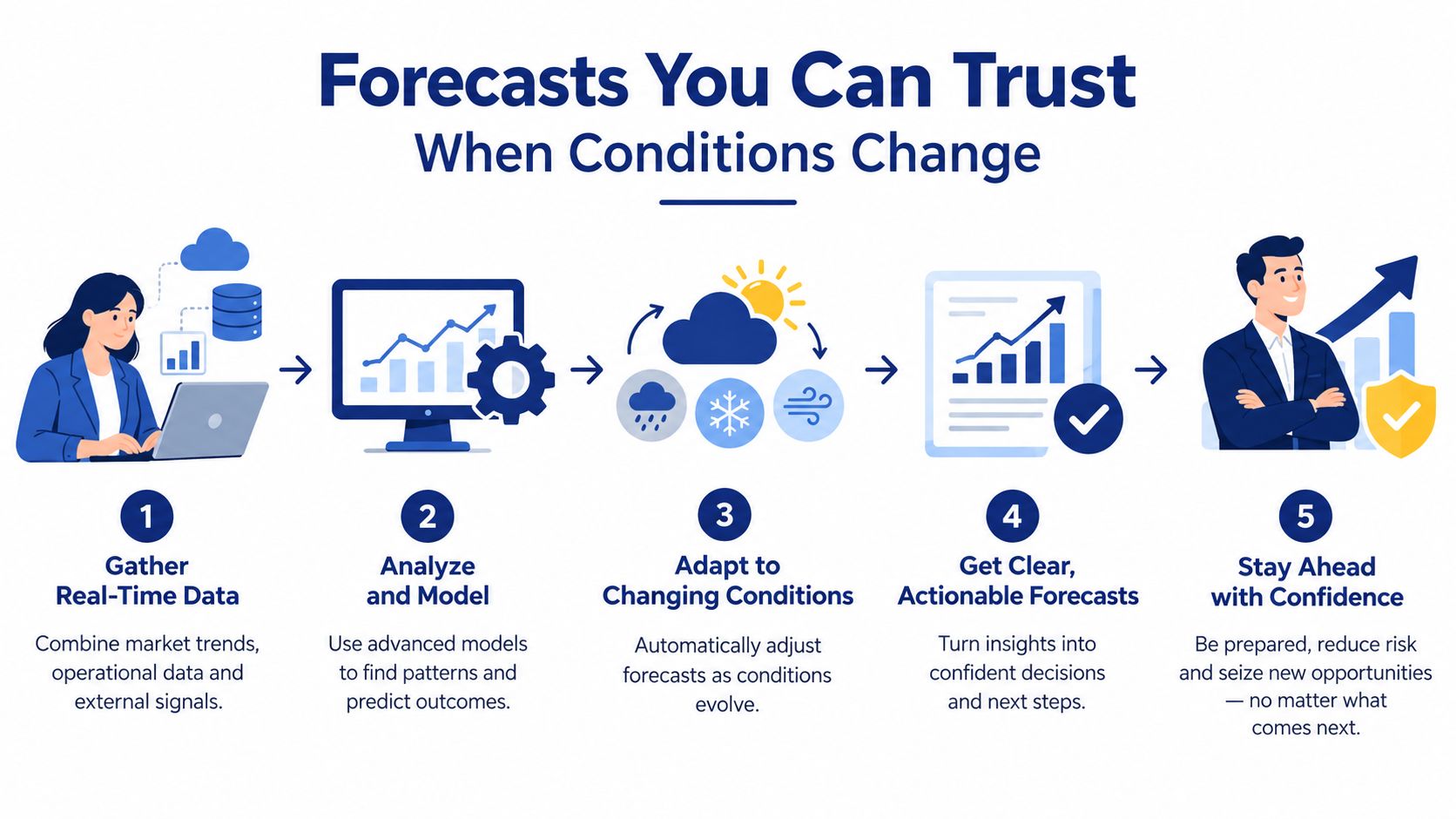
For practical guidance on connecting assumptions, cash movement, and operating plans, business planning and financial forecasting provides a useful reference. The model matters, but the operating rhythm matters more.
The most expensive FP&A mistake is buying strategic sophistication before fixing basic trust. A startup with fragmented systems, unreliable close data, and no consistent monthly reporting shouldn't begin with planning software or an expensive strategic FP&A lead.
Start with bookkeeping cleanup and standardized monthly reporting. If the profit and loss is inconsistent, accounts are uncategorized, or revenue timing changes from month to month, an advanced forecast turns unreliable history into confident-looking fiction.
The minimum viable data may already exist in QuickBooks, bank exports, payroll, CRM records, and billing reports. You don't need to wait for perfect integration, but you do need to define how those sources reconcile and who owns the process.
You're ready for rolling forecasts when management can explain the last reporting period without arguing about which number is real. You're ready for broader scenario modeling when operating drivers have owners and enough historical context to support a reasonable assumption.
You're not ready when a provider promises artificial intelligence will solve disconnected systems. Automation can move information faster. It can't repair an undefined metric, an unowned assumption, or a bookkeeping process that changes every month.
The buyer question that matters: Don't ask only, “What does FP&A cost?” Ask, “Which finance work creates decision value first?”
That answer is usually less glamorous than a software demo. It may be cleanup, cash forecasting, and a short monthly report. Good. Glamour doesn't pay payroll.
The staffing model should match how complex the business actually is, not how mature the founder wants it to appear. A pre-seed company rarely needs a full internal FP&A department. A business with multiple products, departments, entities, and recurring planning decisions may eventually need permanent ownership.
Small companies also compete with larger employers for finance talent, which makes a full-time hire slower and more expensive to secure. Labor demand for analytical finance roles remains strong, so an SMB should buy the capability it needs before building a department around it.
| Model | Typical Cost | Speed to Value | Best Fit |
|---|---|---|---|
| In-house | Salary, benefits, recruiting, management, and tools | Slower, because hiring and onboarding take time | Companies with sustained complexity and a need for internal ownership |
| Outsourced | Engagement-based fees tied to defined deliverables | Fast, especially for reporting, forecasting, and model builds | Startups and SMBs that need capability without a permanent department |
| Fractional | Recurring access to a senior operator for selected hours or outcomes | Fast to moderate, depending on data readiness | Businesses that need judgment and leadership without full-time capacity |
Pre-seed and seed companies should outsource reporting first. Get a dependable monthly close view, cash position, and management report before paying for elaborate forecasting. Once those numbers reconcile, add driver-based forecasting. Use fractional support for occasional decisions such as hiring, pricing, fundraising, or major spending.
Series A and growing midsize companies should use a hybrid model. A fractional finance leader can set the operating cadence and challenge assumptions, while an analyst handles recurring reports, model updates, and data preparation. That division keeps senior judgment focused on decisions instead of spreadsheet maintenance.
More complex businesses should consider an in-house hire. If management makes frequent pricing, hiring, capacity, or capital-allocation decisions, someone inside the company needs durable context and authority. Outsourced support can still cover specialist work, transition periods, or projects that do not justify another permanent role.
In-house support fails when the company hires a talented analyst without clean data, clear priorities, or a manager who understands the business. Outsourced support fails when the provider delivers generic templates and disappears between reporting cycles. Fractional support fails when leadership expects a few hours per month to replace a complete finance function.
Choose the model around the decisions that need better evidence and the ownership those decisions require. Start with reporting, add forecasting once the inputs work, then pay for decision support where it can change an outcome. More headcount does not automatically create more control. Sometimes it adds another person waiting for the same broken export.
Remote hiring works when you test the work, not the résumé. A candidate can list forecasting, modeling, and variance analysis while still producing a useless report. Give candidates a small work sample using sanitized company data and ask them to explain their assumptions aloud.
Test three things:
Check time-zone overlap, English fluency, responsiveness, and comfort working across QuickBooks, spreadsheets, CRM exports, payroll data, and billing records. Don't run a trivia contest on obscure Excel functions. You're hiring someone to improve decisions, not win spreadsheet bingo.
For context on evaluating senior finance backgrounds, a StoryCV CFO resume guide can help you distinguish career claims from evidence of actual operating responsibility. For the practical hiring route, financial analyst hiring is relevant when you need a pre-vetted finance professional rather than a long recruiting campaign.

A sensible first 90 days looks like this:
That's the standard. FP&A is worth paying for when it changes what the company does. Start with clean data and a capable remote analyst, then add senior strategy when the business has enough complexity to use it.
HireAccountants connects U.S. companies with pre-vetted accountants and finance professionals for flexible support across reporting, budgeting, forecasting, and analysis. Visit HireAccountants to find finance talent that can help you build the right FP&A capability in the right sequence, without rushing into a full-time department.
Let's simplify your finances today!