


The email lands late on a Thursday: a lender wants audited financial statements, an investor has added an audit condition, or a potential buyer needs clean numbers before it'll keep talking. Suddenly, hiring an auditor feels urgent. Your finance lead is asking what kind of audit, your bookkeeper is recommending a friend, and a large firm has sent a proposal with enough fine print to qualify as bedtime reading.
Don't start by comparing logos or fees. Start by figuring out what you need the auditor to do, who can do it independently, and who'll have enough time and skill to do it properly. An audit isn't just a purchase. It's a governance and risk decision, especially if the same person has been keeping your books and is now offering to audit them.
The panic usually starts with a deadline. A lender asks for audited financial statements; an investor wants assurance before closing; an acquirer wants to understand the quality of earnings. The tempting move is to search for a CPA and ask for a quote. The better move is to identify the engagement first, because “auditor” can mean several very different jobs.

An external financial statement audit gives an independent opinion on whether financial statements are fairly presented under the relevant reporting framework. That's the right lane when a lender, investor, regulator, or transaction partner requires audited statements. If you're preparing for a financing or sale, organize the underlying records before fieldwork; this financial due diligence checklist can help you spot missing support before it becomes an audit delay.
An internal audit examines how your company manages risk, controls, and processes. It can focus on a particular area, such as revenue approvals, cash access, or purchasing. It isn't a substitute for an external financial statement audit, and it shouldn't be performed by someone reviewing their own work.
A SOC report addresses controls relevant to customers' use of your services, often in a technology or outsourced-services context. A prospective customer asking about security and service controls may need a SOC engagement, not audited financial statements.
A regulatory or compliance review tests whether your company meets requirements that apply to its industry, contracts, or operating locations. The scope depends on the rules or obligations involved. “We need an audit” isn't enough detail to hire the right specialist.
Some early-stage companies may be able to meet a stakeholder's needs with a review or compilation instead of a full audit. A review provides less assurance than an audit, while a compilation organizes financial information without providing an audit opinion. Ask the lender or investor what it will accept before you sign an engagement letter. Paying for the wrong service is an expensive way to discover that someone wanted a different deliverable.
The U.S. Bureau of Labor Statistics reported approximately 1.6 million accountant and auditor jobs in 2024, a median annual wage of $81,680 in May 2024, and roughly 124,200 projected openings per year through 2034 (BLS occupational outlook data). That's a broad labor-market benchmark, not proof that every candidate has the specialization or independence your engagement requires.
If you're trying to sort out the external financial statement option in particular, this guide on how to choose a statement auditor offers useful context. Before contacting firms, write down who requires the work, what deliverable they'll accept, and when they need it. That simple diagnosis keeps you from shopping for a generic CPA when the actual need is a specific kind of assurance.
A vague scope is how an apparently reasonable proposal turns into a mid-engagement fee surprise. Firms can't price the same work if one assumes a single entity and another includes subsidiaries, multiple locations, and a second reporting framework. Fix the basics first, then ask for proposals.
Start with the purpose: lender requirement, investor reporting, internal control assurance, customer assurance, or regulatory compliance. Then identify the engagement type and reporting framework. A U.S. GAAP audit, an IFRS engagement, and a statutory audit aren't interchangeable labels. Ask the party requesting the work what it needs, and confirm the framework with a qualified professional before inviting bids.
Next, define the boundaries:
The point isn't to predict every audit procedure. It's to ensure each firm prices the same assignment and identifies its assumptions in writing.
Make a list of the people and firms already involved in your finance function: bookkeepers, tax preparers, consultants, software implementers, and investors with relevant business relationships. Ask prospective auditors to run a conflict check against the company, its owners, affiliates, and the proposed engagement team. If the same person prepared the books and proposes to audit them, don't shrug and assume the relationship is harmless. Ask how the potential conflict will be assessed and resolved before proceeding.
Research involving 40 auditors found that independence and accountability had significant positive effects on audit quality, while integrity and competence were not statistically significant when evaluated individually (study on auditor independence and audit quality). For a founder, the practical lesson is that credentials alone don't answer the most important question: can this auditor challenge the work without protecting their own prior decisions?
Practical rule: If you can't explain the audit's purpose, entities, period, framework, locations, and deadline on one page, you're not ready to ask for a quote.
Finally, note the areas where you expect scrutiny and what records your team can provide. If controls testing is part of the job, get familiar with what internal controls testing involves so you can discuss the work in concrete terms. A concise scope memo gives every finalist the same starting point and makes the proposals far easier to compare.
Big Four isn't a synonym for “right for us.” It means a particular mix of brand recognition, specialist depth, scale, and price. For some companies, that package is exactly what they need. For others, it's like hiring a touring orchestra to play the smoke alarm.
The PCAOB cited a decline in CPA-exam participation from roughly 100,000 candidates in 2016 to just over 67,000 in 2022, a 34% reduction and the lowest level in 17 years, in a 2023 speech (PCAOB remarks on auditing talent trends). That talent backdrop makes it sensible to ask firms about the actual people assigned to your work, not just the brand on the cover.
| Firm Tier | Best Fit | Watch Out For |
|---|---|---|
| Big Four | Public companies, complex multinational groups, or engagements where broad specialist resources and brand recognition matter | Higher cost, layered teams, and the possibility that senior partners have less day-to-day involvement |
| National mid-tier | Scaling companies that need substantial industry expertise and broader resources without automatically choosing a global giant | Confirm the specific local team's experience and availability; the firm name alone doesn't tell you who'll do the work |
| Regional firm | Established businesses with a clear industry fit and a need for partner access | A strong regional team may be excellent, but check that it has the specialists your scope requires |
| Independent local CPA | Smaller or straightforward engagements where direct communication matters | Confirm relevant audit experience, capacity, quality controls, and the firm's ability to meet the required reporting standard |
| Remote or fractional support | Internal audit, readiness work, ongoing controls support, or distributed finance operations | Validate data security, communication, time-zone coverage, independence, and whether the engagement legally requires a registered firm |
A startup with a straightforward audit requirement may be better served by an experienced regional or national mid-tier firm than by paying for a prestigious name it doesn't need. A scaling SaaS company with complex revenue arrangements, international entities, or public-company ambitions may need deeper specialist coverage. Ask each firm to name the relevant industry experience on the proposed team and explain how it maps to your actual risks.
Remote finance talent can help with bookkeeping, readiness, and internal finance work, but remote convenience doesn't turn a support professional into an independent external auditor. HireAccountants is one platform where U.S. companies can review pre-vetted finance and auditor candidates, including remote professionals. Treat any candidate source as a way to widen the pool, then verify engagement eligibility, credentials, independence, and fit yourself.
The same separation matters for tax work. A small business tax accountant may be useful for tax preparation, but that role doesn't automatically make the person the right choice to audit the financial statements. Keep each job clear. The best firm tier is the one whose named team can perform your specific engagement independently, communicate plainly, and deliver on your timetable, without charging you for capacity you'll never use.
Most RFPs invite polished prose instead of useful answers. Then the proposals arrive with different assumptions, different scopes, and fees that can't be compared without a calculator and a mild headache. Keep yours tight: give every firm the same scope memo and ask for the same information in writing.
Ask each finalist to provide:
These questions expose the sales-pitch fog. A firm that says “we'll tailor our approach” but won't describe its risk assessment or staffing plan hasn't answered the question.
Use a spreadsheet with separate columns for technical competence, comparable experience, engagement-team quality, communication, and total cost. Score each finalist on the same criteria. Don't hide everything in one blended number: a low fee shouldn't erase a weak team, and an impressive pitch shouldn't excuse an unclear scope.
The SEC recommends that audit committees assess prospective firms' independence throughout an engagement and investigate possible impairments thoroughly (SEC guidance for audit committees). Ask for the information you need to do that assessment, including a written independence representation, a description of quality controls, and references for comparable engagements. If a firm won't provide reasonable diligence materials, don't let a slick presentation distract you from the gap.
You don't need a parade of free work to evaluate a firm. A focused scoping discussion is reasonable; asking someone to audit real books for free is not a clever procurement trick. Compare written proposals against your scope memo, confirm the named team is available, and get any ambiguity resolved before signing. That's how you avoid choosing the proposal that looks cheapest only because it leaves the difficult parts off the page.
The cheapest auditor isn't a bargain if they helped create the numbers they're supposed to challenge. Startups run into trouble when a single trusted professional handles bookkeeping, tax preparation, and financial-system setup, then offers to provide assurance. Convenience feels efficient until a lender, investor, or buyer asks who independently checked the work.
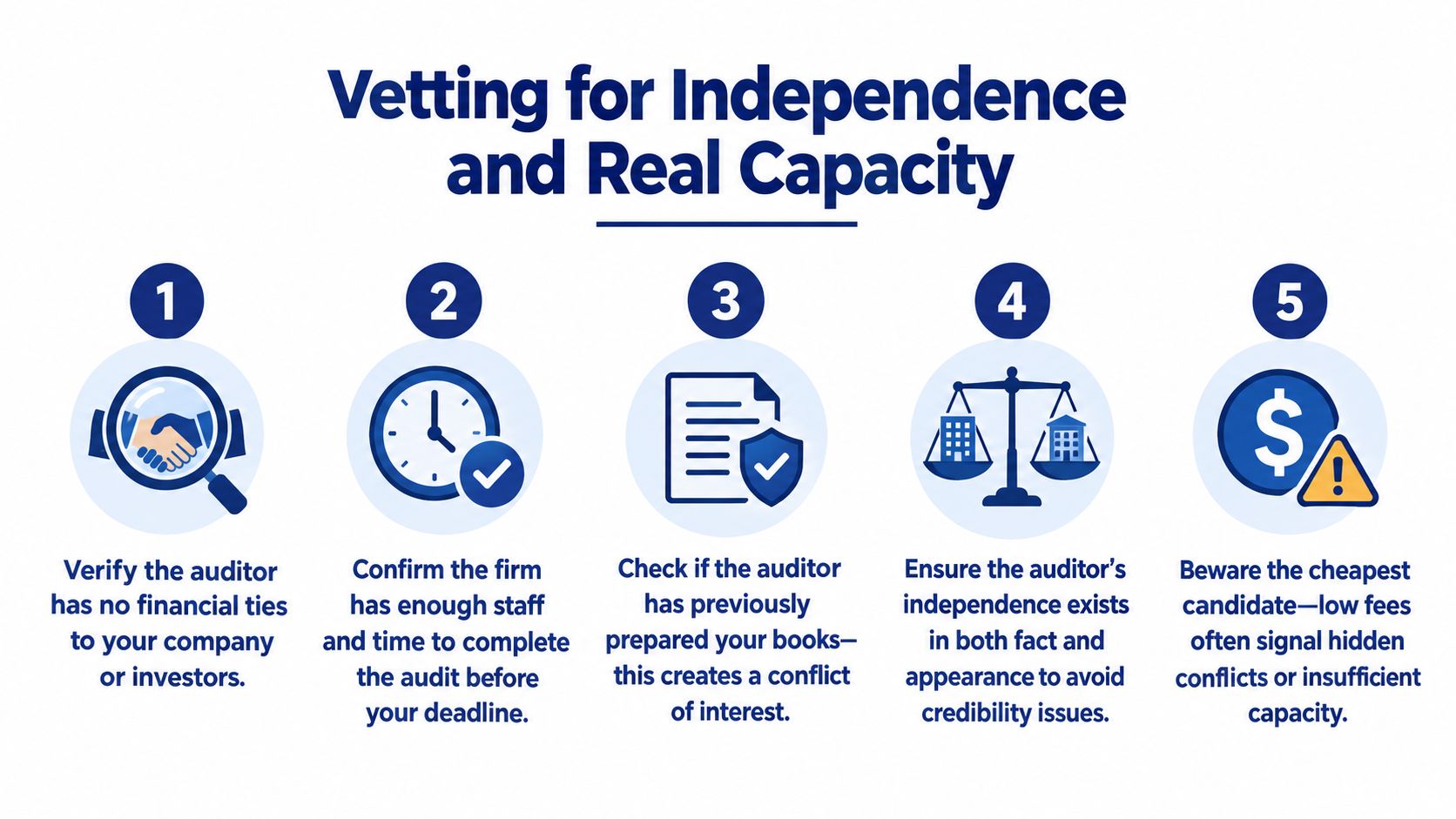
Independence needs to exist in fact and in appearance. Don't stop at asking whether the lead partner knows the founder. Have the firm review relationships involving the firm, its affiliates, the proposed team, owners, and former employees. Disclose any bookkeeping, consulting, tax, system-implementation, or other non-audit services already provided. Get the auditor's written assessment before accepting the proposal.
A practical screen looks like this:
The audit-committee guidance for public-company engagements also emphasizes communication about relationships that could reasonably bear on independence and active discussion of disclosed services (PCAOB auditor-independence guidance). If you're not a public company, borrowing that discipline still makes sense. Your financing partner cares about credibility, not whether your conflict review was technically required.
Ask for the actual team: names, roles, partner and manager hours, planned specialists, review layers, turnover, and availability around your deadline. Then ask how the engagement team will challenge management estimates, revenue recognition, related-party transactions, and going-concern assumptions. “We follow standard procedures” isn't a capacity plan.
Use concrete interview questions to test the answer, and check whether the firm can explain how it raises significant control deficiencies and other difficult findings. A useful auditor interview question list can help structure that conversation. You want an auditor who can describe how the team will test evidence and escalate disagreement, not just promise a smooth process.
Independence isn't a box to tick at kickoff. It's a condition you protect as the people, services, and relationships around the engagement change.
A slightly higher fee from an independent team is usually a better trade than a discount from someone who already knows where the bodies are buried in your general ledger. That doesn't mean paying any price for a famous name. It means treating independence and capacity as hard requirements, then negotiating the scope and fee around them.
The engagement letter isn't housekeeping. It's where you find out who controls scope, how the firm can change the fee, what happens when deadlines move, and how the relationship ends. Read it as a governance document, not as the form you click through after picking a vendor.
Check whether the letter defines the entities, reporting period, framework, locations, deliverables, and expected timeline. If it says the scope may expand at the firm's discretion, ask what specifically would trigger additional procedures and how the firm will price and approve them. A reasonable change process requires notice, a written explanation, and your approval before the extra work begins.
The fee section deserves the same scrutiny. Ask whether travel, specialist work, inventory observation, information-technology controls, tax provisions, or other expected procedures are included or separately billed. Confirm who can authorize fee changes and what happens if your team supplies records later than expected. “We'll work it out as we go” is not a budget.
Also review:
For U.S. public companies, the audit committee is directly responsible for appointing, compensating, retaining, evaluating, and replacing the independent auditor, including assessing independence at least annually (SEC audit committee responsibilities). Management shouldn't choose its own referee and then call that governance. For a private company, separating the finance team's recommendation from approval by owners or independent directors can create cleaner accountability too.
Read the letter against the proposal. If the proposal promises a defined scope and team, the contract shouldn't quietly replace those commitments with broad discretion.
Negotiation doesn't need to be theatrical. Ask for plain wording on what is included, how changes get approved, who owns key decisions, and how the firm will protect your data. A solid firm should be able to explain its terms without treating ordinary questions as an insult. If it can't, the uncomfortable conversation is probably coming later, when you have less influence.
A first-year audit can take a couple of months from scoping to signed opinion, and longer when records are messy, the scope shifts, or the team misses a reporting window. A 60–90 day planning window can be a useful working assumption for a straightforward engagement, not a promise that every audit will finish on that schedule. Confirm the milestones with your auditor before tying them to a financing or acquisition date.
Walk away, or pause until the issue is resolved, if a firm resists a conflict screen, won't provide appropriate quality or peer-review information, proposes outcome-contingent fees, gives unclear answers on data security, or can't explain partner rotation. For SEC independence rules, the lead audit partner and concurring partner may serve for a maximum of five years before required rotation (SEC Office of the Chief Accountant guidance). Ask how long the proposed partner has served and who would take over when rotation applies.
Remote and fractional professionals can support internal audit, SOC readiness, and ongoing control work when the scope and independence arrangements fit. But remote availability doesn't replace required registration, licensing, or firm qualifications for a statutory financial statement audit. Verify the rules that apply to your engagement and location before hiring.
Go back to the deadline email and turn it into a one-page checklist: required deliverable, scope, deadline, reporting framework, conflicts, named team, fee assumptions, and contract terms. That's a better afternoon's work than sending “Need an auditor ASAP” to every firm in your inbox.
HireAccountants helps U.S. companies find pre-vetted finance professionals, including remote auditor candidates, with candidate shortlists available in as little as 24 hours. If you're building finance capacity alongside an audit search, visit HireAccountants to review candidates and discuss the support your team needs.
Let's simplify your finances today!