


You're reconciling invoices at midnight, your bank feed's three weeks behind, and the one person who understood your chart of accounts just gave notice. Welcome to hiring accounting staff the hard way. Most founders react by posting a job for a mythical accountant who'll fix bookkeeping, run close, file taxes, build forecasts, and smile through audit requests. That person either doesn't exist, costs more than your product roadmap, or quits once they discover the job description was fiction. Hire for the work causing pain first, design the controls around it, and you'll avoid buying an expensive title that leaves the bottleneck exactly where you found it.
It's 11:47 p.m. and you're matching Stripe payouts to invoices while a controller posting sits open, gathering digital dust. A SaaS founder I know lived that scene for months. Deferred revenue schedules were hand-built, cash looked healthier than it was, and every board question triggered a spreadsheet archaeology project. The company didn't lack effort. It lacked a system with owners for production, review, and escalation.
An ecommerce operator had the opposite flavor of mess. Orders, refunds, marketplace fees, and inventory adjustments poured in daily, but nobody owned exception management. Bookkeeping became a backlog, not a process. Hiring accounting staff based on a generic title wouldn't have fixed either company because neither had first mapped transaction volume, close deadlines, tax obligations, and reporting needs.
Start with an honest inventory. Separate recurring production from judgment and control. Production includes coding transactions, reconciliations, accounts payable, accounts receivable, and payroll inputs. Review includes approving adjustments, investigating variances, checking reconciliations, and owning the close calendar. Escalation covers the ugly moments, like a missing tax notice or a bank balance that refuses to reconcile.
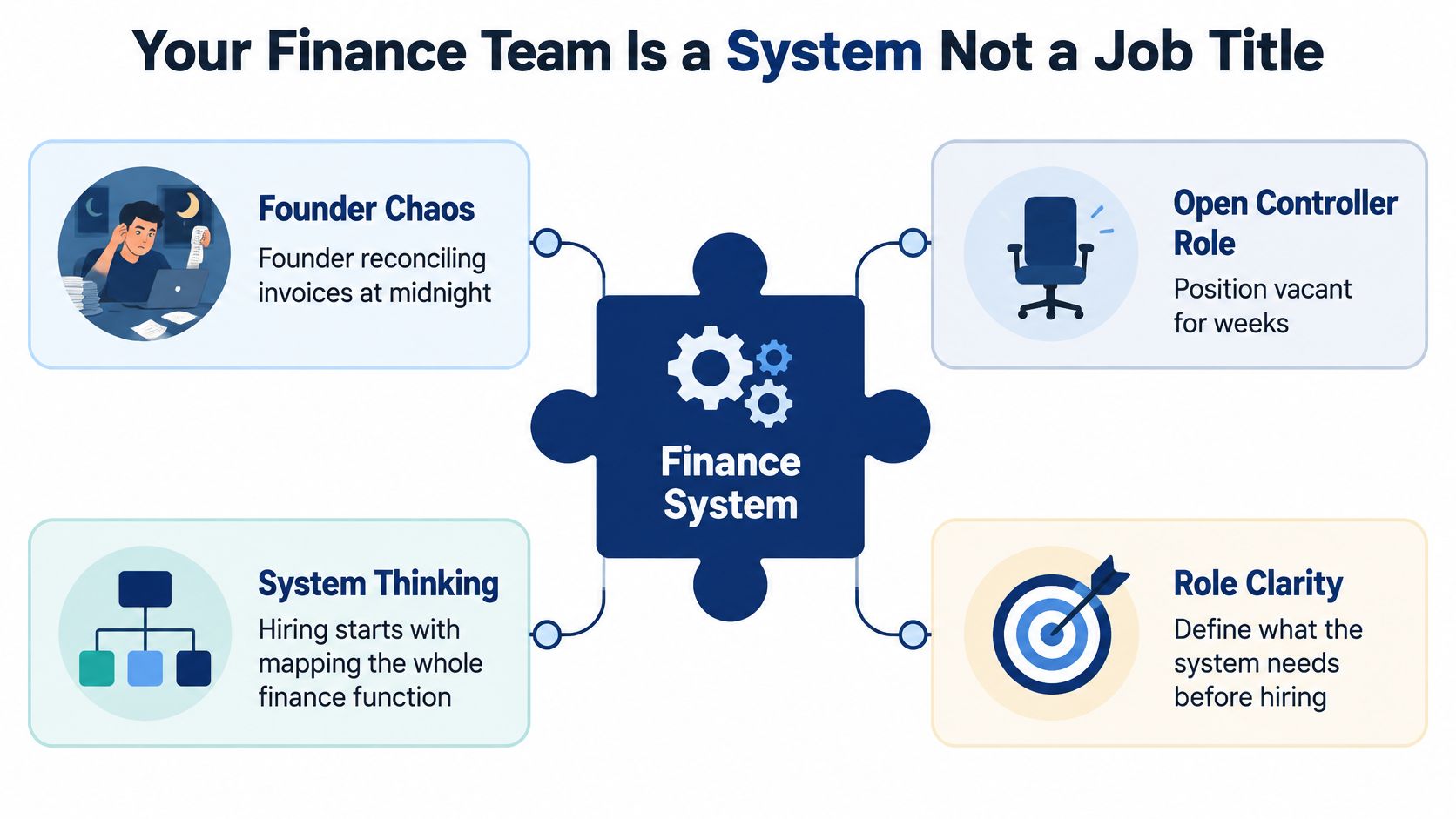
That inventory produces your minimum viable finance function. It tells you whether the first gap is bookkeeping capacity, close ownership, tax expertise, internal controls, or FP&A. A useful guide to accounting department organizational structure can help you compare reporting lines, but your transaction patterns should drive the design.
Map the finance work before choosing a title
| Capability area | Typical hiring trigger | Evidence to seek |
|---|---|---|
| Bookkeeping and reconciliations | Backlog, uncategorized transactions, late bank recs | Clean reconciliation samples, exception-tracking habits |
| Month-end close and reporting | Slow close, unreliable statements | Close checklist, variance commentary, adjustment support |
| Tax compliance | Filing risk, notices, multi-state exposure | Deadline management, workpaper discipline |
| Controls | One person can create, approve, and pay vendors | Segregation-of-duties awareness, review evidence |
| FP&A | Cash surprises, weak runway visibility | Forecast logic, driver-based assumptions, clear communication |
Don't expect the market to rescue a fuzzy brief. A 2026 CFO survey found organizations reported an average of 17 open finance and accounting positions, up from five in 2025 and two in 2024, while half said filling these roles takes more than 120 days, according to Thomson Reuters reporting on the CFO survey. If you wait until the books are burning, you're competing from inside the fire.
Founder rule: If you can't name the owner, deadline, input, output, and reviewer for a finance task, you don't have a hiring plan yet. You have a hope.
Define the system first. Then, and only then, go find the humans who can run their assigned parts without turning month-end into performance art.
A polished job description can still be useless. It lists QuickBooks, Excel, attention to detail, and strong communication, which describes roughly every accountant with a pulse and a LinkedIn profile. A role scorecard is stricter. It starts with outcomes, translates them into competencies, and gives recruiters and interviewers one shared definition of good.
Begin with capacity, not vibes. Estimate hours per week for transaction processing, reconciliations, payable cycles, payroll support, reporting, and exception follow-up. Add peak periods around close, tax filings, inventory counts, or board reporting. If the work fluctuates sharply, say so. Pretending a seasonal surge is a calm year-round workload is how good hires become resentful former hires.
Split requirements into three buckets.
Seniority belongs in this analysis. Hiring a senior accountant to code routine bills all day wastes budget and bores the hire. Hiring a junior bookkeeper to own revenue recognition, multi-entity eliminations, or technical close judgments creates hidden risk. The title should follow the judgment required, not your anxiety level.
Your scorecard should name the reporting line, review owner, work schedule, required U.S. time-zone overlap, and systems they'll touch, whether that's QuickBooks Online, NetSuite, Xero, Bill.com, Ramp, or a battered spreadsheet nobody admits to owning. It should also state the written communication expected. Remote accounting fails when someone can post journals but can't explain an exception in plain English.
Candidate experience matters here too. A scorecard lets you respond faster, ask consistent questions, and avoid making strong applicants repeat the same story to four people. Teams outside finance face the same discipline problem, which is why resources on how to improve your Web3 candidate experience can be useful when you're tightening handoffs and response times. Different industry, same lesson. Slow, confused processes repel capable people.
The market won't grade you generously for improvising. In a 2025 corporate finance and accounting talent survey, 43% of respondents experienced significant or minor shortages, with Controller and Assistant Controller roles hardest to fill at 34%, followed by Bookkeeper and Financial Reporting roles at 27%, per the 2025 Corporate Accounting Finance Talent Study. That means your scorecard needs priorities. If close ownership is the risk, don't let an impressive tax background distract you. If reconciliations are drowning the team, don't pay for forecasting talent you won't use.
Finish with observable success measures. Examples include reconciliations completed by an agreed business day, unresolved exceptions aged and explained, close tasks delivered with support, and documentation another accountant can follow. Now recruiters know what to find, interviewers know what to test, and candidates know what job they're accepting.
A founder I know hired a cross-border bookkeeper at a rate that made his CFO friends jealous, then spent six months untangling reconciliations nobody had reviewed. The hourly number looked friendly. The operating risk didn't. Local employees, remote employees, freelancers, marketplaces, firms, and cross-border hires differ in speed, continuity, supervision, and control burden. Pick based on the work's risk and duration, not whoever replies first.

A local employee earns the higher cost when the role needs frequent in-person collaboration, physical records, bank visits, or daily contact with operations. You gain simpler oversight and compete in one labor market. A remote employee widens the pool, and that widening is an operating-model decision. It demands documented processes, access controls, and scheduled overlap for exceptions. Treat remote and cross-border hiring as a control design question, not a discount.
Freelancers work well for bounded projects: clearing a reconciliation backlog, preparing schedules, supporting a system migration. They become fragile when payroll, filings, and close depend on them every month. Continuity isn't a luxury in finance. It's how deadlines survive vacations, illness, and resignations.
| Route | Best fit | Watch-outs |
|---|---|---|
| Local employee | High-collaboration, long-term ownership | Narrower pool, longer recruiting cycle |
| Remote employee | Recurring work with documented processes | Needs access controls, overlap, active review |
| Freelance specialist | Defined project or temporary surge | Continuity and backup coverage |
| Marketplace or staffing platform | Faster shortlist for a scoped role | You still own vetting, controls, and management |
| Accounting firm | Broad coverage or specialist oversight | Less embedded knowledge, possible handoff delays |
Total cost includes recruiting time, manager review, software seats, training, compliance, rework, and backup coverage. A cheap rate paired with heavy supervision costs more than a stronger hire who documents work properly the first time. Run the same test on external capacity, including trade business service offerings for operational support around the finance function. What work disappears from your plate, what new coordination appears, and who stays accountable when something breaks?
Platforms can compress sourcing time. HireAccountants says businesses can hire pre-vetted accountants and finance professionals in as little as 24 hours, often from $10 per hour or under $3,000 per month, with full-time or part-time engagements and complimentary HR, payroll, and compliance support. Speed like that helps when your scorecard is already clear. It's one route to evaluate against your requirements, not a reason to skip them.
If you're weighing external support more broadly, weigh the benefits of outsourcing accounting services against control ownership and how much internal knowledge you'd give up. My blunt recommendation: keep judgment, approvals, and final review close to accountable leadership. Give flexible capacity scoped production work first, then expand only after the output proves accurate under review.
A founder posts "senior accountant, Excel expert, fast paced" and gets 400 confident applications by Friday. Two months later the close still slips, bank recs carry unexplained balances, and the new hire is very good at saying "I handled that at my last job." That is résumé theater: polished evidence-free claims meeting a search too vague to catch them.
Write the search from the scorecard and the risk it controls. Say the capability gap plainly: own bank and credit card reconciliations in QuickBooks Online, clear aged exceptions, document adjustments, support close with workpapers a reviewer can reperform. Name systems, volume, deadline pressure, review structure, and time-zone needs. Vague ads invite vague answers. The right people recognize the job. The title collectors keep scrolling.
Use several channels, each with a job. Targeted outreach finds people by demonstrated functions, industry context, systems, and close exposure. Referrals from your CPA firm, fractional CFO, bookkeeper network, and operators matter when they saw the workpapers and can describe how the candidate closed. Pre-vetted marketplaces can widen geography and speed shortlists once scope is clear. Direct postings should read like operating briefs: workload, deliverables, review cadence, data access, and who is accountable when output is wrong.
Strong candidates describe artifacts. Weak candidates describe themselves.
Remote and cross-border sourcing belong in the same discipline. Treat them as an operating-model choice shaped by access controls, review windows, documentation standards, and escalation paths. That is a control design question before it is a recruiting question. A lower rate earns attention only after you know who reviews the work, how exceptions surface, and which approvals stay inside your control boundary.
Before any long interview, ask for process evidence. How do they organize a close checklist? How do they age unresolved reconciliation items? Show an adjustment memo they wrote. Ask for a transaction they flagged because it looked wrong and who had final sign-off. Keep answers scored against the same criteria for every serious applicant.
The supply signal argues for wider, sharper sourcing. U.S. schools awarded 55,152 bachelor's and master's degrees in accounting during the 2023-2024 academic year, a 6.6% decline from the previous year, while participating public accounting firms reported hiring 11,985 new graduates in 2024, according to AICPA reporting on its 2025 Trends findings. Read that as participating-firm evidence with limits, then accept the practical point: local-only and degree-only filters can leave a control gap open while you admire credentials.
Match speed to danger. An urgent backfill protects payroll, payables, bank reconciliations, and filing deadlines first, with a narrow interim scope and fast decisions. A planned build can compare seniority, industry scars, and cross-border coverage without stuffing every need into one heroic job post. Reply quickly to credible applicants, send identical screeners, decline weak fits cleanly, and keep the funnel small enough that every finalist has shown plausible evidence before charm enters the room.
Hand two finalists the same broken bank reconciliation: a duplicated deposit, a stale check, missing support on one large entry, and a transaction that needs a phone call nobody can make. One reconciles to the penny and writes up the anomaly. The other talks beautifully and parks the difference in suspense. You just learned more in ninety minutes than three rounds of interviews would give you.
Confidence performs in interviews. Accuracy shows up in work. Run a structured, job-linked process where every serious candidate answers identical questions, completes the same relevant sample, and gets scored against criteria you wrote before anyone charming walked in.
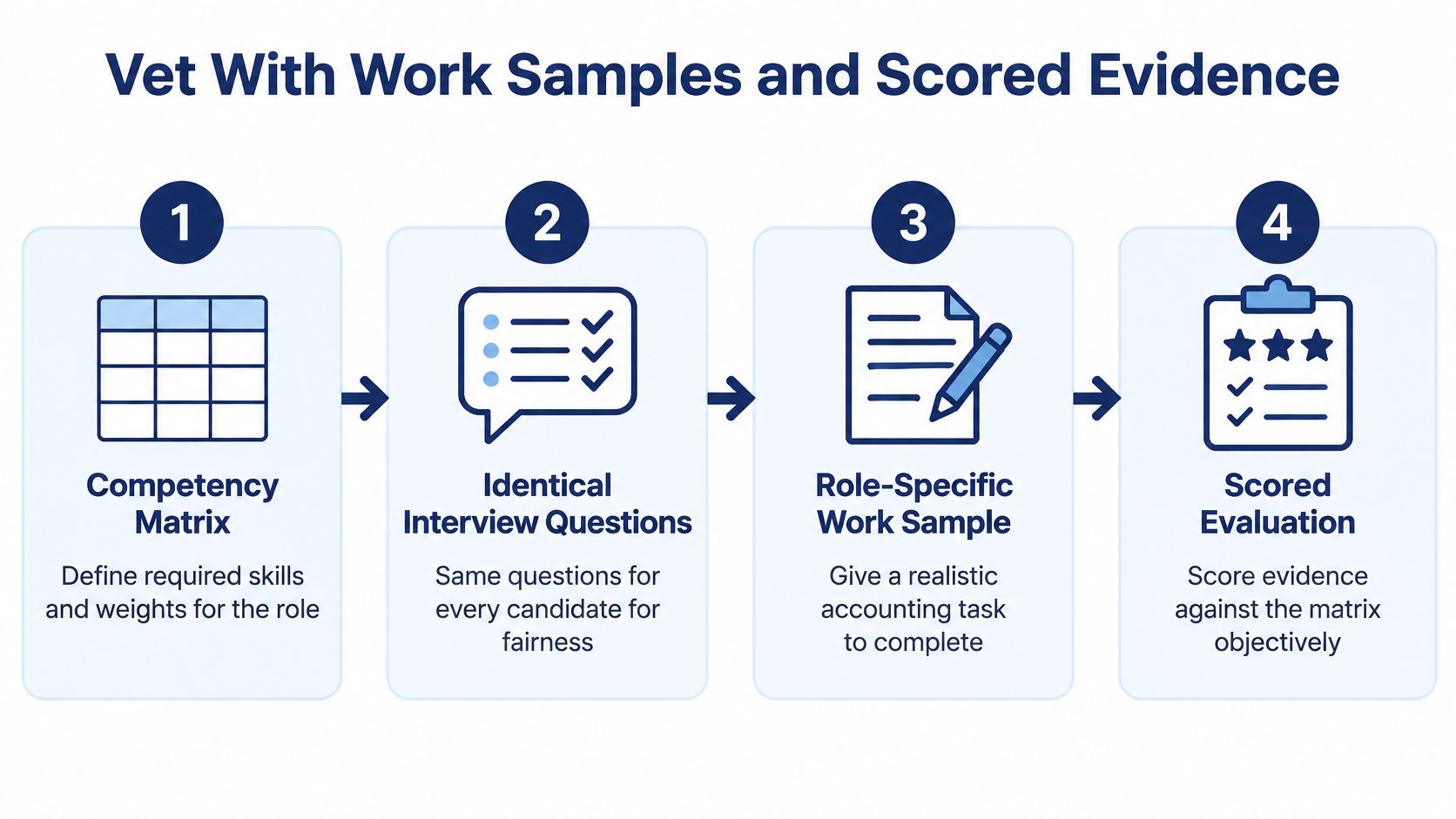
Pull the test design straight from your role scorecard. A bookkeeper gets the reconciliation above. A senior accountant gets a close-adjustment memo, a supporting schedule, and a variance analysis with incomplete information. An accounts payable candidate gets vendor-setup documents, invoices to match, approval evidence to inspect, and one duplicate payment hiding in the pile. Score for control awareness and judgment, because arithmetic alone proves nothing. A candidate can multiply beautifully and still bury an unexplained difference where nobody looks, and that difference becomes your cleanup invoice.
Build a weighted matrix from the scorecard, covering reconciliations, close skills, GAAP where relevant, software, documentation, and escalation judgment:
| Dimension | What you're checking |
|---|---|
| Technical accuracy | Right accounting treatment, properly supported |
| Control awareness | Approval gaps, duplicate payments, unsupported changes spotted |
| Reasoning | Assumptions explained without bluffing through missing information |
| Documentation | A reviewer could reperform the work from the notes alone |
| Communication and pacing | Material issues flagged first and clearly |
Weight it to the role. A bookkeeping hire decided by elegant strategy talk is a mismatch. So is a senior hire decided by data-entry speed.
Have two independent reviewers score each sample against written anchors before comparing impressions. Resolve disagreements against the submitted evidence, and keep the rubrics and notes on file so the decision is auditable. Structure earns that effort: a 2022 reanalysis estimated structured-interview validity at approximately 0.42 for predicting job performance, above the revised 0.31 estimate for cognitive-ability tests, as summarized in the CIPD selection factsheet.
Interview prompts should come from failure modes, not hypothetical heroics. Ask how they handled an unresolved exception near deadline, explained a bad variance to a finance leader, corrected a prior-period error, or juggled competing tax and close priorities. A broader bank of accounting interview questions helps you build the script, but weight every question against your scorecard.
Run the non-accounting checks with the same discipline: identity, claimed credentials, references, work authorization through the proper channel, and any lawful background review in a documented sequence. A pre employment screening process guide lays out those steps so nothing gets skipped before a stranger touches your financial systems.
My rule stays unforgiving: when résumé prestige conflicts with work-sample evidence, believe the sample. Sparkly career histories don't reconcile bank accounts.
Two finance setups, same quarter. An in-office team shared one bank portal login because everyone felt trustworthy; a remote bookkeeper three time zones away held read-only access with every entry reviewed before posting. The shared login produced the unauthorized vendor. Control comes from design, wherever the hire sits. So treat remote and cross-border accounting hires as an operating-model decision. The cheaper-shortcut framing is how control gaps get priced as savings.
Design access around least privilege. Map the role to the entities, bank feeds, reports, and functions it requires, then grant only those. Broad administrator rights stay off the table unless the role requires them, and almost no role does on day one. Require multifactor authentication, a password manager, approved devices where appropriate, and a documented offboarding step that removes access the same day an engagement ends.
One person should never create a vendor, approve that vendor's invoice, release payment, and reconcile the bank account. That sequence is a fraud tutorial. Split initiation, approval, payment, and reconciliation across people wherever team size allows. Where the team is too small, a compensating review fills the gap: an owner, controller, or external accountant examines bank activity and vendor changes independently.
Promote access through reviewed work. A cheerful first week earns nothing.
| Stage | What the hire can do | What earns the next stage |
|---|---|---|
| Observe and prepare | Read reports, draft reconciliations, no posting rights | A clean sample reconciliation |
| Post under review | Submit entries and bills with full support | A reviewed close cycle without repeat errors |
| Own a bounded cycle | Run a defined scope end to end | Owner sign-off after cycle review |
| Expanded scope | New entities, payroll, or payment functions | A fresh control check plus a named backup |
Documentation carries the rest of the weight. Keep the close checklist, source files, naming conventions, review evidence, and exception log where an authorized second person can reach them. Hold U.S. time-zone overlap for live questions and deadline-sensitive issues. Require written updates showing what was completed, what's blocked, which exceptions remain, and who owns the next action. Silence lets problems age.
Calling someone a contractor doesn't make them one. The Department of Labor's six-factor economic-reality analysis weighs opportunity for profit or loss, control, permanence, whether the work is integral to the business, skill and initiative, and relative investments, per the Department of Labor misclassification guidance. A person working continuously, under your procedures, exclusively for your company, on core finance work describes an employee wearing contractor paperwork.
Review the actual arrangement: supervision, schedule control, ability to serve other clients, payment structure, duration, who supplies the tools. Get qualified tax and employment advice for the specific setup, especially across borders. Contractor savings evaporate the moment payroll taxes, penalties, or back pay arrive.
You can delegate preparation. Ownership of controls stays with your business.
Continuity planning finishes the job. Name a backup for payroll inputs, tax filings, reconciliations, payables, and close tasks. Store procedures where that backup can find them, and review access on a schedule. Remote accounting works when the process survives one person's absence. Without that, you've rented a single point of failure.
A signed offer doesn't close your books. The first month determines whether your new hire becomes dependable capacity or another person asking where the prior-year workpapers live. Onboard like an operator, not a welcomer with a slide deck and good intentions.
Give access in stages, provide chart-of-accounts context, explain entity structure, revenue flows, major vendors, payroll timing, tax registrations, and known problem areas. Don't hide the mess. A good accountant can handle an ugly backlog. What they can't handle is discovering three undocumented bank accounts during close.
Assign a small sample of real work immediately, review it early, and correct patterns before month-end multiplies them. Use weekly check-ins for ordinary roles and more frequent reviews for close, payroll, or payment-adjacent work. Your scorecard should cover reconciliation accuracy, close-cycle adherence, unresolved exceptions, documentation completeness, communication quality, and escalation behavior.
Track outcomes a manager can verify. Were reconciliations supported and reviewed on schedule? Did exceptions get owners and dates rather than vague promises? Did journal entries include explanations another accountant could follow? Did the hire surface a problem while there was still time to fix it? Measure those behaviors, not hours spent looking busy in Slack.
Pair every critical task with a backup owner and a handoff note. Payroll, sales tax, income tax support, payables, bank reconciliations, and close deadlines shouldn't depend on one person's memory. By day 30, the business should know which work the hire owns, which work needs review, and which gaps require training or a different staffing decision.
This discipline matters because accounting capacity won't suddenly become cheap or abundant. The Bureau of Labor Statistics reported a median annual wage of $83,680 for accountants and auditors in May 2025 and projected employment to grow 5% from 2025 to 2035, according to the Bureau of Labor Statistics occupational outlook for accountants and auditors. Treat that growth figure as a projection, not a promise. Either way, sloppy onboarding is an expensive way to waste scarce talent.
Bring in outside recruiting or specialist support when the vacancy blocks filings, close, cash visibility, or a transaction, or when your team lacks time to test and supervise candidates properly. Don't bring it in to avoid defining the role. External help can find and screen people, but it can't decide which risks your business should own.
Hiring accounting staff well comes down to a sequence you can repeat. Map the system, score the role, choose the route, source for evidence, test the work, control the access, and measure the first month. Toot, toot, that isn't glamorous. It's just how you stop paying for the same finance mess twice.
If your scorecard is clear and you need accounting capacity without spending months rebuilding the candidate pipeline yourself, HireAccountants offers pre-vetted accountants and finance professionals for full-time or part-time engagements, with HR, payroll, and compliance support. Visit the platform, compare candidates against your actual capability gaps, and put the finalists through the same work-sample discipline you'd use for any serious finance hire.
Let's simplify your finances today!