


The usual advice about accounting manager jobs starts with a degree, a software checklist and a salary estimate. That's backward. Start with what breaks when nobody owns the close, then hire someone who can prevent it, document it and explain the numbers afterward.
A strong accounting manager is a close owner, control designer and systems operator. If you recruit only for bookkeeping experience with a management title attached, you can end up paying for senior oversight while still doing the oversight yourself.
Say a founder-run company fails its first audit because nobody clearly owns the close. The bookkeeper posted transactions, an outside accountant made adjustments, and the founder approved payments. Nobody maintained a complete reconciliation file or decided when the financial statements were final.
The problem wasn't necessarily bad arithmetic. It was missing accountability.
An accounting manager runs daily accounting operations and makes sure the numbers can survive scrutiny. The broader O*NET financial-manager profile includes directing financial operations, supervising employees, approving expenditures, maintaining compliance documentation, and preparing financial reports and budgets. Accounting-management responsibilities also encompass controls, cash monitoring and audit coordination.

A senior bookkeeper can maintain excellent records. The manager must turn those records into reports executives, lenders, auditors, tax professionals and regulators can use. That includes resolving conflicting inputs, challenging unsupported entries and deciding what needs escalation.
The position becomes useful as a business moves from founder-managed finances into a structured department. The founder shouldn't remain the unofficial routing system for every missing invoice, payroll question and unexplained balance.
Accounting manager duties by area
| Duty area | What it covers | Why employers check it |
|---|---|---|
| Month-end and year-end close | Close calendar, reconciliations, journal entries and final sign-off | Missed closes reveal weak process fast |
| Team supervision | Directs accounts payable, receivable, payroll and billing staff | Span of control shows up in close speed |
| Internal controls | Approval limits, segregation of duties and control documentation | Auditors and lenders scrutinize authorization and evidence |
| Cash flow and budgeting | Cash position, reserves and budget variance tracking | Turns records into forward-looking decisions |
| Audit and compliance | External audit coordination, tax inputs, US GAAP and applicable state requirements | Supports fewer findings and fewer late filings |
| Systems and process | Configuring ERP and close tools, improving manual steps | Ties the role to automation and scale |
In the hypothetical company, the fix isn't telling everyone to be more careful. The manager needs authority to require supporting schedules, return incomplete reconciliations and hold reports until material questions are resolved.
Practical rule: If someone signs the close but can't require corrections, you've assigned blame, not ownership.
Define where that authority ends, too. The distinction between an accounting manager and controller matters when technical policy decisions or broader financial governance need a more senior owner.
Match every duty area against the job you're hiring for or applying to, and count how many the person would own. A title that covers everything but authorizes nothing is a warning sign.
Start with baseline requirements, but don't mistake them for proof of performance. Robert Half's general accounting manager profile says employers generally seek at least five years of experience, a bachelor's degree in accounting or finance, ERP proficiency, and strong communication, technology and analytical abilities; CPA, MBA, CGMA or CMA credentials may be preferred.
For your hiring criteria, add demonstrated supervision explicitly. Tenure alone doesn't show that someone can review another accountant's work without either rubber-stamping it or redoing everything themselves.
Accounting manager requirements and what they signal
| Requirement | Typical expectation | Why it matters |
|---|---|---|
| Experience | At least five years, including supervision | Provides a basis for testing independent close ownership |
| Education | Bachelor's degree in accounting or finance | Baseline for technical reporting and standards |
| Credentials | CPA, CGMA, CMA or MBA, often preferred | Signals relevant depth and can support higher pay bands |
| ERP and systems | Working proficiency in a major ERP | Needed to validate automated reports and workflows |
| Communication | Explains results to non-finance leaders | Turns numbers into decisions for executives and lenders |
| Controls and audit | Owns month-end, year-end and audit coordination | Demonstrates accountability for evidence and reporting |
A CPA without supervisory experience is a different hire from a non-CPA who has independently managed demanding closes. Neither should win automatically. Decide whether the job primarily needs technical interpretation, dependable execution, team development or a combination.
ERP proficiency also means more than recognizing NetSuite, SAP or Microsoft Dynamics on a screen. Ask how the candidate validates report parameters, handles posting permissions and checks whether a dashboard agrees with the general ledger. A polished dashboard with the wrong date filter is still wrong, just better dressed.
Robert Half's finance and accounting hiring analysis identifies continuing demand for accounting managers alongside employer emphasis on forecasting, internal controls, data analytics, ERP skills and critical thinking. That supports a broader hiring test than journal-entry knowledge alone.
Build the scorecard around evidence:
Never ask candidates to disclose confidential employer files. A recreated template or sanitized example is enough to test their thinking.
Give the candidate a bank reconciliation containing a duplicated receipt, an outstanding payment and an unsupported journal entry. Ask them to identify the issue, propose the correction, describe the evidence they'd request and design a preventive or detective control.
A strong answer separates timing differences from actual errors. It preserves an audit trail and identifies who should approve the correction. A weak answer forces the balance to match and calls it finished.
Follow with direct questions:
Candidates can use Interview Pilot's interview preparation for aspiring accountants to rehearse explaining their reasoning. Employers should still evaluate the working session, not just the rehearsed answer.
For a hypothetical small SaaS company, the manager might supervise staff, close the books, forecast cash and implement automation simultaneously. Test all those responsibilities before advertising them as a single tidy job. Mark the genuine must-haves separately from skills someone can learn after joining.
Posting a vague salary number attracts mismatched applicants. Underprice a technical role and experienced candidates opt out; overprice a routine role and you can pay for expertise the business won't use.
Robert Half's national finance and accounting salary guide places accounting manager compensation at $98,250 for the low range, $115,000 at the midpoint and $128,500 at the high range.
Accounting manager salary bands
| Band | Annual salary | Candidate profile |
|---|---|---|
| Low range | $98,250 | Newer to the role or still building core skills |
| Midpoint | $115,000 | Meets most requirements for the role |
| High range | $128,500 | Advanced skills, specialized certifications or relevant industry experience |
The low range makes sense when the candidate is developing managerial independence and has access to experienced review. It doesn't make sense when the business expects that person to rescue an undocumented close with no technical support.
The midpoint describes someone who can meet most requirements. The high range reflects deeper skills, relevant certifications or industry experience. These are national reference points, not a promise that a particular local search will clear at that price.
Specialization changes the comparison. Revenue recognition, SEC reporting, cost accounting and multi-entity consolidation introduce different technical demands from a straightforward general ledger role. Price those responsibilities explicitly rather than hiding them beneath other duties as assigned.
A salary band should describe the work you need someone to handle, not how impressive you want the title to sound.
Consider a hypothetical company hiring for a single-entity close on an established ERP. A midpoint-oriented search is a reasonable starting hypothesis if the records are orderly and an experienced reviewer handles unusual technical questions.
Add multi-entity consolidation and SEC reporting, and the same company needs a different candidate profile. Start with the high-range comparison, then validate whether the relevant specialist market requires more. Don't treat the table as a ceiling.
Location also matters, as do employment arrangements and the responsibilities retained by a controller. National employee salary figures aren't interchangeable with international contractor fees or a part-time engagement.
For broader context, the Bureau of Labor Statistics accountants and auditors profile reports median annual pay of $83,680 in May 2025. That's a professional accounting benchmark, not an accounting-manager-specific median.
Write the salary band into the job post with its assumptions: technical scope, supervisory load, location and expected independence. Let candidates judge the actual job instead of guessing what competitive compensation means this time.
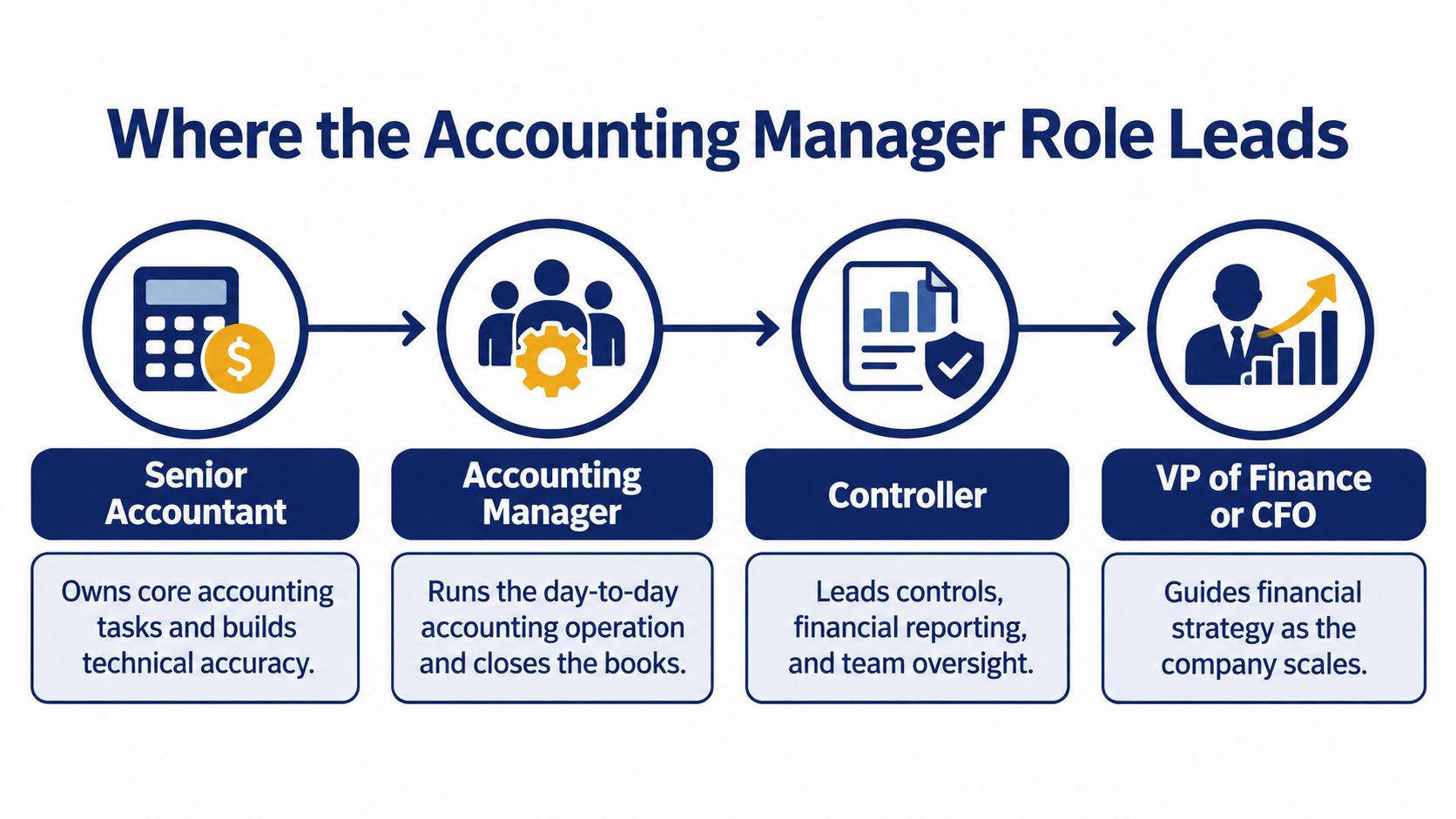
Consider a senior accountant who covers the close during a colleague's leave. Rather than completing extra entries, they assign dependencies, chase missing schedules, and give management a clear status report. In a hypothetical promotion scenario, they're running the process within a year because they've demonstrated ownership, not just endurance.
Now consider a manager who rebuilds an inconsistent monthly board pack. They reconcile the management schedules to the ledger, document review responsibilities and resolve recurring audit questions. After a clean audit, a controller promotion becomes plausible, provided they can also handle the broader technical and governance responsibilities.
Those scenarios illustrate a career path, not a timetable. Companies distribute responsibilities differently, so inspect decision rights before celebrating the new business card.
A useful accounting department organizational structure makes those boundaries visible. Without it, a manager can inherit controller-level exposure while still being measured on how quickly they process transactions.
For Latin America-based accountants pursuing US-aligned accounting manager jobs, technical execution is the starting point. US GAAP fluency, workable overlap with US time zones and clear written English help demonstrate readiness to lead discussions rather than merely receive assignments.
Practice writing a short variance explanation that states the cause, cash implication and recommended action. Learn to distinguish a true accounting-policy question from a workflow problem. Executives need the decision explained, not a tour of every spreadsheet tab.
Readiness for the next role becomes tangible when you can explain a variance without notes, show a control you designed that operated, and refuse a request that would compromise the close. Promotion should follow that evidence, not the number of late nights logged.
Talent scarcity makes this more than a salary exercise. The 2025 AdvanceTrack Accounting Talent Index found that 40% of firms experienced a very significant or severe impact from talent shortages, 44% saw remuneration costs rise to mitigate shortages, and 37% reported that shortages impaired their ability to take on new clients.
Those findings concern accounting firms, not every startup's finance department. Still, they highlight why waiting for an inexpensive, all-purpose candidate isn't a staffing strategy.
Accounting manager operating models compared
| Model | Best when | Main risk | Who owns the close |
|---|---|---|---|
| Full-time in-house manager | Complex close, several entities, steady volume | Salary and retention cost for a small team | Manager owns and signs the close |
| Part-time manager plus transactional support | Modest volume, controls still need senior review | Gaps when the manager is off-site or unavailable | Manager reviews and signs, staff prepares |
| Fractional or outsourced manager | Seasonal sales, system migration, one-off reporting | Less institutional knowledge of the business | Named external owner with agreed deadlines |
| Bookkeeper team with manager review | Low volume and clean, stable systems | Review load grows fast if systems change | Bookkeeper runs the close, manager approves |
Headcount is a poor shortcut. Evaluate workload volatility, control risk, close complexity and finance-system maturity. A lean business undergoing a migration may need substantial senior attention, while a larger business with stable workflows may need less intervention.
Full-time oversight works when decisions and exceptions arrive continuously. Part-time management works when preparation is dependable and review can be scheduled. Fractional support can address a defined transition, but somebody must retain business context after the engagement ends.

For project peaks or coverage gaps, temporary accounting positions can add preparation capacity without confusing temporary staffing with permanent accountability. Candidates can also compare remote work opportunities through JobGlance, paying attention to actual review responsibilities and required availability rather than the remote label alone.
Specify who prepares each schedule, who reviews it, who resolves exceptions and who signs the close. Reserve availability around the close calendar rather than buying an arbitrary block of hours and hoping it's enough.
Ownership test: If an exception appears while the manager is unavailable, everyone should know who can decide, who must be notified and what cannot proceed.
At HireAccountants, we provide a detailed CV for every accountant and bookkeeper in our network. We also send a custom shortlist of the top pre-vetted candidates for your open position within 24 hours.
Use those materials to select candidates for the working test, not to waive it. Whether someone works in-house or remotely, ask them to diagnose the broken reconciliation and explain the review handoff. Flexibility changes scheduling. It shouldn't lower the standard of evidence.
A job post should settle the operating decisions before candidates enter the conversation. Otherwise, you'll spend interviews discovering that the founder wants a controller, the finance team needs a reviewer and the budget assumes a bookkeeper.
HireAccountants is the largest dedicated talent platform for hiring accounting and finance professionals in the US. Each of our Accountants, Bookkeepers, CPAs, Tax Accountants, Financial Analysts, Auditors, Accounting Managers and Accounting Assistants categories has 500+ active profiles.
That breadth makes clear selection criteria more important, not less. Before opening applications, answer this: which outcome would tell you in six months that the hire worked?
Bring your close responsibilities, technical requirements and hiring criteria to HireAccountants. We'll help you find pre-vetted accounting manager candidates aligned with the work, so you can interview for documented judgment and ownership instead of sorting through titles alone.
Let's simplify your finances today!