


A reliable close isn't built on heroic late nights. It's built on sequencing, ownership, evidence, and disciplined cutoff rules. APQC reports a median month-end close of 6.0 calendar days across 10,198 organizations, measured from the initial trial balance through completed consolidated financial statements. Its benchmark summaries put top-quartile closes at 4.8 days or less and bottom-quartile closes at 10 days or more, a useful reminder that process design matters more than heroic spreadsheet gymnastics. (APQC close benchmarks)
This accounting close checklist is organized as an operating system, not a pile of chores. The order matters. Start with cash and balance-sheet reality checks, then test revenue cutoff, capture accruals, validate inventory where relevant, eliminate intercompany activity, and finish with journal-entry review and evidence preservation.
Run the standard version every month. Expand the supporting evidence and review depth at quarter-end. Apply the fullest version at year-end, when auditors, tax work, reporting demands, and everyone's suddenly excellent memory all arrive together. The objective isn't to make accounting look busy. It's to produce decision-ready numbers without the monthly fire drill.
Bank reconciliation is where the ledger meets the bank's version of reality. Your accounting system may say cash is available, but the bank statement gets the final vote on processed deposits, cleared payments, service fees, transfers, and timing differences. That makes this the first operational checkpoint in the close, not a task to squeeze in after everything else.
A sound reconciliation explains every difference. Deposits in transit, outstanding checks, card settlements, bank fees, duplicate payments, and unusual wires should appear as identified items with owners and next steps. “Timing difference” isn't a magic spell. It's an explanation that needs a date, a source document, and a reasonable expectation of clearance.
For a SaaS business, a duplicate ACH payment can sit until someone compares the bank activity to the ledger. For an e-commerce company, settlements from Stripe, PayPal, and bank transfers can land on different schedules, creating gaps that look mysterious until the payment processor reports are tied out. A growing company should also treat an unfamiliar wire as an investigation trigger, not an annoying reconciling item.
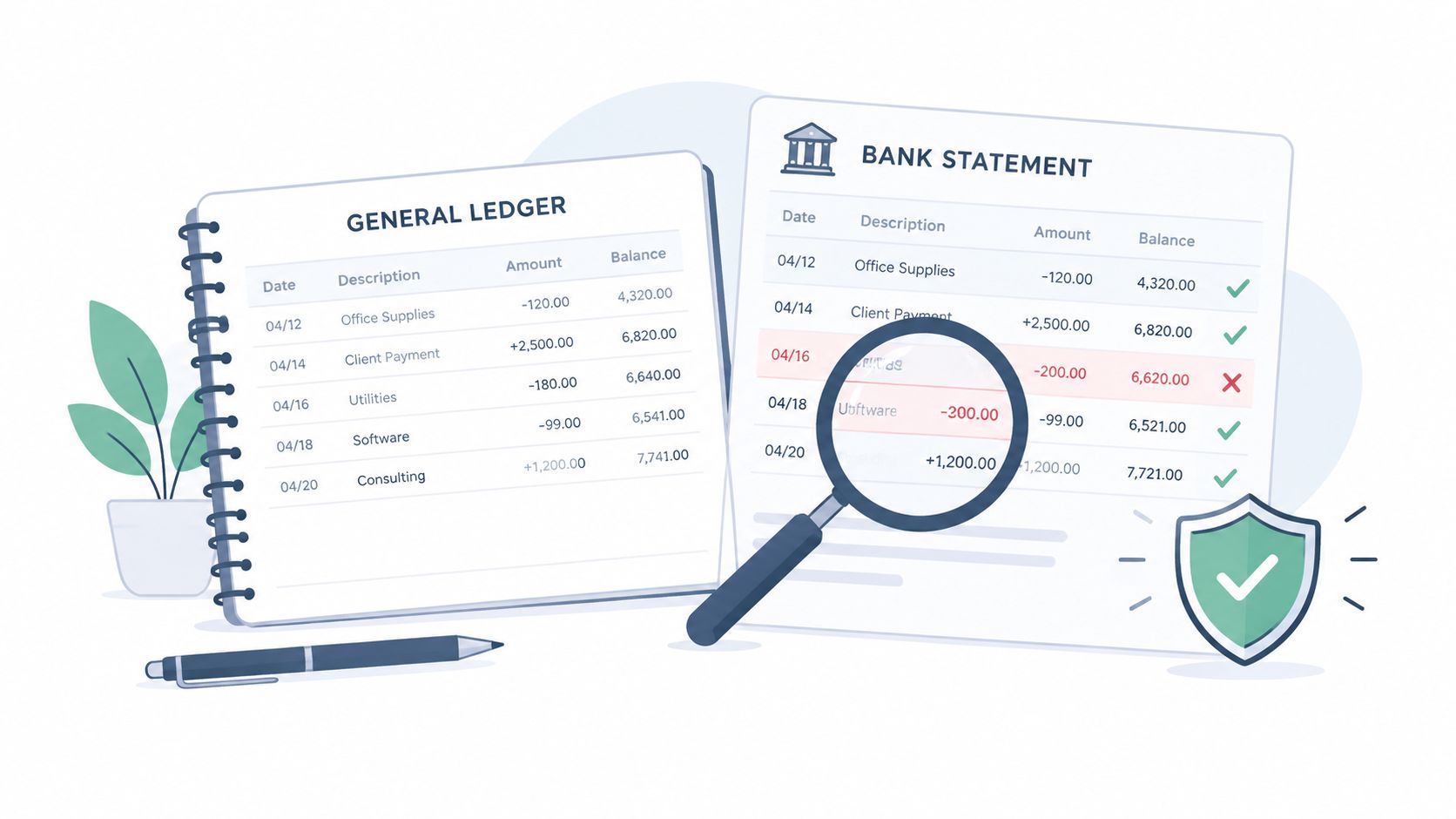
Use automated bank feeds where they're dependable, then compare the imported activity to bank-native statements or APIs. Reconcile high-volume accounts more frequently instead of letting every transaction pile up until month-end. The checklist should require:
The reconciliation should answer one blunt question: can management trust the cash balance today? Teams needing a closer look at general ledger tie-outs can also review this guide to general ledger reconciliation. For marketplace sellers, keep a separate procedure for troubleshooting Amazon reconciliation issues, because platform settlements rarely behave like a simple bank feed.
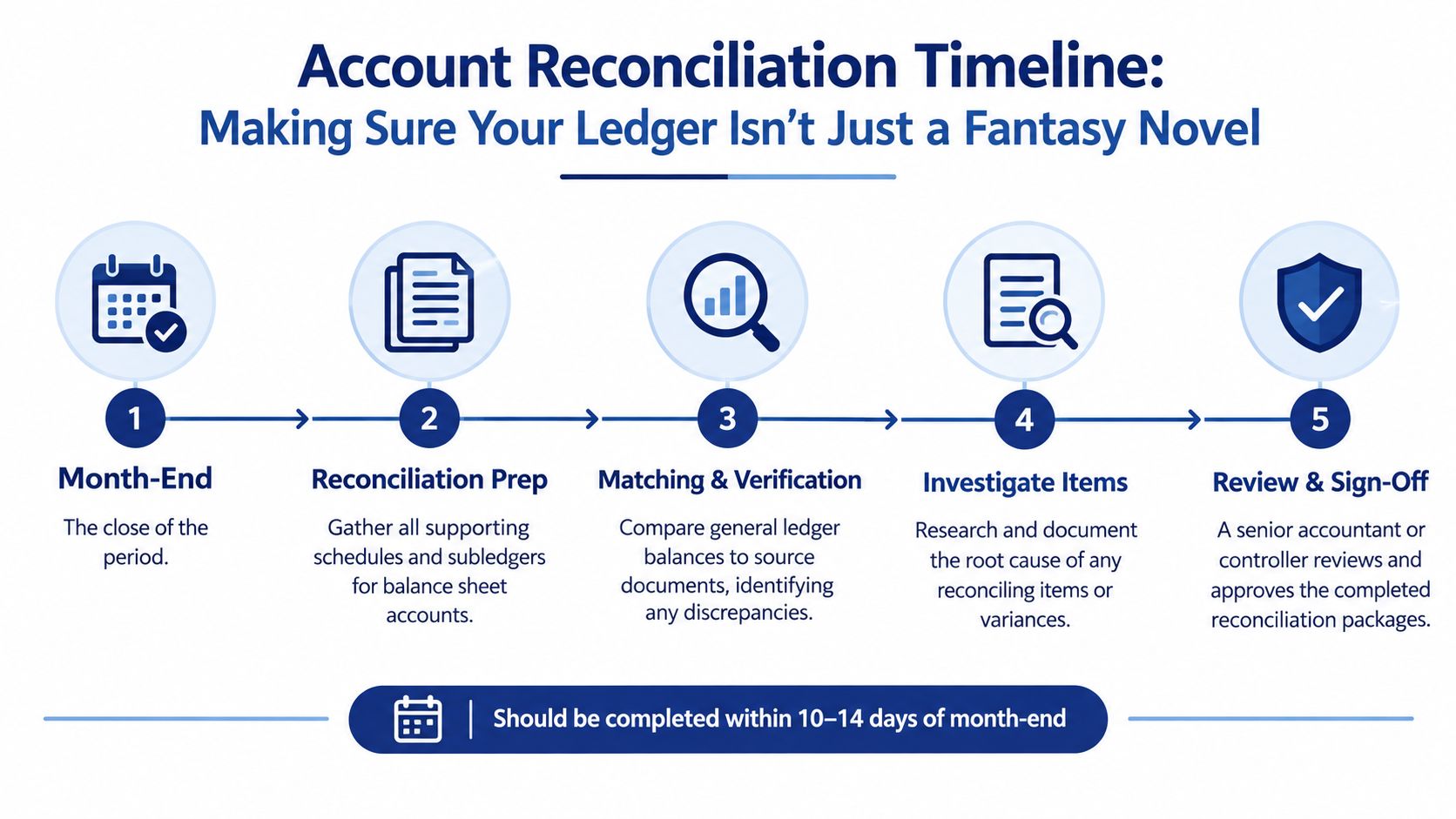
Bank reconciliation is only the appetizer. The balance sheet contains plenty of other accounts that need their own source of truth, including credit cards, loans, customer deposits, prepaid expenses, accrued liabilities, fixed assets, and accounts payable or receivable subledgers.
The practical test is simple. For each material account, identify what the general ledger balance should agree to, then prove that agreement with a workpaper. A credit card account should tie to the card statement. A loan balance should tie to the lender's schedule. Customer deposits should tie to the underlying customer or contract records. If the account has no independent support, it's not reconciled. It's merely decorated.
A growing company can uncover duplicate vendor payments buried in accounts payable, discover revenue sitting in the wrong account instead of being deferred, or find that accrued payroll doesn't match the payroll processed. None of these errors requires exotic accounting. They require someone to compare the ledger with the right operational record.
Standardize the workpapers by account type, but don't force cash, prepaid expenses, and debt into the same template. Each template should capture the balance, supporting source, reconciling items, explanation, expected resolution, and reviewer approval.
Practical rule: If the preparer can't explain an item in one clear paragraph, the item isn't ready to roll forward.
Use formulas or reconciliation features in your accounting software for repeatable matching, but don't automate judgment. High-volume accounts may need to be split by vendor, date range, entity, or transaction class so the reviewer can isolate the actual problem instead of inspecting one enormous worksheet.
Reconcile monthly, while errors are still recognizable. Set an escalation rule for unresolved items, and document why an item remains open. Future-you will be grateful, and future-you is usually the person asked to explain a three-month-old balance during an audit.
Revenue can look reasonable in the ledger and still belong to a different reporting period. The close owner must trace each material stream to its contract, delivery or service period, payment terms, and recognition trigger. An invoice proves billing activity. It does not, by itself, prove earned revenue.
Start with the operational handoff. Sales owns contract terms, billing owns invoice accuracy, and accounting owns the recognition schedule and conclusion. Assign a named owner for each revenue stream, set a cutoff window covering the final days of the period and the opening days of the next, and require evidence that a reviewer can reproduce without chasing three departments.
Subscription, services, and e-commerce transactions create different failure points. An annual subscription paid upfront generally requires recognition across the service period. A services firm should not recognize a milestone before the related work is delivered. An e-commerce company needs shipment, delivery, return, and cancellation data aligned with its cutoff policy. The messy cases are usually amendments, side letters, unusual terms, and manual overrides.
Run the test in this order:
Automate standard subscription schedules and exception reports, not judgment. A useful plain-language reference is what revenue recognition means in accounting. Shopify sellers can keep platform-specific procedures nearby, including guidance on accounting for Shopify subscriptions.
The rule is simple: recognize what was earned in the period, not what happened to be billed or collected. If the schedule cannot show why the entry belongs in that period, the close is not finished.
Accruals capture obligations created before an invoice reaches accounts payable. Software may have been used, legal advice delivered, utilities consumed, payroll earned, or contractor work accepted before billing. Cash has not moved, but the expense belongs to the period that received the benefit.
Start with the operating teams, not the ledger. Before the close window, department owners should confirm what they received, what remains unbilled, and which recurring services continued through period-end. Accounting calculates and records the entry; operations supplies the facts. Give one person ownership of collecting confirmations and another responsibility for reviewing the treatment. That separation catches omissions before an invoice exposes them.
Recurring costs need maintained schedules. Payroll-related costs, utilities, insurance, professional services, software, rent, and contractor work should each show a documented basis. A template should identify the vendor, service period, calculation method, source document, preparer, reviewer, and reversal treatment. Historical patterns can guide an estimate, but they cannot support it alone. Attach the contract or retain the operational confirmation used to calculate the amount.
Run the work in this order:
Automation can send confirmation requests, populate recurring schedules, flag missing approvals, and produce reversal reports. It should not decide whether a service was received or whether an estimate remains reasonable. A documented accounts payable workflow, such as the guidance from Kushan Business Solutions, can clarify intake and approval responsibilities.
Waiting for the bill is a control failure, not a close strategy. If the evidence file cannot show what was received, how the amount was calculated, and who approved it, the accrual is unfinished.
Inventory accounting has a dangerous talent for making physical reality and financial reporting disagree. The warehouse may show one quantity, the inventory system another, and the general ledger a third number that everyone hopes is close enough. It usually isn't.
For businesses holding stock, the checklist must connect receiving, shipping, returns, damaged goods, adjustments, and physical counts to the ledger. Cost of goods sold affects gross margin, so inventory errors don't stay politely inside the balance sheet. They flow into profitability and operating decisions.
An e-commerce company might find obsolete products that haven't moved. A manufacturer may identify damage, shrinkage, or incorrect material allocations. A retailer may discover that the perpetual inventory record has drifted from physical stock because counts, receipts, and write-offs weren't posted consistently. These are operational control failures with accounting consequences.
Document the valuation method approved for the business, whether that's FIFO, LIFO, or weighted average, and apply it consistently. Review obsolete and slow-moving items using a defined process, then document the evidence behind write-downs or reserves. Test a sample of cost calculations, including materials, labor, freight, overhead allocation, and any relevant adjustments.
Inventory is not reconciled because the system says it is. It's reconciled when the system, the warehouse, and the general ledger agree, or when every difference has a documented explanation.
Cycle counting throughout the month is more useful than relying entirely on a year-end physical count. Barcode scanning and inventory management integrations can reduce manual entry, but automation won't fix poor receiving discipline or unrecorded damage. Reconcile the perpetual system to the general ledger regularly, coordinate cutoff timing with operations, and investigate recurring shrinkage rather than treating it as background noise.
For the accounting mechanics, use a documented method for calculating cost of goods sold. The reviewer should sign off on both the valuation workpaper and the operational source data. Otherwise, the margin report is just a confident-looking guess.
Prepaids and accruals need a named owner, a defined review window, and evidence that survives staff turnover. A payment may cover future periods, while an incurred expense may still lack an invoice. Without a monthly roll-forward, stale balances and forgotten reversals distort the close.
Build one schedule for each material prepaid or accrued item. Record the original amount, start and end dates, monthly allocation, remaining balance, source document, responsible owner, and expected reversal or expiration. The schedule should show the next entry without forcing the preparer to search old email threads. If the history requires detective work, the control has already failed.
Use the underlying arrangement to determine the accounting treatment. An annual insurance payment moves from prepaid expense to the P&L as coverage passes. An accrued bonus, rent obligation, tax amount, or donor-related liability requires a validity check, settlement review, and planned reversal. Last year's formula is not evidence that this year's balance still belongs.
Automate recurring allocations when the calculation is mechanical, then attach contracts, invoices, payment evidence, or other support to each schedule line. Automation should prepare the entry, not approve the balance. Review aging, unusual movements, missing support, and items that failed to reverse on schedule.
Use the monthly close meeting to resolve four questions:
Require the reviewer to initial the schedule and retain the support package with the close evidence. Train non-accounting stakeholders on prepaid and accrual policies because obligations often appear first in contracts, purchase requests, or operating conversations, not in the ledger. A useful schedule directs judgment to exceptions and exposes year-end archaeology while there is still time to fix it.
Multi-entity accounting creates a special kind of accounting illusion. Company A records a sale to Company B, Company B records an expense or inventory purchase, and the consolidated group has apparently generated revenue by selling to itself. The group hasn't. Consolidation must remove the internal activity and preserve only transactions with outside parties.
The same issue appears with intercompany loans, management fees, shared payroll, rent, interest, inventory transfers, and cost allocations. Each entity may have a reasonable standalone balance, yet the intercompany receivable and payable don't match because one side posted late, used a different currency rate, or coded the transaction differently.
Maintain an intercompany register that records the entities, transaction type, date, amount, currency, business purpose, pricing basis, originating entry, receiving entry, and expected elimination. Reconcile the two sides before consolidation, not after the consolidated statements produce an ugly unexplained variance.
Use a standard elimination-entry template with the accounts affected, calculation, source reports, preparer, reviewer, and consolidation period. A senior accountant or controller should review eliminations before final posting, particularly when inventory markup, transfer pricing, tax exposure, or complex allocations are involved.
A practical scenario is an inventory transfer from a subsidiary to its parent at a markup. The parent may still hold the inventory at period-end, which means the internal profit hasn't been earned from the group's perspective. The elimination must address the internal sale and the unrealized profit according to the group's accounting policy. Missing that step distorts both revenue and gross margin.
Test completeness by comparing intercompany activity from each entity, not just by reviewing the elimination journal. Look for mismatched amounts, one-sided entries, unexpected balances, and transactions posted after the consolidation cutoff. Documentation should explain why the transaction exists and how the entities settled or eliminated it. Without that trail, the consolidated ledger becomes a shell game with no reliable ending.
Manual journal entries are where a tidy close can still go sideways. Accruals, reclasses, corrections, estimates, depreciation, eliminations, and unusual transactions all need entries, but every entry should tell a complete story. What happened, why is the entry necessary, which period does it belong to, who prepared it, who approved it, and what evidence supports it?
A reviewer shouldn't have to reverse-engineer the preparer's thinking from a vague description such as “month-end adjustment.” That description explains almost nothing. Attach the calculation, contract, invoice, report, reconciliation, or approval that supports the amount and accounts used.
A services company might discover a salary accrual with no supporting documentation. Another team may catch office equipment posted to rent expense. A system-generated accrual might also be duplicated by a manual entry. These errors are avoidable when the review compares manual entries with automated feeds, schedules, and source systems.
Require each manual entry to include the date, description, accounts, amount, supporting documents, preparer, approver, reversal details where applicable, and posting status. Use workflow approval so entries can't be posted before review. Segregate preparation from approval, even in a lean team. If there aren't enough people for perfect segregation, document the compensating review performed by the controller or finance lead.
The final reviewer is not a ceremonial signature. They're the person deciding whether the evidence supports the accounting conclusion.
Review unusual account combinations, round amounts, late entries, duplicate descriptions, and entries that bypass normal subledger processes. Test the arithmetic and confirm the account coding fits the underlying transaction. Archive approved entries with the rest of the close evidence, then lock the accounting period once reporting is finalized. A hard period lock prevents casual backdating from changing numbers that already passed review.
| Item | Implementation complexity | Resource requirements | Expected outcomes | Ideal use cases | Key advantages |
|---|---|---|---|---|---|
| Bank Reconciliation: The Reality Check Your CFO Actually Needs | Low–Moderate (higher if manual) | Bank feeds/APIs, accounting software, detail-oriented staff | Accurate cash position; fraud/error detection; faster close | Any company with bank accounts; firms with multiple payment channels | Detects fraud/errors; improves cash visibility and audit readiness |
| Account Reconciliations: Making Sure Your Ledger Isn't Just a Fantasy Novel | High | Experienced accountants, subledgers/schedules, reconciliation templates | Validated balance sheet; fewer audit adjustments; identified hidden issues | Companies with complex ledgers, high transaction volumes, audit-bound firms | Ensures ledger accuracy; speeds audits; reveals misstatements |
| Revenue Recognition & Cutoff Testing: Getting Your Timing Right (Or Face Restatements) | High (ASC 606 complexity) | Contract reviewers, cross-functional coordination, revenue tools | Compliant revenue reporting; correct period recognition; reduced restatement risk | SaaS/subscription, project-based, multi-deliverable contracts | Prevents restatements; ensures ASC 606 compliance and reliable revenue trends |
| Accruals & Expenses: Capturing What You Actually Owe (Before It Bites You) | Moderate–High (judgment-heavy) | Accrual schedules, AP coordination, operational inputs | P&L reflects incurred costs; fewer month-over surprises | Scaling firms with delayed invoices or variable payables | Accurate expense timing; improved budgeting and variance analysis |
| Inventory & COGS Valuation: Making Sure Your Stockroom Isn't a Financial Black Hole | High | Inventory management system, cycle/physical counts, ops coordination | Accurate COGS and gross margin; identified shrinkage/obsolescence | Manufacturing, retail, e-commerce, businesses holding stock | Defensible gross margins; detects shrinkage and obsolete inventory |
| Prepaid & Accrued Expenses Schedule: The Accounting Equivalent of Unsolved Mysteries | Moderate | Rolling prepaid/accrual schedule, documentation, automation where possible | Proper monthly expense allocation; reduced stale items on balance sheet | Companies with many prepaid contracts or recurring charges | Prevents misallocated expenses; maintains clean balance sheet items |
| Intercompany Transactions & Eliminations: The Accounting Shell Game You Need to Nail | Very High | Entity-level coordination, elimination templates, transfer pricing docs | Correct consolidated statements; eliminated double-counting; tax compliance | Multi-entity groups, subsidiaries, international structures | Ensures consolidation accuracy; supports audit and tax positions |
| Journal Entries Review & Supporting Documentation: The Last Line of Defense Before the Books Close | Moderate | Reviewers, approval workflow, supporting documentation repository | Fewer unsupported adjustments; stronger audit trail; error prevention | Organizations with frequent manual adjustments at close | Prevents unauthorized or unsupported entries; strengthens internal controls |
A good close operating rhythm is intentionally repetitive. Assign one owner and one reviewer to every task, publish deadlines backward from the reporting date, and make dependencies visible. If revenue cutoff depends on sales operations, name the sales contact. If inventory valuation depends on warehouse counts, name the operations owner. “Finance” is not an owner. It's a department-shaped fog.
Use a shared close calendar with pre-close work, close-day activities, review deadlines, reporting delivery, period lock, and post-close retrospective. One practical cadence starts pre-close work 3–5 days before month-end, including reviews of unposted AP, AR, payroll, and journal entries, deadline reminders to departments, and a pre-close trial balance. A separate framework places days 1–5 around monthly results, days 6–10 around balance-sheet review and post-closing adjustments, days 11–15 around longer-term projects, and days 16–20 around preparing the next cycle. (Keiter's close checklist guidance)
The benchmark is useful, but don't chase speed by deleting controls. APQC's median close is 6.0 calendar days, while another benchmark summary says 59% of businesses still need six business days or more. (Numeric's close-time analysis) That points to a practical target for many teams, but the right design depends on transaction volume, entities, reporting requirements, and control risk.
Automation should attack repetition first. Bank feeds, recurring allocations, transaction matching, reversal entries, approval routing, and exception alerts are good candidates. Automation adoption remains uneven. A Controllers Council benchmark found 74% of organizations at basic or developing automation maturity, with 38% automating balance-sheet reconciliations and 37% automating high-volume transaction matching. The same benchmark identified deadlines and time pressure as the biggest close pain point for 52% of respondents, while two-thirds wanted to reduce days-to-close. (Controllers Council benchmark)
Keep the evidence in one consistent location with predictable naming. Each reconciliation, journal entry, schedule, approval, variance explanation, and final report should be retrievable without asking the person who prepared it. Age unresolved items, assign escalation dates, and review root causes after every close. A framework that includes period lock, evidence archiving, and a post-close retrospective is stronger than a checklist that ends at “send report.” (Xenett's financial close framework)
For lean teams, extra capacity can help, but hiring doesn't replace ownership, review, or controls. HireAccountants offers a marketplace and recruiting support for finding pre-vetted accounting and finance professionals, which can help a startup or growing business staff reconciliations, schedules, reporting support, and close administration. (HireAccountants) The finance leader still needs to define the process, approve the work, and retain control of the final numbers.
The accounting close checklist works when it creates accountability and decision-ready numbers. It fails when it becomes another spreadsheet nobody opens. Make each task executable, assign the human responsible, require evidence, automate what doesn't require judgment, and use the post-close review to remove the next bottleneck. The most successful close is the one nobody has to dramatize.
If your close needs more hands without weakening review discipline, HireAccountants connects US companies with pre-vetted accountants and finance professionals through its marketplace and recruiting support. Visit HireAccountants to find support for reconciliations, bookkeeping, reporting, and the recurring work that keeps your close moving.
Let's simplify your finances today!