


Stop treating audit preparation like a fire drill. Audit readiness is won well before fieldwork, not during a heroic final-week spreadsheet marathon fueled by cold coffee and increasingly creative explanations. The popular advice says “gather your documents,” as if the auditor will be impressed by a shared drive containing 400 files named final_FINAL2.xlsx.
A useful audit preparation checklist does more. It follows the actual workflow, from planning and record cleanup through reconciliations, control testing, auditor coordination, and post-audit follow-up. Each step needs a clear owner, a finish line, a realistic view of what can go wrong, and a reusable message or schedule that keeps people moving.
Audit preparation also isn't one-size-fits-all. Routine bookkeeping can keep ledgers, bills, reconciliations, and schedules current. Higher-skill work, such as complex revenue analysis, consolidation, control testing, or auditor response management, may justify rapid support from a senior accountant or controller. The objective isn't to mortgage the office ping-pong table to fix preventable accounting chaos. It's to make evidence easy to find, decisions easy to explain, and fieldwork boring in the best possible way.
An auditor can't test what your team can't locate. Start by bringing the general ledger, trial balance, bank reconciliations, invoices, receipts, expense support, contracts, and journal-entry explanations into one controlled system. That doesn't necessarily mean one software product. It does mean one clearly documented source of truth.
Owner: Finance lead or controller. A bookkeeper can organize routine records, but a senior reviewer should decide how unusual transactions, estimates, and policy judgments are documented.
Target timing: Keep the structure current throughout the close cycle. Complete a full evidence cleanup before fieldwork, then run a mock retrieval exercise while there's still time to repair gaps.
Audit preparation has become expensive partly because the work is repetitive and documentation-heavy. One industry source, citing AICPA 2025 audit-quality data, says preparation can consume 35% to 45% of total engagement hours, while a summary of Thomson Reuters' 2025 audit technology survey says 78% of audit-preparation tasks are repetitive and administrative. The same source puts document chasing at 25.2 hours per audit, or about 12% of total engagement time. See the audit preparation checklist analysis for the cited figures and context.
Use consistent folders such as Cash, Revenue, Payroll, Fixed Assets, Debt, and Board Materials. Within each folder, use a naming convention that captures the period, document type, entity, and version. Then write the convention down. A system that only its creator understands isn't a system. It's a hostage situation.
A monthly closing checklist should confirm that records were posted, reviewed, reconciled, and filed. Assign each task to a named person, with a reviewer for higher-risk accounts. If routine bookkeeping is falling behind, a pre-vetted HireAccountants bookkeeper can help maintain the record system while your finance lead handles judgment-heavy review.
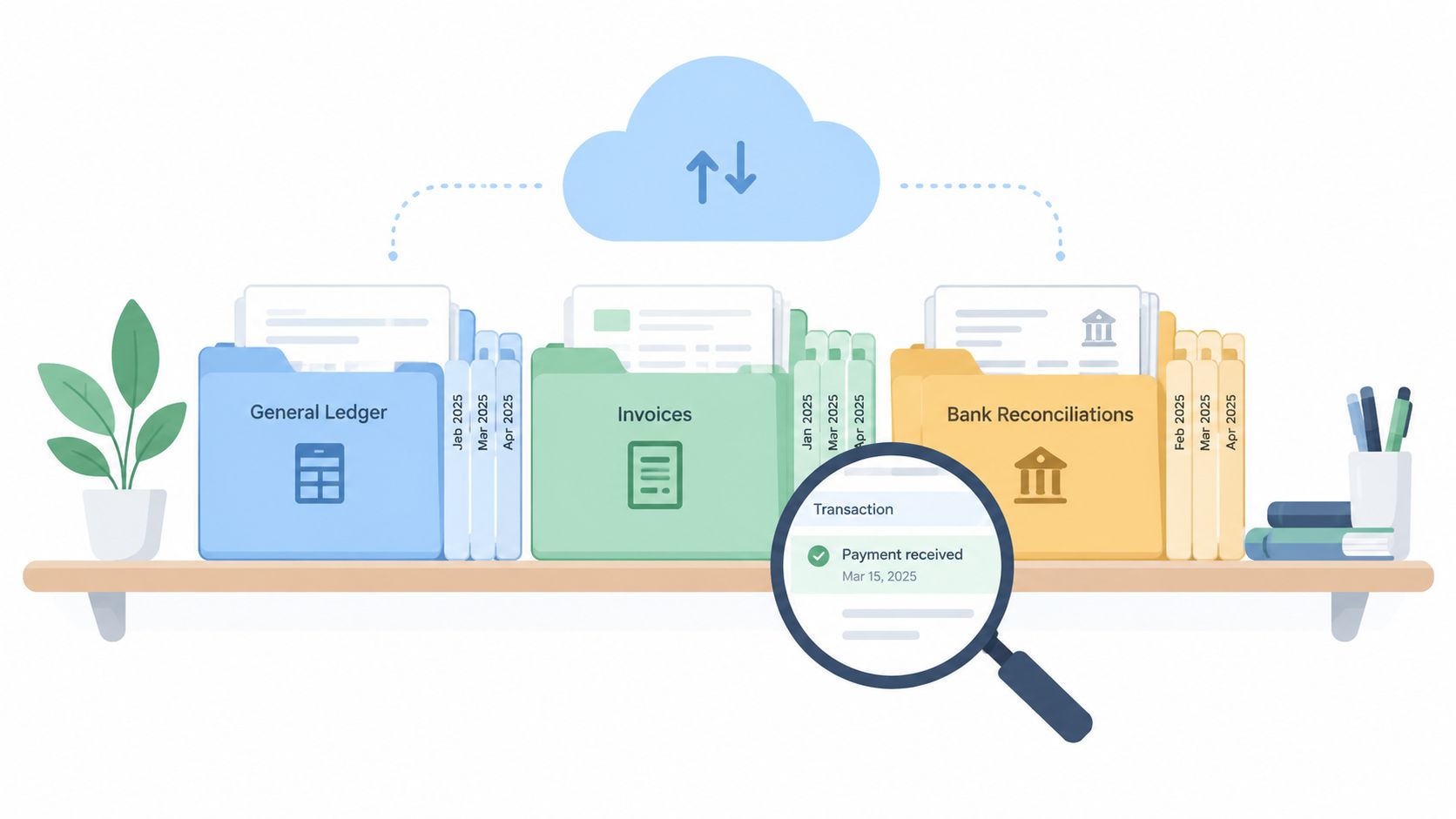
Useful automation includes bank feeds, invoice capture, recurring transaction rules, and reconciliation tools. But automation doesn't replace review. It only makes bad coding happen faster if nobody checks the output.
Practical rule: Ask a teammate who didn't prepare the files to find five common audit items. If they can't do it without asking for directions, the auditor won't enjoy the experience either.
For teams modernizing the close, automating expense reconciliation can reduce manual handling. The test is simple: can someone retrieve the evidence, understand its status, and trace it back to the ledger without a guided tour?
Cash is where bookkeeping shortcuts become visible. Reconcile every operating account, savings account, merchant account, loan account, and business credit card to the accounting records. “We barely use that card” isn't a control. It's an invitation for an auditor to ask why the balance is unexplained.
Owner: Bookkeeper prepares the reconciliation. Finance lead or controller reviews exceptions, aged items, and adjustments.
Target timing: Reconcile monthly as part of the close, then complete an audit-date reconciliation before fieldwork. Don't wait for the auditor's request list to reveal that an uncleared transaction has been haunting the ledger.
Match statement activity to the ledger, investigate differences, document timing items, and post corrections with a clear explanation. For cards, reconcile to the statement date rather than the payment date. That distinction prevents the classic error where the payment is recorded but the underlying charges remain parked in the wrong period.
A clean reconciliation has more than a zero difference. It has support for deposits in transit, outstanding checks, merchant settlements, fees, transfers, and unusual entries. Review old reconciling items instead of rolling them forward indefinitely. If an item no longer represents a real timing difference, resolve it through an approved adjustment.
Keep a short recurring-transaction reference for subscriptions, payroll transfers, loan payments, and processor settlements. It helps the preparer move quickly without turning every month into a memory test. For more complex ledgers, use general ledger reconciliation support to separate routine matching from senior-level investigation.
A reconciliation template should include:
The common shortcut that fails is importing a spreadsheet balance and calling it reconciled. Auditors need to see the path from external statement to ledger, not just a number that happens to agree. Keep the evidence in the same location as the reconciliation, with links that still work after staff changes.
A financial statement balance is a headline. A supporting schedule is the article underneath it. Prepare schedules for aged receivables, inventory, fixed assets, debt, accruals, prepaid expenses, leases, equity, and any account where the ending balance requires explanation.
Owner: Senior accountant or controller. Routine data gathering can sit with bookkeeping staff, but the person reviewing the schedule must understand the accounting treatment and the audit risk.
Target timing: Prepare schedules during year-end close and update them through the audit date. Don't create a blank template after the auditor asks for one. That is how a simple request becomes a small crisis with tabs.
Each schedule should identify the related general ledger account, reporting date, opening balance, additions, reductions, ending balance, and tie-out difference. Use formulas where they improve traceability, but lock or clearly label calculated fields. A schedule that produces a number nobody can explain is just a more attractive mystery.
For inventory, show categories, quantities, valuation basis, and slow-moving or obsolete items where relevant. For fixed assets, include acquisition date, cost, useful life, depreciation method, accumulated depreciation, disposals, and supporting invoices. For debt, include lender, principal, interest terms, maturity, payments, covenants, and balance confirmation support.
Your documentation index should include procedure titles, version numbers, approval dates, and document locations. An external-audit preparation guide also recommends a pre-audit information package covering the organizational chart, process map, outsourced processes, and significant business changes. See the financial statement preparation guidance when the close requires more than routine data entry.
A schedule should answer three questions without a meeting: what makes up the balance, how does it tie to the ledger, and what changed from the prior period?
Add a reviewer sign-off and a notes column for unusual items. If an accrual changed because of a new bonus plan, say so. If a receivable reserve changed because a customer entered financial difficulty, document the evidence. Auditors don't expect every business decision to be tidy. They do expect the accounting team to know what happened and why.
The failure mode here is overbuilding. You don't need a 30-tab workbook for an immaterial account with no judgment. You do need a concise, defensible schedule for accounts involving valuation, estimates, cutoff, ownership, or unusual activity.
A policy sitting in a folder isn't a control. It becomes useful when the team applies it consistently and can show how decisions were made. Review revenue recognition, inventory valuation, depreciation, capitalization, contingencies, reserves, leases, expense classification, and equity accounting before the year-end close is locked.
Owner: Controller or CFO, with operating owners contributing facts about how transactions happen.
Target timing: Review policies before the audit planning conversation and whenever the business model, systems, contracts, or transaction types change.
Start with the business, not a generic policy library. A SaaS company needs a clear explanation of how subscription arrangements are evaluated and recognized. A product business needs a practical inventory and obsolescence approach. A services company needs rules for project costs, unbilled revenue, retainers, and doubtful accounts. The policy should be detailed enough to guide staff without pretending every transaction is identical.
Select recent transactions and trace them through the policy. Did the team code them consistently? Did approval happen as required? Did the financial statement note reflect a change in treatment? If the answer is no, fix the transaction and document the reason rather than hoping the auditor sees only the clean examples.
The European Court of Auditors' methodology says materiality should be considered during planning to assess risks and determine the nature, timing, and extent of audit procedures. It notes that a 2% threshold is generally used in its methodology, though materiality depends on the engagement and context. Read the materiality methodology rather than treating a threshold as a universal shortcut.
Train the accounting team on policy changes and preserve evidence of the training in meeting notes, emails, or an approval log. Maintain an exceptions register with the transaction, policy involved, decision, reviewer, and business rationale. A documented exception can be defensible. An undocumented inconsistency looks accidental.
The shortcut that doesn't work is copying a policy from another company and never checking whether your systems support it. Policy quality is measured by repeatable application, not by how formal the PDF looks.
A control documented after the audit request is evidence of panic, not control. Test the controls that protect cash, payroll, revenue, purchasing, journal entries, debt, system access, and financial reporting while the process is still operating.
Owner: The controller or finance lead coordinates the work. Control performers produce the evidence, while the board or audit committee reviews significant issues where that governance structure exists. Assign one person to track exceptions, or small gaps will become year-end surprises.
Target timing: Test key controls during the year, then run a focused review before fieldwork. Quarterly testing fits regularly performed controls, but higher-risk activities may need more frequent attention. Set the schedule around the risk and the control's operating frequency, not convenience.
Describe each control as it works. If the CFO reviews a monthly payroll reconciliation, retain the reconciliation and sign-off. If purchasing requires a purchase order, receipt, and invoice to match, keep all three records together. A control supported only by an undocumented Slack message will create questions, not confidence.
A usable control register records the Control objective, Control owner, Frequency, Evidence, Test result, and Remediation. In practice, that means stating the risk addressed, naming the performer and reviewer, recording when the control operates, identifying the report or system log that proves completion, marking the outcome as passed, exception, or failed, and assigning an owner and target completion date for corrective action. Save the test schedule and use a consistent file name so another reviewer can reproduce the conclusion.
Evidence collection often strains finance teams. A 2025 survey of 500 IT and security decision-makers found that only 29% said their compliance programs consistently met internal and external standards, while 62% said evidence gathering was at least occasionally error-prone, according to audit-readiness guidance. Those figures describe compliance programs, not every financial audit, but the operating lesson is still useful: evidence needs a named owner and a due date.
For routine bookkeeping, the controller's team can usually maintain the register and perform scheduled tests. Designing controls, testing complex system access, or assessing a serious deficiency may justify rapid support from HireAccountants, whose internal controls testing resource addresses control design and testing.
Record every failure. Note what happened, why, the affected period, the risk, the corrective action, and the person responsible. Deleting awkward evidence does not clean the process. It removes the explanation the auditor will later request.
A clean ledger cannot answer every audit question. Contingencies, subsequent events, debt covenants, related-party activity, fraud risks, unusual transactions, and major business changes require management's explanation plus evidence.
Put the CFO or finance lead in charge of the response process. Department heads supply facts, but one person should approve the final wording and send it to the auditor. Otherwise, the auditor gets three versions of the same event and finance inherits an avoidable cleanup job.
Request the inquiry letter early, then set response deadlines before fieldwork begins. Contact outside counsel in advance if litigation or claims could affect reporting. The target is simple: every question has an owner, a due date, a reviewer, and a complete evidence package before the auditor asks twice.
Start with the answer, then connect it to proof. For every item, record the responsible executive, documents required, latest review date, status, reviewer, and the next unresolved point. A spreadsheet, shared tracker, or audit-request system can carry the process, provided the file shows who changed what and when.
Review board minutes, legal correspondence, contracts, financing documents, insurance notices, and subsequent cash activity. Ask department heads to disclose unusual commitments, disputes, or events after period-end. Preserve both the request and the response. If the evidence is incomplete, say so and assign the missing item rather than marking the question “ready” because the deadline is uncomfortable.
The step-by-step security assessment process offers a useful adjacent example: structured inquiries work better when questions, owners, evidence, and review status stay connected. Finance teams should tailor that approach to the audit scope.
Common trouble spots deserve a second review. Ask outside counsel for a formal assessment of contingent liabilities for financial reporting. For debt, recalculate covenant compliance and retain the agreement, calculations, and lender correspondence. For related parties, compare the transaction listing with board minutes and declarations of interest.
Suggested internal email: “Please disclose any pending claims, unusual commitments, related-party transactions, or significant events through the reporting date. Include the relevant contract, correspondence, approval, or calculation. Send responses to the finance lead by the date shown in the tracker.”
Keep a working management representation letter from the start. Update it as facts change and let the audit team comment before the final week. A controlled response file gives the auditor a considered management position, not a last-minute scavenger hunt.
Multiple entities create a special kind of accounting mischief. One company records an invoice, another records an expense, a third records a transfer, and everyone agrees the balances are “basically right.” Consolidated statements don't accept basically right.
Owner: Controller or senior accountant with authority across entities. Each entity's bookkeeper should reconcile its side, but one person must own the consolidated view.
Target timing: Reconcile intercompany activity monthly. Complete the final intercompany confirmation and elimination schedule before consolidated financial statements are submitted for audit.
Identify intercompany invoices, management fees, cash transfers, loans, interest, shared payroll, equity movements, and reimbursements. Match both sides by entity, period, account, amount, and transaction type. Investigate differences caused by timing, foreign exchange, coding, or one-sided entries.
A useful consolidation worksheet should show each entity's trial balance, the intercompany balances, proposed eliminations, and the resulting consolidated amount. Use a standardized chart of accounts where practical. Consistent account numbering makes it easier to distinguish external activity from intercompany activity.
For intercompany loans, maintain the original amount, interest rate, payment terms, maturity, repayments, accrued interest, and ending balance. Tie the schedule to each entity's payable and receivable. If entities operate across state or international borders, document the transfer-pricing methodology and keep the tax support with the accounting analysis.
The common shortcut is eliminating a round number at year-end because the entities “should” agree. That creates a consolidated statement that balances while leaving the underlying records unreconciled. Auditors can still trace the mismatch, and now the team has to explain why the elimination was manufactured.
Use a standard confirmation message between entity owners:
“Please confirm the intercompany balance owed to or from [entity] as of [reporting date]. Attach the supporting ledger detail, invoices, payments, loan schedule, and any reconciling items. Identify differences by transaction, not by net balance.”
If an organization has only one legal entity, document that intercompany activity isn't applicable. A signed scope note is better than leaving the auditor to wonder whether the topic was forgotten.
A kickoff meeting can prevent avoidable audit surprises. Give the auditor a concise view of the business, recent changes, significant transactions, accounting estimates, systems, key personnel, and known problem areas. Early transparency helps the audit team plan appropriate procedures instead of discovering major issues during fieldwork.
Owner: CFO, controller, or designated audit coordinator. Assign one coordinator at least two months before the audit, as recommended in external-audit preparation guidance.
Target timing: Hold the planning conversation before fieldwork. Confirm access, availability, scope, and deliverables before the audit window opens.
Prepare a one-page business overview covering the industry, business model, products or services, revenue streams, systems, organizational chart, outsourced processes, and significant changes. Add a key-personnel schedule for the CFO, controller, accounting staff, operational leaders, legal contacts, and IT administrators. Routine bookkeeping can usually support this preparation. Complex accounting questions, system access issues, or tight deadlines may justify rapid support from HireAccountants.
Record each request, internal owner, evidence location, reviewer, status, and response date. Review the tracker on a standing schedule, such as twice weekly during fieldwork. Route responses through the coordinator rather than letting requests scatter across email, chat, and personal folders. “Quick question” threads have a habit of becoming a filing system.
Use the kickoff meeting to confirm:
Vanta's audit guidance emphasizes scope, timelines, resource owners, evidence collection, auditor communication, and confirmation of the audit view, roles, frameworks, and policy attestations before the audit window opens. Its compliance audit preparation checklist supports this workflow.
Send a kickoff email that creates a usable record:
“Attached is our business overview, audit request tracker, key-personnel schedule, and list of known complex areas. Please confirm scope, framework, initial requests, required system access, and dates for walkthroughs. We'll route responses through [coordinator] so evidence and follow-up stay in one place.”
Set a realistic response rhythm. Flag blocked requests early, assign backup contacts, and avoid promising instant answers the team cannot provide. That discipline keeps auditor questions from becoming last-minute emergencies.
| Task | Implementation complexity | Resource requirements | Expected outcomes | Ideal use cases | Key advantages |
|---|---|---|---|---|---|
| Organize Your Financial Records Like Your Auditor's Sanity Depends On It | Moderate–High, substantial upfront cleanup and ongoing maintenance | Accounting software/cloud repository; centralized filing; part‑time bookkeeper or finance lead | Shorter audit fieldwork, faster month/year closes, fewer corrections | Startups, SMEs preparing for audit or regular reporting | Reduces audit time/fees; improves controls and visibility; easier onboarding |
| Reconcile Your Bank Accounts (Yes, All of Them) | Low–Moderate with automation; high if backlog/manual | Bank feeds, reconciliation tools, timely statements; part‑time bookkeeper (10–15 hrs/mo) | Accurate cash balances, quicker fraud detection, less auditor testing | Businesses with multiple bank/credit accounts or payment processors | Detects fraud/bank errors; clarifies cash position; reduces audit sampling |
| Create Detailed Supporting Schedules (The Auditor's Favorite Snack Food) | High, technical preparation and review required | Mid‑level accountant or accounting manager; templates and GL tie‑outs | Faster auditor testing, fewer misstatements, clearer disclosures | Companies with inventory, fixed assets, accruals or complex receivables | Speeds audit testing; supports valuation and disclosure; aids trend analysis |
| Review Your Accounting Policies and Ensure They're Actually Followed | Moderate, policy drafting, training, and enforcement | Senior accountant/CFO; written policy manual; staff training and documentation | Consistent accounting treatment year‑over‑year, fewer control weaknesses | Growing companies or those with complex revenue, capitalization rules | Demonstrates governance; reduces audit adjustments; eases comparability |
| Test and Document Your Internal Controls (Auditors Love Evidence) | High, design, evidence collection, and periodic testing | Senior accountant/internal audit resource; control testing tools and samples | Reduced audit scope, early detection of control failures or fraud | Organizations subject to regulatory oversight, SOX/COSO focus, higher risk areas | Lowers audit effort; strengthens governance; creates accountability |
| Gather and Organize Audit Inquiry Responses (The Back‑and‑Forth Dance) | Moderate, cross‑functional coordination and documentation | Finance lead/CFO coordination; legal and operations support; documented evidence | Faster responses to auditor inquiries, fewer delays, clearer management assertions | Companies with litigation, contingencies, related‑party transactions or covenants | Speeds fieldwork; reduces back‑and‑forth; enables proactive issue resolution |
| Reconcile Intercompany Transactions and Eliminate Consolidation Entries | High, complex reconciliations and eliminations across entities | Controller/senior accountant; consolidation worksheet/software; standardized COA | Accurate consolidated financials, fewer consolidation adjustments, transfer pricing support | Groups with multiple subsidiaries or cross‑jurisdiction operations | Ensures consolidation accuracy; supports tax/transfer pricing; streamlines close |
| Schedule and Prepare Audit Communications (Getting Ahead of Questions) | Low–Moderate, planning and logistical coordination | Finance lead/CFO; audit planning memo, schedules, key contacts and workspace | Auditors arrive prepared, more efficient fieldwork, clearer timelines | Any audited organization, especially with complex operations or transactions | Reduces fieldwork time; sets expectations; uncovers issues early |
The audit isn't finished when the auditor leaves the call or sends the report. It's finished when the organization has converted the findings, adjustments, and unanswered questions into operating improvements. Otherwise, next year's preparation will feature the same missing schedules, the same stale reconciliations, and the same brave declaration that “we'll start earlier this time.”
Start with an adjustment and finding log. Record every proposed adjustment, passed adjustment, control exception, documentation gap, audit comment, and management response. Include the affected account or process, the reason, the financial or control implication, the owner, the target date, and the reviewer.
Retention deserves its own line on the checklist. For PCAOB audits, the final audit documentation file must be assembled within 60 days after the report release date. If no report is issued, the documentation must be retained for seven years from the date fieldwork was substantially completed, according to GAO's AICPA audit documentation reference. That means teams need a controlled archive, not a temporary folder that disappears when the project ends.
The SEC's records-retention rule also covers workpapers and related memoranda, correspondence, communications, and other records created, sent, or received in connection with an audit or review when they contain conclusions, opinions, analyses, or financial data. Email threads and spreadsheet commentary can therefore matter, as explained in the SEC audit-records retention rule. “We'll dig it out later” is not a retention strategy. It's forensic archaeology with worse snacks.
A year-round program should keep evidence accessible, review user access, refresh reconciliations, preserve approvals, and monitor controls instead of starting from zero each year. Guidance on year-round audit readiness makes the same practical point: centralized evidence, regular access reviews, continuous monitoring, and a reliable audit trail matter as much as the initial document list.
The best audit preparation checklist becomes part of the close calendar. Routine bookkeeping keeps the ledgers, reconciliations, invoices, and schedules moving. Higher-skill support handles accounting policies, consolidation, materiality judgments, controls, complex estimates, and auditor responses. If those capabilities aren't available internally, HireAccountants can help fill bookkeeping, senior accounting, controller, or audit-preparation gaps while the finance leader retains decision authority.
That is the standard. Not a heroic week. Not a pristine folder assembled after the auditor asks for it. A repeatable rhythm that leaves the business more explainable, more controlled, and considerably less likely to spend Friday night searching for a receipt from three years ago.
If your next audit is approaching, HireAccountants can connect you with pre-vetted bookkeeping and finance professionals for ongoing close support or focused audit preparation. Share the gaps you need covered, whether that's reconciliations, schedules, controls, consolidation, or auditor responses, and build the support before the spreadsheet marathon begins.
Let's simplify your finances today!