


Book to bill is bookings divided by billings for the same period. A ratio above 1.0 means demand is outrunning shipments, while a ratio below 1.0 means the business is burning through backlog faster than new orders replace it.
That sounds tidy. It isn't always tidy in the finance meeting.
Sales celebrates a strong order quarter. Finance points at flat revenue. Operations says the factory is full, but the delivery schedule is slipping. The founder opens the dashboard and wonders whether the company is growing, choking, or measuring three different things with three different spreadsheets.
That's where book to bill earns its keep. It's not merely a sales score. It's a demand-versus-delivery health check. The ratio asks whether fresh customer commitments are arriving faster than the business can ship and bill them. Useful? Very. Foolproof? Not remotely.
A founder enters the quarterly review with healthy bookings and leaves with an uneasy cash forecast. New orders look strong, yet billings stay flat because customers will not receive the product until later. Sales sees momentum. Finance sees timing risk. Both can be correct.
Book to bill gives them a shared frame. It compares new orders booked with shipments or revenue billed in the same period. A reading above 1.0 generally signals a growing order backlog. A reading below 1.0 generally signals that shipments are outpacing new demand and the backlog is shrinking, as explained in this SEC filing's description of the ratio.
The practical question: Are we creating future revenue, or spending down the revenue already waiting in the queue?
That question carries more weight in businesses with long production cycles, complex delivery schedules, or uneven customer demand. Semiconductor equipment makers used the metric heavily because orders could shift faster than factories could ship. The measure became standardized in the late 1970s and early 1980s, then spread into aerospace, industrial machinery, electronics manufacturing, and enterprise technology as documented in this history of book to bill.
The arithmetic is simple. The definitions are where teams get hurt. Use a clean reporting period, apply consistent rules to bookings and billings, and check whether capacity can convert demand into deliveries.
A high ratio is a signal, not a trophy. A 1.3 may reflect genuine demand. It may also reflect one large contract, a different treatment of cancellations, or production bottlenecks that delay shipments. Backlog can swell while cash waits. The ratio can look excellent precisely when delivery is under strain.
That is why book to bill works better as a demand-versus-delivery health check than as a standalone sales score. It connects incoming commitments with the business's ability to fulfill them, while leaving plenty of room for timing, definitions, and operational reality to distort the headline.
A factory can look busy and still fall behind.
Orders arrive faster than the production line can ship them. The new orders are bookings. Completed deliveries that qualify for billing are billings. If the factory accepts ten orders and ships eight products, demand is running ahead of delivery and the queue grows. If it accepts eight and ships ten, the queue shrinks.
That queue is backlog. It represents work waiting for fulfillment, not cash already collected.
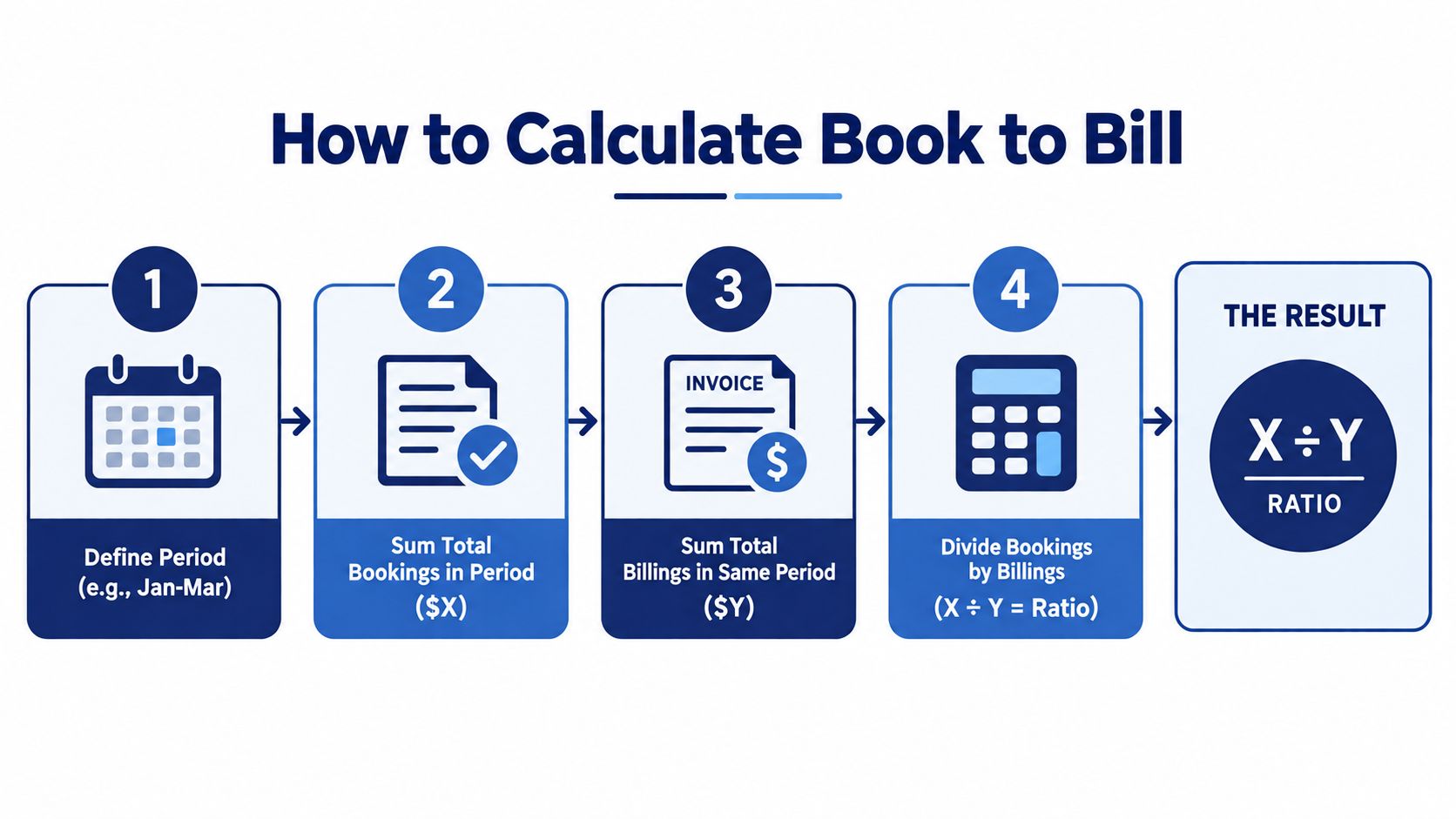
The formal calculation is straightforward:
Book-to-bill ratio = bookings during the period ÷ billings during the same period
The period may be a month or a quarter. Alignment matters more than clever arithmetic. Compare bookings and billings from the same reporting window. Mixing one quarter's orders with another quarter's billings can turn a harmless spreadsheet error into a misleading management signal.
A ratio of 1.0 means incoming commitments and current delivery are broadly balanced. Above 1.0, bookings exceed billings, so the backlog may be expanding. Below 1.0, the company is delivering from existing backlog faster than it is replacing that work. The ratio therefore acts as a leading indicator, because orders can reveal future production needs before shipments appear in reported sales as outlined by Investopedia.
A manufacturer may accept an order today but schedule shipment for a later production slot. The booking confirms customer demand. The billing arrives only after delivery occurs. The gap shows how much work may be waiting ahead.
It also creates traps. A booking can be canceled, delayed, renegotiated, or pushed into another period. A rising ratio can signal healthy demand, or it can expose a factory that cannot convert orders into shipments. A 1.3 may look impressive while bottlenecks keep cash and revenue waiting.
Book to bill became useful in cyclical markets with long lead times, including semiconductor equipment. Order flow could change faster than factories could ship, making the relationship between demand and delivery worth tracking. Industry groups later formalized the measure and published monthly data, helping it spread into other manufacturing and technology sectors according to the historical overview from Longbridge.
Book to bill measures whether incoming demand is growing faster or slower than current delivery.
That definition keeps the metric in its proper lane. Sales can secure the order. Operations must build and ship it. Finance must determine when billing is recognized. Book to bill sits between those functions, checking whether demand, fulfillment capacity, and timing are moving together. It is a health check, not a sales trophy.
The arithmetic takes seconds. The period setup decides whether the answer means anything.
Start by choosing one time window. For a monthly ratio, include qualifying bookings and billings recorded in that month. For a quarterly ratio, use the complete quarter for both figures. Then divide bookings by billings.
A 1.10 book-to-bill ratio means $1.10 of new orders for every $1.00 shipped. That can indicate stronger demand and increased future production utilization, yet delivery timing still controls when the signal reaches revenue and cash, as discussed in this faculty research on book to bill.
The denominator deserves more scrutiny than it usually gets. Bookings can arrive today while shipments, invoices, and recognized revenue occur later. For a practical explanation of revenue recognition in accounting, review how accounting treatment connects revenue with delivery and performance. A ratio built from mismatched definitions can look precise while comparing different economic events.
A single month can mislead. One large contract may send the ratio sharply higher. A delayed shipment may push it lower, even when underlying demand has barely changed.
A three-month moving average can reduce that noise and make changes in capital-spending demand easier to see, as described by Investopedia. Use the monthly figure for operational alerts, such as a sudden order surge or shipment shortfall. Use the moving average for trend decisions. One shows the latest bump. The other helps prevent a single unusually strong Tuesday from dictating the whole forecast.
“Bookings” is not a universal accounting bucket. One issuer calculates book to bill using additions to backlog and awarded contracts, excluding acquisition-related additions, divided by revenue from fixed-price contracts for the period, in the issuer's stated methodology.
Another company may include different contract types, apply a different cancellation policy, or report only one segment. Before comparing ratios, check:
A 1.3 can therefore signal demand, delivery pressure, or a different formula. Confirm the inputs before treating it as a clean performance score.
A book-to-bill ratio is a direction-of-travel signal, not a standalone grade. A 1.3 may look excellent while delivery teams are already wrestling with bottlenecks, distant backlog, or a formula that cannot be compared with another company's.
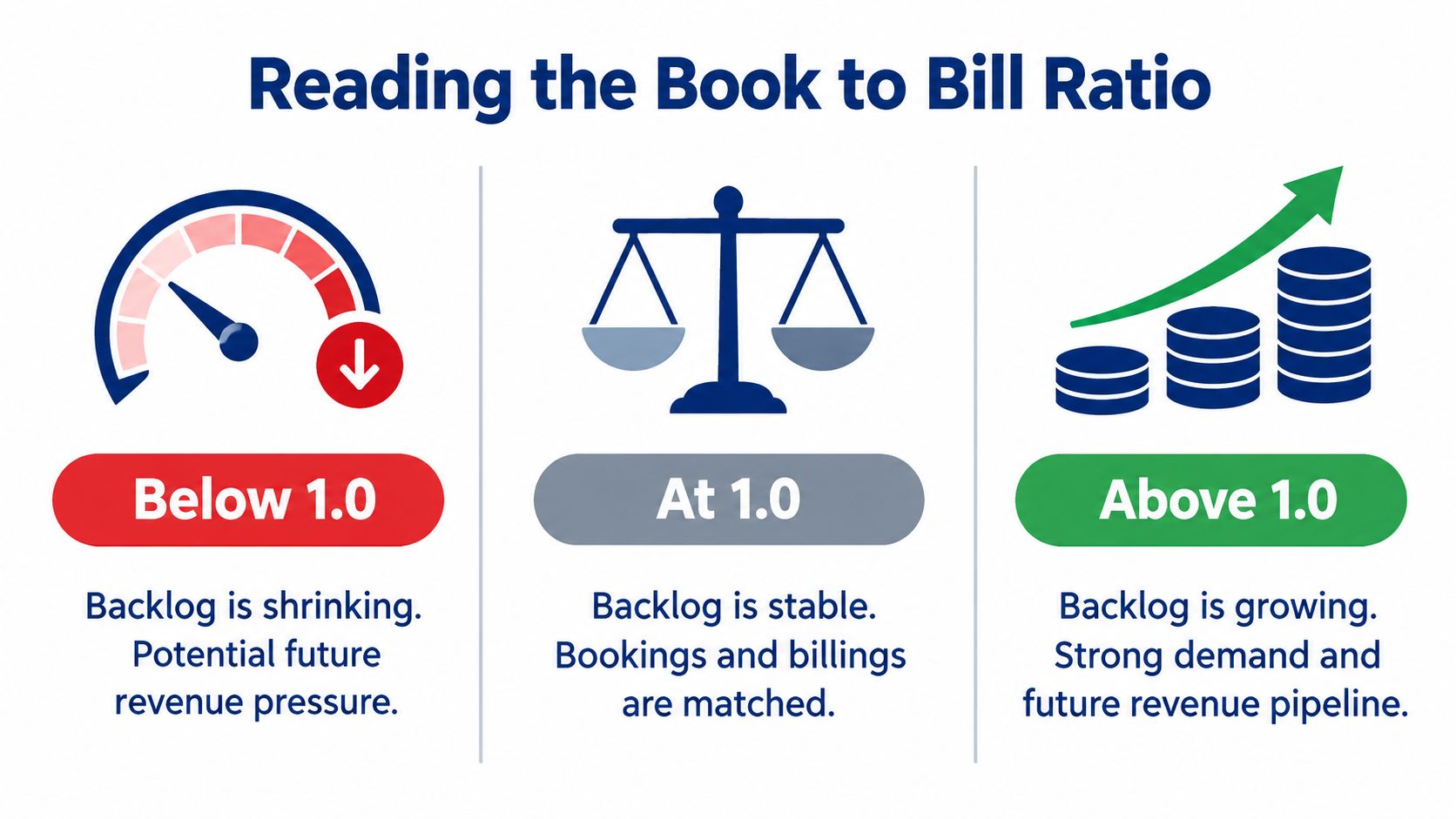
Above 1.0, bookings exceeded billings during the period. Backlog is generally growing, which can support capacity planning, purchasing, and hiring if the orders are credible and deliverable.
At 1.0, bookings and billings are broadly matched. The backlog is stable. That may sound dull, yet a mature operation often prefers a steady queue to a surge it cannot ship.
Below 1.0, billings exceeded new bookings. The company is using existing backlog to support current revenue. That can follow a major delivery cycle, or it can signal weaker future coverage.
| Ratio Range | What It Signals | Operational Implication |
|---|---|---|
| Above 1.0 | New orders exceed current billings | Review capacity, supplier commitments, and delivery schedules |
| At 1.0 | Bookings and billings are broadly matched | Maintain capacity while watching conversion and cancellations |
| Below 1.0 | Billings exceed new orders | Test backlog coverage and avoid assuming current revenue will persist |
The 1.10 benchmark means the company books $1.10 for every $1.00 shipped. The order queue is growing modestly. Treat that as a question, not a victory lap: can the business convert those orders without stretching delivery timelines or cash reserves, as explained in the Trinity University research source?
Persistent separation between bookings and billings can affect staffing, inventory, and working capital before revenue shows the full effect. A rising ratio may require more production labor or components. A falling ratio may call for restraint. Hiring ahead of verified demand is expensive. Hiring after the factory is underwater is worse. For related calculations, see this guide to financial ratio formulas and their practical use.
The ratio shows backlog direction. It does not show how quickly backlog becomes revenue. A 1.10 built from orders scheduled for near-term shipment is more useful operationally than the same ratio built from distant projects.
Ask three questions:
Those answers turn a headline metric into a planning tool. The spreadsheet earns its keep at last.
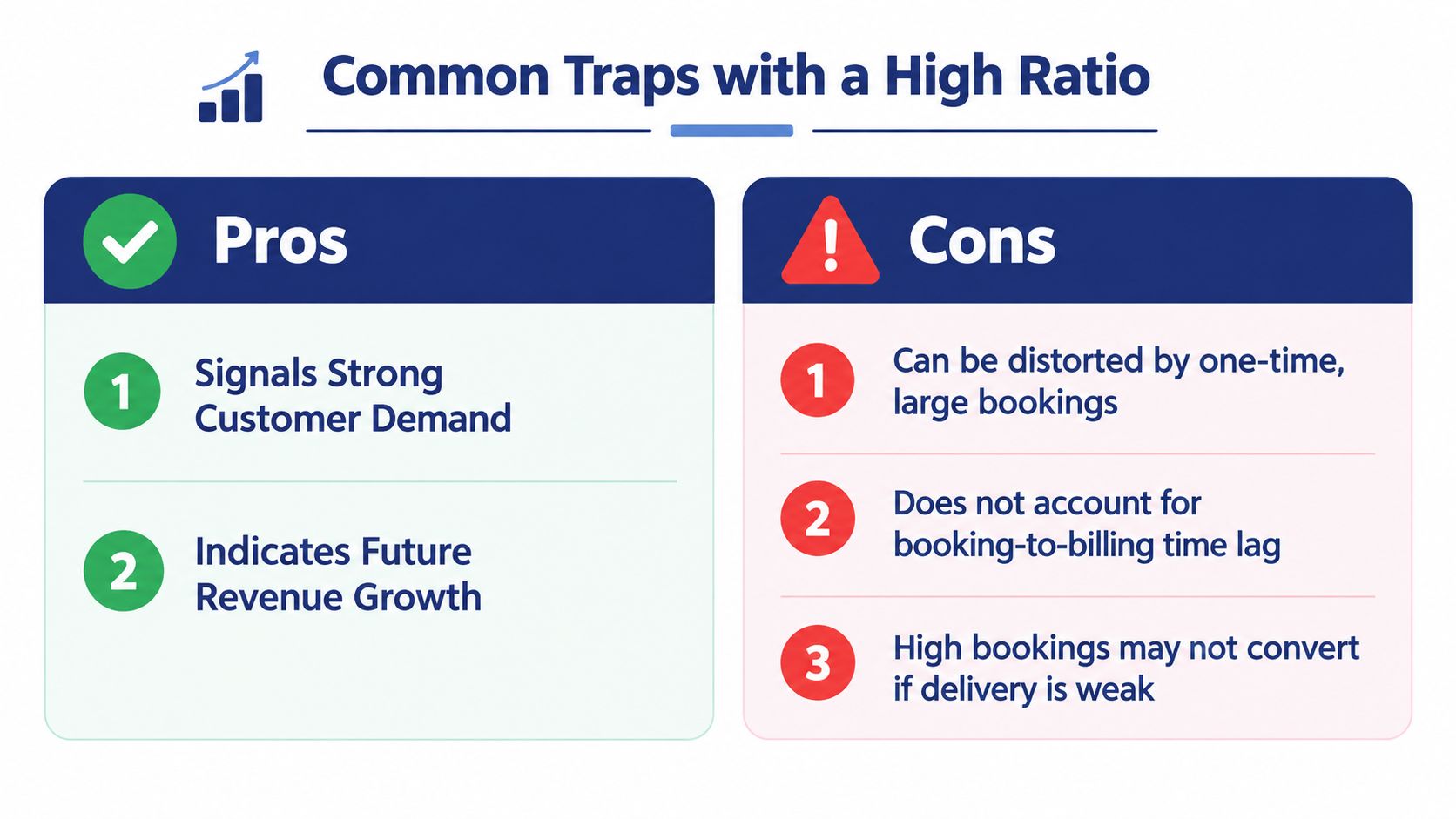
A reported book-to-bill ratio of 1.3 can look like a victory. Then the factory misses ship dates, customers defer orders, and revenue refuses to follow. The ratio measures demand entering the queue against work leaving it. It does not certify that the queue can move.
The first trap is timing. A large booking may not ship for months, lifting the ratio without changing current-quarter billings or delivery requirements. Sales can celebrate the order while operations prepares for a problem that has not reached the income statement yet.
The second trap is capacity constraint. If equipment, labor, or components limit shipments, billings fall while bookings continue. The ratio rises, but the increase may reflect a blocked production system rather than healthier demand. Customers may wait, delay acceptance, or reconsider the order.
A high ratio can describe a full pipeline, a blocked factory, or both.
The third trap is measurement scope. Companies may include different segments, contract types, or cancellation treatments. One business may count an awarded contract. Another may count only a signed order. Comparing the two produces apples versus very expensive oranges.
The Global Electronics Association reported North American PCB book-to-bill readings of 1.24 in April 2026, 1.49 in July 2026, and 1.18 in the 2025 year-end summary in its North American PCB bookings release. The readings show bookings outpacing billed sales, not that every company has identical demand, delivery capacity, or backlog quality.
The association's three-month calculation divides orders booked during the past three months by sales billed during that period. A company using another period, segment, or order definition may produce a ratio that is not directly comparable.
Company disclosures add another warning. Vishay reported a total-company ratio of 1.34 in Q1 2026, while TTM Technologies reported 1.49 in Q2 2026, and PCB bookings reached 1.46 in August 2026, according to the cited industry commentary and earnings transcript from TTM Technologies' Q2 2026 earnings call. These are useful signals, not interchangeable scorecards.
The better question is “How much of the backlog converts soon?”
Review order age, scheduled ship dates, customer concentration, cancellation history, and production constraints. A high reading with a clean near-term schedule supports confidence. A high reading paired with aging backlog and delayed fulfillment deserves suspicion.
The U.S. government's chip supplier report shows how quickly end-market mix can distort the picture. Median book to bill rose from 1.0 in 2019 to 1.13 in 2021 overall, while automotive suppliers moved from 1.05 to 2.02 during that period in the Bureau of Industry and Security report. A sharp increase can reflect concentrated demand rather than durable growth.
Reconcile the bookings with delivery capacity before treating the ratio as a hiring or investment signal. A score is only as useful as the backlog's timing, quality, and path to shipment.
A ratio can look healthy while the factory falls behind. Put book to bill beside the backlog schedule, capacity plan, and cash forecast. On its own, the metric is a speedometer with no view of traffic.
A rising ratio should trigger an operating review. Can machines, suppliers, and labor handle the incoming work? Procurement should separate firm requirements from orders carrying cancellation risk. Teams managing purchasing data can also use these audit-ready procurement data tips when purchase commitments need to match the order pipeline.
The ratio shows whether the queue is growing. A conversion schedule shows when that queue might become billings. That difference matters. A backlog that ships next month supports a different forecast from one waiting on customer approval.
Track each major backlog category by:
Electronics supply chains often use book to bill as a forward-looking benchmark. Readings above 1.00 typically imply sales growth over the next three to 12 months, according to the Global Electronics Association's explanation of its three-month measure in the association's PCB release. Treat that range as a planning signal, not a delivery promise. A strong ratio can expose a bottleneck rather than solve one.
New orders may require inventory, deposits, production labor, and receivables capacity before customers pay. Book to bill therefore belongs in working capital management, alongside collection timing and supplier terms. The sales queue can grow while the bank balance shrinks. That is not a contradiction. It is the cost of funding delivery.
A practical operating rhythm is simple:
Bookings are not free money. An order can create obligations long before it creates cash. A reading of 1.3 may look excellent, yet deliver little near-term revenue if production slots are full, components are late, or customers keep changing specifications.
For startups and small businesses, a finance professional can maintain the booking log, reconcile invoices, monitor aged backlog, and tie the forecast to delivery capacity. HireAccountants connects businesses with pre-vetted accountants and finance professionals for bookkeeping, accounts receivable, financial analysis, and related work. That gives a growing team clear ownership instead of leaving the founder to babysit another spreadsheet.
Book to bill is a demand-versus-delivery check. That framing is the part to remember.
A ratio above 1.0 says incoming orders are ahead of current billings. A ratio below 1.0 says the business is spending down its backlog. Neither result tells the whole story without conversion timing, cancellation treatment, customer quality, and operational capacity.
Use a consistent formula. Define what counts as a booking. Define what counts as a billing. Keep the periods aligned. If you change the method, disclose the change instead of moving the goalposts.
Then pair the ratio with a short operating checklist:
A strong ratio deserves attention, not automatic applause. A weak ratio deserves investigation, not immediate panic. The number is useful because it forces sales, operations, and finance to discuss the same queue.
If your team can't produce the inputs cleanly, the ratio is decoration. Get the records right first. Then make the metric earn its place in the forecast.
HireAccountants can connect your business with pre-vetted accountants and finance professionals who support bookkeeping, accounts receivable, invoicing, reconciliations, and forecasting workflows. Visit HireAccountants to find finance talent that can keep your book-to-bill tracking grounded in clean, decision-ready data.
Let's simplify your finances today!