


US employee bookkeeper wages cluster near $23.66 per hour, while outsourced or contract bookkeeper bill rates commonly start near $25 per hour and can climb past $150 per hour once the scope gets serious. The decision isn't finding one “average” rate. It's choosing the pricing layer that matches your workload, risk tolerance, and need for judgment.
Most advice about bookkeeper hourly rates starts with a number and ends with a shrug. That's backwards. A single average blends an employee's wage, a freelancer's bill rate, and an outsourced team's price, then pretends they're interchangeable.
They aren't.
I've hired bookkeepers who were cheap on paper and expensive in practice, usually because nobody defined who owned reconciliations, cleanup, payroll coordination, or month-end close. The invoice looked tidy. The books looked like a crime scene.
The useful question is simpler: what are you buying for that hourly rate?
The popular “average bookkeeper rate” is often a comparison error wearing business casual. An employee wage pays one person for labor. A freelance bill rate also covers taxes, software, insurance, unpaid administration, downtime, and profit. An outsourced remote rate may include a team, review, management, and technology, but it may also come with minimum commitments and tightly defined scope.
Those are three separate markets:
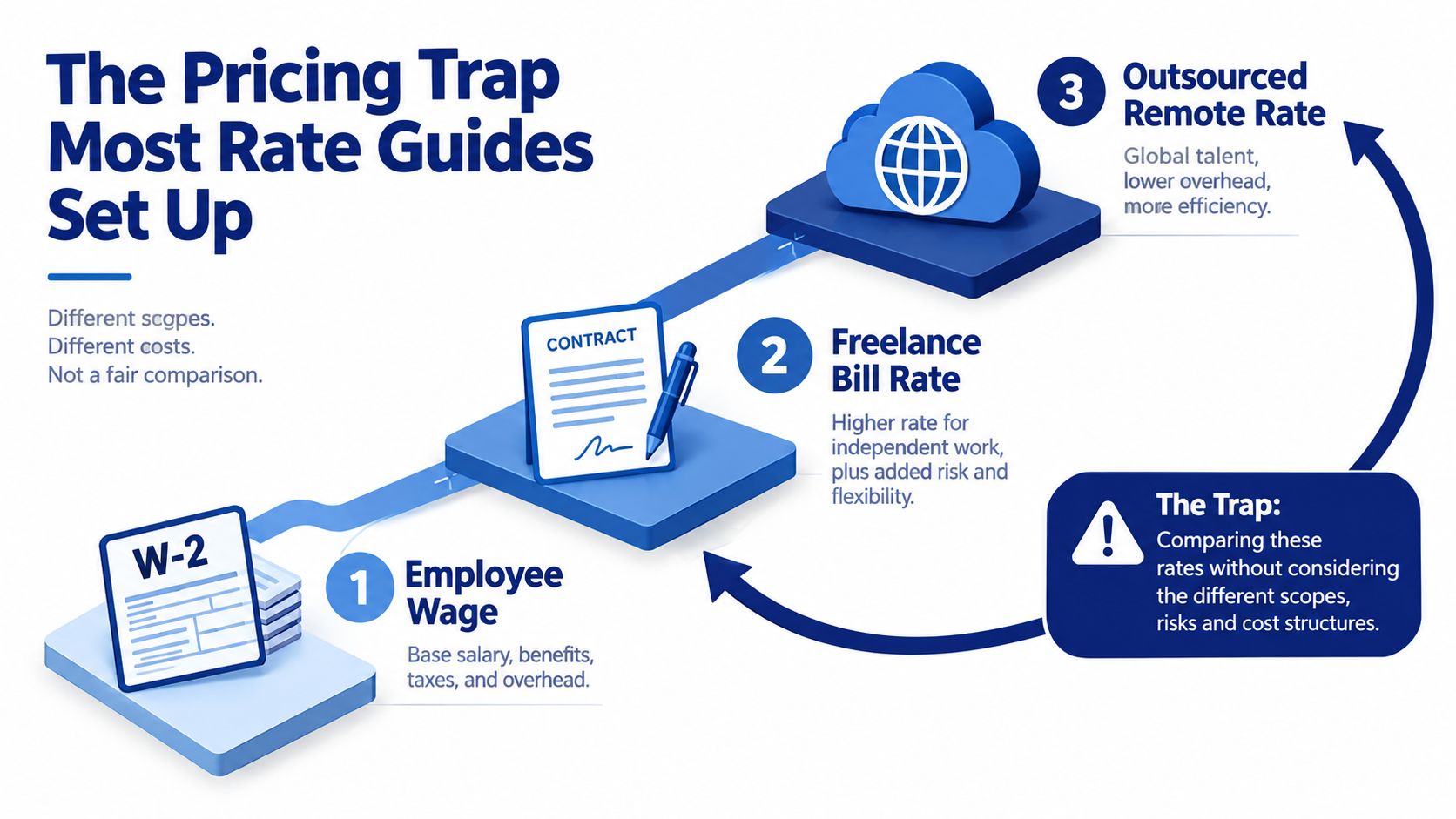
The U.S. W-2 benchmark sits near $23.66 per hour, with the BLS occupational wage profile showing a broad distribution from about $16.64 to $34.94 per hour. Outsourced and freelance pricing commonly starts around $25 per hour, while more complex work can reach $150 or more per hour, according to recent 2026 bookkeeping rate guidance.
That isn't a contradiction. It's the price of different responsibilities.
Aggregator sites flatten these layers because a single number is easy to publish and hard to use. A founder sees a low employee wage, compares it with a contractor quote, and assumes the contractor is overcharging. Then the founder hires the cheaper option, discovers there's no backup coverage, and spends evenings explaining why a customer refund isn't revenue.
The rate wasn't necessarily wrong. The comparison was.
Practical rule: Read the rate, then read the scope sitting underneath it.
A quote should tell you whether the person is entering transactions, reconciling accounts, handling payroll coordination, closing the books, explaining variances, or advising leadership. If it doesn't, you're not comparing prices. You're comparing guesses.
The employee benchmark is the cleanest starting point because it measures wages rather than marketing packages. The BLS data places the median hourly wage for bookkeeping, accounting, and auditing clerks at $23.66, with the lower end around $16.64 and the upper end around $34.94 per hour in the cited occupational profile. That spread tells you the title covers very different work.
Entry-level transactional posting belongs near the lower end. Reconciliation ownership, close support, payroll coordination, and multi-entity work push a candidate toward the upper end. A founder who budgets around the median for a role requiring senior judgment is underfunding the hire.
The older BLS reference also shows a $22.81 median hourly wage, with the middle half clustered between $18.65 and $27.90 in May 2023, as summarized in this bookkeeper hourly rate reference. Treat that figure as historical context, not a replacement for the more current occupational benchmark.
A W-2 wage excludes the employer's share of payroll taxes, benefits, paid time away, recruiting effort, equipment, and software access. It also excludes the cost of coverage when the employee is sick, takes leave, or leaves suddenly.
That doesn't mean you should blindly add an invented loading percentage. It means the wage is a floor for comparison, not the final budget. A $23.66 wage and a $25 freelance quote don't represent similar costs because the freelancer's number is designed to absorb expenses the employee wage leaves on your desk.
| Percentile | Hourly Wage | Approx. Loaded Cost to Employer |
|---|---|---|
| 10th | About $16.64 | Higher than wage after payroll, benefits, software, and management costs |
| Median | $23.66 | Higher than wage after employer-paid costs |
| 90th | About $34.94 | Higher than wage after employer-paid costs |
The entry-level bookkeeping hiring guide is useful when the work is primarily repetitive posting and basic reconciliation. Don't use an entry-level budget for a bookkeeper who must diagnose messy historical balances or defend a close package to investors.
My recommendation is blunt: use the BLS median as a labor-market anchor, then build the actual employment budget around the job's scope. If the candidate owns judgment-heavy work, the upper wage band is more realistic. If the role is narrow and highly supervised, the lower band may work.
Non-employee pricing solves different problems, and each model hides a different cost. A solo freelancer may give you direct access and flexibility. A boutique firm may give you review and backup. A managed outsourced team may absorb software and coverage while imposing a minimum commitment.
Published pricing guidance places freelance or contract work commonly around $25 to $75 per hour, while outsourced teams may begin around $10 per hour for narrow work, as described in this bookkeeping rate comparison. Broader 2026 roundups place real-world billing around $30 to $90 per hour, with senior and advisory work reaching $150 per hour, according to published bookkeeping services pricing guidance.
Those ranges are useful only after you identify the engagement model.
| Engagement Type | Typical Hourly Rate | Monthly Minimum | Hidden Cost Factor |
|---|---|---|---|
| Solo freelancer | Often starts around $25 | May be none or negotiated | Single-person dependency, backup gaps, and unpaid coordination |
| Boutique agency | Often higher than solo work | Commonly structured around a recurring package | Senior review may be bundled, but the firm's markup funds it |
| Managed outsourced team | Can start lower for transactional scope | Often tied to a package or minimum | Software and coverage may be included, while scope limits stay strict |
A freelancer is sensible when you need limited weekly support, the books are reasonably clean, and you can tolerate a single point of failure. You'll usually get speed and a direct relationship, but you may become the backup system.
A boutique agency makes more sense when continuity and review matter. You're paying for an operating layer, not just keystrokes. The catch is that a junior person may do the work while a senior person reviews it, so ask exactly who handles each deliverable.
Managed outsourcing works well for standardized bookkeeping, especially when the provider already supports your software stack. It can be efficient, but don't accept a low headline rate without checking account limits, response times, cleanup fees, payroll boundaries, and monthly minimums. The startup bookkeeping outsourcing guide covers the decision from an early-company perspective.
For a pre-revenue company, keep the model light. At Series A, continuity and investor-ready reporting usually matter more than shaving the hourly rate. For an established SMB, choose the model that keeps month-end from depending on one heroic contractor.
“Bookkeeper” is a job title, not a scope of work. One person posts transactions and reconciles a bank account. Another handles complex revenue treatment, supports a multi-entity close, builds cash forecasts, and answers questions that affect hiring and fundraising.
The price follows the judgment.
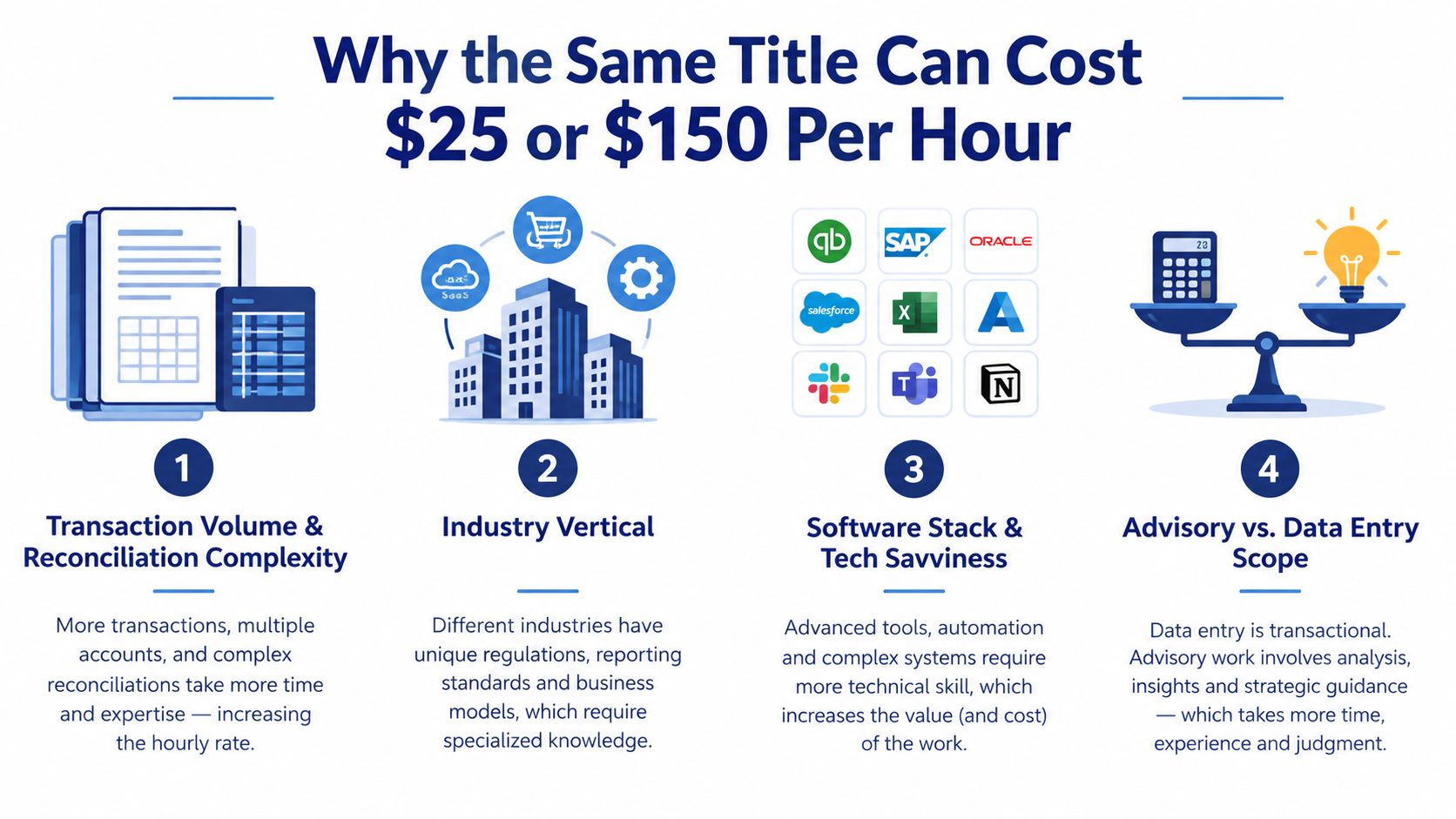
Transaction volume and reconciliation complexity come first. A file with many accounts, payment processors, refunds, transfers, and uncleared items takes more judgment than a clean ledger with a small number of predictable entries. Transaction count alone isn't enough. The mess attached to each transaction matters.
Industry vertical changes the accounting logic. A Shopify store may need payment processor reconciliation and inventory awareness. A SaaS business may need deferred revenue analysis and support for ASC 606. Construction brings job costing and retainage. Restaurants add location-level controls, payroll coordination, and cash handling questions.
Software stack depth creates another jump. QuickBooks Online with a disciplined chart of accounts is one environment. NetSuite connected to payroll, billing, expense management, inventory, and reporting tools is another. Integration failures don't politely wait for month-end.
Advisory scope is where the title becomes especially misleading. A person who prepares a monthly close narrative, builds KPI dashboards, explains cash movement, or performs fractional controller work is selling interpretation, not data entry.
A Shopify store with roughly 200 transactions and straightforward reconciliations might reasonably seek basic work near $25 per hour. The job is still real, but the decision burden is limited if the systems are clean.
A Series A SaaS company dealing with deferred revenue and ASC 606 needs a materially different skill set. A rate around $85 per hour can be rational when the engagement includes technical judgment and close support rather than simple posting.
A multi-entity restaurant group requiring cash forecasts and management-level interpretation may reach $150 per hour for senior work. That rate isn't justified by the word “bookkeeper.” It's justified, or not, by the consequences of the decisions the person is helping you make.
Negotiating against the headline rate is wasted leverage. Negotiate the deliverables, review responsibility, turnaround time, and definition of done.
Nearshore and offshore bookkeeping can reduce the labor rate, but the cheapest invoice isn't automatically the cheapest operating model. Remote work adds coordination, review, handoffs, and sometimes management overhead. The correct comparison is the work delivered reliably, not the lowest number in a marketplace search.
Available 2026 pricing guidance commonly cites remote and offshore bookkeeping around $8 to $28 per hour, while U.S. freelance pricing can rise from $25 to $75 per hour and beyond for specialized work, as outlined in recent bookkeeper rate coverage. Those figures are broad market ranges, not promises for every country or candidate.
| Region | Bill Rate Range | All-In Cost | Best Fit For |
|---|---|---|---|
| United States | Commonly $25 to $75+, with higher senior advisory pricing | Wage or bill rate plus the relevant employment or contractor overhead | Complex U.S. accounting judgment, regulated work, close ownership |
| Latin America | Commonly $8 to $28 for remote or offshore work | Add recruiting, management, software, compliance, and review costs | Transactional AP and AR, reconciliations, standardized recurring work |
Time-zone overlap can make Latin America practical for U.S. companies that need live collaboration rather than overnight handoffs. English fluency varies by candidate, so test communication directly instead of treating geography as a proxy for quality.
Nearshore talent is often a good fit for accounts payable and receivable workflows, bank reconciliations, transaction classification, payroll processing support, and recurring reporting preparation. These tasks benefit from clear procedures, consistent documentation, and defined review rules.
The U.S. premium is easier to justify when the work involves complex tax interplay, audit-ready close packages, or sectors with heavy regulatory pressure, such as healthcare and fintech. A lower-cost operator can execute a well-designed process. They shouldn't be expected to improvise the accounting policy behind it without the right supervision.
If your manager has to rewrite instructions, chase status updates, correct avoidable errors, and reperform every reconciliation, the rate advantage is fictional. Build a review cadence, document the chart of accounts, define escalation rules, and make the first assignment a paid test of the actual workflow.
The winning model isn't “U.S. versus Latin America.” It's specialized judgment where you need it, repeatable execution where you can systematize it.
The fastest way to waste money is to hire against a title. Hire against a workload, a system, and a close responsibility.
Start by answering five questions:
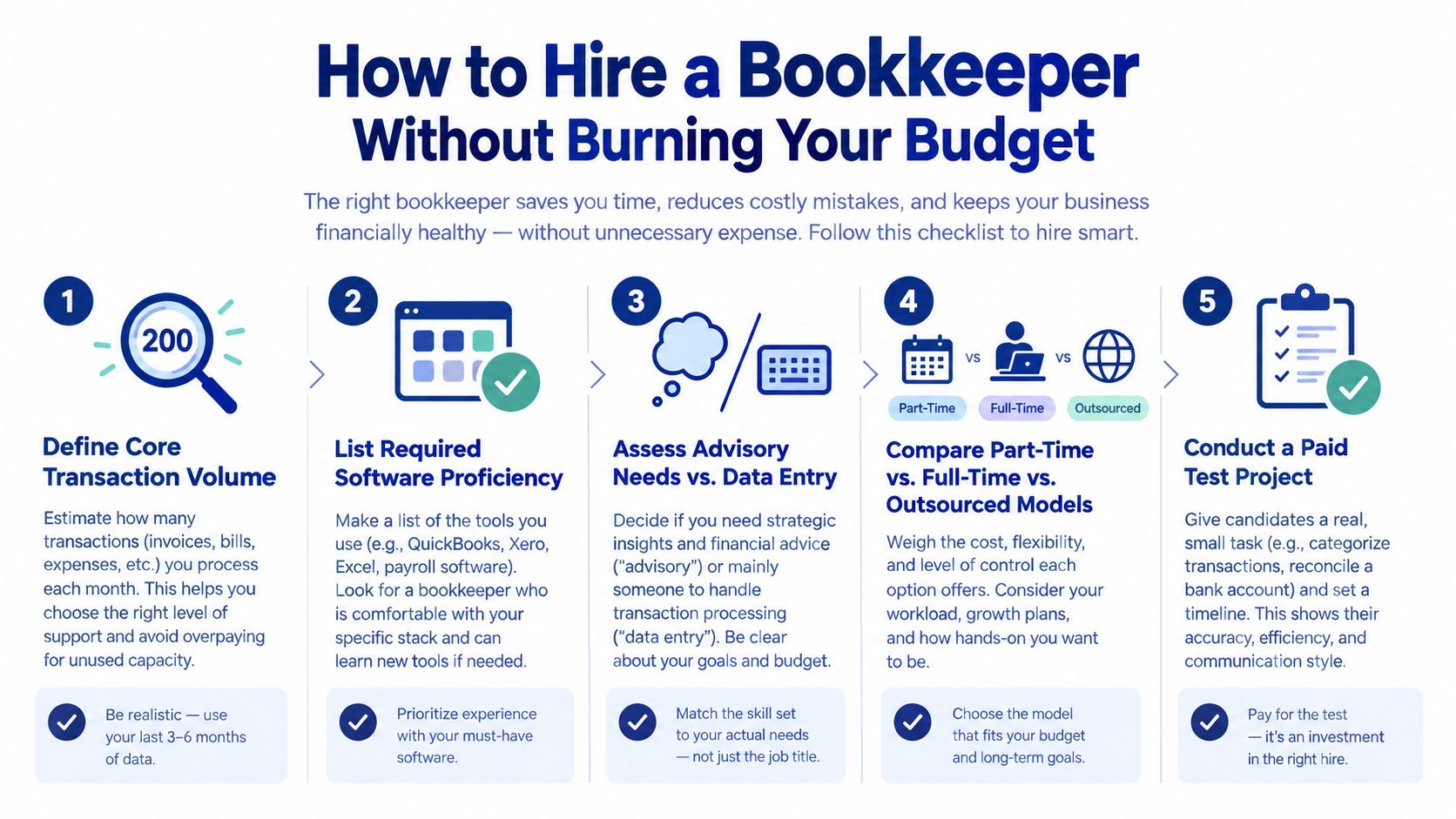
Don't run a grand hiring pageant with endless interviews. Give finalists a paid project using sanitized or limited data. Ask them to reconcile an account, identify unclear transactions, document assumptions, and explain what they'd need before closing the period.
A 10 to 15 hour trial can expose a mismatch before you commit to a much larger engagement. That range comes from the hiring approach itself, not a market statistic, so treat it as a practical recommendation rather than a benchmark.
Ask these questions:
Listen for method, not confidence. The smoothest interview performer can still leave you with suspense accounts multiplying like rabbits.
Referrals reduce screening effort but can narrow the candidate pool. Marketplaces offer speed and choice, but you carry more vetting responsibility. Fractional firms provide structure and review, but their rates reflect that operating layer.
For companies comparing vetted finance consultants with a faster matching process, Talent Pronto for consultants is one resource worth evaluating alongside referrals and specialist firms.
Your scope-of-work should define accounts covered, deliverables, deadlines, software access, cleanup treatment, communication expectations, and the person responsible for review. If a quote looks suspiciously cheap, ask what it excludes. Cheap bookkeeping often means you're buying data entry and donating your own time for cleanup.
Negotiation script: “We're comparing proposals by deliverables, not just hourly rate. Please separate recurring bookkeeping, cleanup, payroll support, close ownership, review, and advisory work so we can choose the right scope.”
Company stage is a useful shortcut, but transaction volume and decision complexity matter more than the fundraising label. A pre-revenue startup with complicated capitalization and multiple entities may need more judgment than a larger services firm with clean books.
Use the stage framework as a starting point, then adjust for the actual work.
| Stage | Recommended Layer | Typical Hourly Rate | Graduate When |
|---|---|---|---|
| Pre-revenue or very early | Part-time freelancer or outsourced remote support | Often near entry-level outsourced pricing or freelance starting rates | The founder spends too much time reviewing or chasing basic work |
| Growing company | Fractional support or carefully scoped employee | Employee wages near the BLS benchmark, or a higher contractor bill rate | Close ownership, reporting, and continuity need a dedicated operator |
| Larger or more complex company | In-house team plus specialized fractional support | Senior work may reach $60 to $150 per hour | Advisory, multi-entity, or controller-adjacent work dominates |
For companies below $500,000 in revenue, part-time or outsourced support often avoids paying for unused capacity. Businesses between $500,000 and $5 million usually need a clearer operating model, whether that means a fractional bookkeeper or an in-house hire near the $23 to $30 wage band plus employment costs. Above $5 million, scope frequently dominates geography, and controller-adjacent work in the $60 to $150 per hour range can make sense when it prevents bad decisions or accelerates a reliable close. These stage bands and pricing recommendations are editorial guidance, informed by the rate layers documented in the bookkeeping services price list.
Does equity change the calculation? Usually, it pushes you toward outsourced or fractional work. Bookkeeping is recurring operational accountability, and equity rarely compensates for weak execution or unclear availability.
What about multi-entity work? Intercompany entries, eliminations, shared costs, and consolidated reporting add a layer of coordination that can multiply the baseline rate. Don't price multi-entity work as if it were one clean ledger.
When should you bring the function in-house? Move when the outsourced model becomes a bottleneck, when the business needs daily ownership, or when the cost of coordination exceeds the cost of a dedicated employee. Make the transition deliberately. Keep the chart of accounts, close checklist, reconciliations, and documentation intact so the new hire isn't starting in a fog.
The blunt recommendation is this: choose the pricing layer that matches your transaction volume and advisory need, not the one with the lowest posted rate. A cheap bookkeeper who creates rework is just an expensive bookkeeper with better marketing.
HireAccountants helps U.S. companies compare and hire pre-vetted accounting and bookkeeping professionals for part-time, full-time, and remote engagements. Visit HireAccountants to match your workload with finance talent instead of guessing from a headline hourly rate.
Let's simplify your finances today!