


The cheapest bookkeeping setup can still consume a full workweek. Businesses surveyed for Intuit's 2024 QuickBooks Business Solutions report spent an average of 25 hours a week manually entering data or reconciling it across applications. That's a lot of founder time to spend correcting a process that was supposed to save it.
The right choice among bookkeeping services online isn't the lowest monthly price. It's the service that fits your transaction volume and leaves behind records you can trust, retrieve, and explain.
| Delivery model | Best for | Who does the work | Main risk |
|---|---|---|---|
| Freelance bookkeeper | Simple books and low transaction volume | One person | No cover during holidays or illness |
| Agency | Companies wanting team backup and sign-off | Firm staff with partner review | Rotating staff and slower process changes |
| Dedicated remote hire | Growing ecommerce or SaaS businesses with weekly volume | One bookkeeper on your hours | You manage the relationship yourself |
A freelancer is often the cheapest entry point, and can be a sensible fit for a cash-based service business with a few bank accounts and straightforward monthly activity. You get direct communication and less process overhead. The weakness is the obvious one: if that person is away, sick, or resigns, there may be nobody to pick up the close.
An agency gives you more coverage. A team can share the work, a partner can review the close, and formal reporting suits companies that need a reliable sign-off process. The trade-off is continuity: staff may rotate, and changing a workflow can take longer than asking one bookkeeper to adjust.
A dedicated remote hire works your hours, gets familiar with your chart of accounts, and can stay close to your tools and recurring transactions. That makes the model useful for an ecommerce or SaaS business with weekly activity. But you still manage the working relationship, set priorities, and make sure someone on your team answers questions.
Choose for control, not just cost. The right model follows transaction volume and how much daily oversight you want, not simply the cheapest quote.
Online tools aren't a passing experiment. In a 2023 survey of 1,043 U.S. small-business owners and decision-makers, 43% of respondents had used online financial-accounting tools for more than three years, 39% began during the COVID-19 pandemic, and 18% had used them for less than one year, according to the Small Business Majority survey. Shared digital access is now a practical way for owners and bookkeepers to work from the same current records.
If you're weighing outsourced support across borders, accounting and tax support with renn offers another resource for considering how bookkeeping fits with broader finance needs. You can also compare the practical trade-offs of outsourcing bookkeeping overseas. Next, cost your preferred model against the actual work and define what the monthly engagement includes.
A real monthly engagement closes the books. A categorized transaction list is an input, not a deliverable. At minimum, expect the provider to categorize bank and card activity, match receipts and invoices to entries, reconcile bank and credit-card balances, tie accounts receivable and accounts payable back to the general ledger, and run the close. You should receive a profit and loss statement and a balance sheet. Payroll journals and sales-tax support belong in scope when your business carries them.
Speed of entry is not the test. The Bureau of Labor Statistics description of bookkeeping work emphasizes computing, classifying, and recording financial data so records stay complete and accurate. Consistent classification is what makes reports comparable from one month to the next. If the same software subscription lands in three different expense accounts, the books are current and useless at the same time.
Before you ask for a quote, write down:
For a practical walkthrough of the process, use this guide to key steps in closing the books. It turns "month-end close" into a defined sequence rather than a vague promise.
Volume drives the quote more than any other variable. A service business at 150 transactions a month needs categorization, receipt matching, and reconciliations. A store processing 1,500 orders has channel data, payment deposits, returns, inventory, and often sales-tax activity stacked on top. Those counts are illustrative profiles, not thresholds. The point is to describe the workload precisely enough that two quotes cover the same job.
Confirm the accounting platform before you sign. QuickBooks accounted for 69% of reported financial-accounting software use in a 2023 survey of U.S. small-business owners, and Xero 11%, according to the Small Business Majority survey. Ask whether the software seat is included or billed separately, and confirm the person doing the work has run your system. For a plain-language breakdown of what a bookkeeper does for a small business, compare the listed tasks against your own.
Write a one-page scope before you request quotes. A provider can't price a moving target accurately, and you don't want to learn after onboarding that "monthly bookkeeping" meant a smaller job than you pictured.
A low monthly fee works until the service cadence no longer matches the business. The IRS says a recordkeeping system should summarize transactions in journals and ledgers, identify income and expenses, and support financial statements. Transactions generally should be recorded daily. It also says businesses may use cash or accrual accounting, but inventory businesses generally need accrual treatment for inventory-related sales and purchases unless a specific small-business exception applies, as explained in the IRS recordkeeping guidance.
| Business profile | Minimum service level | Warning sign |
|---|---|---|
| Cash-based service business with few accounts | Monthly categorization and bank reconciliation | Tidy reports that arrive late |
| Ecommerce with inventory | Daily feeds, inventory reconciliation, and revenue cutoffs | Clean books while inventory stays unreconciled |
| SaaS with subscriptions | Deferred revenue, accruals, AR aging, and a named month-end owner | Revenue booked on cash timing |
| Multi-state sales | Tax-jurisdiction tracking inside the monthly close | Sales-tax filings that are late or wrong |
A simple service business can often run on monthly categorization and bank reconciliation. If you bill clients directly, receive payments into a small number of accounts, and don't carry inventory, paying for a complex finance operation may be unnecessary. But late reports still matter: a tidy profit and loss statement that arrives after you needed to make a decision is tidy paperwork, not useful management information.
An ecommerce brand needs a tighter rhythm. Storefront sales, payment-processor deposits, returns, and inventory don't always land in the ledger in the same way or at the same time. Without daily feeds, inventory reconciliation, and revenue cutoffs, a clean-looking report can hide processor balances or inventory records that don't tie out.
A SaaS company has a different set of traps. If customers pay in advance, cash received and revenue earned may fall in different periods. Deferred revenue, accruals, accounts-receivable aging, and a month-end close with a named owner help keep those numbers from being treated as interchangeable.
Multi-state sales add another operational layer. Tax jurisdictions need to be tracked inside the monthly close, and late or incorrect filings are a warning that the current service may be too thin. To diagnose your own needs, score transaction volume, sales channels, inventory, revenue model, tax jurisdictions, and the deadlines your decisions depend on.
The cheapest plan is the right plan only while none of those inputs has grown past it. If your books look clean but key balances remain unreconciled, the low price is just deferring the bill.
| Pricing structure | Typical cost | Best for | Watch out for |
|---|---|---|---|
| Hourly freelance | From $10 per hour | Irregular catch-up work | Hours can creep up unnoticed |
| Monthly retainer | Quoted fixed fee per month | Steady monthly work with a predictable budget | Scope exclusions in the fine print |
| Part-time dedicated plan | $999 per month for 10 hours a week | Steady weekly upkeep | Thin cover for month-end |
| Full-time dedicated plan | $1,999 per month for 40 hours a week | High volume and a daily owner | Overkill for simple books |
| In-house clerk | Median wage of $50,670 a year before taxes and benefits | Full control | Payroll taxes, benefits, recruiting, and paid leave |
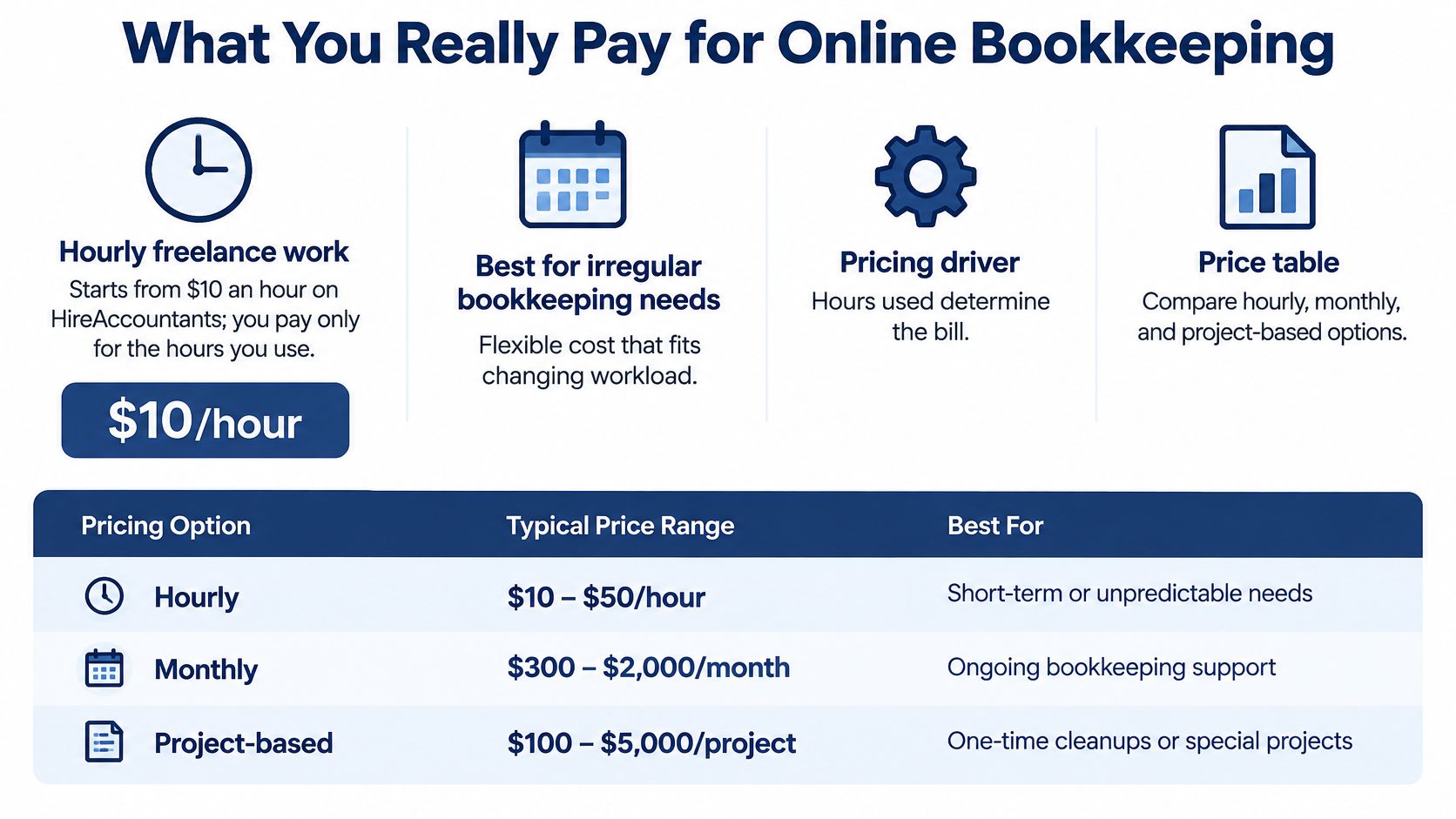
Hourly work can be a good fit when you need catch-up help or the workload comes in bursts. Accountants and bookkeepers can be hired from $10 an hour through HireAccountants, and you pay only for the hours used. But set a cap and ask for a time log. A low hourly rate isn't a bargain if the cleanup keeps growing and nobody flags the backlog.
The dedicated plans have a different structure. The part-time plan offers 10 hours a week for $999 a month. That averages about 43 hours a month, or roughly $23 an hour. The full-time plan provides 40 hours a week in your business hours for $1,999 a month, about 173 hours a month, or roughly $11.50 an hour. That math is useful, but only if the work fills those hours and the plan matches your needs.
A fixed monthly retainer is easier to budget for steady work, but read the scope closely. Confirm whether catch-up, payroll journals, extra accounts, sales-tax support, or increased volume trigger added fees. Ask for the monthly price in writing and confirm that billing is monthly with no hidden fees.
In-house hiring gives you direct control, but wages are only part of the cost. The Bureau of Labor Statistics reported a median annual wage of $50,670 for bookkeeping, accounting, and auditing clerks in May 2025. That figure doesn't include payroll taxes, benefits, recruiting, equipment, paid leave, or the manager time needed to support the hire. Sometimes another employee is exactly right. Sometimes it's an expensive way to solve a small, uneven workload.
Compare the monthly cost of the plan with the monthly hours of workload you have, not with the rate that looks best in a table.
“Online” doesn't automatically mean compliant, secure, or recoverable. For U.S. companies, the IRS expects electronic records to be indexed, preserved, retrievable, and reproducible in legible form, with a complete and accurate record accessible to the agency. The system also needs controls equivalent to those used for paper originals, according to IRS Publication 583.
A provider that sends monthly PDFs but doesn't preserve underlying invoices, receipts, approvals, and change history leaves an evidence gap. Put these questions to any provider, and get the answers in writing:
The IRS generally suggests keeping many records for three years, while employment-tax records should be retained for at least four years, as described in Publication 583. The right schedule depends on the record and tax matter, so a universal short retention rule is a red flag. Our plans include legal compliance and payment handling, and we list U.S. GAAP compliance among what we offer, but those service details don't replace your own access and retention controls.

If a provider can't show a tested restore or produce an exportable transaction history, don't sign. A backup you've never restored is a comforting story, not a recovery plan.
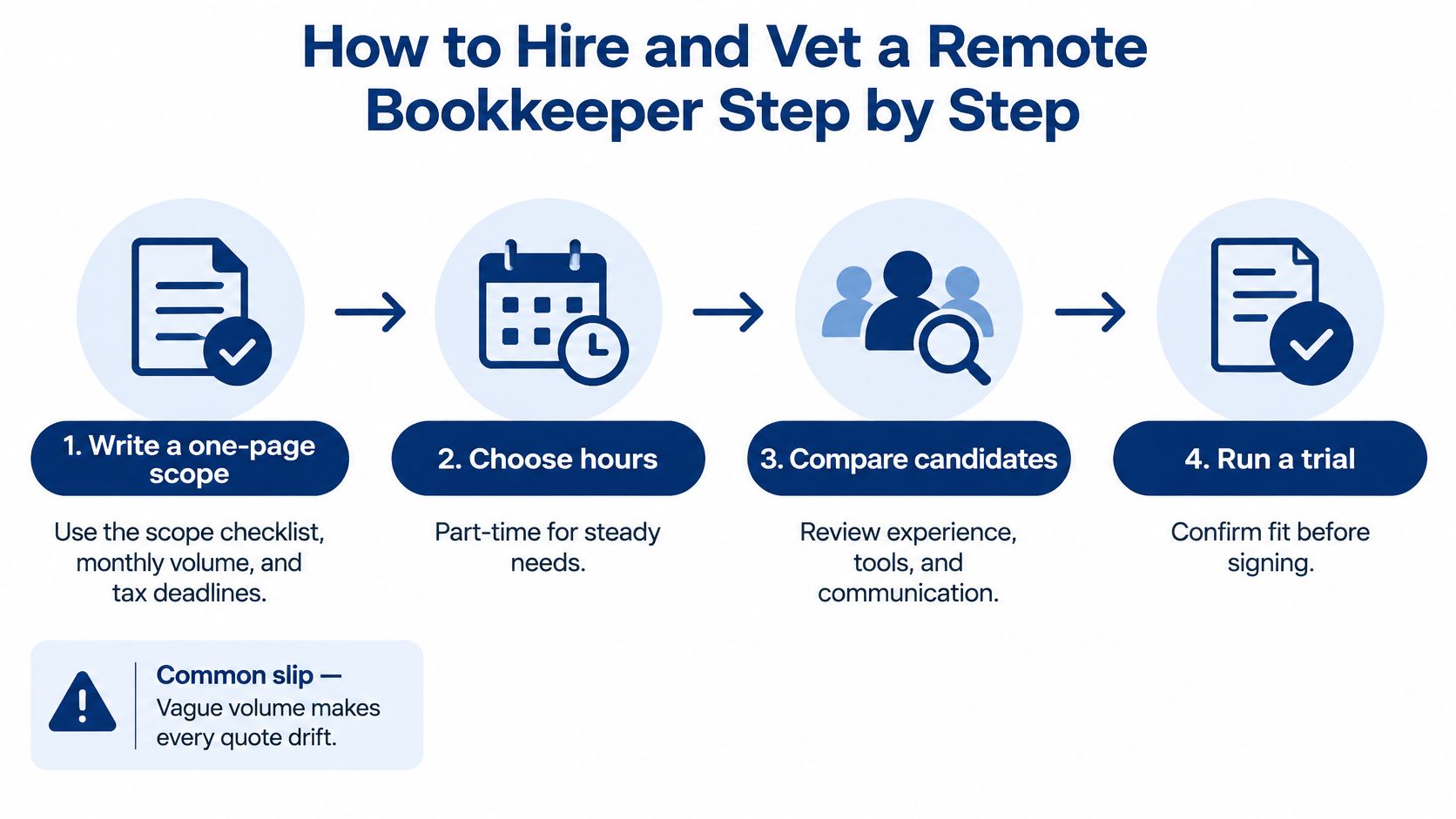
Write a one-page scope. Include monthly transaction volume, accounts, required reports, and tax deadlines. The common slip is vague volume, which makes every quote drift and leaves you comparing different jobs.
Choose the hours you need. Part-time support fits steady upkeep; full-time is more appropriate for high volume or a close that needs a daily owner. The usual mistake is buying full-time capacity for books that only need a regular monthly tidy-up.
Shortlist for relevant experience, not just rate. On our self-service platform, clients create an account, specify requirements, and get matched with qualified accountants. Each profile includes a detailed CV, so compare candidates by bookkeeping, CPA, or tax experience, plus the tools your business uses. Our bookkeepers can work in your time zone. For a useful distinction between roles, compare bookkeeper and accountant roles.
Run a practical trial. Give each shortlisted candidate 30 real transactions and a bank reconciliation to complete. Compare the categorization, whether the reconciliation ties out, and the questions they ask. Skipping this test is how a polished profile can outrun the actual work.
Check access before go-live. Confirm role-based permissions, multi-factor authentication, and full export rights. Don't give every contractor administrator access just because setup is easier that way.
Agree on approvals and onboarding in writing. Make clear who approves payments and who owns the handoff of records. The full-time Bookkeeper plan includes HR and onboarding management, and we handle legal compliance and payments across all three pricing plans. A verbal “we'll sort it out” isn't an approval process.
Set the first review date before work begins. Choose a bookkeeper who works in your time zone so questions and review meetings don't wait overnight. Use this list of questions to ask accountants to structure the conversation, and put the 30-day checkpoint on the calendar before the first transaction is touched.
A sample task should reveal how a candidate thinks, not just how fast they click. Look for consistent account coding, clear explanations for ambiguous transactions, and evidence that they know the difference between a reconciliation and a ledger balance that merely looks plausible.
Choose the delivery model that fits your workload, set the hours and scope, then run a 30-day trial before signing a longer contract. A trial gives both sides a real chance to test the close, communication, and record quality without confusing a good interview with good bookkeeping.
At the end of the trial, score four things:
If three of the four pass, extend the engagement and address the remaining gap. If the books still need your weekend rework, change providers. That's not a close; it's a handoff of busywork with a recurring invoice attached.
There's little reason to commit blindly. No deposit or upfront fee is required to get started on our platform, and there's no fee until you hire. You can compare local or global pre-vetted remote talent for accounting, bookkeeping, and finance before choosing someone. The trial is where you find out whether the match works with your books and your team, not just on a profile page.
Make your next move concrete: write the scope, shortlist three profiles, and book the first trial month. A good bookkeeper should leave you with reconciled records and more time to run the business, not a new weekend hobby.
HireAccountants connects businesses with pre-vetted remote accounting and bookkeeping talent for flexible support that can fit your hours and time zone. Write your scope, compare candidates, and visit HireAccountants to find a bookkeeper who fits the work your business needs.
Let's simplify your finances today!