


You're staring at a bank reconciliation that should've been finished days ago. The books are technically alive, the close is drifting, investors want GAAP-ready reporting, and your bookkeeper keeps asking questions that a controller should've answered already. Hiring a full-time controller feels premature, but continuing without one feels reckless.
That awkward middle is where financial controller outsourcing earns its keep. It isn't a cheap substitute for finance leadership. Done properly, it adds the controls, close discipline, and reporting judgment your company needs without forcing you to build an entire department before the business is ready.
Most founders don't wake up wanting to outsource a controller. They get pushed there by operational friction.
A SaaS company's invoices don't match its revenue schedule. A growing e-commerce business has inventory and cash movements nobody can explain quickly. The board asks for a clean variance report, and the finance team produces a spreadsheet archaeology project. Meanwhile, the founder is deciding whether to hire a senior finance leader or keep patching the process with bookkeeper hours.
I've been in that chair. The full-time hire looks reassuring until you add salary, benefits, recruiting time, onboarding, and the risk of choosing someone whose experience doesn't match the mess on your desk. The alternative, keeping everything internal, turns leadership into an unpaid accounting manager. Neither option is especially clever.
Outsourcing is the pragmatic middle path. You buy accountable capability, not random hours. The right provider can own the close, tighten controls, improve reporting, and give leadership faster answers while your company decides whether it needs permanent finance infrastructure.
The model is already moving beyond early-adopter territory. A 2024 UHY middle-market survey found that 45% of firms outsource accounting, with 26% outsourcing partially and 19% entirely, compared with nearly 80% that hadn't explored outsourcing in 2022, as reported in this summary of the UHY outsourcing findings.
That shift makes sense. Businesses often outgrow basic bookkeeping before they need a full internal controller. The gap is expensive, messy, and surprisingly common. A practical overview of the broader model appears in this guide to the benefits of outsourcing accounting services.
This guide cuts through the sales pitch. You'll see what an outsourced controller owns, where an in-house hire remains stronger, how service pricing works, which compliance safeguards matter, why Latin American time zones can help US teams, and how to run an evaluation and first-close process without turning your company into a recruiting laboratory.
The question isn't, “Can I find a cheaper controller?” It's, “Which model gets my books closed accurately, my controls documented, and my decisions supported sooner?”
A bookkeeper records transactions. A controller makes sure the accounting system produces reliable information on schedule. A CFO uses that information to guide capital allocation, forecasting, fundraising, and strategy.
Think of the controller as air traffic control for the finance function. The bookkeeper manages the incoming and outgoing flights, meaning transactions, reconciliations, invoices, and payments. The controller coordinates the routes, checks the instruments, sets operating procedures, and stops one bad process from creating a pileup at month-end.
That ownership usually includes:
An outsourced controller delivers that ownership as a managed service. You're not buying a remote employee to prepare journal entries. You're assigning responsibility for the quality and rhythm of the accounting function, while deciding which approvals and executive decisions remain with your internal leadership.
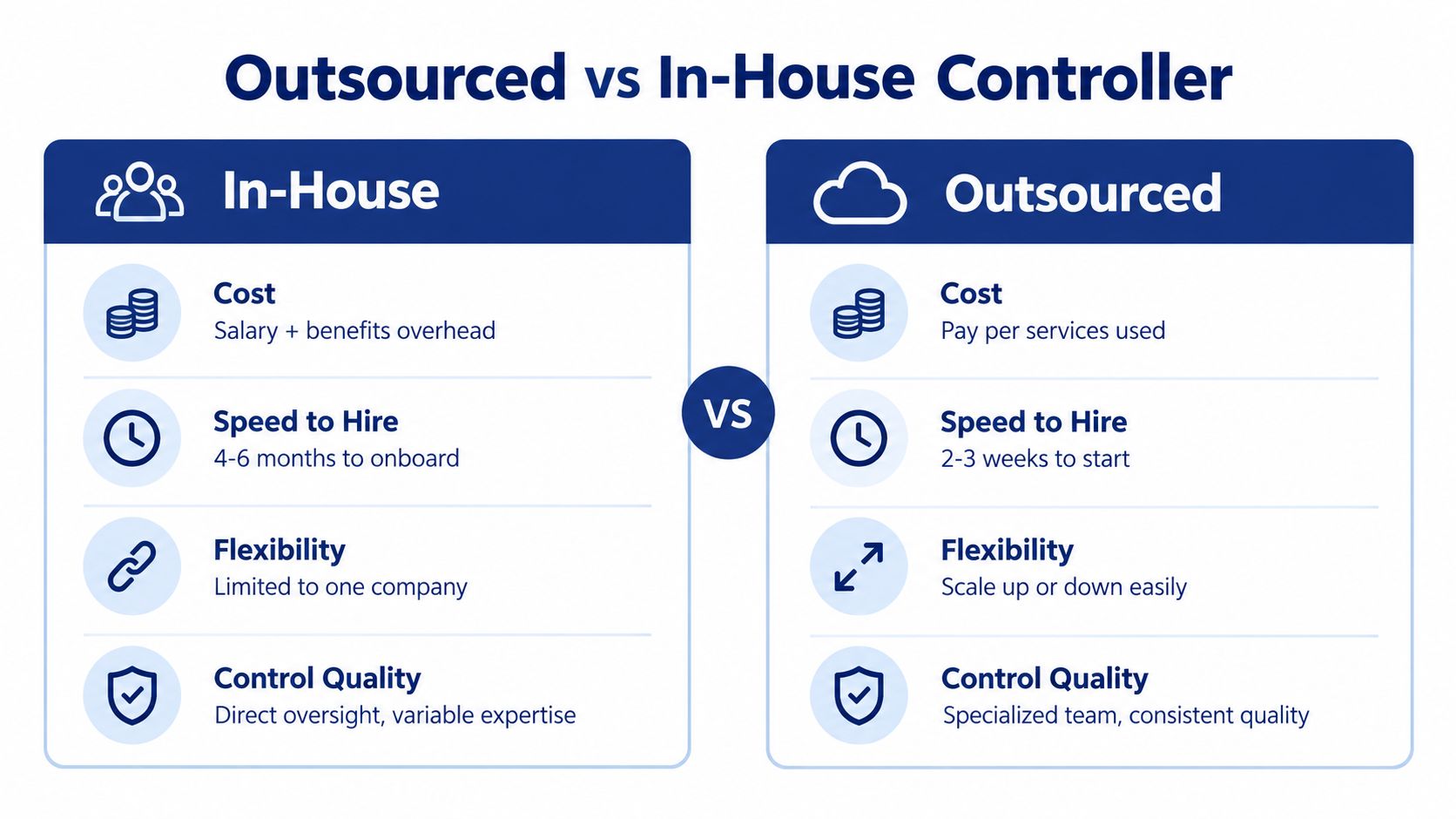
A light engagement might review monthly reports and supervise the bookkeeper. A core engagement may own the close, reconciliations, controls, and reporting package. A more strategic arrangement can add budgeting, forecasting support, fundraising preparation, and executive reporting.
The distinction matters because companies often buy the wrong layer. They hire a CFO when their close is broken, or they hire a bookkeeper when nobody owns the accounting process. That's how teams end up paying for strategy built on unreliable numbers.
The market's growth reflects this broader use. The closest historical proxy for controller outsourcing, the finance and accounting outsourcing market, was estimated at US$37.9 billion globally in 2020 and projected to reach US$53.4 billion by 2026, representing a 5.9% CAGR, according to Global Industry Analysts' market estimate.
Practical rule: Buy the responsibility your business needs, not the most impressive job title.
What stays in-house? Usually, the CEO, CFO, or finance lead keeps final authority over cash disbursements, banking, major accounting judgments, board communication, and business decisions. The outsourced controller should recommend, document, review, and execute within clearly defined boundaries. If the provider can approve its own work without oversight, you haven't built a control system. You've built a trust exercise.
The outsourced versus in-house decision comes down to speed, depth, flexibility, and accountability. Cost matters, but it's rarely the whole story. A controller who closes the books late is expensive even if the salary looks reasonable.
An in-house controller wins when the business needs constant physical proximity, deep institutional knowledge, or a leader dedicated to a large internal accounting team. The downside is concentration risk. One person carries a broad role, and if that person leaves, your close process may leave with them.
Outsourcing wins when you need experienced oversight now, want to scale support as complexity changes, or need several specialties without hiring several people. The tradeoff is deliberate coordination. You must document access, approval rights, communication expectations, and ownership. “They're smart, they'll figure it out” is not an operating model.
The broader demand is substantial. One recent industry summary reported 40% to 60% labor cost savings from accounting outsourcing and said 96% of CFOs rely on at least one third-party finance and accounting provider, up from 79% the previous year, as detailed in this accounting outsourcing statistics report.
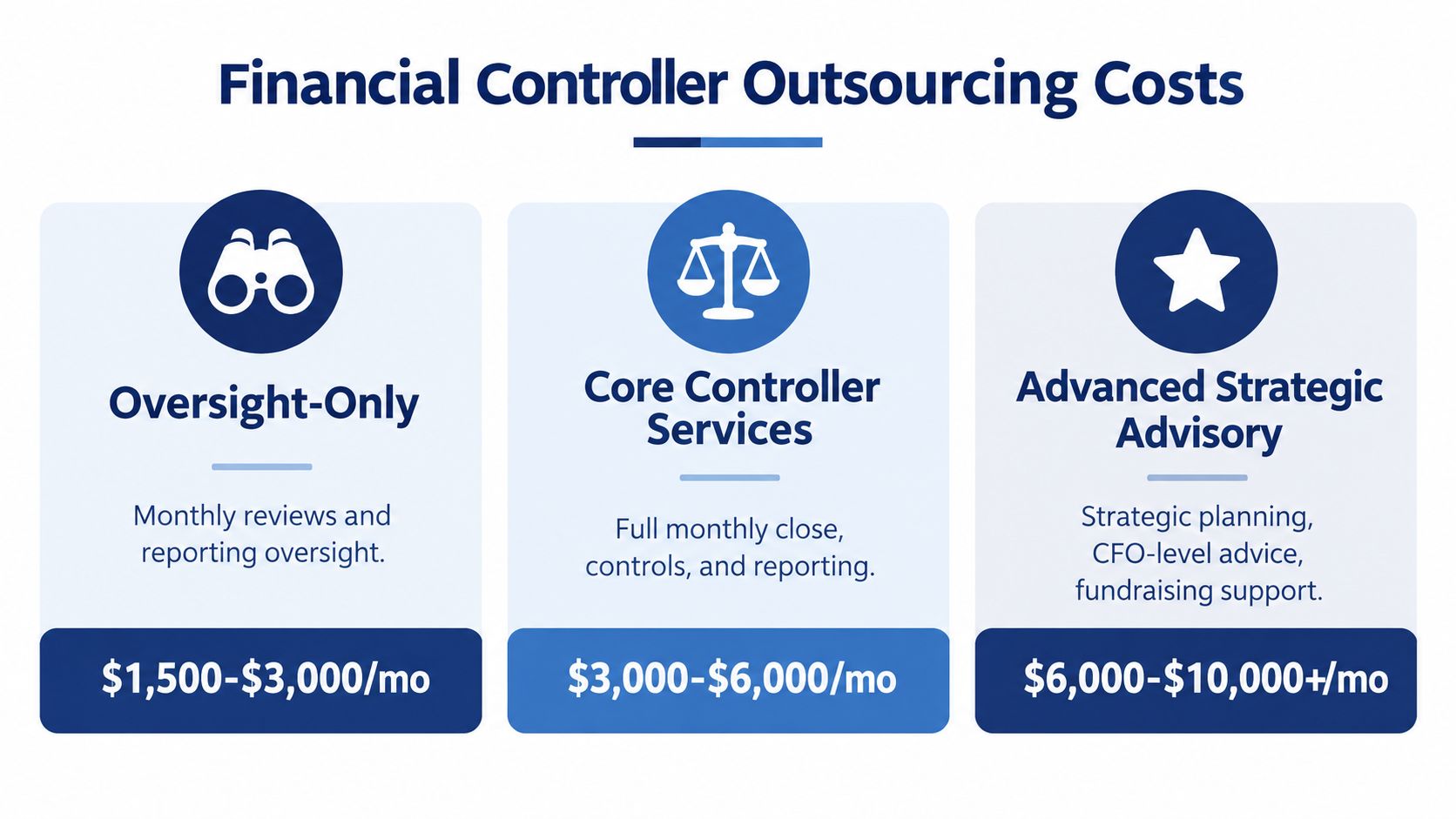
| Criteria | Outsourced Controller | In House Controller |
|---|---|---|
| Cost structure | Variable service cost tied to scope | Fixed salary, benefits, and employment overhead |
| Hiring speed | Can start with an existing specialist or team | Requires recruiting, selection, and onboarding |
| Flexibility | Support can expand or contract with reporting needs | Capacity is tied mainly to one employee |
| Control quality | Strong when workflows, reviews, and evidence are documented | Strong when the hire has the right expertise and enough time |
| Institutional knowledge | Builds through structured documentation and recurring collaboration | Develops naturally through daily proximity |
| Coverage | May provide access to broader accounting expertise | Depends on the individual's background |
| Best fit | Growth-stage teams with uneven or changing needs | Businesses with sustained complexity and a permanent finance department |
My recommendation is blunt. Outsource when your biggest problem is capability, not headcount. If your close is inconsistent, controls are informal, or reporting depends on one exhausted operator, an experienced outsourced team can improve the system faster than a single new employee.
Hire in-house when the finance function has stable complexity, the controller will lead a substantial internal team, and executive collaboration requires continuous presence. Don't hire a full-time controller merely because the company has reached a certain revenue milestone. Revenue doesn't close the books. Process does.
Pricing becomes rational once you stop asking, “What does a controller cost?” and start asking, “Which controller outcomes do we need?”
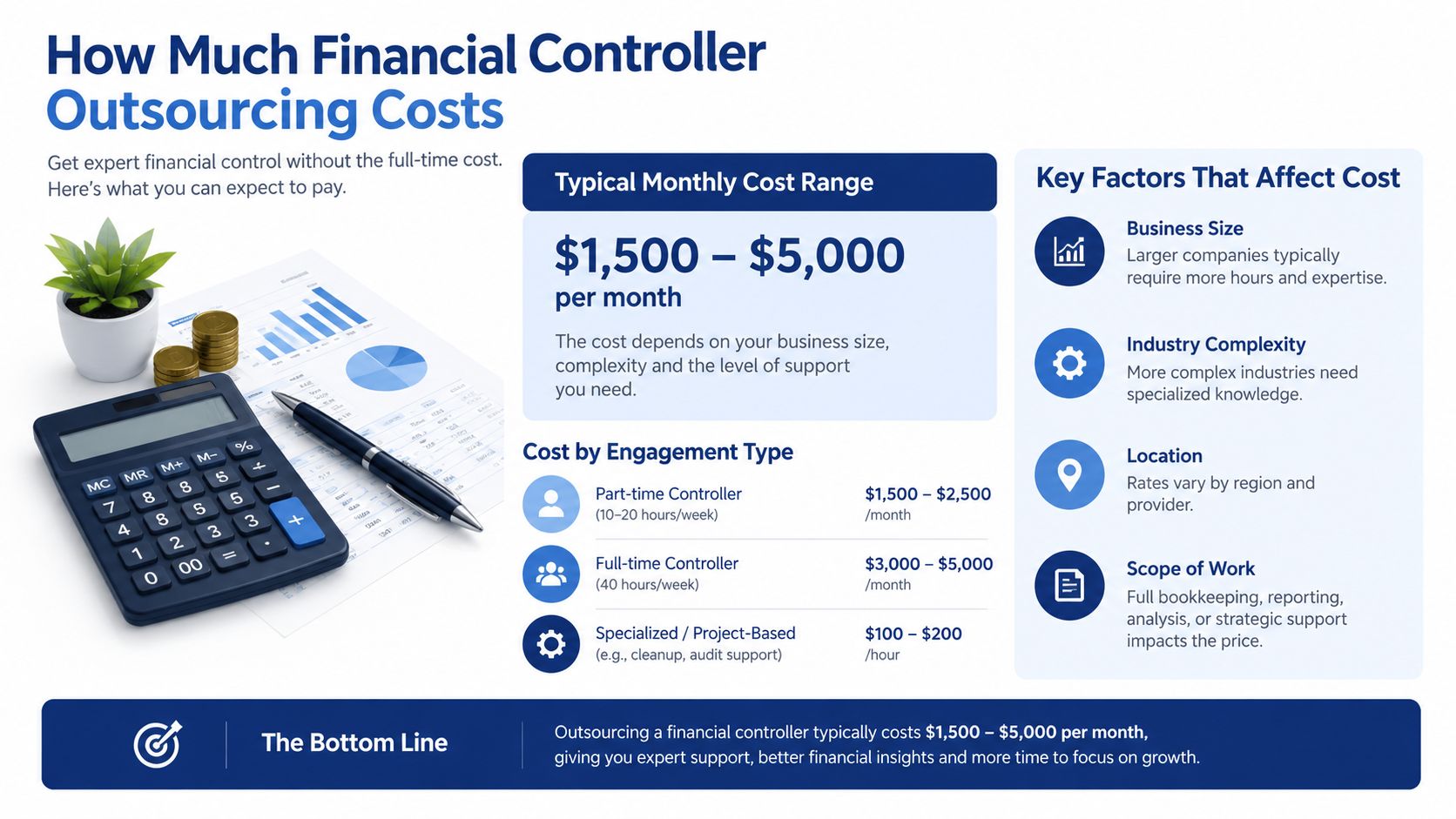
A light oversight arrangement may cover monthly review and reporting supervision. Core controller work usually includes the close, reconciliations, controls, and management reporting. Advanced advisory adds planning, analysis, fundraising support, and deeper executive involvement.
One benchmark places outsourced engagements at $1,500 to $2,500 per month for oversight-only, $2,500 to $5,000 per month for core controller services, and $5,000 to $8,000 per month for advanced strategic advisory. The same benchmark estimates a fully loaded in-house controller cost of roughly $130,000 to $190,000 per year, with 40% to 60% savings possible when scope matches need, according to this outsourced controller pricing benchmark.
The cheapest proposal can become the most expensive if it excludes the work that fixes your finance function. Ask whether the fee includes:
Annualizing the monthly fee helps, but it doesn't tell you whether the engagement is worth buying. Compare the cost with the business consequences of late reporting, weak controls, missed audit requests, and founder time spent hunting for answers. For a broader hiring benchmark, use this guide to accountant hiring costs.
The right comparison isn't outsourcing versus salary. It's reliable finance infrastructure versus repeated operating surprises.
Don't mortgage the office ping-pong table for a controller you only need part-time. But don't buy a bargain package that leaves you with the same messy close and a prettier invoice.
Cross-border finance work doesn't fail because the controller lives outside the United States. It fails when accountability is vague.
A US company using an outsourced controller still needs clear ownership of US GAAP reporting, revenue recognition judgments, tax coordination, audit support, approval thresholds, and evidence retention. The provider can operate the process, but company leadership remains responsible for governance. You can outsource execution. You can't outsource judgment about who is allowed to move money or approve financial statements.
Build the relationship around controls that someone can inspect. Separate preparation from approval. Review bank access regularly. Require documented journal-entry support. Maintain an exception log for unusual transactions, unreconciled balances, late approvals, and unresolved system issues. Connect every key control to an owner and a piece of evidence.
Latin America can work particularly well for US finance teams because the collaboration window overlaps with the US business day. Colombia operates on UTC-5, matching US Eastern Time and providing roughly eight hours of daily overlap, while Mexico can align with multiple US time zones and Argentina generally provides five to six hours of overlap, according to this overview of Latin American finance outsourcing time zones.
That overlap changes the close experience. A finance lead can ask about a variance in the morning and receive an answer while the issue still matters. The controller can join a live meeting about a revenue schedule, cash forecast, or audit request instead of sending a message into the overnight void.
Timezone alignment doesn't replace skill. It makes skilled collaboration easier.
Use a written service agreement and a practical operating calendar. Define response expectations, close deadlines, system permissions, approval limits, escalation paths, and the exact reports leadership expects. Schedule recurring meetings around the close, not around vague “check-ins.”
Security deserves the same attention. Use role-based permissions, multi-factor authentication, approved password management, and a documented offboarding process. Give the provider access to the systems required for the work, not unrestricted control over every financial tool.
A distributed team becomes safer when the process is visible enough that no individual has to be trusted blindly.
Start with the outcome, not the résumé. Write down what's broken today, what must be true after the first successful close, and which responsibilities remain with your internal team.
Specify your accounting platform, payroll system, billing tools, bank feeds, entity structure, reporting basis, close history, and known problem areas. State whether you need oversight, full close ownership, technical accounting support, audit preparation, or executive reporting.
Then test communication, not just credentials. Ask the candidate to explain how they'd investigate an unreconciled balance or challenge an unsupported journal entry. Strong controllers make the reasoning understandable to a founder who doesn't live in the general ledger.
A useful interview resource is this collection of questions to ask a hiring manager, which can help structure the broader conversation around expectations, communication, and role fit.
Run a paid trial using sanitized or approved company data. Give the candidate a prior close package, a short list of known issues, and a reporting goal. Watch how they document assumptions, prioritize exceptions, communicate blockers, and distinguish a data problem from a process problem.
Check references for control discipline. Ask whether the person improved close reliability, documented procedures, challenged questionable entries, and communicated bad news early. A controller who only reports good news is not a controller. They're a press secretary for your ledger.
Your first onboarding checklist should include:
Use a structured remote employee onboarding process so access, documentation, communication, and responsibilities don't depend on memory.
The first thirty days should establish access, baseline reporting, and the current close process. The next thirty should remove recurring exceptions, standardize documentation, and clarify ownership. By ninety days, leadership should see a repeatable close rhythm, a prioritized control backlog, and reporting that answers business questions rather than merely displaying balances.
Expect improvement to take time. Financial shared-service research found cost-control capability improved by 13.2% after implementation, with a two-year lag associated with system integration and organizational learning, according to this study of financial shared-service implementation. The lesson isn't to wait two years. It's to stop judging the model after one chaotic month.
Outsourced controller support beats a full-time hire when your company needs better finance capability before it needs permanent finance headcount.
Choose outsourcing when the close is unreliable, controls live in people's heads, reporting arrives too late, or leadership needs experienced oversight without building a full department. A capable provider can bring process design, review discipline, and broader technical coverage to a company that isn't ready to carry one full-time specialist.
Choose in-house later when your finance operation has sustained complexity, a permanent team needs daily leadership, and the business benefits from deep internal context more than flexible capacity. Outsourcing shouldn't become a permanent excuse to avoid building internal ownership. It should make the eventual build smarter.
For US teams, Latin American nearshore talent can add a practical advantage through aligned working hours and real-time collaboration. The capability upgrade is the point. Savings are useful, but clean closes, stronger controls, and faster answers pay the rent.
Start with a scope document, shortlist people who can explain their control approach, and run a paid trial close. If the candidate can't make your numbers clearer during the test, they won't magically become clearer after signing.
HireAccountants gives US companies access to pre-vetted Latin American accountants and controllers for flexible finance support, including close assistance, reconciliations, bookkeeping, and process execution. Visit HireAccountants, define the controller outcomes you need, and start with a focused trial instead of committing to the wrong full-time hire.
Let's simplify your finances today!