


$40.23 per hour is the 2025 median pay for accountants and auditors, yet client billing can range from $66 per hour to about $280 per hour or more, depending on the role. Hourly rate accounting isn't a simple wage pass-through. It's the price of expertise, overhead, unused capacity, risk, and profit bundled into one number.
That gap is where most budgeting mistakes begin. A founder sees an accountant's wage and assumes the invoice should sit nearby. A firm sees payroll, software, insurance, management time, training, unpaid admin, and collection risk. Both sides can be right, but only one of them is looking at the full bill.
A $40.23 hourly wage doesn't mean a business can buy professional accounting for $40.23 an hour. The U.S. Bureau of Labor Statistics wage data describes employee pay, not the price a client pays for completed work. The invoice also carries payroll taxes, benefits, software, licensing, insurance, management, office costs, non-billable time, and profit.
That explains why external benchmarks sit much higher. Intuit's survey data put average hourly rates at $66 for bookkeepers, $112 for tax accountants, and $126 for CPAs in the United States, while current market guides place many CPA rates around $150 to $400 per hour. The same market coverage places freelance bookkeepers around $20 to $60 per hour. Those figures aren't interchangeable. They describe different skills, credentials, delivery models, and levels of responsibility. See the detailed CPA cost breakdown for the role and market context.
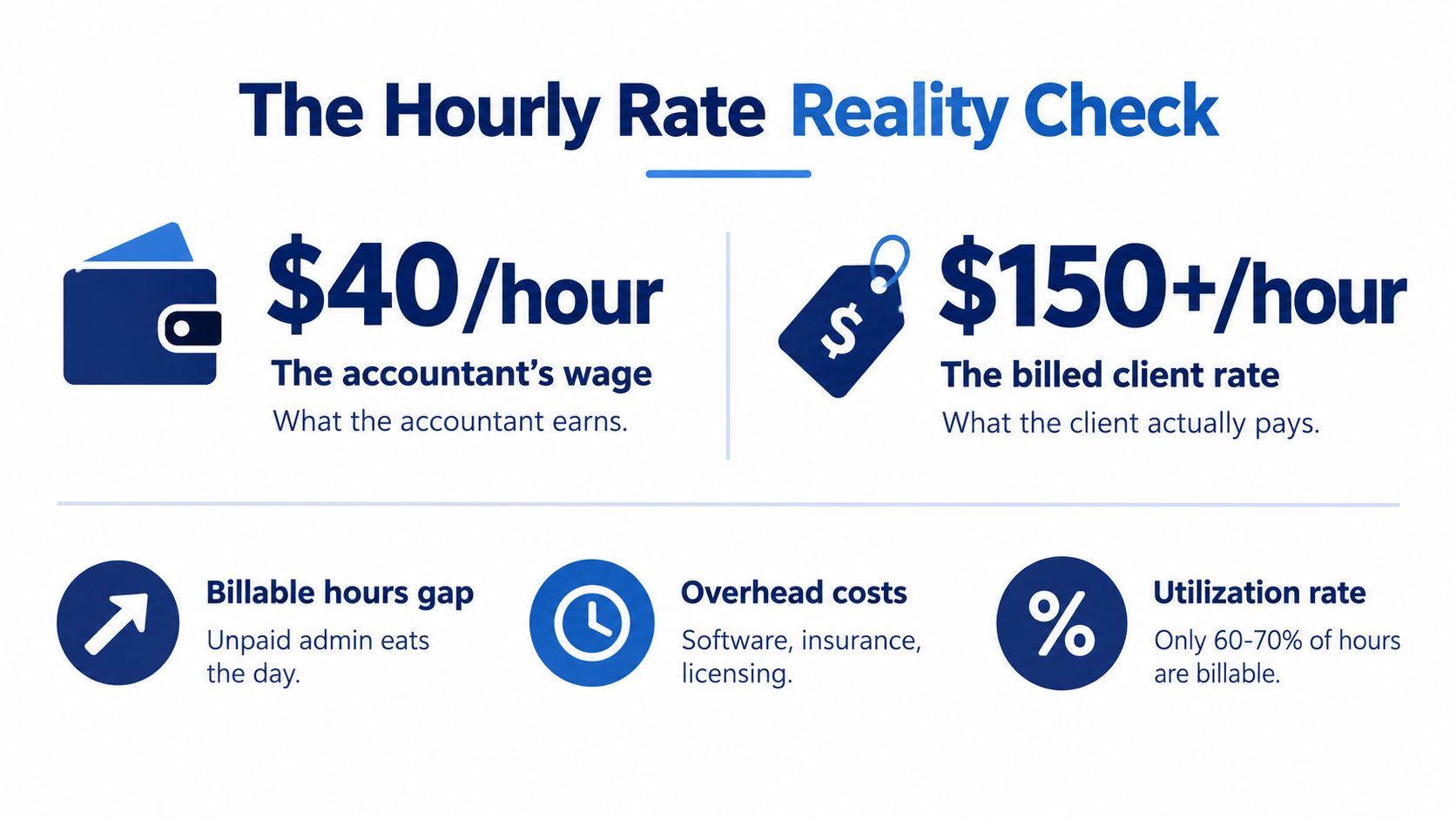
Practical rule: Treat the wage as one ingredient in the rate, not as the rate itself.
A business can still control the total cost by choosing the right delivery model. HireAccountants connects US companies with pre-vetted accounting and finance professionals for full-time or part-time arrangements, including hourly engagements. That can make the budget more flexible than hiring a domestic employee for every task, especially when the work doesn't require a local license or constant executive oversight.
Cheap isn't automatically efficient, though. A low rate paired with slow reconciliations, weak documentation, or endless supervision is just expensive incompetence wearing a discount label.
Accounting work has a hierarchy, and the invoice usually reflects it. A bookkeeper maintaining transaction records isn't priced like a CPA handling complex tax work. A fractional CFO advising on financing, cash planning, or a board presentation brings a different level of judgment again.
Here are the most useful benchmarks available:
| Role | Typical benchmark | Best fit |
|---|---|---|
| Bookkeeper or certified bookkeeper | $66 per hour average | Transaction entry, reconciliations, routine close support |
| Tax accountant | $112 per hour average | Tax preparation, compliance, tax-related accounting |
| CPA | $126 per hour average in Intuit's survey, with broader guides commonly showing $150 to $400 per hour | Complex tax, audit, financial review, technical accounting |
| Freelance bookkeeper | $20 to $60 per hour | Flexible operational support and recurring bookkeeping |
| Tax professional | $182 per hour average for tax preparation in the NATP study | Tax preparation across tax professionals |
| CPA preparing a basic individual return | About $280 per hour average in the NATP coverage | Credential-heavy individual tax work |
The figures come from different surveys and market guides, so don't compare them as if they were one perfectly controlled price list. The accountant hiring cost guide is useful for translating the benchmarks into an actual hiring decision rather than treating an average as a quote.
A rate looks fair when the role matches the work. Paying CPA pricing for data entry is wasteful. Hiring a low-cost bookkeeper to resolve a complicated revenue-recognition issue is false economy. The cheapest person in the wrong seat can cost more than the specialist you avoided.
Credentials matter, but they aren't the whole story. Geography, communication, familiarity with your accounting stack, turnaround expectations, and the quality of review all affect the practical value of an hourly rate. Ask what the person will own, what gets reviewed, and what happens when the work is wrong. The number on the quote is only the opening sentence.
The classic model starts with employee economics. A long-running Journal of Accountancy benchmark described a standard hourly billing rate as about 0.0018 times an employee's base annual salary. Under that benchmark, a staff member earning $50,000 would produce a $90 hourly billing rate.
The same article reported that small and midsize CPA firms typically billed about 1,400 hours annually per staff member and collected 90% to 95% of those billable hours. That framework matters because employees don't spend every working hour serving clients. Meetings, training, internal reviews, proposals, leave, corrections, and administration still consume capacity.
The basic logic is straightforward:
Required rate = total employment cost plus overhead and profit, divided by realistically collectible billable hours.
The word “realistically” does the heavy lifting. A firm that assumes every available hour becomes invoiceable will underprice itself with impressive efficiency. It will then discover that invoices don't pay for optimism.
Collection also matters. A nominal rate is meaningless if clients dispute time, invoices go out late, or the firm writes off vague entries. The Journal of Accountancy benchmark's realization range shows why firms monitor both hours worked and hours collected. Revenue appears only when the client accepts and pays for the work.
This is also why a fractional CFO hourly rate guide shouldn't be used as a universal benchmark for bookkeeping. Advisory work contains more judgment, more consequence, and often more preparation outside the visible client call. The role changes the economics before anyone starts a timer.
Hourly billing remains common, but common doesn't mean optimal. Intuit's 2021 rate survey found hourly billing for monthly accounting or bookkeeping among 50% of respondents, while 49% used fixed fees. For catch-up work, hourly billing reached 62%, and for cleanup or troubleshooting it reached 66%. Those numbers point to a sensible pattern. Predictable recurring work is easier to package, while messy work is harder to estimate.
The profession is also moving away from hourly pricing in several higher-value categories. Recent benchmark coverage found hourly billing at 3% for tax preparation, 10% for CFO or controller services, and 17% for tax planning or advisory. Yet the AICPA MAP survey still found 63% of firms using hourly billing, with a median net hourly billing rate of $170, up 6.9% over two years. The market is not abandoning hourly pricing. It's becoming more selective about where it uses it. The pricing shift coverage captures that tension clearly.
Hourly pricing makes sense when:
Fixed fees work better for recurring bookkeeping, standard monthly close packages, and clearly bounded compliance work. They reward efficiency and give the client budget certainty. Value pricing can work for advisory when the outcome matters more than the hours, but it requires trust and a clear definition of the result.
Hourly billing becomes a trap when the provider controls the process but the client carries all the uncertainty. Require a scope, an estimated range, approval thresholds, and clear descriptions of billable activities. For broader protection against avoidable invoicing problems, this guide to B2B billing errors is a useful companion.
A sticker price tells you what someone charges. A fully burdened labor rate tells you what the person actually costs. QuickBooks describes that burden as wages plus payroll taxes, benefits, bonuses, commissions, and other expenses. Ignore those inputs and your budget becomes fantasy math with a spreadsheet costume.
Start with the employee's cash compensation. Add employer payroll taxes, benefits, bonus or commission commitments, recruiting costs, training, and paid time that doesn't produce client work. Then add the operating layer, including accounting software, workflow tools, equipment, insurance, licenses, office costs, management, and professional development. This guide to determining true employee cost explains why salary alone is incomplete.
Next, estimate the hours that can become billable or productive. Don't use all paid hours. Remove internal meetings, leave, training, sales activity, administrative work, and expected downtime. If you sell services, also account for the percentage of billed work that gets discounted, written off, or remains uncollected.
Use this sequence:
For a buyer, the same calculation works in reverse. Compare the provider's rate with the complexity of the work, expected hours, review burden, and error cost. A higher rate can be cheaper when the person finishes cleanly without management drag. A low rate can burn cash if the founder becomes the unpaid accounting supervisor.
Hourly billing works only when the time record can survive a skeptical reader. “Accounting work, three hours” is not an invoice line. It's a small invitation to start an argument.
Record time as the work happens, with the client or project attached. A defensible entry includes the start and end times, the task performed, and enough context for someone else to understand the result. Guidance on invoicing for hours worked emphasizes tying recorded time to the client or project, grouping entries into line items, and totaling them before tax.
Many professional-services firms use six-minute increments, or 0.1 hour, so short tasks are captured consistently. Other arrangements use a minimum unit such as 15 or 30 minutes, provided the rule is agreed in advance. NetSuite's explanation of billable hours covers the calculation, billable hours multiplied by the agreed rate.
Agree on billing cadence before work begins. Weekly, biweekly, and monthly schedules can all work, but surprises work for nobody except the person who created them. Set rules for client meetings, email, research, revisions, travel, and internal review.
For a broader look at invoice mechanics and software considerations, this invoice guide for service pros adds useful operational detail. Good tracking isn't bureaucracy. It's how both sides verify that the bill reflects the work.
A domestic hire offers proximity to local processes, familiar business norms, and potentially easier access to licensed professionals. It can also carry a higher market price, particularly when the role demands a CPA credential, specialized tax knowledge, or senior advisory judgment. That premium may be justified, but it shouldn't be paid automatically for routine work.
Nearshore Latin American talent can create more budget flexibility while preserving practical collaboration. English-fluent professionals working in US time zones can overlap with the team, attend live meetings, and resolve questions during the same business day. The right comparison isn't “domestic versus cheap.” It's required capability versus total operating cost.

Routine bookkeeping, accounts payable support, reconciliations, reporting preparation, and finance operations often travel well when documentation and review are strong. Tax positions requiring local jurisdiction knowledge, audit sign-off, or regulated representation may still need a credentialed domestic professional.
Ask four questions before choosing:
Time-zone overlap helps, but it isn't automatic. Set a shared schedule, define response expectations, and document handoffs. These Virtustant Jobs time zone tips are useful when evaluating South American collaboration windows.
A practical structure often combines talent types. Use an operational accountant for recurring work, then bring in a domestic CPA or tax specialist when the issue demands local authority. That isn't cutting corners. It's refusing to pay specialist rates for tasks that don't need specialist judgment.
Use the table as a starting point, not a procurement commandment. The ranges come from different benchmarks and reflect different markets, credentials, and service definitions.
| Role | Typical rate or benchmark | Hire for |
|---|---|---|
| Freelance bookkeeper | $20 to $60 per hour | Routine books and flexible support |
| Bookkeeper or certified bookkeeper | $66 per hour average | Recurring bookkeeping and reconciliations |
| Tax accountant | $112 per hour average | Tax-related accounting and preparation |
| CPA | $126 per hour average in Intuit's survey | Complex accounting, tax, and review work |
| CPA market guide | $150 to $400 per hour commonly | Specialized or senior CPA services |
| Tax professional | $182 per hour average | Tax preparation work |
| CPA for a basic individual return | About $280 per hour average | Credentialed individual tax preparation |
For more detail on the operational end of the market, review this guide to bookkeeper fees for small businesses. Then compare the rate with the output you need.
Choose a bookkeeper for clean, repeatable transaction work. Choose a CPA when technical judgment, tax responsibility, or formal review matters. Choose a controller or fractional CFO when the business needs planning, reporting interpretation, or finance leadership rather than more data entry.
A suspiciously low quote deserves questions, not applause. Ask what is included, who reviews the work, what software the provider uses, and how corrections are handled.
Hourly rate accounting makes sense once you stop treating the hourly number as a wage. The invoice reflects compensation, payroll costs, software, insurance, management, non-billable capacity, collection risk, expertise, and profit. A $40.23 wage and a much higher client rate can both be rational because they answer different questions.
The pricing model matters just as much as the rate. Use hourly billing for uncertain cleanup, investigations, and work with moving scope. Push for fixed fees when the monthly deliverables are stable and measurable. Consider value-based pricing for advisory only when the outcome, boundaries, and accountability are clear.
Hiring strategy gives you another lever. Keep licensed or highly specialized work with the people who need those credentials. Use capable operational talent for repeatable work, whether domestic or nearshore, and judge the arrangement by total output and management time rather than the hourly sticker.
Before signing a contract, write down the scope, billing unit, rate, approval threshold, invoice cadence, and expected deliverables. Then ask one blunt question: What would make this engagement more expensive than planned? If the provider can't answer, the estimate isn't ready.
HireAccountants helps US companies hire pre-vetted accountants and finance professionals for full-time or part-time work, including flexible hourly arrangements. Visit HireAccountants to compare candidates, clarify the role you need, and build an accounting budget around actual capability rather than guesswork.
Let's simplify your finances today!