


A fractional CFO typically costs $150 to $500 per hour, or $3,000 to $15,000 per month on retainer, depending entirely on your company's stage and financial complexity. Some high-complexity assignments go beyond that, especially when the work involves transactions, multiple entities, or serious fundraising pressure.
You're probably asking because the numbers on your quotes look like they were pulled from completely different planets. One provider says $3,000 a month. Another says $12,000. A third wants an hourly rate that makes you briefly consider learning financial modeling yourself.
Don't panic. The gap usually has less to do with greed and more to do with what the CFO is being asked to untangle. Two companies can have similar revenue and radically different finance problems. One needs a clean forecast and monthly reporting. The other needs someone to reconcile entities, satisfy lenders, repair a broken ERP workflow, and explain why the cap table looks like it was assembled during a power outage.
A $3,000 quote and a $12,000 quote can both be reasonable. The difference usually sits in the mess behind the request, not in the CFO's title. Fractional CFO hourly rates commonly range from $150 to $500, with many mid-career engagements around $200 to $350 per hour, according to fractional CFO pricing data from GSquared CFO. Recurring retainers often fall between $3,000 and $12,000 per month, while broader strategic or complex arrangements reach about $3,000 to $15,000.
Project work follows a different pricing logic. High-complexity assignments can cost $10,000 to $35,000 or more when they involve a demanding financial review, fundraising preparation, or transaction-related work. Those assignments require concentrated judgment, fast answers, and a tolerance for ugly surprises.
The complexity tax explains why companies with similar revenue can receive wildly different proposals. A business with one entity, clean books, and reliable reporting needs a forecast and management insight. Another company of the same size may need entity reconciliations, lender reporting, an ERP workflow repair, or a cap table reconstruction. Comparing hourly rates without comparing the workload is how founders choose the wrong bargain.
A full-time CFO in the United States is often cited at $400,000 or more annually after salary, benefits, and related employment costs, according to 512 Financial's fractional CFO pricing guide. Recruiting fees, equity, bonuses, executive benefits, and unused capacity push the commitment higher. Hiring a full-time executive for a part-time problem is an expensive way to signal ambition.
The same guide places early-stage fractional engagements around $3,000 to $5,000 per month, growth-stage work around $5,000 to $8,000, and mid-market engagements around $7,000 to $15,000. Companies often use 10 to 40 hours per month, rather than hiring a full-time CFO.
Practical rule: Don't hire a full-time CFO to fill ten hours of monthly work just because the title sounds impressive.
A fractional CFO is a capital allocation decision. You buy senior financial judgment when the business can use it, without carrying a full executive seat before the workload justifies one. That distinction matters when the same cash could extend runway, fund hiring, or support growth.
If the work is mainly transaction processing, reconciliations, or routine accounting, hire accounting support instead. This guide to accountant hiring costs helps separate operational finance work from the strategic decisions that warrant CFO-level fees.
The invoice structure changes the economics more than most founders expect. A $300 hourly rate may be sensible for a targeted decision and terrible for recurring reporting. A $6,000 retainer may be efficient for a company that uses the capacity well and wasteful for one that treats the CFO like an emergency plumber.
Here's the practical comparison.
| Pricing Model | Predictability | Best Use Case | Hidden Risk |
|---|---|---|---|
| Hourly advisory | Low | Targeted analysis, coaching, or occasional decisions | Slow work can inflate the bill |
| Monthly retainer | High | Ongoing forecasting, reporting, and leadership support | You may pay for unused capacity |
| Project-based sprint | Medium | Fundraising preparation, cleanup, or a defined financial model | The project ends before strategy is embedded |
Hourly billing works when the question is narrow. You need someone to review a financing proposal, challenge a forecast, or inspect a proposed acquisition. You know what you want, and the CFO can deliver it without becoming part of your weekly operating rhythm.
The problem is incentives. Hourly work rewards time spent, not necessarily speed or business impact. Ask for a clear estimate, a cap, and a definition of what happens if the work takes longer. If the provider can't explain the expected output, you're not buying certainty. You're renting ambiguity.
Retainers are usually the best model for companies that need financial leadership to become part of the management cadence. A recurring CFO can maintain cash forecasts, build KPI dashboards, prepare board materials, review performance, and challenge decisions before they become expensive mistakes.
The risk is paying for theoretical availability. Specify the expected capacity, meeting cadence, deliverables, response times, and treatment of unused hours. A retainer should buy an operating system for decision-making, not a decorative name on your leadership slide.
For a useful side-by-side look at what providers include, review CEFCore's compare plan pricing before you request proposals. Also distinguish CFO work from broader fractional CFO services, since some providers bundle accounting, controller support, and strategic finance under one label.
Project fees make sense when the finish line is obvious. A financial model, lender package, due diligence preparation, or fundraising data room can be scoped around specific outputs and deadlines.
They're a poor substitute for ongoing leadership. A polished model won't help if nobody updates the assumptions, explains the variances, or forces the leadership team to act on what the numbers reveal. Use a project sprint to fix a defined problem, then decide whether the business needs recurring support.
My recommendation is simple. Use hourly pricing for isolated judgment, project pricing for a defined deliverable, and a retainer when finance decisions affect the business every month.
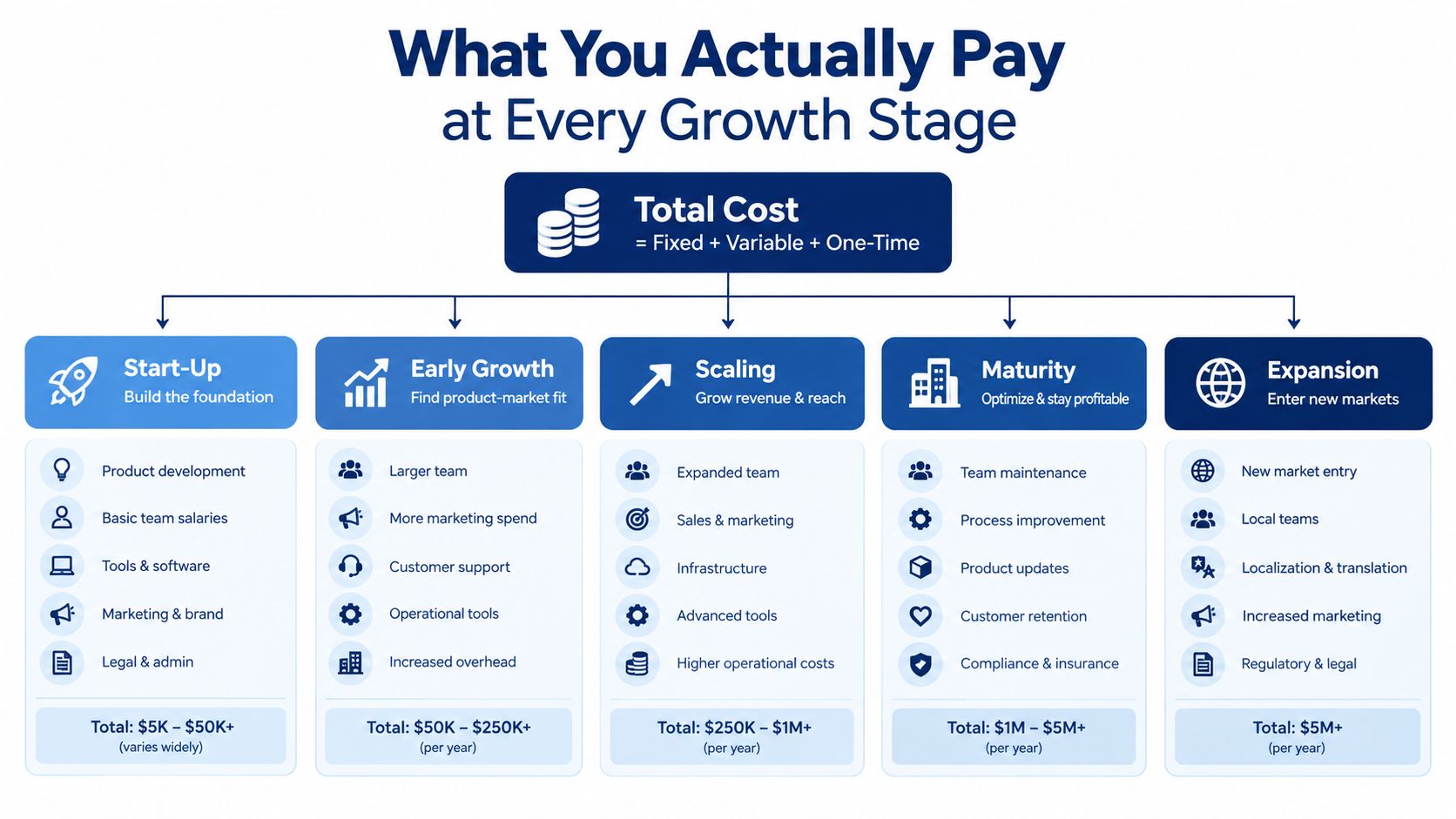
A company's stage gives you a starting point, but it doesn't determine the bill by itself. The deliverables change as the business grows, and the CFO's workload shifts from survival to coordination to capital strategy.
The stage-based ranges below come from Milestone's fractional CFO cost guide and Preferred CFO's pricing breakdown. Treat them as budgeting bands, not a menu where you blindly order the “growth” package.
Startups commonly sit around $3,000 to $7,500 per month, with the lower end covering foundational work and the higher end reflecting more involved planning or investor preparation. At this stage, the CFO should help you understand cash runway, establish a usable forecast, define sensible KPIs, and produce credible materials for investors or lenders.
You don't need a grand finance department. You need clean answers to basic questions: How much cash is available? What commitments are coming? Which assumptions drive the next financing decision? If your CFO spends the engagement producing elaborate reports nobody reads, you're buying theater.
Growth-stage companies may fall around $7,500 to $15,000 per month, according to Preferred CFO's guide. The work becomes more operational. Board reporting, scenario planning, hiring decisions, pricing analysis, fundraising support, and finance-team oversight all compete for attention.
Founders often underbuy. Revenue may look healthy, but growth introduces more moving parts. A CFO should connect the income statement to staffing, customer economics, cash timing, and strategic choices. “Revenue is up” isn't a financial strategy. It's a sentence.
High-complexity businesses can reach $15,000 to $30,000 or more per month, especially when the engagement includes full financial leadership, multi-entity reporting, major transactions, or significant capital-raising work, as reported by Preferred CFO.
At this level, you're not paying for a prettier spreadsheet. You're paying for consolidation, governance, transaction readiness, lender communication, planning discipline, and someone who can keep the finance function from becoming the company's largest recurring fire.
The sensible way to budget is to list the decisions and deliverables first, then match the engagement to them. Don't start with a number pulled from a blog post and force the CFO into it. That's how you end up paying for the wrong person with impressive credentials and no time for your actual problems.
Two companies can have similar revenue and receive very different quotes because revenue isn't the workload. Complexity is the workload.
A single-entity business with straightforward reporting is relatively easy to understand. Add multiple legal entities, different revenue streams, international activity, complicated ownership, or demanding lenders, and the CFO spends more time validating inputs before offering advice. You're no longer paying only for recommendations. You're paying for the effort required to make the recommendations trustworthy.
Multi-entity consolidation creates recurring work. Each entity may have different accounts, reporting practices, intercompany transactions, and close timelines. Consolidated reporting then becomes a process that needs ownership, not a spreadsheet assembled the night before the board meeting.
Fundraising and cap-table work can also push a quote upward. Investors expect coherent historical results, defensible forecasts, ownership clarity, and answers that hold together under questioning. If the underlying records are messy, the CFO has to become part strategist and part financial detective.
Legacy systems are another quiet cost driver. An outdated ERP, disconnected billing system, or manually maintained spreadsheet can turn a straightforward forecast into a data-wrangling exercise. The CFO may spend valuable hours cleaning feeds instead of interpreting the business.
Lender compliance adds pressure because reporting deadlines and covenant requirements don't care that your controller is on vacation. A CFO handling lender packages, liquidity planning, and compliance communication carries more responsibility than someone producing a monthly management report.
The Tipalti overview of fractional CFO pricing connects higher rates with work such as fundraising support, board reporting, and multi-entity consolidation. That's the important distinction. The premium reflects decision quality and transaction complexity, not just time logged.
A messy finance function doesn't become cheaper because you call it “a light engagement.”
Before speaking with candidates, map your finance environment. List the entities, revenue streams, reporting deadlines, systems, active financing requirements, and upcoming strategic events. Then separate problems that require CFO judgment from problems that an accountant, controller, or systems specialist can solve.
This audit gives you negotiating power. You can clean up basic data issues before the CFO starts, define the deliverables precisely, and avoid paying a senior operator to perform work that belongs elsewhere.

The wrong question is, “Why does this company pay less?” The useful question is, “What complexity am I asking this person to absorb, and can I remove any of it before the engagement begins?”
If you judge a fractional CFO only by the invoice, you're using the wrong scoreboard. The right CFO earns their keep by improving decisions, preventing avoidable damage, and giving the leadership team enough clarity to move with confidence.
That doesn't mean accepting vague promises about “strategic value.” Put outcomes on the table. A CFO should connect their work to specific management decisions and financial milestones.
A useful CFO engagement might help you catch a pricing error in your SaaS metrics before it contaminates the forecast. It might expose an unprofitable customer segment, renegotiate vendor terms, improve the timing of collections and payments, or prepare the business for a debt facility that preserves equity.
Those outcomes won't all appear as a neat line called “CFO ROI.” Track the evidence around them:
The NerdWallet guide to fractional CFO costs notes that retainer scope often expands when it includes cash forecasting, KPI dashboards, lender compliance, or M&A support. Those deliverables matter because they influence decisions with consequences beyond the finance department.
A failed financing process, a misunderstood cash position, or a pricing model built on bad assumptions can cost more than the engagement that would have exposed the problem. You don't need a dramatic rescue story to justify the investment. You need a consistent improvement in the quality and speed of decisions.
That's why the cheapest quote can be the most expensive option. A low-cost provider who only reports what happened may leave you blind to what's coming. A capable CFO challenges assumptions, explains trade-offs, and tells you when the plan doesn't survive contact with reality.
Measure the CFO by the quality of decisions they improve, not the number of spreadsheets they deliver.
Set a review cadence from the start. Agree on the core reporting package, the planning rhythm, the decisions requiring CFO involvement, and the signals that would justify expanding or reducing the scope. If the CFO can't explain how their work changes management behavior, keep interviewing.
Hiring well starts before you search. Write the scope as a business problem, not a title. “Need a fractional CFO” is vague. “Need a rolling cash forecast, board reporting, fundraising preparation, and finance-team oversight” gives candidates something they can price and prove.
Your brief should identify:
Then interview for judgment. Give candidates a real decision from your business with sensitive details removed. Ask what they'd inspect first, which assumptions they'd challenge, what data they'd need, and what they'd deliver initially. A candidate who jumps straight to a dashboard without asking about data quality is selling presentation, not finance leadership.
Don't pay for IPO experience when you need cash discipline and management reporting. Don't hire a generalist when a transaction, complex consolidation, or specialized compliance issue demands deeper expertise. The ideal candidate has enough pattern recognition to move quickly and enough humility to admit when the problem belongs with a tax specialist, controller, or accountant.
Remote talent platforms can also change the economics. HireAccountants connects US companies with pre-vetted accountants and finance professionals, including fractional and part-time support, through a marketplace, recruiting assistance, and matching technology. Its fractional CFO for startups guidance is relevant when a young company needs senior financial direction without building a full executive layer.
For broader context on flexible leadership roles, review Chicago Brandstarters fractional guidance. Compare the scope, seniority, availability, communication habits, and deliverables, not just the hourly figure.

Start with a defined initial period, document the first deliverables, and schedule a formal scope review before the work expands. That protects both sides. You'll know whether the CFO is creating value, and they won't be expected to absorb every finance problem your company has accumulated since its first invoice.
HireAccountants helps US companies find pre-vetted accountants and finance professionals for flexible part-time or full-time finance support, including fractional CFO needs. Visit HireAccountants to define your scope, compare qualified talent, and build the right finance capacity without hiring a full-time executive before your business needs one.
Let's simplify your finances today!