


$81,680 per year is the practical U.S. median baseline for an accountant or auditor, while hiring a CPA through a firm commonly means paying $150 to $450 per hour. A full-time CPA-specific hire often lands around $99,000 to $102,275 annually, before the extra costs of benefits, payroll taxes, recruiting, software, and management.
The popular advice says to search for “the average CPA rate,” pick a provider near that number, and move on. That advice is too shallow to survive contact with an actual invoice. A CPA preparing one business return, maintaining monthly books, advising on a fundraise, and joining your company as a full-time employee isn't selling the same product.
The smarter question is, what exactly do you need done, how often, and who must own the outcome? Once you answer that, CPA pricing gets much less mysterious, and a lot easier to negotiate.
“Hiring a CPA” can mean four very different purchases. Treating them as one category is how buyers compare a tax-return quote with a controller salary and conclude that someone is overcharging. Usually, the scope is just different.
A one-off tax engagement is built around a defined filing or cleanup project. You pay for a deliverable, often through a fixed fee. Monthly bookkeeping and compliance are recurring operations, so a retainer usually makes more sense. Advisory work is more senior and less predictable, which pushes pricing toward premium hourly rates or a monthly commitment. Full-time employment buys ownership, availability, and continuity, but it also creates a fully loaded cost far beyond salary.
Those models sit in different cost universes:
A credential matters, but it doesn't determine the invoice by itself. A CPA who spends an hour reviewing a multi-state structure isn't providing the same service as one categorizing routine transactions.
Practical rule: Describe your need in one sentence before asking for a quote. “We need monthly close and quarterly tax filings for one U.S. entity” is useful. “We need accounting help” is an invitation to pricing fog.
Ask yourself: Do I need a CPA, or do I need finance work performed under CPA supervision? A bookkeeper or senior accountant may handle recurring transaction work efficiently, while a licensed CPA handles tax, audit, representation, and higher-risk judgment.
That distinction keeps you from buying a partner-level solution for a bookkeeping problem. It also keeps you from hiring a low-cost operator for work that requires licensed expertise. The right answer isn't the cheapest person. It's the narrowest capable engagement.
The cleanest employee benchmark is the U.S. Bureau of Labor Statistics data for accountants and auditors. The median annual wage was $81,680 in May 2024, equivalent to $39.27 per hour, as reported in this BLS wage benchmark summary. That figure describes the broader occupation, not a guaranteed CPA salary.
A separate compensation benchmark places the mean for accountants and auditors at $90,780 per year and $43.65 per hour in May 2023, with a median hourly wage of $38.41, a 25th percentile of $30.15, and a 75th percentile of $49.99 in the CPA compensation data/Hourly_Rate). The same dataset translates to roughly $50,440 at the 10th percentile, $79,880 at the median, and $137,280 at the 90th percentile for full-time annual compensation, before benefits and overhead.
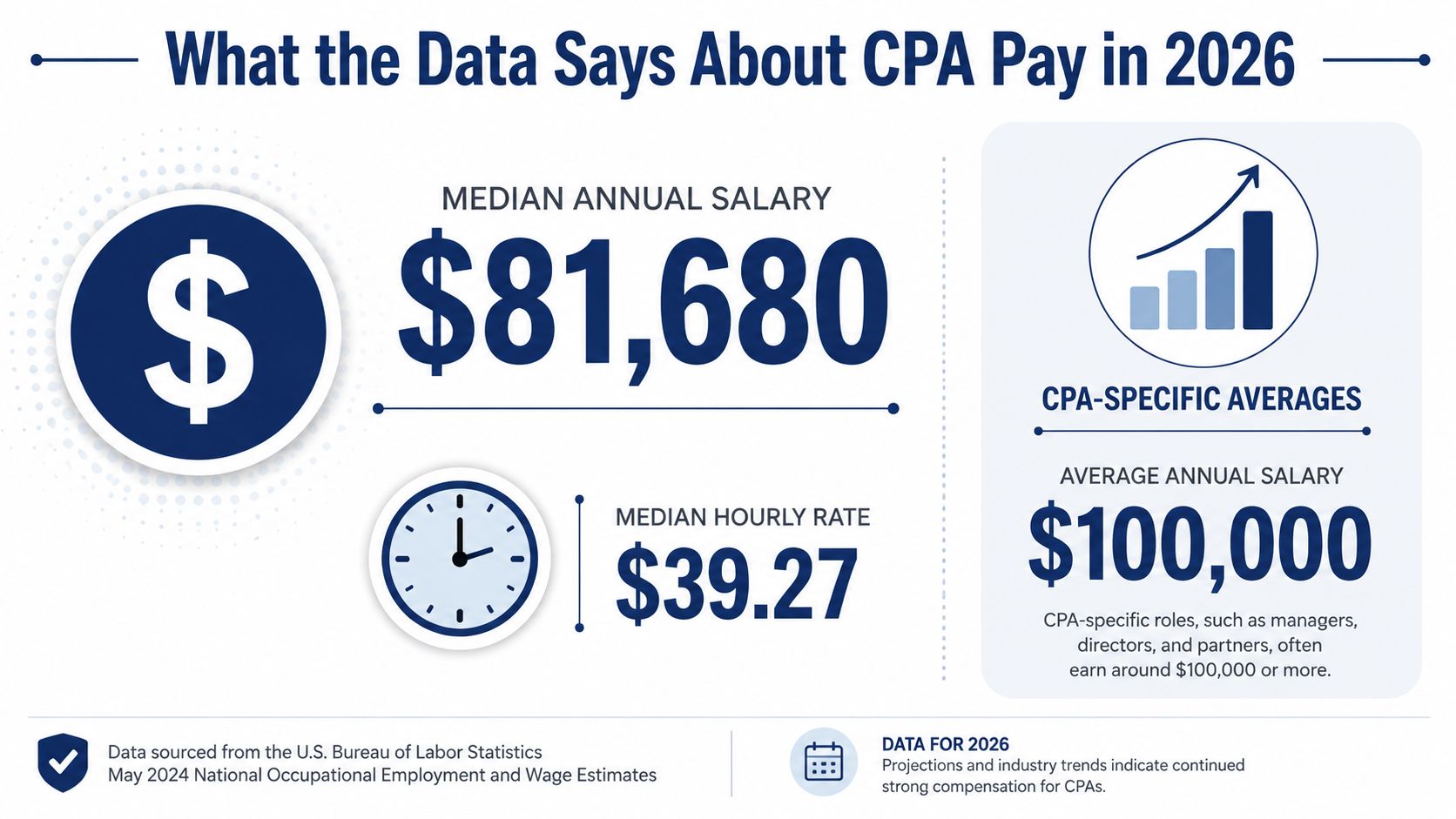
CPA-focused surveys generally place certified professionals above the broader accountant-and-auditor population. Accounting.com reported an average CPA salary of $99,000 in 2024, while another industry benchmark reported a U.S. average of $102,275 per year, or about $49.17 per hour, with a 25th percentile of $78,750 and a 90th percentile of $130,500, as summarized by Becker's CPA salary insights.
Use the numbers as budgeting brackets, not promises:
Salary is only the first line. Add employer payroll taxes, benefits, recruiting, software seats, equipment, management time, and coverage for vacations or turnover. That's why a salary that looks manageable on paper can become a much larger operating commitment.
For a useful framework on scaling with freelance vs full-time finance talent, compare the freelance and full-time hiring models. The same tradeoff applies here: recurring ownership may justify employment, while defined work usually favors flexible capacity.
CPA pricing gets easier once you stop treating every quote as an hourly-rate contest. Firms increasingly use fixed or value-based pricing for routine compliance. Benchmarking shows only 3% of firms charge hourly for tax preparation, while fewer than 10% charge hourly for many advisory services, according to CPA firm pricing research.
| Pricing Model | Typical Range | Best For |
|---|---|---|
| Hourly | $150 to $450 for standard professional work | Unpredictable scope, technical reviews, urgent questions |
| Tax or audit hourly | $200 to $500+ | Complex tax, audit support, representation, specialist work |
| Metro or major-firm partner | $300 to $800 | High-stakes advisory, complex transactions, senior judgment |
| Routine monthly retainer | $500 to $2,500 or more | Bookkeeping, compliance, recurring reporting |
| Fractional CFO retainer | $3,000 to $10,000 per month | Forecasting, board reporting, fundraising, executive finance |
| Simple tax project | Low hundreds | Straightforward individual filing |
| Business tax project | $1,500 to $3,500 | Business returns with defined scope |
| Full-time salary | $81,680 median annual wage for accountants and auditors | In-house ownership and daily availability |
Hourly billing works when neither side can confidently define the work. It also creates budget risk, so ask for an estimate and a cap. A retainer fits recurring work, but only if the engagement letter says exactly what the monthly fee includes.
Project pricing is my preference for cleanly defined tax preparation or cleanup. You know the deliverable, the fee, and the point at which a change order becomes necessary. Salary makes sense when finance is part of the company's daily operating rhythm, not when you need help during a few predictable deadlines.
CPA firm billing can sit far above employee wages because firms must cover nonbillable time, overhead, utilization gaps, and profit margin, as explained in the CPA business model report. You aren't paying only for the person's wage. You're paying for the delivery system around that person.
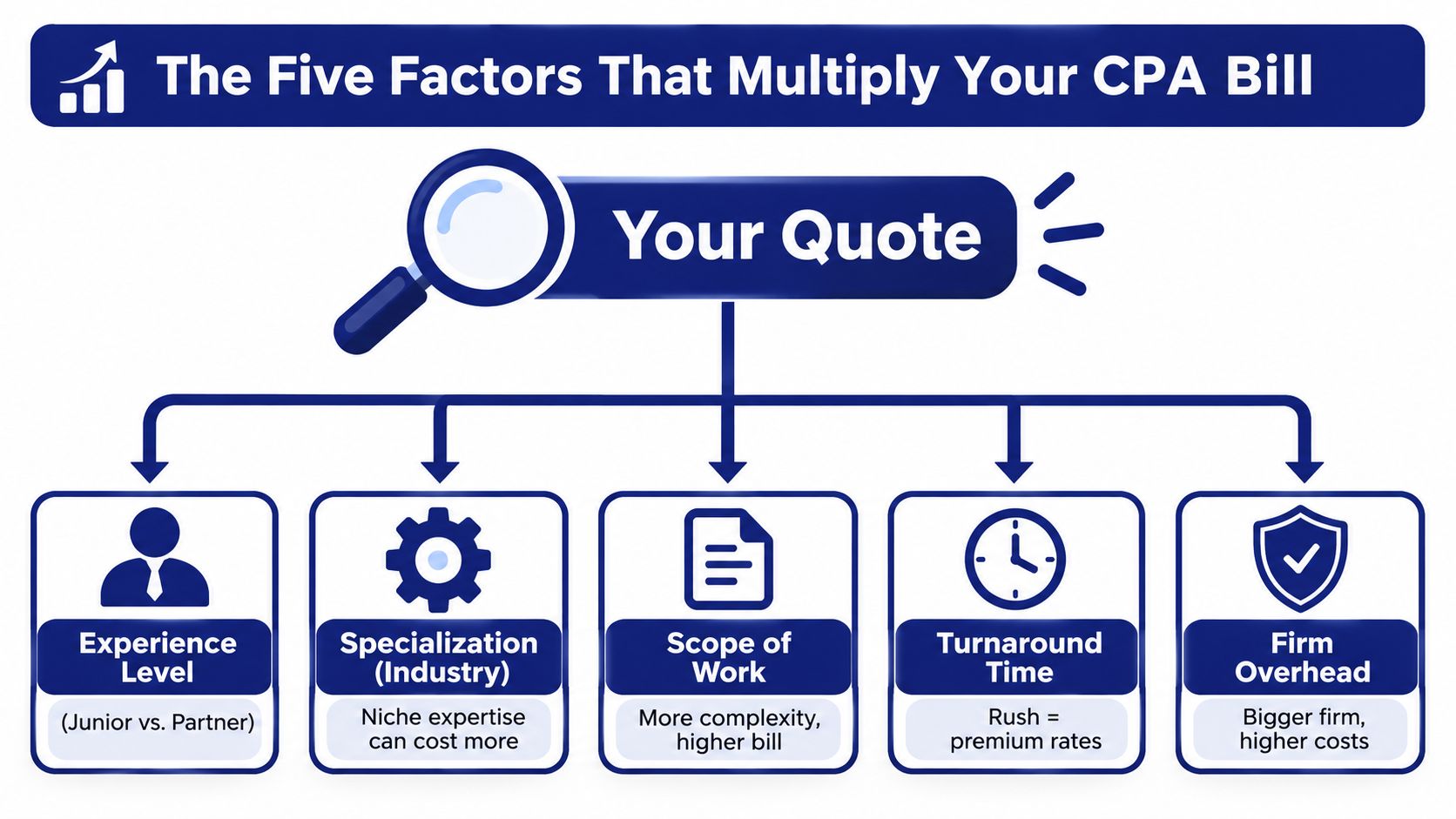
A quote is rarely random. It usually reflects five levers, and each one tells you where to push back or narrow the scope.
A staff accountant, senior CPA, and partner don't carry the same price. Small and solo firms commonly sit around $150 to $275 per hour, regional firms around $200 to $400, and large national or Big Four firms around $300 to $600 or more, with partners sometimes exceeding $500, according to CPA firm pricing benchmarks.
Use senior people for judgment, not data entry. If a partner is doing reconciliations, you're buying an expensive keyboard.
Technical accounting, multi-state tax, transaction support, and industry-specific work require knowledge that general bookkeeping doesn't. SaaS revenue recognition, forensics, and tax controversy carry a premium because mistakes can affect financing, filings, or deal outcomes.
Major-metro firms generally charge more than rural solo practices. Remote delivery can reduce the geographic premium, but it doesn't erase the need for state-specific expertise. A remote CPA who understands your jurisdiction is more useful than a local generalist guessing at a complicated issue.
Multiple entities, several states, messy prior periods, audited financial statements, foreign activity, and high transaction volume all expand the work. Put those details in the first request for proposal, or watch them appear later as “out of scope.”
A defined annual return is easier to price than embedded monthly support. Advisory work also changes as your decisions change. Pricing guidance for CPA hiring makes the important point that the question isn't only the hourly rate. It's what the use case will cost.
Abstract rates are fine until someone sends an invoice. These three scenarios show how scope changes the number.
A seed-stage startup may need monthly bookkeeping, payroll oversight, and quarterly tax filings. A realistic monthly range for that package is $1,200 to $2,500 with a mid-tier remote firm.
The deliverables might include reconciled bank and credit-card accounts, a monthly income statement and balance sheet, payroll coordination, quarterly filing support, and a scheduled review call. That isn't fractional CFO work. It's operational finance with tax oversight, which is why a recurring package fits better than open-ended hourly billing.
Unfiled returns plus a damaged chart of accounts is a cleanup project, not ordinary tax preparation. A typical cleanup can run $4,000 to $9,000, followed by ongoing filing and bookkeeping fees.
The quote should separate historical reconstruction, chart-of-accounts redesign, return preparation, notices or amendments, and future-state maintenance. Otherwise, the provider may quote the filing and bill the cleanup by the hour.
A Series B SaaS company seeking board reporting and fundraising diligence may need fractional CFO support at $5,000 to $10,000 per month, depending on time commitment and scope.
That package can include board materials, cash-flow forecasting, KPI reporting, investor diligence, scenario modeling, and coordination with the tax CPA. It's a leadership engagement, not a bookkeeping retainer. For another useful breakdown of what fractional CFOs cost, compare the deliverables before comparing the monthly figure.
The invoice follows the mess, the risk, and the decision load. Clean books and a defined deliverable keep the bill civilized.
Traditional local firms aren't the only way to add finance capacity. For recurring operational work, remote, U.S.-time-zone talent can change the economics without pretending that every accounting task belongs offshore.
HireAccountants matches companies with pre-vetted accountants and finance professionals, including Latin America-based talent working in U.S. time zones. Its published pricing says many roles can be filled at $10 per hour or under $3,000 per month, with flexible full-time and part-time arrangements, as described on the accounting outsourcing benefits page.
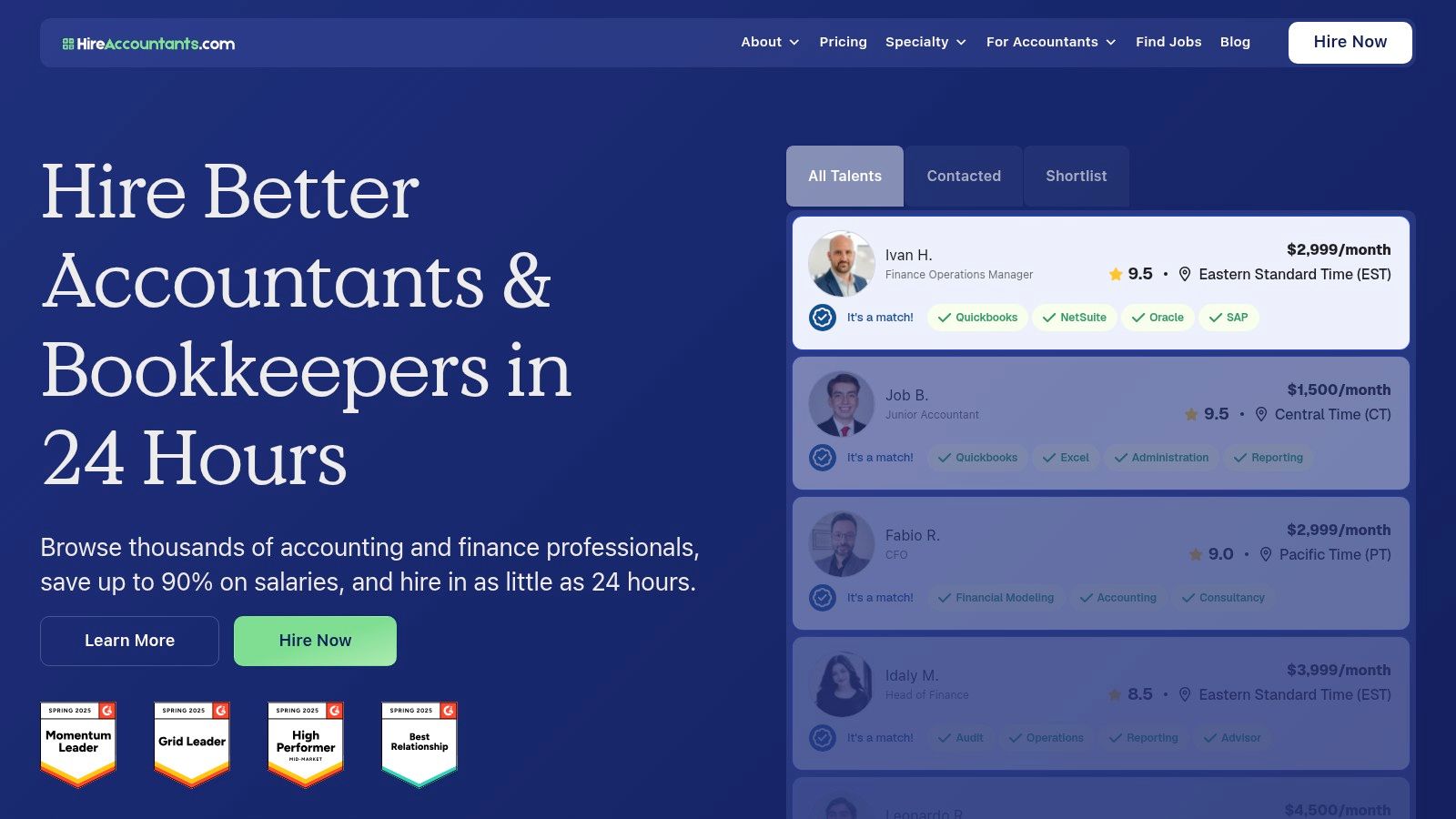
Compare a remote recurring operator with a U.S. employee whose salary benchmark starts around $81,680, before payroll taxes, benefits, recruiting, software, and overhead. Compare it with a $300-per-hour firm engagement, where routine monthly work can consume budget quickly even when the task itself isn't highly technical.
Remote capacity makes the most sense for reconciliations, accounts payable and receivable support, close preparation, reporting packages, bookkeeping cleanup, and finance operations. Pre-vetting and matching also replace some of the resume-screening and interview grind. Hope you enjoy fact-checking resumes and running accounting interviews, because that can become your second job.
Don't use a remote generalist for a local audit sign-off, jurisdiction-specific tax opinion, or work requiring in-person board presence. Cross-border payroll, data access, time-zone coordination, and supervision still need clear processes.
The sensible model is often hybrid. Keep licensed, jurisdiction-specific judgment with the appropriate U.S. CPA, and place repeatable finance operations with remote talent. That way, you aren't paying partner rates to reconcile bank feeds, and you aren't asking a bookkeeper to make a legal or technical judgment outside their role.
The engagement letter controls your actual cost more than the sales call does. Get the commercial details in writing before anyone touches your books.
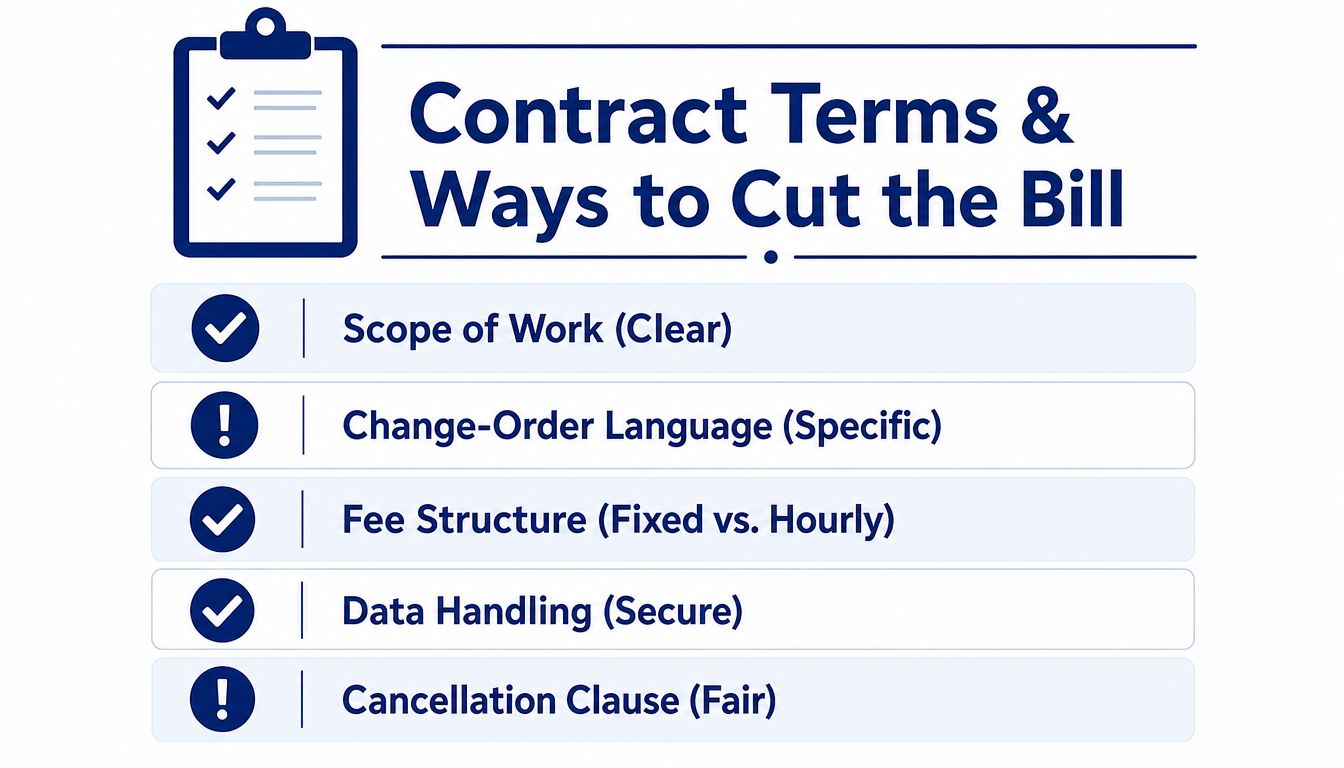
Insist on a clear scope of work, named deliverables, deadlines, review responsibilities, and a definition of what counts as extra work. The document should also address change orders, data and document ownership, termination, confidentiality, and what happens if the engagement runs beyond the original estimate.
Watch for these warning signs:
The CPA hiring checklist is useful for organizing credentials, scope, communication, and pricing questions before you sign.
Give the CPA clean records, consistent account access, and a complete document package. Data cleanup is expensive when a senior professional has to reconstruct basic information.
Ask for fixed-fee alternatives for defined returns, bundle recurring services where the combination reduces handoffs, and consider an annual commitment if the provider offers better retainer economics. Don't chase a discount by hiding complexity. That moves the cost into change orders.
Yes, but negotiate scope before rate. Ask whether the provider can offer a fixed fee, separate senior review from routine preparation, or bundle recurring work. Three comparable written quotes beat one aggressive haggling session.
Expect possible charges for cleanup, amended returns, extra states, payroll changes, urgent requests, audit support, and advisory calls outside the package. The biggest hidden cost is vague scope, so ask what isn't included before you ask for a discount.
Usually, full-time employment makes sense when you need daily ownership and enough work to keep the person busy. Otherwise, outsourcing or flexible remote capacity avoids the additional salary load created by benefits, payroll taxes, recruiting, software, and management.
Hire professional help when tax complexity, messy records, payroll, multiple entities, or a high-stakes financing event makes errors more expensive than the fee. If you're unsure whether the person must be licensed in your state, review the CPA requirements by state before choosing a provider.
Request three quotes, give each finalist the same scope, and compare local, remote, and in-house options on deliverables rather than labels. That's how you avoid both bargain-bin accounting and luxury pricing for routine work.
HireAccountants helps U.S. companies find pre-vetted accountants and finance professionals for recurring bookkeeping, accounting, tax support, and finance operations, with options that can fit full-time or part-time needs. Visit HireAccountants to compare qualified remote talent against the cost of a local CPA firm or full-time hire.
Let's simplify your finances today!