


A cheap bookkeeping quote can become an expensive first 90 days. The monthly retainer is only part of the cost. You may also pay for cleanup, the work needed to bring records into shape, and time spent checking the provider's work.
Before signing, price the setup and the exit as well as the recurring service. Confirm who keeps your records, which files you can export, and what happens if you leave. A low quote is useful only if the books stay usable and the handoff does not become another project.
The monthly fee is only one part of the price. Scope, the first 90 days, and the terms for retrieving your records when you leave can determine whether a low retainer stays low.
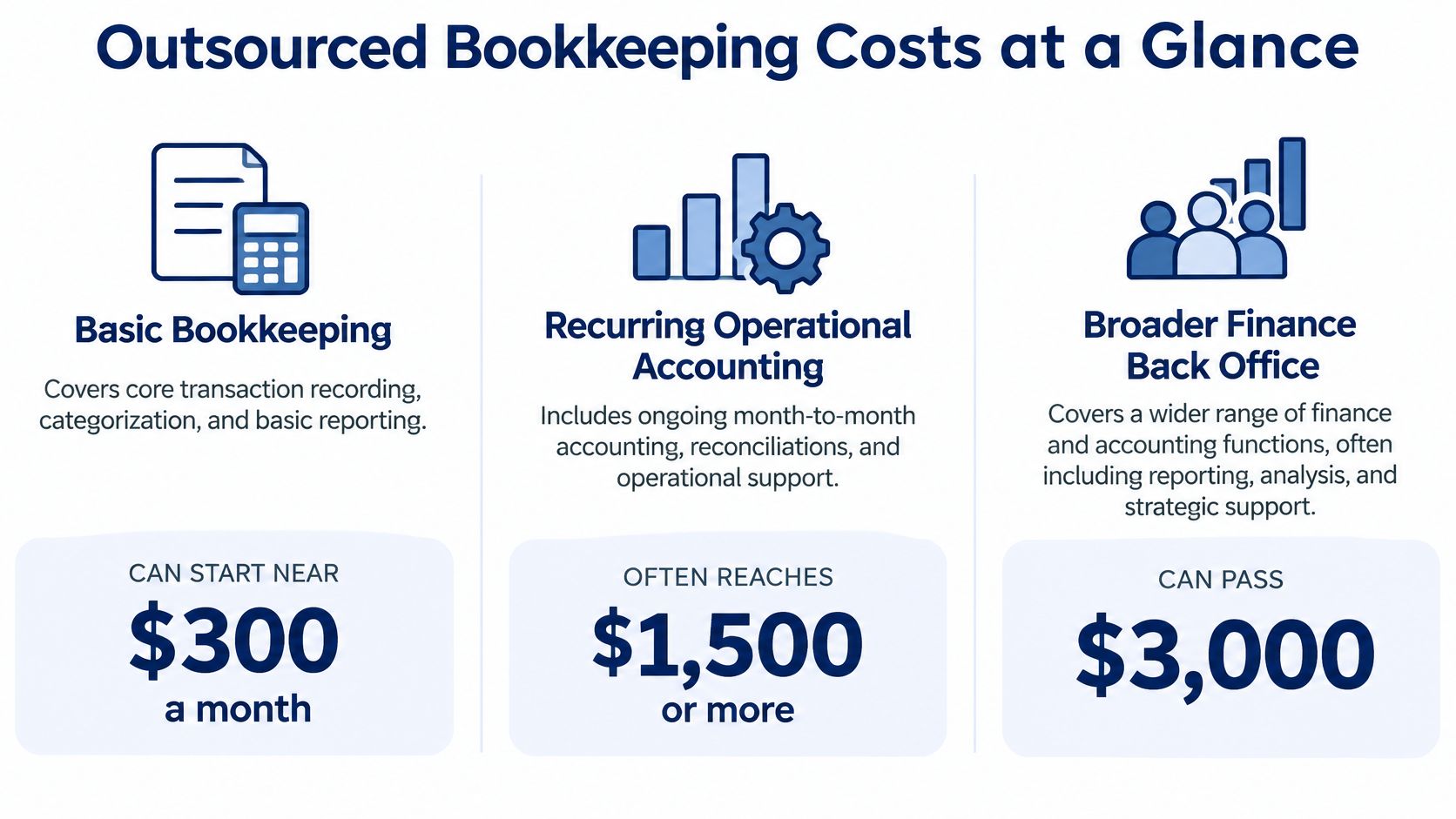
| Service level | Typical monthly fee | What it usually covers |
|---|---|---|
| Bookkeeping only | $300 to $1,500 | Transaction recording, bank reconciliation, basic reports |
| Full monthly bookkeeping for 50 to 200 transactions | $1,500 to $3,000 | Bookkeeping at that volume, reconciliations and reporting |
| Bookkeeping plus operations | $1,500 to $3,500 | Accounts payable and receivable, payroll coordination, monthly close, financial statements |
| Controller-level oversight | $2,000 to $5,000 | Review, judgment calls, investor, lender or board reporting |
These ranges describe different scopes, not a single standard package. Transaction posting costs less than a service that also closes the books, coordinates payroll, and prepares financial statements. For a property business, bookkeeping workflows explained by VerticalRent gives context on how accounting tasks fit together.
Before requesting proposals, count your monthly transactions, bank accounts, and payment gateways. Decide how often you need reports, too. Those details help you compare providers on the work included, rather than on a label like “outsourced bookkeeping.” Ask who handles setup during the first 90 days, how you receive your records and exports, and what the contract requires if you leave.
A flat monthly retainer is the default I'd choose for steady, recurring bookkeeping. You know what to budget, and the provider has a defined job to complete. The catch is the contract: if it doesn't say what happens when transaction volume rises, a predictable fee can turn into a scope-creep negotiation.
| Model | How it bills | Best fit | Watch for |
|---|---|---|---|
| Flat monthly retainer | Fixed fee each month | Steady, predictable volume | Scope creep when volume rises |
| Tiered by volume | Price steps at transaction bands | Growing e-commerce or SaaS | A jump at the next band |
| Per transaction | Charge per entry processed | Low, irregular volume | Costs climb in peak months |
| Hourly | Billed per hour worked, CPA review at $200 to $500 an hour | Occasional questions and review | Hours grow unpredictably |
| Project cleanup | Fixed or hourly catch-up | Books months or years behind | A scope that isn't written down |
Tiered pricing works when a business is growing and can estimate how its transaction count will change. Just get the bands and the price at each one in writing. A jump into the next band can make a small increase in activity feel like a much larger increase in cost.
Per-transaction pricing can look tidy until a peak month arrives. Say an online retailer's November activity doubles the number of entries it processes. If the provider charges for each transaction, the invoice can double too, even if the business's reporting needs haven't changed.
Use hourly billing for occasional questions or discrete review work, not as a blank cheque for routine monthly books. A pricing analysis reports CPA rates of about $200 to $500 an hour, with highly specialized work reaching $800 or more per hour. That's advisory-level pricing, not a sensible yardstick for ordinary transaction recording. A separate 2025 analysis of outsourced bookkeeping costs for small and medium-sized Texas businesses puts monthly pricing at $250 to $2,500, with most full-service packages at $500 to $900. Use that as a regional sanity check, not a promise that your company will land at the midpoint.
Simple rule: Use a retainer for predictable volume, hourly billing for occasional questions, and a project fee for catch-up work.
Before comparing proposals, convert every fee to a monthly figure. Spread project costs over the contract year, add a realistic allowance for questions billed by the hour, then compare the providers' deliverables side by side. A spreadsheet is less glamorous than a sales call, but it's better at spotting mismatched scopes.
A bookkeeping quote reflects the records your provider must reconcile, the judgment your reporting requires, and how often the work needs review. A single-account service firm with cash-basis books has a different scope from an e-commerce business handling several payment processors, inventory, and sales tax.
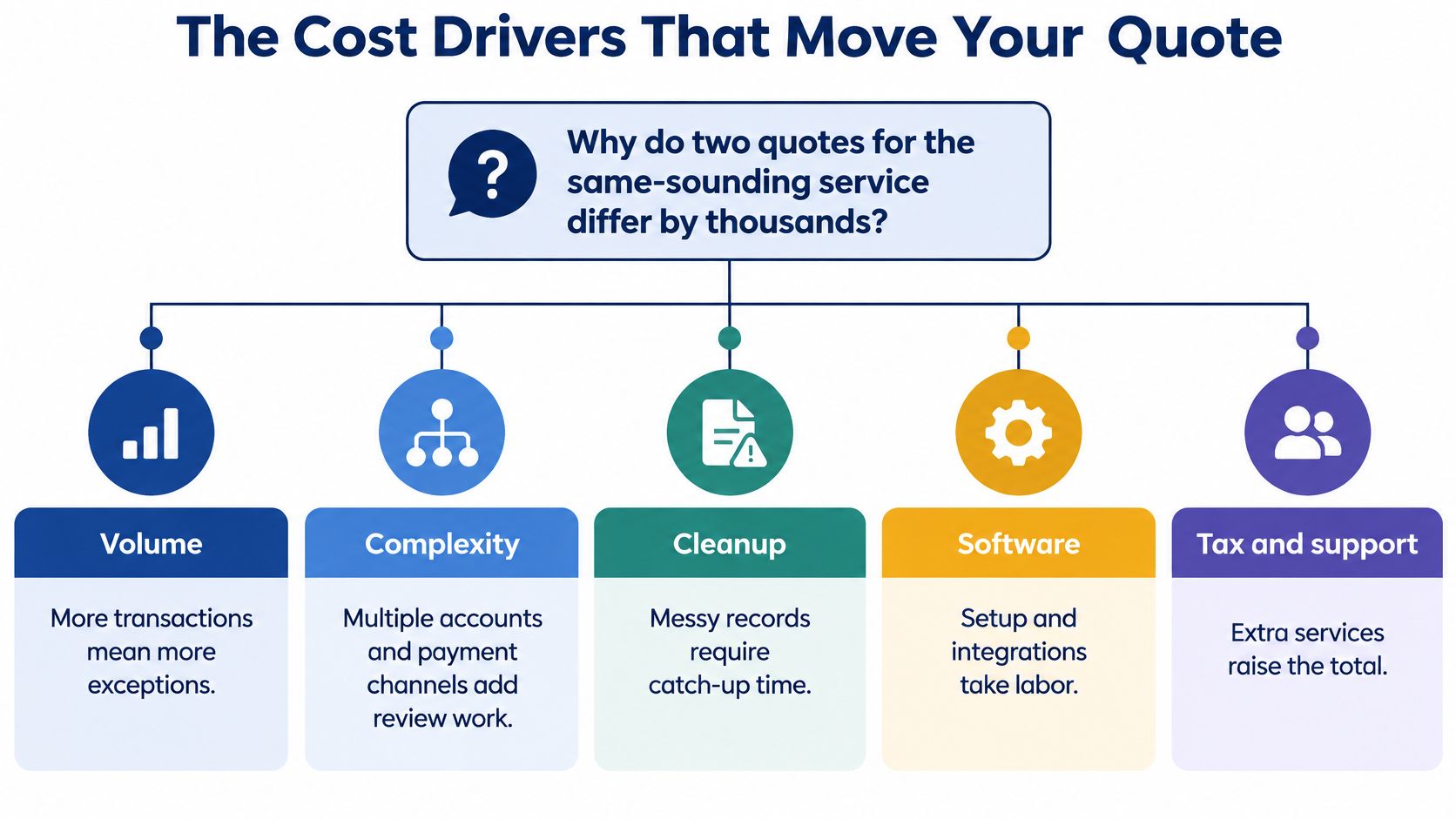
| Scenario | Likely service level | Typical monthly fee |
|---|---|---|
| Single-account service firm, cash basis | Bookkeeping only | $300 to $1,500 |
| E-commerce store on Shopify, Stripe, and PayPal with inventory and multi-state sales tax | Bookkeeping plus operations | $1,500 to $3,500 |
| SaaS company with deferred revenue and monthly investor reporting | Controller-level oversight | $2,000 to $5,000 |
The service firm needs transaction posting and straightforward reports. The e-commerce store must match payment channels and account for inventory and tax obligations. The SaaS company needs added judgment around revenue timing and reporting controls. These are typical ranges, not guaranteed quotes; the actual fee depends on the work included and the condition of the records.
For businesses connecting several finance tools, review accounting software integration options before choosing a setup. Each additional gateway or inventory line creates records to reconcile, explain, and retain, so confirm who owns those records and how you can export them if the arrangement ends.
The U.S. Bureau of Labor Statistics reported median pay of $50,670 per year, or $24.36 an hour, for bookkeeping, accounting and auditing clerks in May 2025. At a full-time schedule of 2,080 hours a year, that comes to about $4,223 a month in base wages alone, before employer-paid costs, according to the BLS occupational outlook for bookkeeping, accounting and auditing clerks.
Salary is the easy line to see. It's also only the starting line.
| In-house cost line | Outsourced equivalent |
|---|---|
| Base wage, BLS median $24.36 an hour | Included in the retainer |
| Employer payroll taxes | Provider's cost, not yours |
| Health insurance | Provider's cost, not yours |
| Retirement contributions | Provider's cost, not yours |
| Recruiting and training | Provider handles vetting; check what onboarding costs you |
| Equipment and software | Often included; confirm in writing |
| Paid leave and coverage gaps | Provider covers absences |
| Management time | Still yours: your review hours |
Outsourcing can reduce the cost of buying capacity you don't need full-time, but the comparison isn't one-to-one. A part-time or task-based engagement may cost much less in absolute dollars because you're paying for less capacity. A full-time outsourced resource should be compared with the total cost of employment, not just salary. For a broader look at those trade-offs, see the benefits and considerations of outsourcing accounting services.
Use this formula to estimate the annual difference:
Annual saving = total in-house cost − annual outsourced fees − value of your review hours
For example, suppose your team spends 5 hours a month reviewing an outsourced bookkeeper's work at an assumed $60 an hour. That's $300 a month in review time. Add it to a $1,500 monthly retainer, and the effective cost is $1,800 a month, compared with about $4,223 in base wages for the BLS benchmark, before the additional employment costs in the table.
That's a directional check, not a perfect comparison, because the provider's scope and the employee's duties may differ. The true test is whether the work arrives accurately enough that your team doesn't spend every month correcting it. A cheap retainer that leaves you doing the quality control isn't a saving; it's a second job with better branding.
A startup switches providers expecting its usual monthly bill, then gets a first invoice with cleanup and setup charges attached. That isn't automatically a rip-off. The provider may have to repair old records before it can produce reliable current reports, and cleanup, catch-up bookkeeping, tax preparation, software setup and year-end support are often billed separately, as outlined in this guide to outsourced accounting costs.
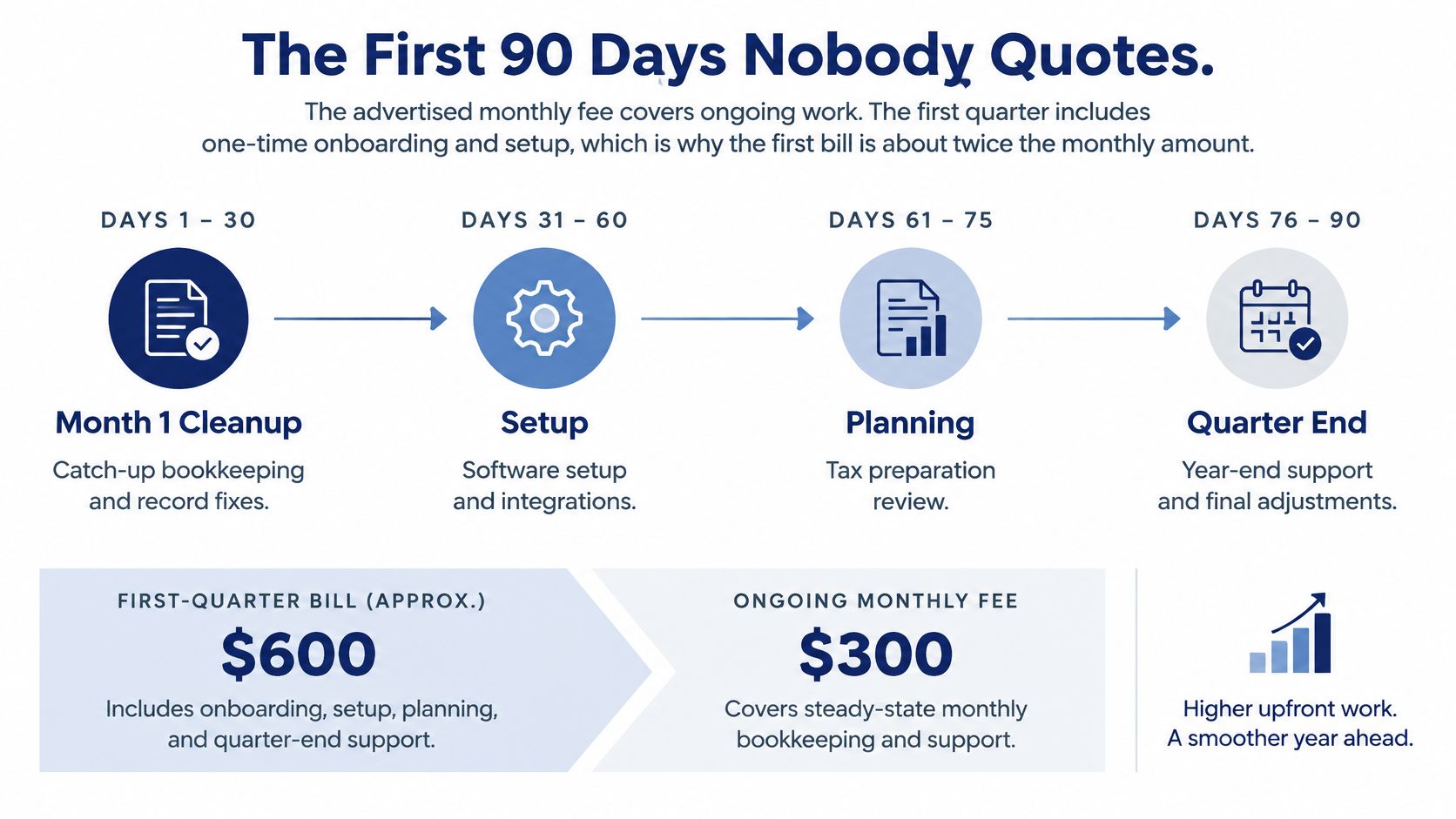
Work out the likely first-quarter spend before you sign:
Initial cleanup hours × hourly rate + software and integration costs + recurring fees for the months in scope + volume surcharges + payroll or sales-tax support
Assume the provider needs 40 cleanup hours at $60 an hour, or $2,400. Add $300 for software setup and three months at $1,000 a month for recurring work. The first 90 days come to about $5,700, even though the advertised retainer is $1,000 a month.
Those are assumed figures for an example, not a standard market quote. The useful point is that one-time remediation can sit beside the recurring fee, and the two should be presented separately.
A typical transition has distinct phases:
Ask the provider to list prior-period reconciliation, chart-of-accounts redesign, uncategorized transactions, duplicate entries, historical financial statements and handoff documents in the written scope. If any item is excluded, find out whether it will be billed hourly, as a fixed project or through a separate service.
If you're comparing providers, use a practical guide to hiring a bookkeeper to prepare your questions before kickoff. Then ask every provider the question that cuts through the sales pitch: What will the first 90 days cost, not just the advertised monthly price?
The IRS generally suggests keeping tax records for three years, and employment-tax records must be retained for at least four years. Electronic records follow the same requirements as paper records, so moving files into cloud software doesn't remove the responsibility to keep them. The IRS guidance on small-business recordkeeping makes the distinction clear: “monthly books completed” isn't the same as “records managed properly.”
A low monthly quote may cover posting transactions but exclude receipt capture and organized document storage. If the provider holds the source files or controls the software logins, you need to know what happens when the relationship ends. That's not digital housekeeping for its own sake; it's how you avoid paying someone to reconstruct records you thought you already had. Clear reconciliation procedures also help with tricky cash flows, such as matching tour deposits and installments.
Say your company changes providers after working with the same firm for two years, then discovers the old provider holds the bank exports. Your team now has to rebuild the support, spend time chasing files and potentially pay for rushed cleanup. The problem isn't that every provider will mishandle an exit. It's that a contract without an export process leaves you guessing at precisely the wrong time.
Write the export and exit terms into the agreement and price them openly. If a provider can explain its monthly fee but can't explain how you'll get your own records back, the quote isn't complete.
Don't choose a provider based on the first monthly number in the proposal. Confirm that the price covers the work, the cleanup and the records you'll need later.

If you need a finance hire rather than a managed service, HireAccountants offers pre-vetted bookkeepers and accountants for full-time or part-time roles, with English-fluent Latin American talent working in U.S. time zones. Its bookkeeper pricing is $1,100–$1,999 per month and claims savings of up to 80 to 90 percent; test that claim against your scope, review time and support needs before treating it as your budget.
The rule is simple: the cheapest quote is the one that covers the work you have. Ask for the full scope, the first-quarter total and the exit terms, then choose the proposal that leaves your team with useful books instead of a monthly repair project.
If you're comparing finance support, visit HireAccountants to review pre-vetted bookkeeping and accounting talent for full-time or part-time roles. Match the proposed capacity and cost against your written scope before deciding whether a hire or a managed service fits your books.
Let's simplify your finances today!