


At 11 p.m., the spreadsheet pivot table breaks under six months of Stripe payouts, contractor invoices, PayPal activity, and a freshly issued SAFE. Your seed close is two weeks away. You're the bookkeeper, controller, auditor, and person expected to explain cash burn to investors, which is a charming arrangement until product work starts slipping.
That's when outsourced accounting for startups stops looking like a luxury and starts looking like basic survival. The trigger might be first real revenue, the first investor update, the first payroll run, or the first time a board member asks why deferred revenue moved in the wrong direction. The problem isn't that you're bad at accounting. The problem is that a growing company has finally produced more financial work than one distracted founder can safely carry.
The spreadsheet didn't fail because spreadsheets are evil. It failed because the business outgrew the founder's memory.
Stripe payouts arrived with fees and timing differences. Contractors sent invoices from three different systems. PayPal transactions sat unreconciled. The SAFE appeared in the cap table, but nobody had documented how it should flow through the accounting records. Meanwhile, the founder kept switching between product decisions and manual categorization, hoping the numbers would become trustworthy through sheer exhaustion.
They usually don't.
Practical rule: If you're building the board deck by guessing which version of cash is correct, you don't have a reporting system. You have a suspense novel.
The first growth triggers are predictable:
A managed accounting team replaces more than late-night data entry. It replaces last-minute tax scrambles, board decks built on half-remembered figures, and the quiet dread of opening QuickBooks before breakfast. The useful handoff isn't “someone else enters transactions.” It's “someone else owns the close, documents the exceptions, and tells me what the numbers mean.”
Small businesses were already treating outsourcing as a normal operating choice before startup finance became a polished category. A 2019 U.S. survey of 529 small-business owners and managers found that 37% were outsourcing at least part of the business, with accounting among the most commonly outsourced functions at 37%; a commonly cited reading puts accounting-specific outsourcing at about 14%, while 52% planned to contract out some business function. The sample covered U.S. firms with 1 to 500 employees, so the pattern wasn't limited to giant companies with finance departments. The survey context and accounting outsourcing analysis are summarized by BILL.
Outsourced accounting is a third-party finance function delivered as a managed service. The provider may handle bookkeeping, reconciliations, payroll oversight, accounts payable, accounts receivable, monthly close, financial reporting, tax coordination, and, when needed, controller or CFO support.
The important word is accountability. A software subscription records transactions. An outsourced team is supposed to explain them, reconcile them, close the books, and own the follow-up when something doesn't tie.
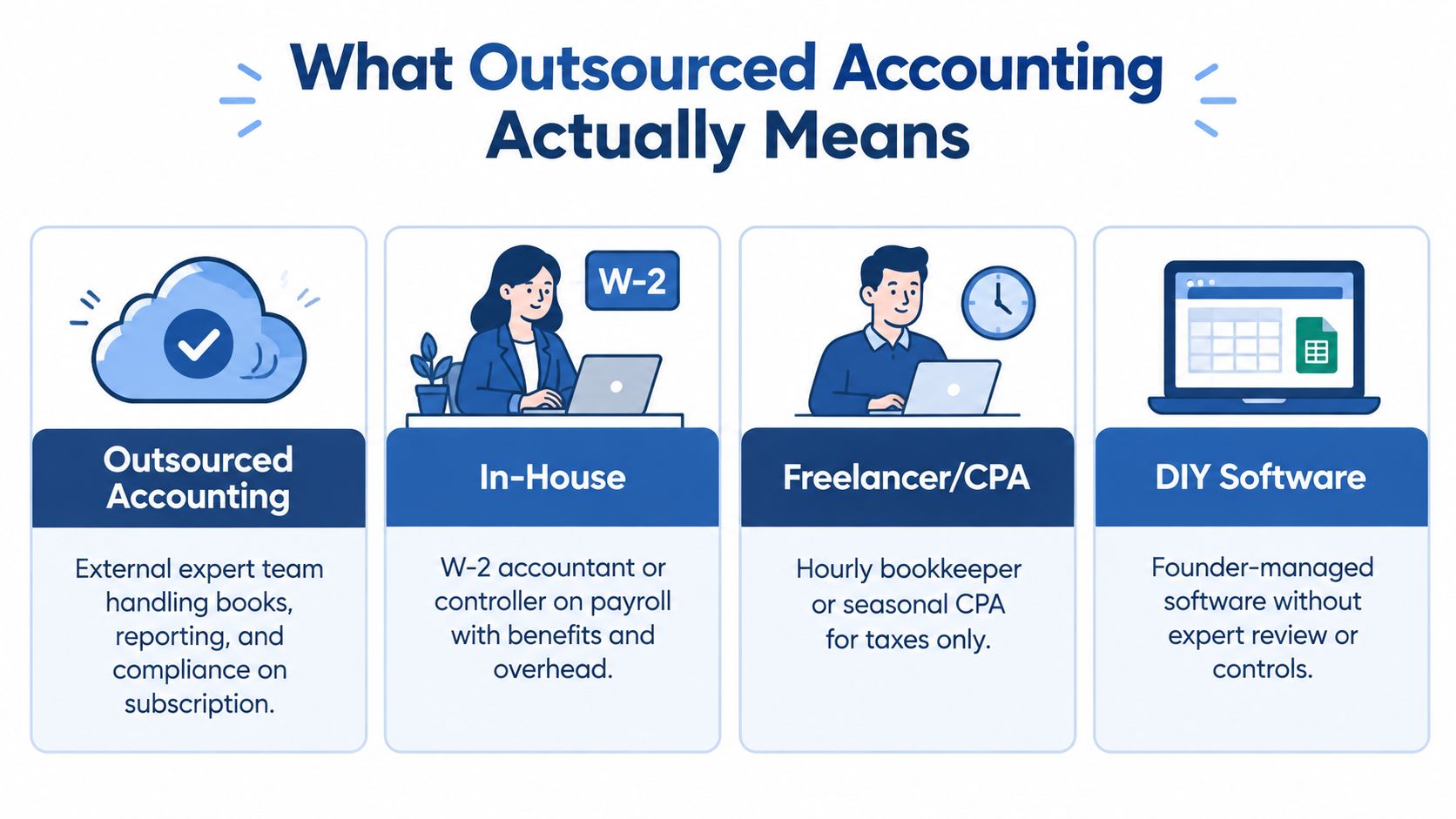
In-house accounting means a W-2 accountant or controller works directly for the company. You get proximity, institutional knowledge, and informal access, but you also take on salary, benefits, software, management, hiring, retention, and coverage risk.
A freelance bookkeeper usually handles categorization, reconciliations, and perhaps a monthly close. That can work beautifully for a simple business. It becomes less comfortable when the company needs revenue recognition, investor reporting, multi-entity consolidation, audit preparation, or someone senior enough to challenge the founder's assumptions.
DIY accounting software includes QuickBooks, Xero, payroll platforms, billing tools, and newer AI-assisted workflows. These tools can automate imports and surface anomalies. They don't automatically decide whether a transaction is classified correctly, whether a close is complete, or whether a reporting package is defensible.
A managed outsourced team combines people, process, and systems. The right provider assigns owners, creates a close calendar, documents controls, and gives you a defined escalation path. It's not merely data entry performed somewhere else.
The distinction matters during a fundraise or audit. If the provider can't tell you who reviewed the close, which accounts were reconciled, and where unusual entries were approved, you haven't outsourced the finance function. You've outsourced the clicking.
Startup proposals usually fall into three structures. The right choice depends less on the provider's branding and more on the trigger that created the problem.
Fractional accounting gives you a senior accountant or controller for a defined amount of monthly capacity. The appeal is flexibility. You can add experienced review without immediately building a full department. It works best when transaction volume and reporting requirements are predictable, but the scope needs to be written tightly. “Available as needed” is not a scope. It's a future argument.
Project-based accounting is a fixed intervention. Cleanup, audit preparation, fundraise-ready financials, historical reconciliations, and chart-of-accounts redesign belong here. A project should end with specific artifacts, not vague reassurance that the books are “in better shape.”
Subscription or managed accounting wraps recurring bookkeeping and finance operations into a monthly service. It suits founders who need someone to own the close, keep reconciliations current, coordinate payroll and tax work, and produce reporting without rebuilding the relationship every time the company grows.
Here's the pricing ladder founders can use to sanity-check a quote:
| Model | Pricing structure | Typical range | Best fit stage |
|---|---|---|---|
| Fractional accounting | Monthly hours or defined senior capacity | $75 to $200 per hour, commonly 10 to 40 hours monthly | Around $1M to $10M ARR, with predictable reporting |
| Project-based | Fixed scope and fixed project fee | $3,000 to $25,000 per project | Cleanup, audit preparation, or fundraising |
| Subscription or managed accounting | Recurring monthly fee tied to scope and complexity | $1,500 to $7,000 monthly | Pre-revenue through sub-$1M ARR, especially during early scaling |
The broader small-business pricing ladder provides another useful reference point. Basic outsourced bookkeeping often falls around $500 to $1,500 per month, more complete finance support around $1,500 to $3,500, and controller-plus-CFO support around $3,500 to $7,500. This breakdown from SDO CPA helps separate “keep the ledger clean” from “own the financial story.”
For a deeper explanation of cash visibility and finance leadership, founders can also use Nexist's cash flow clarity guide. If you're comparing fractional capacity specifically, review the service scope at HireAccountants' fractional accounting services page, then ask every provider to map deliverables to your first fundraise, first audit, or first $1M ARR milestone.
The in-house question gets discussed like a personality test. It's better treated as a break-even exercise.
An internal bookkeeper carries loaded employment costs, software, payroll taxes, benefits, recruiting, management time, and the productivity drag that arrives while a new hire learns the business. A controller adds a different level of cost and scope. Outsourcing carries a recurring fee, but that fee can expand or contract as transaction volume, entities, payroll, and reporting complexity change.
For early-stage work, outsourced bookkeeping may sit around $800 to $2,500 monthly, with more complex engagements reaching $3,500 to $7,000 monthly, according to the operating ranges in the provided startup comparison. Those figures should be treated as quote-checking benchmarks, not promises. The actual scope matters more than the label on the package.
Before the first fundraise, variable capacity usually beats permanent headcount. At the first $1M ARR, the question becomes whether your close and reporting have enough complexity to justify senior fractional ownership. Around $2M to $3M ARR or roughly 800 to 1,200 monthly transactions, the economics may start favoring internal labor, especially if the work is repetitive and tightly connected to daily operations.
| Growth stage | Monthly transactions | In-house loaded cost | Outsourced monthly cost | Verdict |
|---|---|---|---|---|
| Pre-revenue or early revenue | Low and uneven | Fixed employment cost arrives before demand | $800 to $2,500 for early-stage scope | Outsource unless sensitive work requires internal ownership |
| Approaching first $1M ARR | Growing and more regular | Higher fixed cost, plus management and coverage | $1,500 to $3,500 for broader support | Use managed or fractional support, then review quarterly |
| $1M to $3M ARR | Often approaching 800 to 1,200 transactions monthly | Internal ownership may become more efficient | $3,500 to $7,000 as complexity rises | Run an actual break-even analysis |
| Beyond that range | High or operationally complex | Fixed team can absorb recurring volume | Vendor costs may rise with entities and controls | Consider an internal senior hire with outside specialists |
The hidden cost is opportunity. An internal employee still needs direction, review, cover during leave, and a replacement plan if they resign during a close. An outsourced team can bring redundancy and broader expertise, but you give up some informal hallway access. Neither option is magic. One charges in payroll and management time, the other in fees and coordination.
For cross-border operations, finance workflows should account for banking, payroll, documentation, and timing across jurisdictions. A founder comparing those moving parts may find Africhange's cross-border business tools useful as part of the broader operating review. For department design rather than vendor selection, use this accounting department organizational structure guide to define who owns the close, approvals, tax coordination, and financial planning.
Most founders choose an accounting firm by touring the sales process. Friendly people, polished dashboards, agreeable pricing. Then month seven arrives and nobody can explain who reviews the bank reconciliation.
Use a five-filter test before signing.
Ask for three clients at your approximate revenue and complexity band. Speak with those clients without the vendor present. Ask when their books close, who answers technical questions, and what happened during their last fundraise or audit.
Confirm integrations with your bank, payroll system, Stripe or billing platform, accounts-payable tools, and reporting layer. “We can import a CSV” isn't a technology strategy. It's a recurring chore wearing a shirt.
Require role-based permissions, single sign-on where appropriate, documented approval flows, and an offboarding protocol for rotating staff. Finance vendors handle sensitive bank, payroll, tax, and equity information. Access should be granted for a reason and removed when that reason disappears.
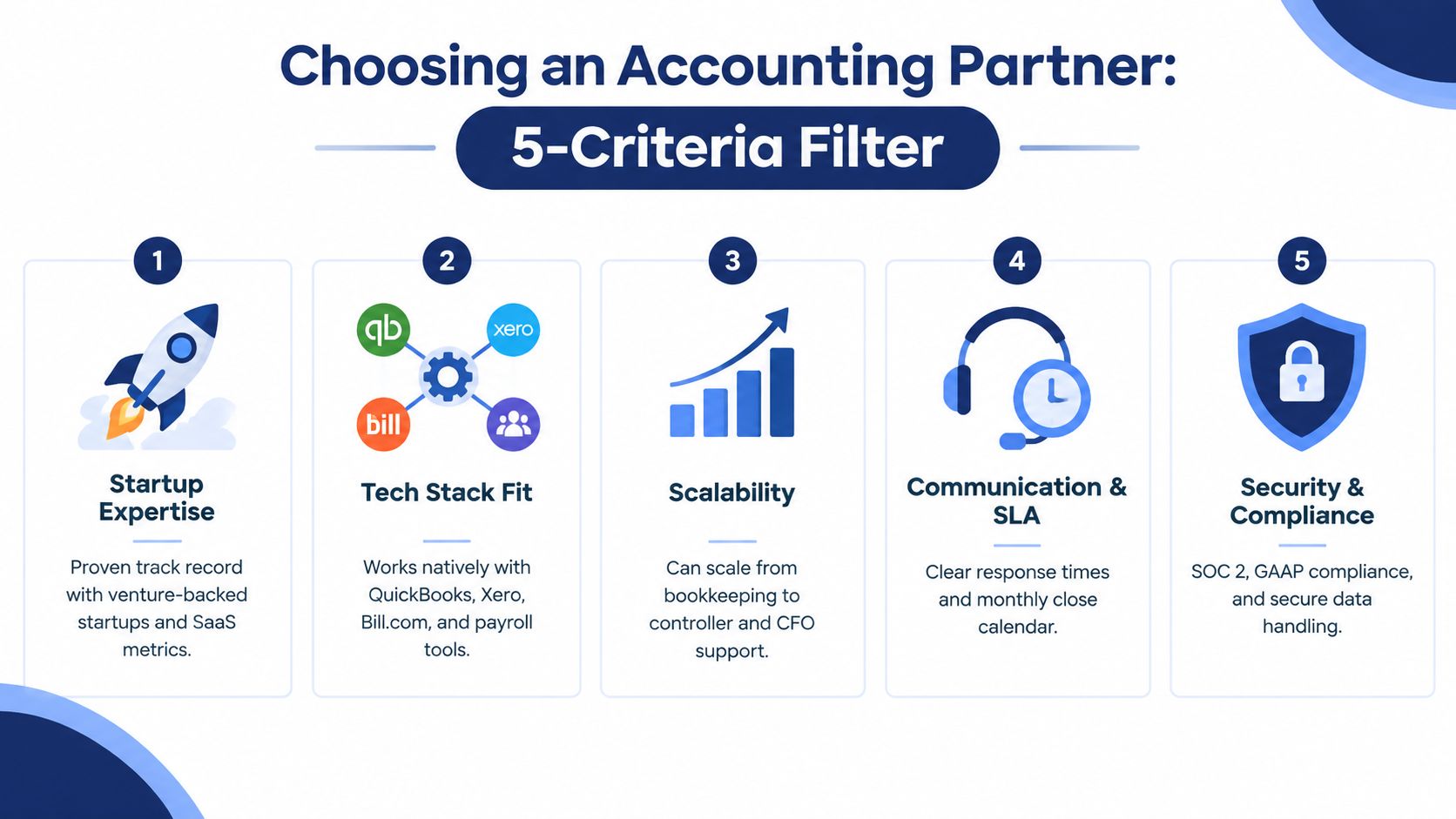
The proposal should show services, transaction assumptions, entity assumptions, included meetings, overage charges, cleanup rates, and termination terms. A vague retainer makes comparison impossible and turns every unusual request into a negotiation.
Then ask for the named senior reviewer, response-time expectations, close calendar, and cost of an unscheduled call. The provider's answer tells you what the engagement will feel like when a board meeting moves forward by two days.
A startup specialist should understand revenue recognition, payroll, sales tax nexus, cap tables, SAFE notes, and investor reporting. They don't need to perform every service themselves, but they need a credible escalation path. If the sales team dodges these questions, believe the dodge. Vendors advertise their future behavior during diligence.
The first month determines whether outsourcing compounds or corrodes. Don't accept a cheerful kickoff call as evidence of progress. Ask for artifacts.
The provider should ingest prior books, bank statements, payroll exports, equity records, debt documents, and relevant billing data. Then they should produce a written assessment separating what's clean, what needs reconstruction, and what can't be verified.
Sign off on the cleanup scope. Historical ambiguity is expensive when nobody defines its boundary.
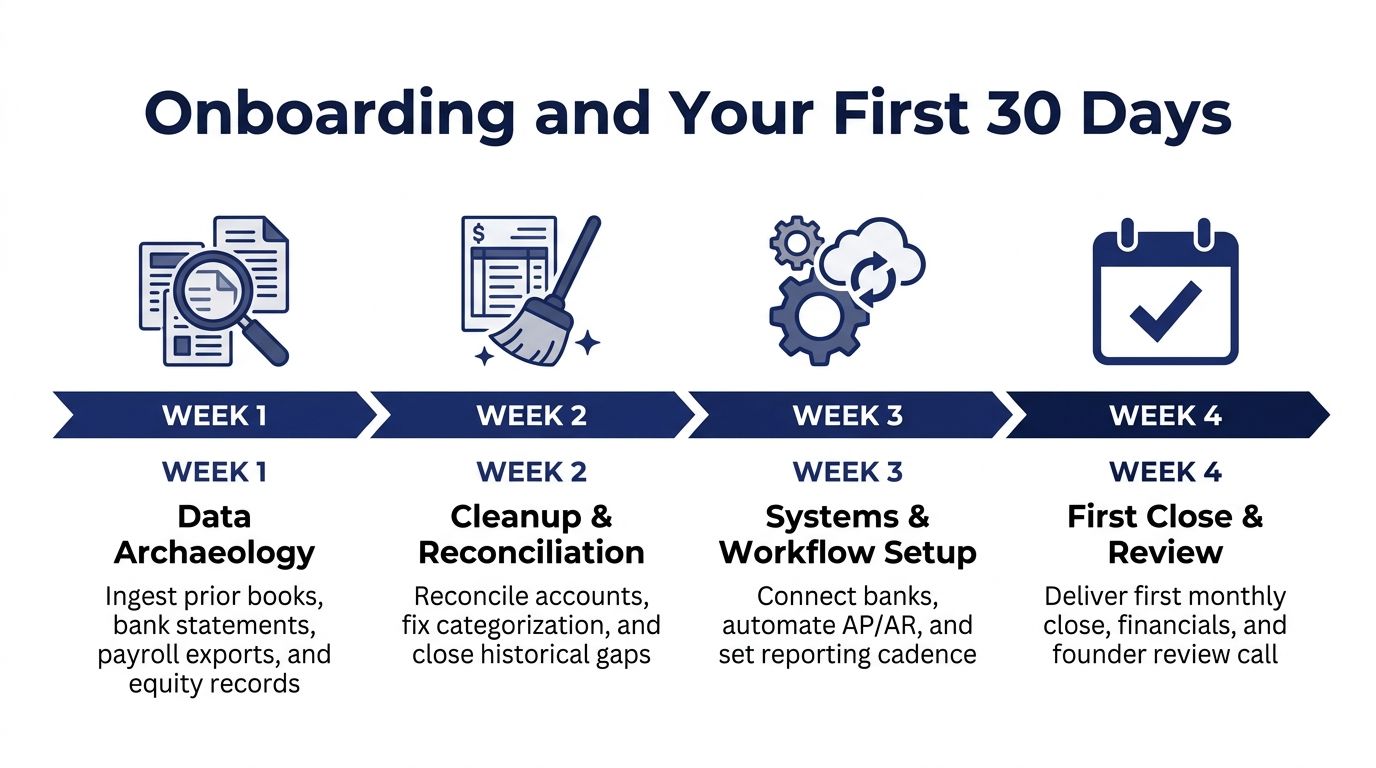
The chart of accounts should reflect how you run and explain the business, not a generic template copied from another client. You also need a month-end close calendar with named owners and target dates, plus an access matrix listing every system the team will touch and why.
During parallel running, the new team closes the current month while the old process remains available for comparison. That gives you something to audit instead of asking everyone to take a leap of faith.
Week four ends with the first close under the new setup and a reviewed trial balance. Expect the provider to explain unusual movements, unresolved items, and the next cleanup decisions. If the team can't show its work, the polished dashboard is decoration.
The deliverable is not a login. It's a repeatable close that another competent person could inspect.
Treat remote finance onboarding with the same discipline you'd apply to any distributed hire. This remote employee onboarding guide offers useful operational context, but your accounting engagement still needs finance-specific controls, approval ownership, and documentation.
By the end of the first month, you should have the chart of accounts, close calendar, access matrix, cleanup assessment, reconciliations, and reviewed trial balance. If those artifacts are missing, the relationship is off-script. Fix it before month two turns a small process gap into institutional folklore.
Outsourcing isn't a lifetime vow. The model fails when the finance function changes shape but the engagement stays frozen.
The first warning is transaction volume that overwhelms the vendor's workflow. If the close keeps slipping past the 15th, questions receive vague answers, or reconciliations become a monthly scavenger hunt, you may need internal ownership or a stronger controller layer.
The next trigger is the first subsidiary. Multi-entity consolidation, intercompany balances, local compliance, and transfer of information across teams require more than efficient bookkeeping. They require a finance architecture that somebody senior actively owns.
| Growth trigger | Symptom you feel | Better role |
|---|---|---|
| More than 1,500 monthly transactions | Close delays and growing unreconciled items | In-house senior accountant or dedicated controller |
| First subsidiary | Intercompany confusion and inconsistent reporting | Controller with multi-entity experience |
| Audit-ready financial package required | Repeated audit findings or missing support | Controller plus project-based audit specialist |
| Fundraising due diligence | Same-day answers depend on vendor availability | Internal finance lead or embedded controller |
| Inventory or complex revenue recognition | Basic bookkeeping can't explain margins or timing | Credentialed accountant with relevant technical ownership |
Inventory and revenue recognition are especially revealing. A vendor optimized for routine close efficiency may not be the right shape for ASC 606 analysis, inventory controls, or investor-grade reporting. That doesn't mean the vendor is bad. It means the job changed.
The compliance downside deserves respect. The IRS applies a 20% accuracy-related penalty to the portion of an underpayment tied to substantial understatement. The IRS also describes a failure-to-file penalty of 5% of unpaid taxes per month, capped at 25%, with a separate failure-to-pay penalty. The IRS explains the accuracy-related penalty here, and Publication 334 outlines filing and payment penalties.
Messy bookkeeping often starts with ordinary mistakes, mixing personal and business expenses, treating meals as entertainment, or recording owner draws as business expenses. This review of bookkeeping mistakes and IRS audit risk explains why classification discipline and reconciliations matter before tax season arrives.
A financing problem can be just as expensive as a tax problem. A $250,000 seed extension can evaporate if the books can't answer a SAFE note allocation question within 48 hours. That isn't an argument for hiring internally by default. It's an argument for owning the finance function at the level the company now requires.
Before every board meeting, run three questions. Answer yes or no. No diplomatic middle ground, no “the team is working on it,” and no Slack archaeology.
Ask for trailing-twelve-month revenue, gross margin, and cash burn without a reminder. If the answer is yes, stay the course and inspect the supporting schedules. If the answer is no, escalate the scope or replace the provider. A finance team that needs chasing to produce basic operating numbers is creating management work, not removing it.
Request reconciliations, accruals, variance explanations, and supporting documentation. The package should make sense to a CFO who wasn't involved in the original transactions. If it needs last-minute cleanup before every investor conversation, renegotiate for controller review or find a partner with stronger close discipline.
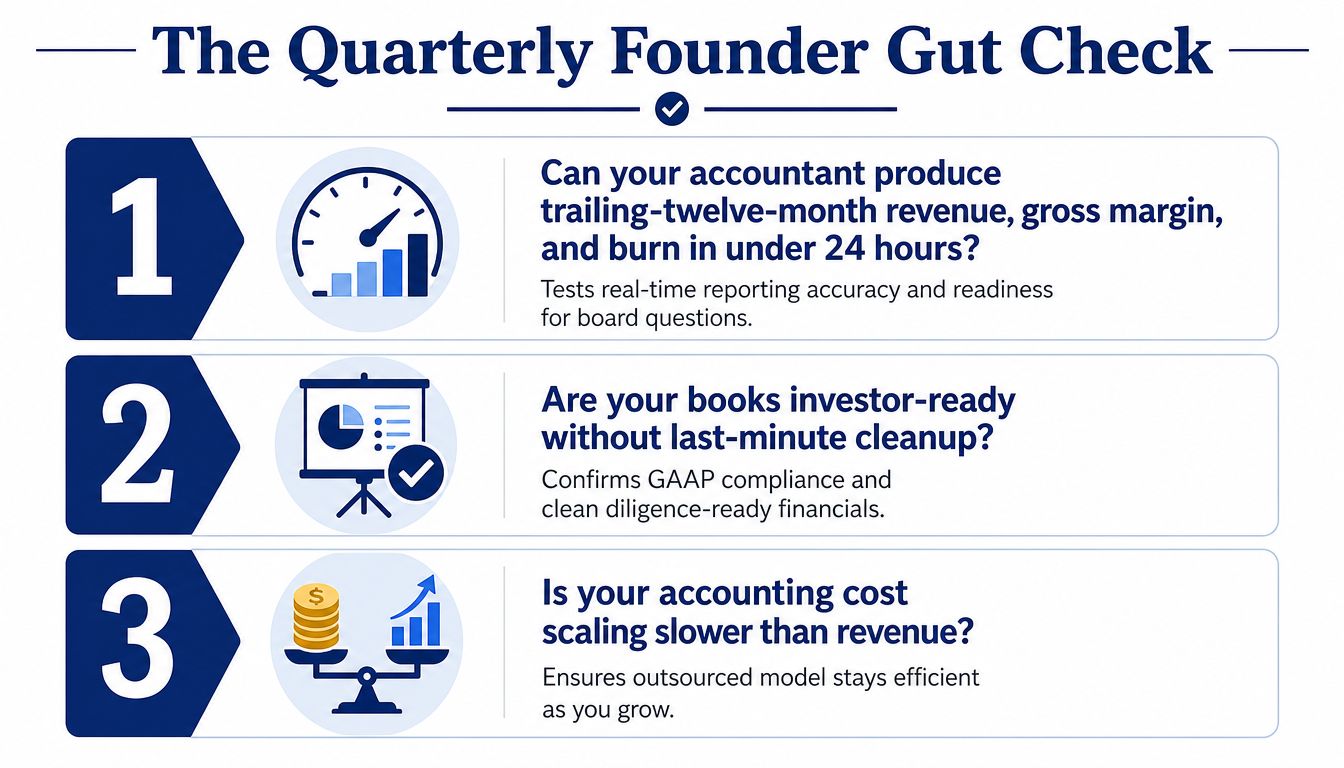
A historical ledger won't tell you when cash runs out. Ask for a forward model with at least three scenarios, then test hiring, pricing, fundraising timing, and major spending changes. If the provider punts forecasting back to your investor update, the engagement is too narrow for the stage you've reached.
Here's what the gut check catches. A startup answered no to the first question and discovered $42,000 in misclassified SaaS revenue, which could have caused a covenant breach on its venture debt facility. The lesson isn't that every outsourced team misses revenue. It's that a founder who reviews only the bank balance can miss a material reporting problem until someone else finds it.
Quarterly verdict: Stay when the numbers arrive on time and withstand questions. Escalate when the work is accurate but too narrow. Renegotiate when the scope is unclear. Replace the vendor when explanations, controls, and ownership keep failing.
The U.S. startup accounting services market was estimated at $14.34 billion in 2025 and projected to reach $39.09 billion by 2033, with a projected 13.5% CAGR from 2026 through 2033; the same report estimated $16.12 billion for 2026. Grand View Research's market report frames the expansion of the provider ecosystem, but market growth doesn't make every provider suitable for your company. Your test remains simpler: does the finance function produce reliable answers when growth triggers demand them?
HireAccountants helps startups find pre-vetted accountants and finance professionals for bookkeeping, accounting operations, and broader finance support, with flexible full-time or part-time arrangements. If your first fundraise, first audit, or first $1M ARR has exposed a finance gap, visit HireAccountants and compare the support your current setup needs with the talent you can add.
Let's simplify your finances today!