


For small businesses, outsourced accounting pricing commonly starts around $500 to $1,500 per month for basic bookkeeping and can rise to $4,000 to $15,000 per month for companies with $5M to $25M in revenue. The range gets wider as you add entities, close complexity, compliance work, AP/AR, payroll coordination, controller review, or CFO-style advice.
That's the answer most pricing guides bury under a swamp of “it depends.” Useful? Barely. A cheap bookkeeping retainer and a finance function that closes the books, manages payables, supports compliance, and gives you decision-ready reporting aren't the same product wearing different hats.
I've hired accounting firms that looked inexpensive until every useful question became a billable event. I've also paid more for a team that made the numbers reliable, the close predictable, and my own calendar noticeably less miserable. The right comparison isn't the monthly headline. It's the total cost of getting clean books and dependable financial control.
Most outsourced accounting pricing advice starts with a wide range and ends with “ask for a custom quote.” That's not guidance. That's a polite way of saying the vendor hasn't told you what drives the bill.
One current pricing guide places basic bookkeeping anywhere from about $200 to $1,500 per month, while full outsourced accounting can run roughly $1,500 to $12,000 or more, depending on scope. The spread is documented in this analysis of outsourced bookkeeping costs, but the important point isn't the range itself. It's that “bookkeeping” can mean transaction entry and reconciliations at one firm, then monthly close, payroll coordination, and management reporting at another.
A vendor can quote a low retainer because the quote excludes the work you assumed was included. Tax preparation might sit outside the package. Payroll may be handed to another provider. Cleanup may be priced after onboarding, once switching costs are working in the vendor's favor.
That creates a particularly silly buying experience. You compare a $500 bookkeeping plan with a more complete service, then discover the cheaper option doesn't handle the tasks that caused you to outsource in the first place. Congratulations, you've bought a bargain and a second vendor relationship.
Practical rule: Compare identical deliverables, not identical service names.
Three businesses with similar revenue can have very different accounting bills. A single-entity company with straightforward bank activity is easier to support than a multi-entity business dealing with consolidation, inventory, contractor payments, or a demanding month-end close.
This article uses a more useful map. Start with the actual operating inputs:
Once you know those drivers, a quote stops looking like a mystery number. It becomes a scope decision. That's the difference between buying accounting and merely renting someone's spreadsheet skills.
Vendors usually package outsourced accounting pricing in one of four ways. The model matters because it determines who carries the risk when your workload changes, your books need cleanup, or someone on your team asks an inconvenient but necessary question.
| Pricing Model | Best For | Cost Predictability | Common Gotcha |
|---|---|---|---|
| Hourly | One-time work, advisory questions, irregular support | Low to moderate | Every request can become a new invoice |
| Fixed-fee monthly retainer | Ongoing bookkeeping and defined finance operations | High | “Fixed” scope may be narrower than expected |
| Subscription-based | Startups wanting a repeatable package | High | Attractive tiers can exclude critical add-ons |
| Project-based | Cleanup, implementation, or specific reporting work | High for the project | Scope changes can trigger expensive revisions |
Hourly billing works when you need a finite cleanup, a tax review, or specialist input. It's less comfortable for ongoing accounting because the vendor's efficiency doesn't automatically reduce your bill. Standard outsourced accounting work can be priced around $8 to $35 per hour, depending on service type and specialization, according to AccuLink CPA's pricing breakdown.
For a startup with uneven needs, hourly support can be sensible. For a growing business that needs dependable monthly work, it can make ordinary communication feel like a luxury purchase.
A fixed monthly fee is usually the cleanest option for recurring bookkeeping, close work, AP/AR, and payroll coordination. The catch is scope. Ask whether the retainer includes account reconciliations, monthly reporting, review by a senior accountant, and corrections when the provider makes an error.
Subscription plans are similar, but they often divide support into tiers. That works well for a SaaS company that knows it will add reporting or controller support as it grows. It can also tempt founders into paying for a CFO layer before they have enough operational complexity to use it.
Catch-up bookkeeping, accounting software implementation, chart-of-accounts redesign, and audit preparation belong in a project quote. Don't force a one-time rescue mission into a monthly retainer. You'll either overpay for ongoing capacity or watch the provider delay the recurring work while they wrestle with historical problems.
If your business needs planning, forecasting, or higher-level virtual CFO support, define the expected decisions and deliverables before discussing the rate. “Strategic advice” is a lovely phrase. It's also a magnificent place for scope to disappear.
The useful way to read outsourced accounting pricing is by service depth, not by transaction count alone. Transaction volume matters, but the major jumps usually happen when the provider adds accrual-based close, control review, reporting oversight, or advisory work.
For small businesses, $500 to $1,500 per month commonly covers basic bookkeeping. As the engagement expands into full bookkeeping, monthly close, AP/AR, and controller oversight, pricing often reaches $1,500 to $5,000 per month. That baseline and the broader evolution from transaction processing to layered finance functions are outlined in Eagle Rock CFO's 2026 outsourced accounting report.
A bookkeeping-only engagement focuses on recording activity, reconciling accounts, and producing routine reports. Full outsourced accounting adds operational ownership, often including AP, AR, payroll coordination, and a more disciplined close.
Controller-level support adds review, controls, accruals, reporting oversight, and the judgment required to make financial statements more dependable. CFO-style advisory goes further, with planning and decision support. You're no longer paying someone to keep the books tidy. You're paying for a finance function that helps you run the company.
For companies generating $5M to $25M in revenue, published pricing guides place monthly outsourced accounting around $4,000 to $15,000. Complete finance-office support can reach $12,000 to $25,000 per month in larger mid-market cases, as the same Eagle Rock CFO pricing research explains.
Before accepting a quote, compare its scope against this bookkeeping service cost guide. Don't use it to hunt for the lowest number. Use it to identify what the vendor has left out.
Several 2026 pricing guides use 1% to 4% of annual revenue as a broad accounting-spend benchmark for small and midsize businesses, with lighter bookkeeping near the low end and controller or CFO support near the high end. OneBridge's outsourced accounting cost guide frames the benchmark alongside business complexity.
It's a sanity check, not a law of nature. Multi-entity reporting, heavy transaction activity, and board-ready reporting can push monthly fees from the low thousands into $5,000 to $20,000 or more. If a quote falls outside the expected range, ask which operational burden explains the difference.
A vendor's monthly fee usually reflects five things, even when the proposal pretends it's based on a simple package. Understanding them lets you estimate your position before you sit through a sales call with twelve slides and suspiciously cheerful stock photography.
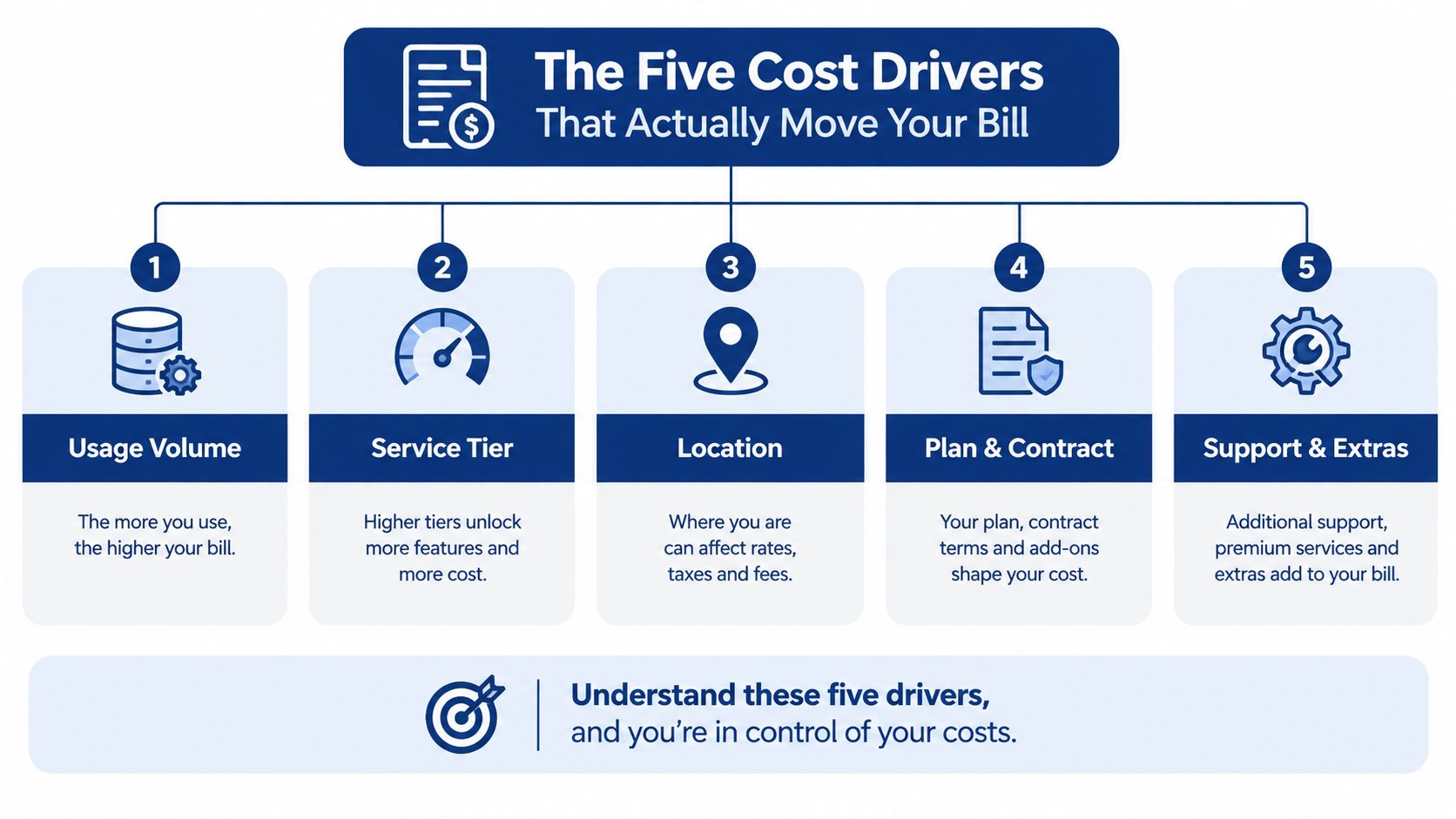
Every invoice, payment, deposit, credit card charge, and transfer creates work. The provider may not quote a per-transaction price, but volume still influences staffing, review time, and the effort required to reconcile accounts.
A company with predictable activity and clean integrations is easier to serve than one with multiple revenue streams, manual spreadsheets, inventory movement, and frequent corrections. Ask how the provider defines a transaction, whether bank feeds count separately, and what happens during unusually busy months.
Each additional entity can bring separate ledgers, bank accounts, intercompany activity, reconciliations, and reporting requirements. Consolidation adds another layer because someone must eliminate intercompany balances and present the group clearly.
Two companies can have identical revenue and completely different entity structures. One needs a straightforward monthly package. The other needs coordination across several books before management can trust the consolidated numbers.
A basic close might mean reconciling accounts and issuing reports. A more demanding close may require accruals, deferred revenue treatment, fixed-asset schedules, intercompany entries, review controls, and management commentary.
That's where the price usually moves from bookkeeping toward controller work. You're paying for judgment, not just keystrokes.
Payroll coordination, tax support, contractor documentation, and multi-jurisdiction obligations all increase the cost of getting something wrong. Ask exactly which filings and reviews are included. A proposal that says “tax support” without naming the deliverable is not transparent. It's fog with a logo.
Forecasting, cash planning, board reporting, and finance meetings require senior attention. They also require the provider to understand your business rather than process its transactions.
A useful check is the 1% to 4% of annual revenue benchmark cited by OneBridge Accounting's cost guidance. If your spend approaches the high end, you should be receiving meaningful controller or advisory value, not merely faster data entry.
Geography changes the rate, but it also changes how work gets reviewed, corrected, escalated, and discussed. Anyone who compares only hourly prices is shopping for a number, not a functioning accounting process.
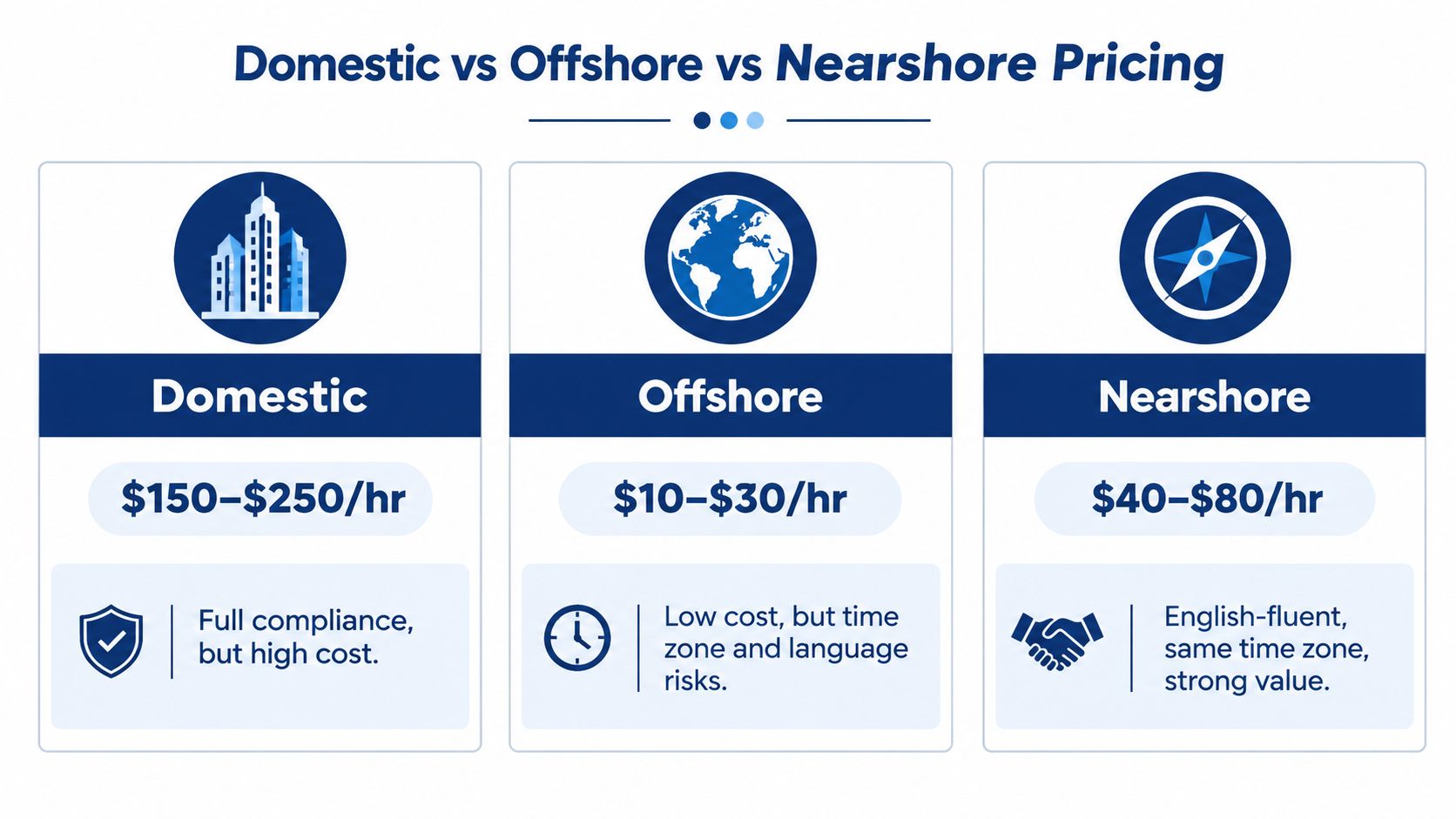
A widely cited cost benchmark places a U.S. staff accountant at about $75,000 to $130,000 per year once salary, benefits, office space, equipment, recruiting, and turnover are included. An equivalent offshore professional may cost about $15,000 to $40,000 fully loaded, according to AccuLink CPA's comparison of domestic and offshore staffing.
Basic bookkeeping outsourcing is often priced at $8 to $15 per hour, tax preparation and review at $15 to $25 per hour, and specialized work such as virtual CFO or audit manager support at $25 to $35 per hour. A separate comparison places India-based outsourced accounting teams around $8 to $12 per hour, versus $75 to $250 per hour for U.S.-based outsourced accountants, as described by VJM Global's outsourcing cost guide.
Those figures explain why offshore delivery attracts attention. They don't prove that the cheapest provider will deliver the lowest total cost.
Rework consumes internal time. Slow responses stretch the close. Time-zone gaps turn a simple clarification into a next-day problem. Fragmented communication can force your finance lead to become a project manager, translator, and quality-control department. That's not savings. That's a second job wearing a spreadsheet costume.
The guide for SMB leaders Calgary is useful context for evaluating outsourced operations more broadly, because collaboration, responsiveness, and risk management matter alongside labor cost.
Domestic teams often offer easier real-time collaboration and familiar compliance context, but their pricing can be materially higher. Offshore teams can offer deep labor-cost advantages, yet require stronger documentation, review controls, and communication discipline. Nearshore teams can fit U.S. working hours more naturally and reduce the friction that turns low rates into expensive rework.
If you're comparing providers for an American operation, evaluate outsourced accounting services in the USA by response expectations, review ownership, accounting-system experience, and escalation paths. Rate is only one line in the total-cost-of-ownership calculation.
Nearshore staffing can make sense when you want lower delivery cost without asking your team to live in an asynchronous accounting maze. HireAccountants connects U.S. companies with pre-vetted, English-fluent accounting and finance professionals in Latin America who work in U.S. time zones.
The platform presents hiring options from $10 per hour or under $3,000 per month, with flexible full-time and part-time arrangements. Its model targets savings of 80% to 90%, while the operational pitch focuses on time-zone alignment, communication, and access to specialized finance talent. Those figures and service details come from the HireAccountants affordable accounting services offering.

Low-cost access doesn't help if you spend your week chasing updates. A nearshore professional working U.S. hours can participate in live handoffs, clarify categorization questions before close, and respond while your own team is online.
HireAccountants uses an AI-powered matching engine to shortlist candidates in 24 hours, according to its publisher information. It also offers complimentary HR, payroll, and compliance support, which addresses the administrative work that often gets ignored when founders compare hourly rates.
That matters most for a startup or midsize business that needs capacity now, not after a long recruiting cycle. You can choose part-time support for a defined workload or full-time capacity when the finance function has become too large for one person.
You still need to define the role. A bookkeeper, accounting manager, tax accountant, financial analyst, and controller solve different problems. Give candidates your systems, close expectations, entity structure, reporting needs, and escalation rules.
The platform's pre-screening and candidate matching can reduce the search burden, but your team must still test practical judgment. Ask a candidate to explain how they'd handle an unreconciled balance, a messy chart of accounts, or an unusual month-end adjustment. Cheap labor doesn't excuse expensive ambiguity.
A good proposal should let you reconstruct the price. Ask for a line-item breakdown covering bookkeeping, close, AP, AR, payroll coordination, tax support, reporting, cleanup, and advisory time. If the vendor refuses to separate those elements, you're not comparing offers. You're comparing sales theater.
Start with a defined onboarding or trial period when the relationship is new. Set clear deliverables, review ownership, response expectations, and an exit process before work begins. Cleanup should be quoted separately if your books need historical repair. Don't let a provider bury catch-up work inside an indefinite monthly retainer.
Challenge these red flags:
Ask one blunt question: “What work will you bill separately after we sign?”
Finally, benchmark the quote against both service depth and revenue. A fee near the upper end of the normal range should buy stronger controls, reporting, or advisory value. If it buys the same reconciliations as the cheap plan, you're probably financing someone else's margin.
HireAccountants connects U.S. businesses with pre-vetted accounting and finance professionals, including flexible part-time and full-time nearshore support, with options from $10 per hour or under $3,000 per month. Visit HireAccountants to compare talent and build an accounting function priced around your real workload, not a vague retainer label.
Let's simplify your finances today!