


You discover the duplicate payment during a cash review, not because the system politely taps you on the shoulder. A vendor invoice went out twice, the bank balance is lower, and everyone involved insists the process worked exactly as designed.
That's the uncomfortable answer to what are financial controls. They're the policies, approvals, system rules, reconciliations, and review checkpoints that make sure money moves, gets recorded, stays protected, and appears correctly in your reports. The useful question isn't whether your company has controls. It's whether the right person owns them, whether they fit the workflow, and whether the evidence proves they operated.
A bootstrapped SaaS founder discovers a $40,000 vendor bill was paid twice. The first payment cleared after an employee approved the invoice. The second cleared because another employee uploaded the same bill from a different email thread. Nobody matched the invoice to the purchase order before releasing funds. Nobody checked the vendor statement. Nobody wanted to be the person who slowed down payment to a supplier the company needed.
That's not a theoretical “control deficiency.” It's cash leaving the business twice.
The company may have had an accounting platform, an accounts payable inbox, and a written approval policy. None of those things stopped the duplicate payment. A control only earns the name when it changes what people or systems do at the point where risk appears.
Financial controls are the designed policies, procedures, and checkpoints that ensure money moves through a business the way its owners intend. They cover four practical jobs:
Your chart of accounts matters because financial controls depend on transactions being classified consistently. If every department invents its own version of “software expense,” no approval workflow can rescue the reporting.
A purchase order approval, role-based payment permission, and vendor setup review are preventive controls. They aim to block an error or fraud event before money moves. Segregation of duties belongs here too, because separating initiation, approval, recording, and reconciliation makes it harder for one person to create and conceal the same transaction.
A bank reconciliation, duplicate-payment scan, variance review, or exception report is a detective control. It assumes something may get past the first gate and creates a second chance to find it.
The SEC describes internal control over financial reporting as a process carried out by executives, the board, management, and other personnel to provide reasonable assurance over reliable financial reporting and GAAP financial statements. Its guidance also includes maintaining reasonably detailed records and protecting assets, the unglamorous plumbing behind every trustworthy close. Read the SEC's internal-control guidance if you want the formal version.
The founder-grade version is simpler: a control is a promise with an owner, a trigger, an action, and evidence. If one of those is missing, you probably have a wish, not a control.
COSO is the framework most finance teams use to organize internal control. COSO first published its Internal Control, Integrated Framework in 1992 and refreshed it in 2013, when the framework formalized 17 principles across its original five components. The history is documented in this overview of COSO's framework and evolution.
Don't treat COSO like a poster for the conference room. Use it as a diagnostic tool.
Ask who owns the numbers, who can challenge the founder, and what happens when someone skips an approval to “keep things moving.” The control environment includes leadership behavior, accountability, governance, and competence. If the CEO routinely approves their own expenses or finance staff share a banking login, the tone at the top is already doing more damage than a dozen policy documents can repair.
Risk assessment means identifying which financial flows can go wrong and how. Map procure-to-pay, order-to-cash, payroll, treasury, revenue recognition, expenses, and close activities. Don't build a control for every conceivable problem. Rank the risks that could distort reporting, lose cash, expose assets, or create a compliance failure.
Control activities are the concrete checks. Approvals, reconciliations, segregation of duties, automated matching, access restrictions, spreadsheet controls, and exception reviews all belong here. The COSO guidance on internal control makes the important technical point: auditors assess whether controls function together, not whether policies merely exist.
Information and communication answer a brutally practical question: does the person who needs to act see the right number soon enough? A controller can't investigate a suspicious vendor payment after the cash has left and the accounting period has closed. Your process needs clear escalation routes, reliable reports, and evidence that reaches the accountable owner.
Monitoring catches controls that became irrelevant, bypassed, or impossible to execute after the business changed. A quarterly review of exceptions, ownership, access, and unresolved deficiencies is more useful than a ceremonial annual sign-off.
COCO can provide a Canadian alternative perspective, while COSO-ERM is useful when enterprise risk management drives the conversation. Public companies need to understand how SOX Section 404 fits into the stack. Management assesses ICFR effectiveness at each fiscal year-end, and periodic reports must disclose material changes after the initial management report, as summarized in this SOX compliance explanation.
If you're weighing a finance leadership hire, don't confuse a CFO versus controller decision with a framework decision. COSO is scaffolding. It helps you see the building. It doesn't install the locks, assign the keys, or reconcile the bank account.
For teams building a more formal environment, a practical resource on strong controls for CEFs can help translate framework language into operational governance. The test remains the same: can a busy employee follow the control, and can an independent reviewer verify that it happened?
The control types below work best as a layered system. Segregation of duties limits who can act. Approval workflows challenge intent. Access controls limit system power. Reconciliations and analytics look for damage that still got through.
| Control Type | Failure Mode Prevented | Example | Common Breakage |
|---|---|---|---|
| Segregation of duties | One person creates and conceals fraud | One employee enters a vendor, another approves payment, and a third reconciles the bank | Shared logins, excessive trust, tiny teams |
| Reconciliations | Missing cash, duplicate payments, and posting errors | Match the bank feed to the ledger and investigate unmatched items | Stale spreadsheets and unsigned reviews |
| Approval workflows | Unauthorized or excessive spending | Require purchase order approval before a vendor invoice can be released | Email approvals with no central evidence |
| Access controls | Unauthorized payment release or data changes | Separate payment initiation from payment release in the ERP | Permanent admin access and weak offboarding |
| Analytics | Patterns that individual reviews miss | Scan for duplicate invoices, unusual variances, or vendor master anomalies | Reports nobody owns or investigates |
The classic small-company problem is the founder who acts as AP clerk, payment approver, and check signer. You may not have enough people to split every task perfectly, but you can add a compensating review. For example, the founder can approve spend while an external bookkeeper prepares the payment batch and a separate bank user releases it.
The loss event this blocks is straightforward: unauthorized cash leaving the company and being hidden inside the books. The cheapest implementation is separate bank permissions and a documented review of new vendors and payment batches. The usual breakage is a shared login justified by convenience. Convenience is a lovely word for “we won't know who did it.”
A monthly bank reconciliation is better than a quarterly scramble. The reconciliation should tie the bank statement to the ledger, list every unresolved item, assign an owner, and include reviewer sign-off. A stale reconciliation is not evidence of control. It's evidence that someone opened a spreadsheet.
For practical guidance on resolving payment exceptions, focus on the exception queue rather than pretending every matched transaction deserves equal human attention. Your accounts payable process best practices should make matching, escalation, and closure visible.
Approval thresholds should sit inside the purchasing or ERP workflow, not in a policy nobody remembers. Vendor setup, payroll changes, refunds, wires, and manual journal entries deserve specific approval paths because each can move money or alter reported results.
Access controls should distinguish who initiates a payment from who releases it. Remove access when roles change, review privileged permissions, and stop letting the former contractor keep admin rights because “we might need them later.”
Duplicate-payment scans, budget-to-actual variance reviews, unusual vendor changes, and margin analysis don't replace judgment. They direct judgment toward the transactions most likely to deserve it.
Practical rule: If a control produces exceptions but nobody has a deadline to investigate them, it's decorative.
The payment is urgent, the approval sits in Slack, and the spreadsheet owner is on vacation. That is how a control fails in practice. The policy may be sound, but the workflow, evidence, and ownership are scattered across tools and people.
The 2025 ICFR benchmark shows the operating problem clearly. Ninety-two percent of organizations still relied on spreadsheets, only 61.5% had dedicated ICFR staff, and 43% had not remediated qualified opinions, according to the 2025 ICFR benchmark survey. Adding more control language will not fix missing owners or fragmented work.
| Failure Mode | Root Cause | Real Fix |
|---|---|---|
| Spreadsheet replaces the system | The official workflow is slow or poorly configured | Choose one system of record and record exceptions there |
| One person dominates AP or AR | Trust substitutes for separation of duties | Split duties or add an independent review |
| Approval sits in email or Slack | Evidence is detached from the transaction | Require approval inside the purchasing or payment workflow |
| Reconciliations happen quarterly | No one owns exception handling on a defined schedule | Assign an owner, deadline, reviewer, and escalation path |
| Access gaps hide behind familiarity | Offboarding and permission reviews are informal | Recertify access and remove unused privileges on a set cycle |
Automation makes an existing process faster, including its mistakes. Duplicate vendors can create duplicate payments at higher speed. A vague approval matrix can leave an AI tool flagging thousands of transactions without identifying who must decide or by when.
A 2026 fraud report found that 27% of organizations used AI in spend management, while 59% did not use it, and only 22% felt well protected. The figures appear in the 2026 fraud report on strengthening controls. AI can classify, flag, and route work. It cannot repair unclear authority, bad master data, or an ownerless exception queue.
Give every control one accountable owner and a backup. Specify where evidence belongs, who reviews it, and how quickly exceptions must close. A control that generates alerts without deadlines is decoration.
Companies with foreign-currency exposure also need a named treasury owner. Accounting close alone does not manage payment timing, currency movements, or counterparty exposure. Guidance on manage FX liquidity and credit risk can help shape that responsibility.
The practical answer is fewer integrated controls beat a larger pile of disconnected checklists. Design the workflow around the risk, attach evidence to the transaction, and make ownership visible. Auditors can inspect the result. Your team can operate it.
Start with the money flows that can hurt you, not with a 200-page policy binder. A seed-stage company usually needs cash access controls, payment approvals, bank reconciliations, basic payroll review, and a clean close. A Series A company should add tighter vendor governance, role-based system access, recurring variance analysis, and documented ownership. A growth-stage company may need entity-level controls, formal testing, stronger revenue controls, and audit-ready evidence.
Don't copy a public-company SOX program before your business has the people and systems to operate it. That's how founders end up hiring consultants to document controls nobody follows.
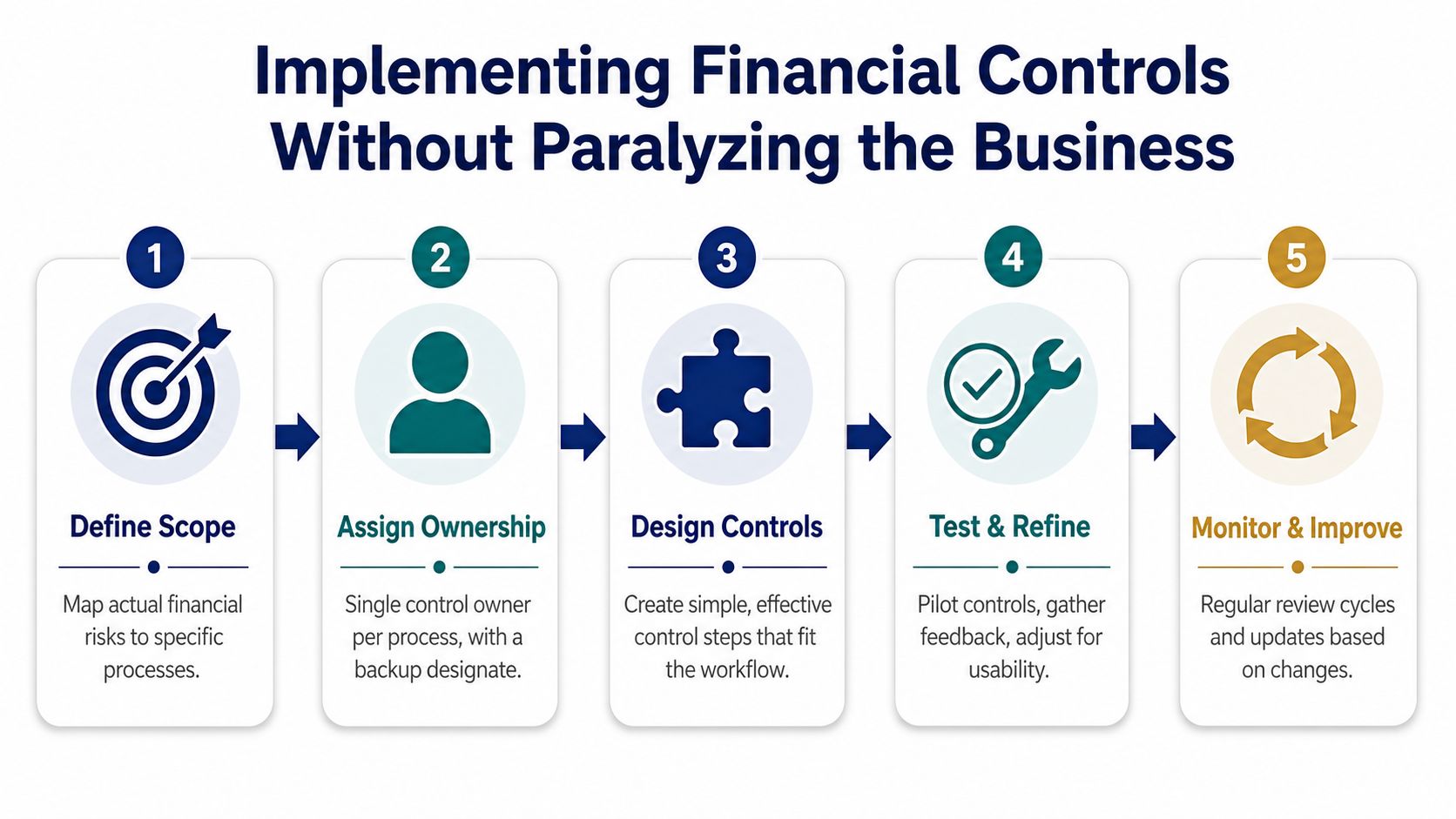
Map the path from request to payment, from customer order to cash receipt, and from transaction to financial statement. For each path, write down the failure event, the control point, the owner, and the evidence. If you can't explain the process on a whiteboard, you're not ready to automate it.
“Finance owns it” is not an assignment. Name one person. Give that person a backup. Make the reviewer independent enough to challenge the work, especially for cash, payroll, vendor changes, and manual entries.
Use ERP approvals, bank logs, ticketing systems, and reconciliation platforms instead of screenshots scattered across folders. Lightweight documentation wins because people can maintain it. Policy-as-code, meaning rules embedded in workflows, is more durable than policy-as-PDF.
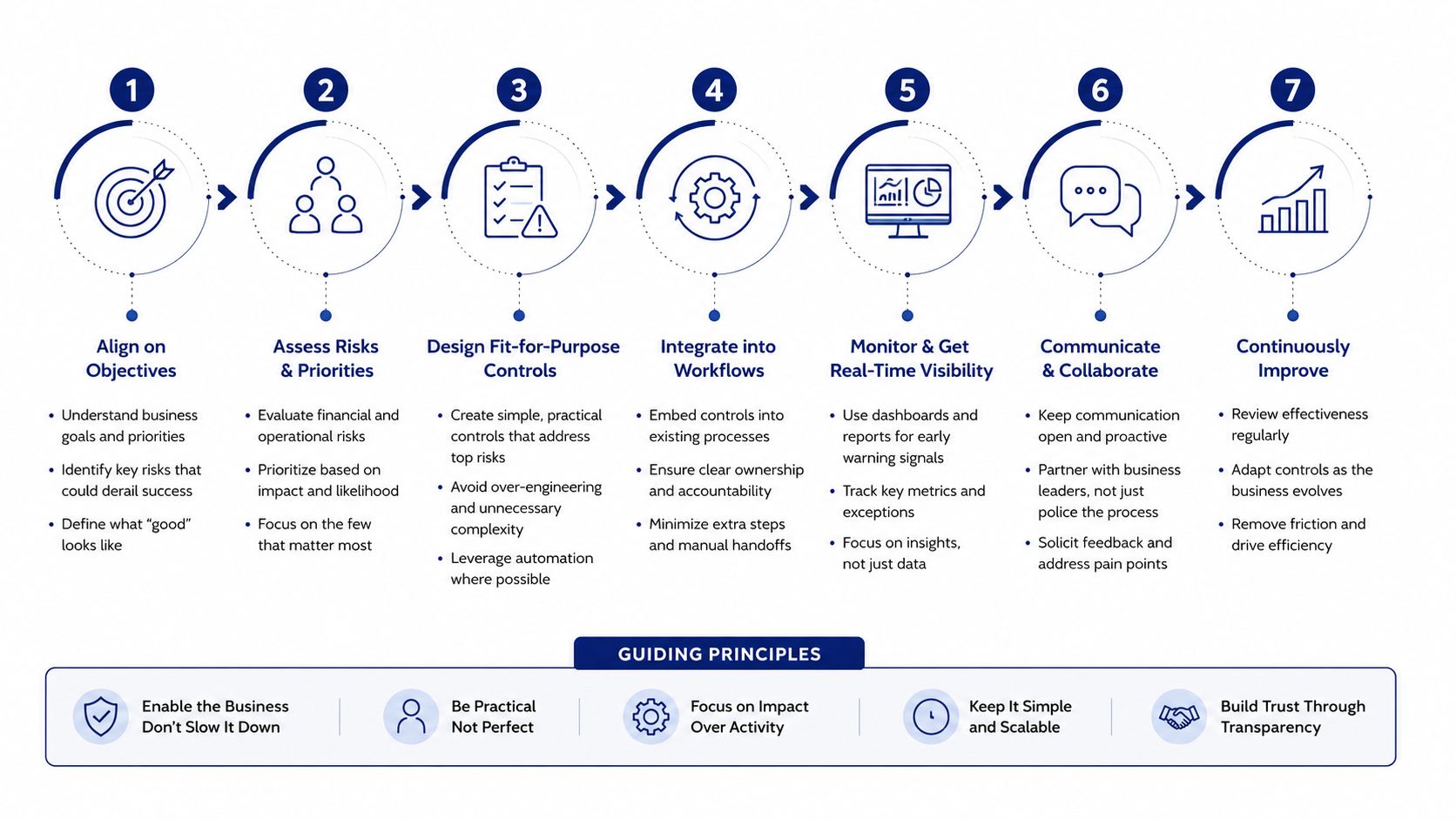
Test controls on a rolling cadence rather than waiting for year-end. Review exceptions, failed approvals, late reconciliations, and access changes. Use deficiency data to adjust the control, not to blame the person who couldn't execute an impossible procedure.
Controls should disappear into daily work. If the team has to leave the system, update a spreadsheet, request a Slack approval, and then upload a screenshot, they'll bypass the lot when the quarter gets busy.
A spreadsheet flags a duplicate payment after cash has left the bank. An AI tool may have caught it earlier, but only if the data was clean, the rule had an owner, and someone reviewed the alert. That is the actual boundary: automation can execute a designed control, not repair unclear ownership or a broken process.
AI handles repetitive pattern work well. Use it for transaction matching, anomaly detection, duplicate-payment scans, and continuous monitoring. Keep close review, reserves, unusual revenue recognition, control design, and final exception decisions with accountable finance professionals.
Set governance before expanding access. Define approved uses, standardize the underlying processes, document decisions, and retain an audit trail. Giving a model access to inconsistent data and calling its output a control is how teams manufacture false confidence. The 2025 finance-operations discussion of AI governance makes the same practical point: automation needs clear rules and traceable work.
An in-house controller fits a business with high transaction volume, complex reporting, audit pressure, or multiple entities that require daily context. A fractional CFO suits leadership that needs forecasting, financing support, board reporting, and control direction without a full-time executive. Outsourced accounting fits dependable bookkeeping, reconciliations, close support, and process execution before permanent headcount makes sense.
Ask four questions:
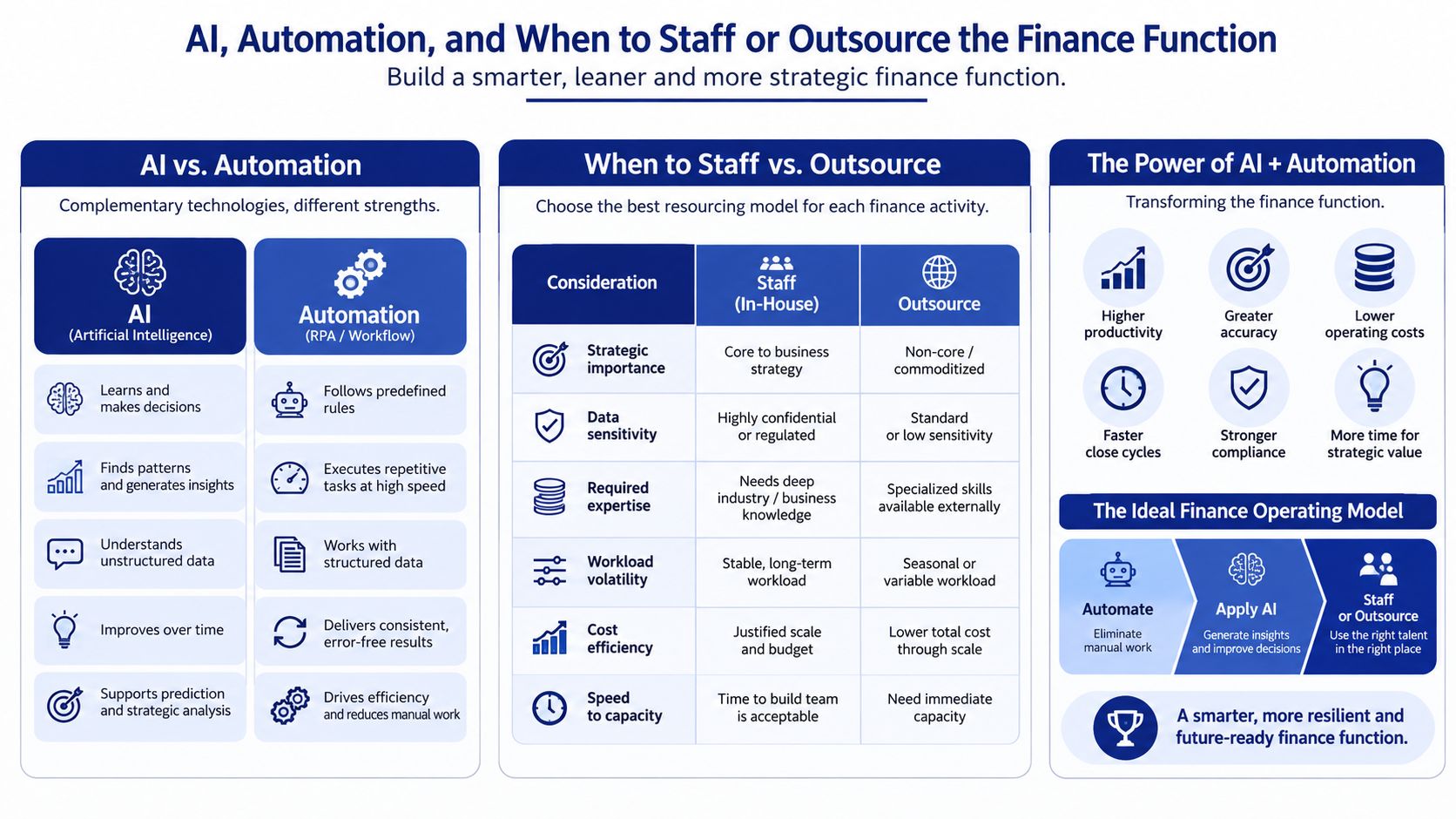
HireAccountants offers a marketplace and recruiting service for pre-vetted accountants and finance professionals. It can provide controller or accounting capacity before a permanent finance leader is justified. The trade-off is straightforward: an outsourced professional may understand the control work, while a long-tenured employee holds more institutional memory.
Move leadership in-house when control ownership, judgment, and business context consume attention every day. Until then, buy the capability required, document the process, and make handoffs explicit.
A founder's dashboard should show whether controls catch problems, not whether the team completed a heroic amount of paperwork. Assign every line to an owner and track exceptions, aging, and remediation.
| Control | Owner | Frequency | KPI / Target |
|---|---|---|---|
| Bank reconciliation | Controller or accounting lead | Daily review, formal close review | Unreconciled items older than 5 days under 2% of accounts |
| AR aging review | AR owner | Weekly | Exceptions assigned and escalated before collection deadlines |
| Revenue, COGS, and operating expense flux analysis | Controller | Monthly | Material variances explained before close sign-off |
| SOC report review | Finance and security owner | Quarterly | Relevant findings documented with remediation owners |
| Access recertification | System owner and finance reviewer | Quarterly | Unnecessary privileged access removed and evidence retained |
| Purchase order compliance | Department and finance approvers | Ongoing | 95% of non-payroll spend pre-approved |
| Financial close | Controller | Monthly | Books closed in 5 business days |
| Audit workpapers | Controller | Ongoing | Audit-ready workpapers available within 10 business days |
The targets above are operating benchmarks, not magic spells. A dashboard also needs the exception rate, the percentage of transactions requiring human intervention or remediation. Transaction volume can rise while control quality falls. If exceptions increase and nobody investigates them, congratulations, you've built theatre with a login screen.
Start with five controls: bank reconciliations, segregation of duties over cash, approval thresholds on spend, monthly flux analysis, and access reviews. Together, they cover a large share of the failure risk founders face, provided someone owns them and reviewers retain evidence.
Pick one control each week. Document the trigger, action, owner, backup, evidence, and escalation path. Test it within 30 days, then fix the workflow while the details are still fresh.
Call HireAccountants when your controller is overloaded, your small team can't separate duties, or an audit is approaching faster than your documentation. A fractional controller or outsourced finance professional can give you an internal-control owner without waiting through a long hiring cycle.
HireAccountants helps US companies find pre-vetted accountants and finance professionals for bookkeeping, controller support, audit preparation, and broader finance operations. Visit HireAccountants to find finance talent that can own reconciliations, approvals, access reviews, and the evidence your controls need to work.
Let's simplify your finances today!