


A founder opens a spreadsheet of receipts and finds three versions of the same expense, a customer payment that never made it into the books, and a bank balance that doesn't match the one on the screen. The numbers are all there, technically. They just aren't telling a useful story.
That's where a bookkeeper comes in. The job isn't to make spreadsheets look tidy. It's to build reliable financial records, keep routine work moving, and flag the moments when a business needs more than bookkeeping.
A bookkeeper captures, classifies, checks, and organizes a business's financial transactions so the company has a dependable record of what came in, what went out, and what it owes. That includes sales, purchases, receipts, invoices, checks, and other activity, typically entered into accounting software and assigned to the appropriate accounts.
In plain English, the bookkeeper makes sure the financial facts are recorded correctly. An accountant interprets those facts and handles more complex analysis. The distinction sounds simple because it is. Confusing the two is how a startup ends up expecting a person hired to reconcile bank feeds to also provide tax advice and strategic forecasting.
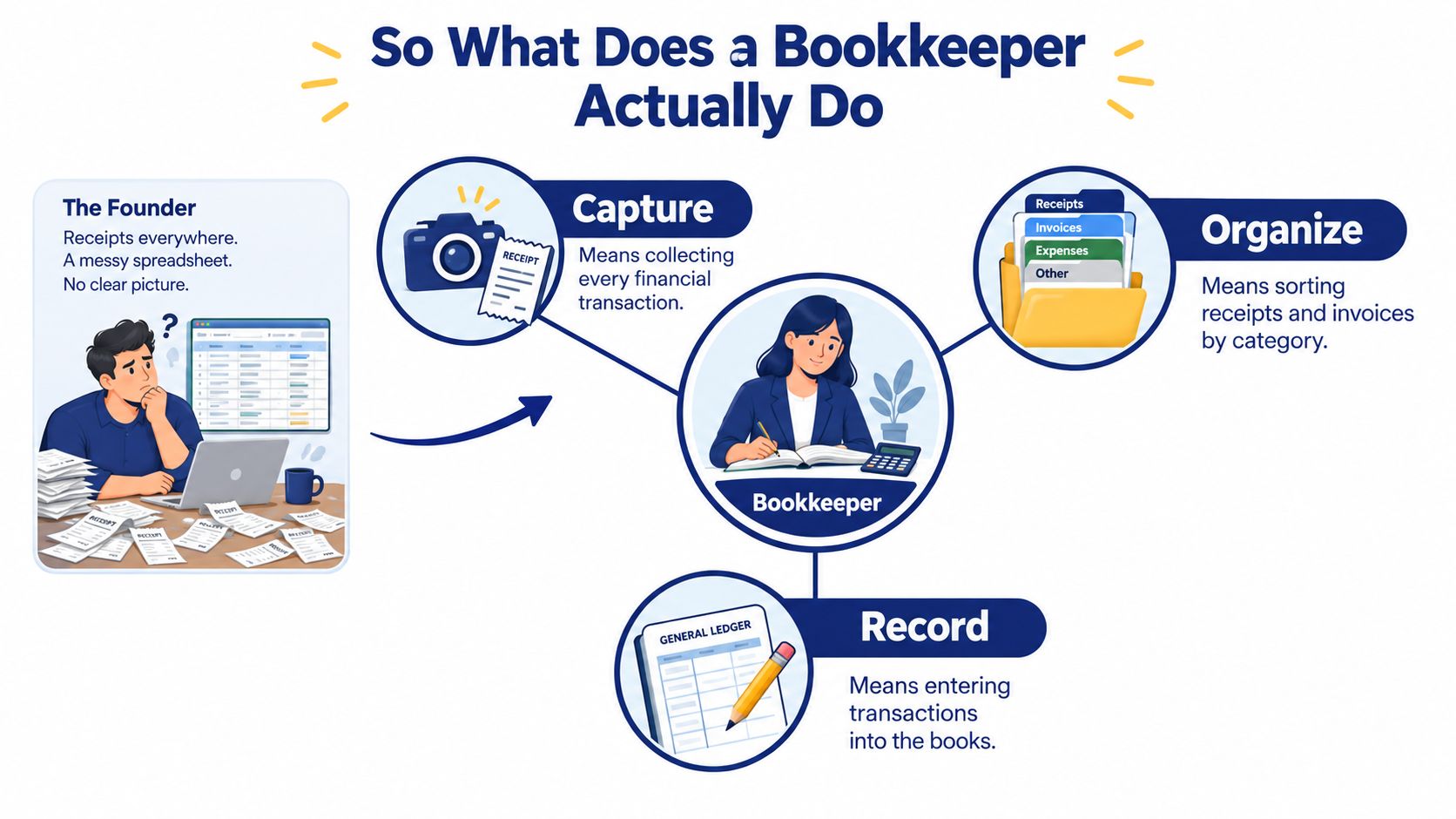
Every useful financial report depends on the underlying transactions being complete and correctly classified. If a customer payment is missing, an expense is coded to the wrong account, or a bank transaction is duplicated, the reports inherit the problem. A bookkeeper's care with source records gives owners and accountants something solid to work from.
The basic logic is older than cloud software. The Library of Congress traces accountancy to the 13th century and identifies Fra Luca Pacioli's 1494 publication as the first major printed bookkeeping treatise. Pacioli documented double-entry methods already used by merchants rather than inventing them. Today, software performs much of the posting, but the principle remains: connected debit and credit entries help keep records internally consistent. (Library of Congress history of early accounting)
This isn't a pretend job invented for startups with too many subscriptions. The U.S. Bureau of Labor Statistics reported approximately 1,532,400 jobs in the combined bookkeeping, accounting, and auditing clerk category in 2025, with a median annual wage of $50,670 in May 2025. The same occupation is projected to have about 144,100 openings a year on average from 2025 through 2035, even as overall employment is projected to decline 6% as software automates routine work. (BLS occupational outlook)
If your business sells through more than one channel, clear records matter even more. For a useful perspective on keeping sales activity legible across platforms, see how HiveHQ explains it. The practical model is still the same: capture the transaction, classify it correctly, and keep evidence for how it got there.
Good bookkeeping is not glamorous. It's a repeatable routine that stops small discrepancies from turning into a month-end scavenger hunt. A bookkeeper records sales and purchases, enters receipts and invoices, checks calculations and postings, reconciles accounts, and prepares reports such as balance sheets and income statements.
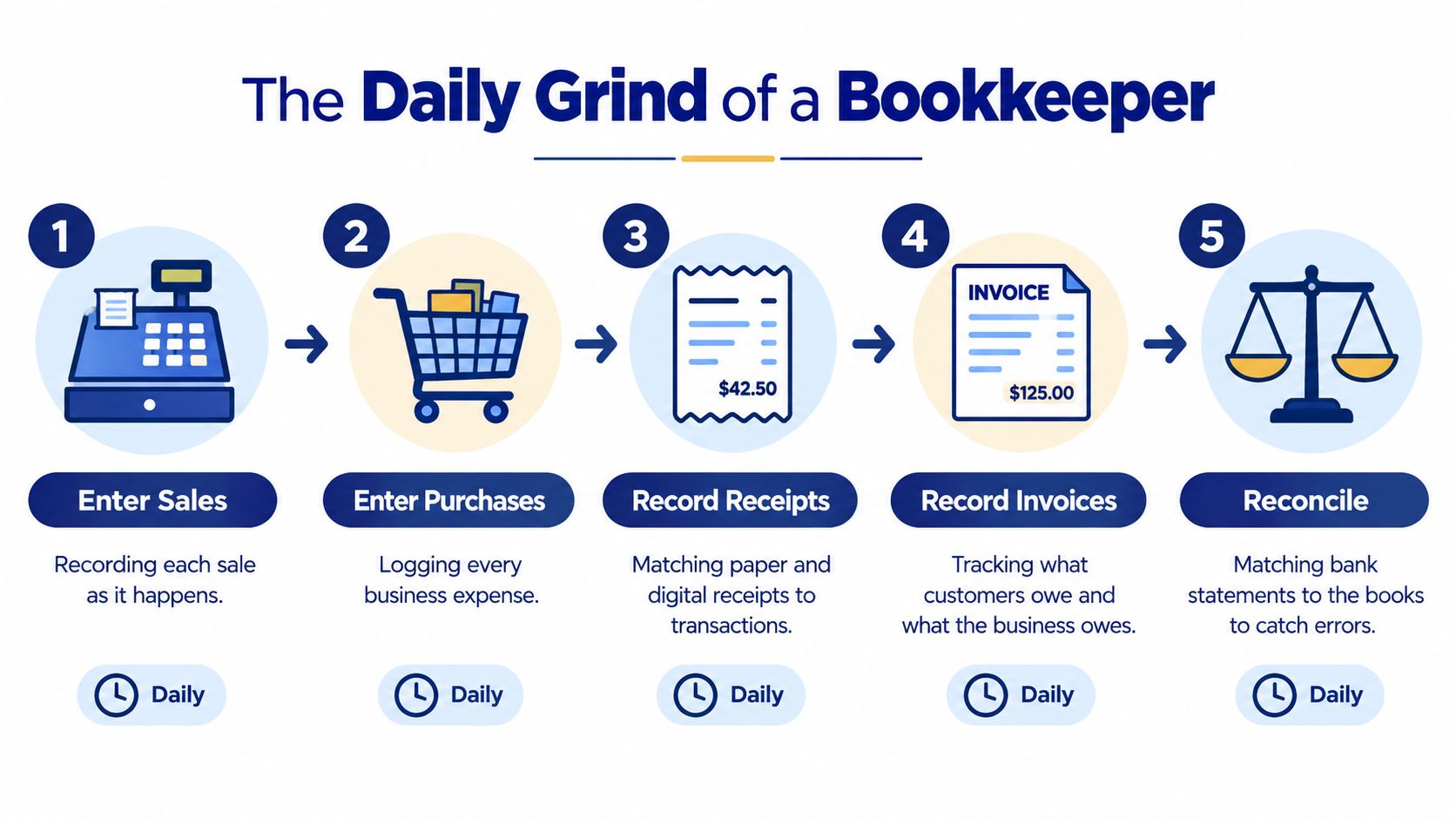
A sale should land in the records with the right date, amount, customer, and account. A purchase needs its supporting receipt or invoice and a sensible category. The bookkeeper records bills the business needs to pay and invoices customers need to pay, then tracks whether those amounts have been settled.
Consider a SaaS company receiving Stripe payouts. The payout arriving in the bank may combine customer charges, fees, refunds, and other adjustments. If someone records the deposit as revenue, the books may not explain the individual activity behind it. The bookkeeper's work is to match the underlying transactions and make the deposit intelligible.
An e-commerce store faces a similar matching problem when sales through Shopify don't arrive as one neat deposit equal to the sales total. Payment timing, fees, refunds, and transfers can all make the bank line look different from the sales screen. The task is to reconcile the records, not to wave away the difference with a miscellaneous entry.
Bank reconciliation means comparing bank activity with the company's ledger and investigating mismatches. A bookkeeper checks calculations and postings, follows up on missing documents, and resolves discrepancies where the evidence supports a clear correction. “It probably belongs in expenses” is not a reconciliation method. It's a future email nobody wants to send.
Practical rule: A balance that matches is useful. A balance you can explain is better.
The rhythm depends on the business, but the principle is consistent: record activity as it happens, keep documentation attached, and review accounts regularly rather than postponing the work until reporting deadlines. The bookkeeper can then prepare financial reports from organized records, while the owner or accountant handles interpretation and decisions.
This division matters. A bookkeeper can flag an unusual payment or point out that an account won't reconcile. That doesn't automatically mean the bookkeeper should decide whether the transaction has a tax consequence or what the company should do with it. Verification and organization come first. Judgment about complex accounting treatment may need a more experienced professional.
Is bookkeeping automated now? Some of it is. Software can import bank transactions, capture receipt details, apply rules to recurring entries, and help route bills for approval. That reduces repetitive typing, but it doesn't make the underlying work disappear. A bank-feed suggestion can still be wrong, a receipt can be unreadable, and a connection between systems can fail without announcing itself with a polite little bell.
U.S. survey data indicates that 95% of accounting firms adopted automation during the past year. The most commonly reported uses were payroll processing (47%), accounts payable and receivable (46%), and data entry or transaction processing (43%). A separate 2025 survey found that 46% of accounting professionals use AI daily, compared with 28% of small businesses. Those numbers point to an important shift: less routine entry, more oversight of what the system produces. (Intuit QuickBooks 2025 survey)
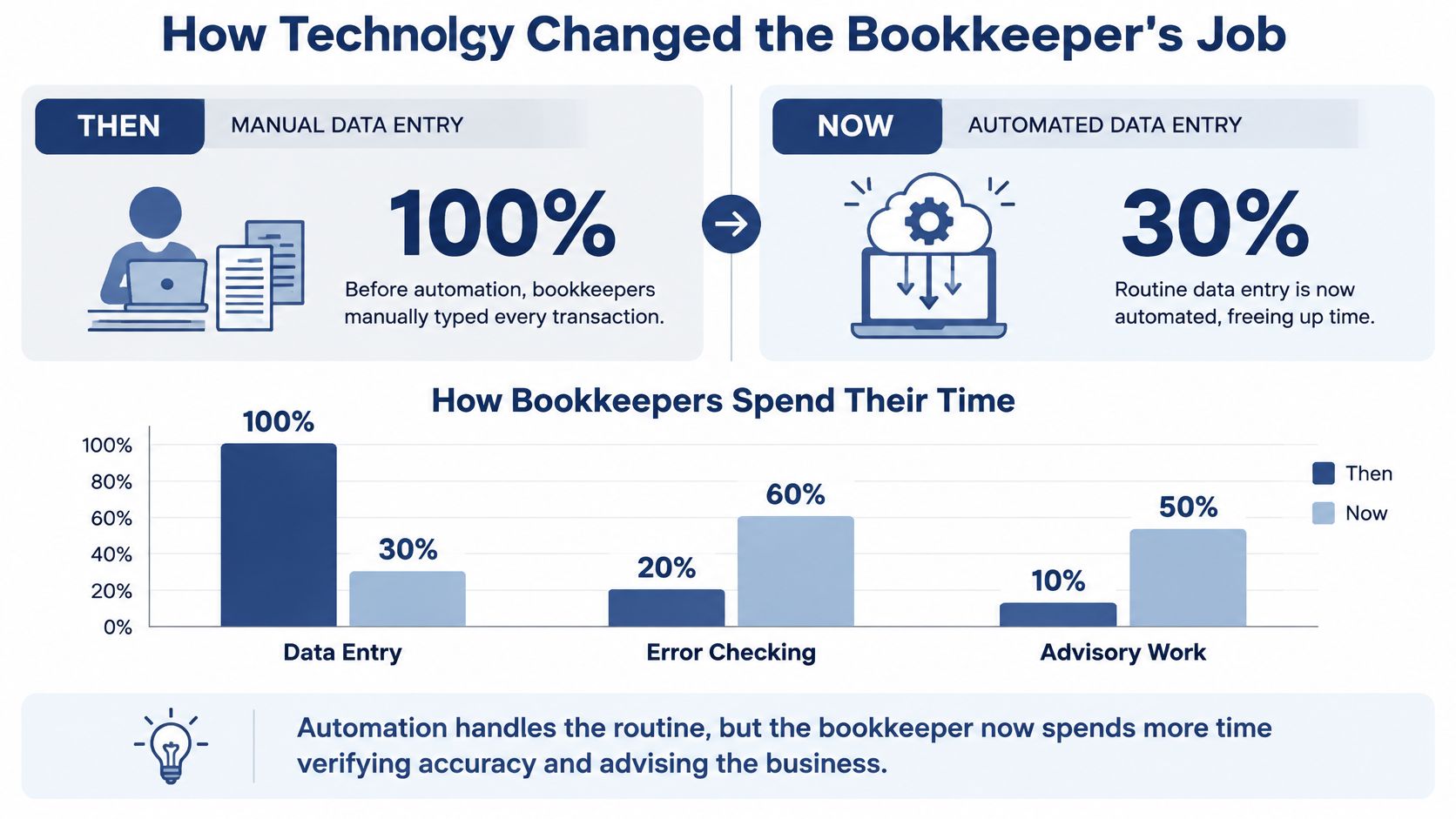
A modern bookkeeper should be comfortable with cloud accounting systems, rules-based categorization, receipt and invoice capture, and integrations between tools. Above all, they should know how to spot an exception: a transaction classified to an implausible account, an unexpected duplicate, or a payout that doesn't match its supporting activity.
That's the trade-off. Automation makes repeatable tasks faster, but a workflow that nobody monitors can spread bad data more efficiently. A capable bookkeeper checks outputs, maintains clean source information, investigates differences, and tells the owner what needs attention. They don't blindly trust the software because it has a cheerful green check mark.
For a quick example of a focused invoicing tool, a tutor can use this tool for creating tutoring invoices. The larger point is to choose tools that fit the actual workflow, then make sure someone owns the handoffs and review. Businesses comparing platforms can also use this guide to small-business accounting software.
The job title alone won't tell you what a finance professional can safely own. Risk and complexity do. A bookkeeper maintains the transaction record. An accountant analyzes that record and handles more advanced accounting work. A controller may oversee close processes, reporting, and internal controls. A CFO uses financial information to guide the company's direction.
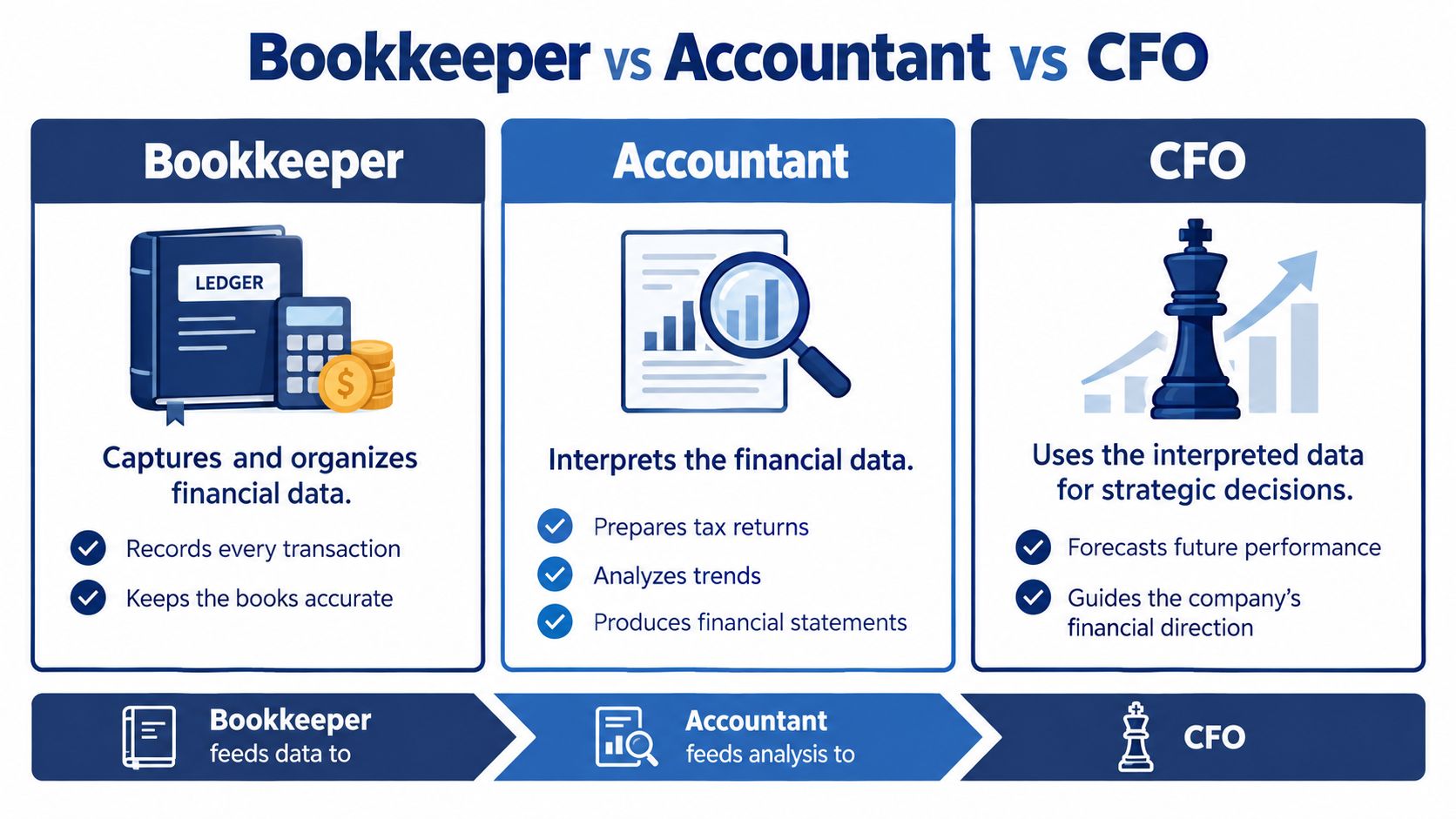
| Role | Work that commonly fits |
|---|---|
| Bookkeeper | Transaction coding, bank and credit-card reconciliations, invoice and bill tracking, and maintaining organized records |
| Accountant | Interpreting records, preparing more complex analyses, and addressing accounting questions that require deeper technical judgment |
| Controller | Managing the close, overseeing reporting processes, and building or reviewing internal controls |
| CFO | Financial planning, forecasting, capital decisions, and strategic leadership |
Routine transaction processing and reconciliations are usually a reasonable place to start with a bookkeeper. Month-end close, accruals, inventory accounting, and revenue recognition can require an experienced accountant or controller, depending on the business and the complexity of the work. Tax opinions, audit representation, and formal assurance are not safe assumptions to attach to a bookkeeping role. Bring in appropriately qualified professionals for those responsibilities.
SaaS and e-commerce businesses should be particularly careful about scope. Subscriptions and deferred revenue, inventory accounting, sales-tax questions, and payment-platform reconciliations can quickly outgrow a basic transaction workflow. If your bookkeeper can keep the records organized but cannot confidently resolve the accounting treatment, that's a signal to add the right specialist, not a reason to cross your fingers and rename an account.
Clients are also looking beyond basic processing when selecting accounting support. In a 2025 survey of small and midsize businesses, 83% of companies paying more than $10,000 annually said a firm's use of technology was a key selection factor; poor responsiveness and lack of industry insight were leading reasons for switching providers. (CPA Practice Advisor survey coverage)
That's a good reminder that the right scope matters as much as the right title. For a straightforward comparison of the underlying disciplines, see the difference between accounting and bookkeeping.
Doing your own books can be perfectly reasonable while the business is simple and you can keep the records current. The trouble starts when “I'll catch up this weekend” becomes the accounting process. A missed invoice, unexplained reconciliation difference, or annual tax-season panic isn't just annoying. It can leave you making decisions from records you don't trust.
Hiring earlier can be less painful than asking someone to rebuild a tangled ledger later. A good bookkeeper maintains a routine, documents decisions, and raises questions while the details are still fresh. That doesn't mean every early-stage company needs a large finance department. It means the owner should be honest about the cost of doing the work badly or not doing it at all.
Remote support can make the arrangement more flexible, but compare providers based on scope, communication, and review process, not only the headline rate. Some services, including HireAccountants, list bookkeeping support at $1,100–$1,999 per month, though the actual fit depends on the work and engagement. The useful question isn't “Can I find the cheapest person?” It's “Can this person keep my records accurate, current, and reviewable without creating more work for me?”
A candidate who can enter transactions is easy to find. A candidate who can build a reliable process, recognize when something looks wrong, and explain the issue without burying you in accounting jargon is more valuable.
Start with the systems your business uses. Ask about experience with your cloud accounting platform, bank feeds, receipt capture, payroll tools, invoicing software, and payment processors. Then ask how the candidate handles data coming from those systems. Familiarity with the software matters, but so does knowing when its suggestions need a human review.
Use practical interview questions:
Attention to detail is important, but a bookkeeper also needs a system for handling exceptions. Ask how they document unresolved questions, protect access to financial files, and communicate when information is missing. If they promise that nothing ever goes wrong, ask what happens when a reconciliation actually doesn't match. Confidence is nice. A process is better.
Time-zone overlap and responsiveness are practical requirements for a remote hire, especially when an approval or clarification is holding up the close. Pre-vetted talent can save time on initial screening, but don't outsource your own judgment. Agree on responsibilities, reporting cadence, and escalation rules before granting access to financial systems.
The red flag isn't a candidate who asks questions. It's one who makes assumptions, hides uncertainty, or can't tell you which work they'll handle and which work needs an accountant or tax professional.
Bookkeeping is part of your evidence trail. If an expense appears in the ledger, you should be able to connect it to a supporting document and understand who was paid, how much, when the expense was incurred, and why it was a business expense. If that chain breaks, preparing reports and substantiating tax items gets harder.
The IRS requires businesses to keep a recordkeeping system that clearly shows income and expenses. Journals summarize transactions, while ledgers collect those totals into account balances; electronic records are expected to maintain the completeness, accuracy, and accessibility of paper records. For U.S. employers, employment-tax records generally need to be retained for at least four years. Other records should be kept long enough to substantiate income and deductions under the applicable limitations periods. (IRS recordkeeping guidance)
A sound process uses consistent file names, approval steps, access controls, recurring close checklists, and document-retention rules. That way, a reviewer can trace the ledger entry back to the supporting document without interrogating the founder or searching a crowded inbox. For a small business managing orders alongside documentation, a practical pickup day invoice checklist can help keep the paperwork tied to the transaction.
The payoff is not limited to tax preparation. Clear evidence makes financial statements easier to produce and review, and it helps owners see whether a balance is supported or merely carried forward. Strong reporting habits are easier to maintain when the source records are organized, as outlined in these financial reporting best practices.
A bookkeeper who thinks beyond the chart of accounts will help design a process people can follow. That's how you avoid treating “we can probably find the receipt” as an internal control. It's also how you keep the next review from turning into a group project nobody volunteered for.
A bookkeeper can organize the records and prepare information that supports tax preparation. Don't assume that means they can give tax opinions, represent you in an audit, or handle every complex filing question. The right tax professional depends on the service and your circumstances, so agree on that boundary before tax season arrives with its usual flair for drama.
The cost varies with the business's transaction volume, the complexity of its accounts, the services included, and where the provider works. A simple set of books and a business with inventory, multiple sales channels, payroll, or complicated reconciliations are different assignments. Ask what the quote includes, who reviews the work, and what costs extra before comparing offers.
A good process catches errors through supporting documents, reconciliations, review, and clear follow-up. Ask how the bookkeeper corrects an error, documents the change, and prevents the same problem from recurring. Mistakes can happen; unexplained adjustments and missing communication are what should make you nervous.
HireAccountants helps U.S. companies find pre-vetted bookkeepers and other finance professionals through a talent marketplace and recruiting support. If you need reliable bookkeeping coverage without turning hiring into another full-time job, visit HireAccountants and review the available options.
Let's simplify your finances today!