


A CPA's core role for a small business is preparing and filing federal, state, and local tax returns, advising on tax strategy, and representing the business before the IRS. Their value also extends into year-round compliance, financial controls, cash flow planning, and decisions that shape how the business grows.
The popular advice says you only need a CPA when tax season rolls around. That advice is responsible for more financial messes than a founder with a company card and no expense policy. A return tells you what happened. A useful CPA helps you decide what happens next, while keeping the business ready for taxes, lenders, investors, and the IRS.
That distinction matters. A seasonal tax filer checks a box. A year-round CPA helps build a financial risk buffer. If your revenue is uneven, your records are unreliable, or your business is adding employees and jurisdictions, waiting until filing season is a spectacularly efficient way to discover problems after they become expensive.
A tax return can be accurate and still leave your business exposed. Small-business owners often treat a CPA as an annual filing service, then wonder why cash surprises, tax notices, and weak financial decisions arrive together. A CPA's core work includes preparing and filing federal, state, and local tax returns, advising on tax strategy, and representing the business before the IRS. CPA Advisor explains the broader role of a CPA for a small business, including responsibilities that extend beyond basic bookkeeping.

Certified public accountants can represent clients before the IRS on matters connected to their tax affairs, including issues they did not personally prepare. That support matters during an audit, extension problem, estimated-tax dispute, or compliance notice. You should not be left alone with government paperwork because your accountant only works during filing season.
Practical rule: If your CPA first sees your books after the year ends, you hired a historian when you needed a financial adviser.
Bookkeeping remains the foundation. Clean transaction records, reconciled accounts, and organized documentation give a CPA something reliable to review. They do not, by themselves, tell you whether the business is using the right tax treatment, presenting its finances clearly, or taking on avoidable risk before the next major decision.
A CPA can review financial records for legitimate deductions, help reduce tax liability, and assess whether financial statements are fairly presented under GAAP. Those services can strengthen financing discussions, investor reporting, and routine management decisions. They can also expose a problem that busy owners overlook: revenue growth means little when poor cash control keeps draining the bank account.
The strategic value appears between tax deadlines. A year-round CPA can flag risks while there is still time to correct them, rather than documenting the consequences after the money is gone. The better question is not whether you need a CPA in April. It is which financial risks should a qualified professional help you manage all year.
A CPA who only prepares your return is documenting the past. A CPA who earns a place in your business protects the numbers today and helps you decide what the business can safely do next. That work runs in two lanes: control and strategy. Small businesses need both, even without a finance department or a boardroom full of executives.
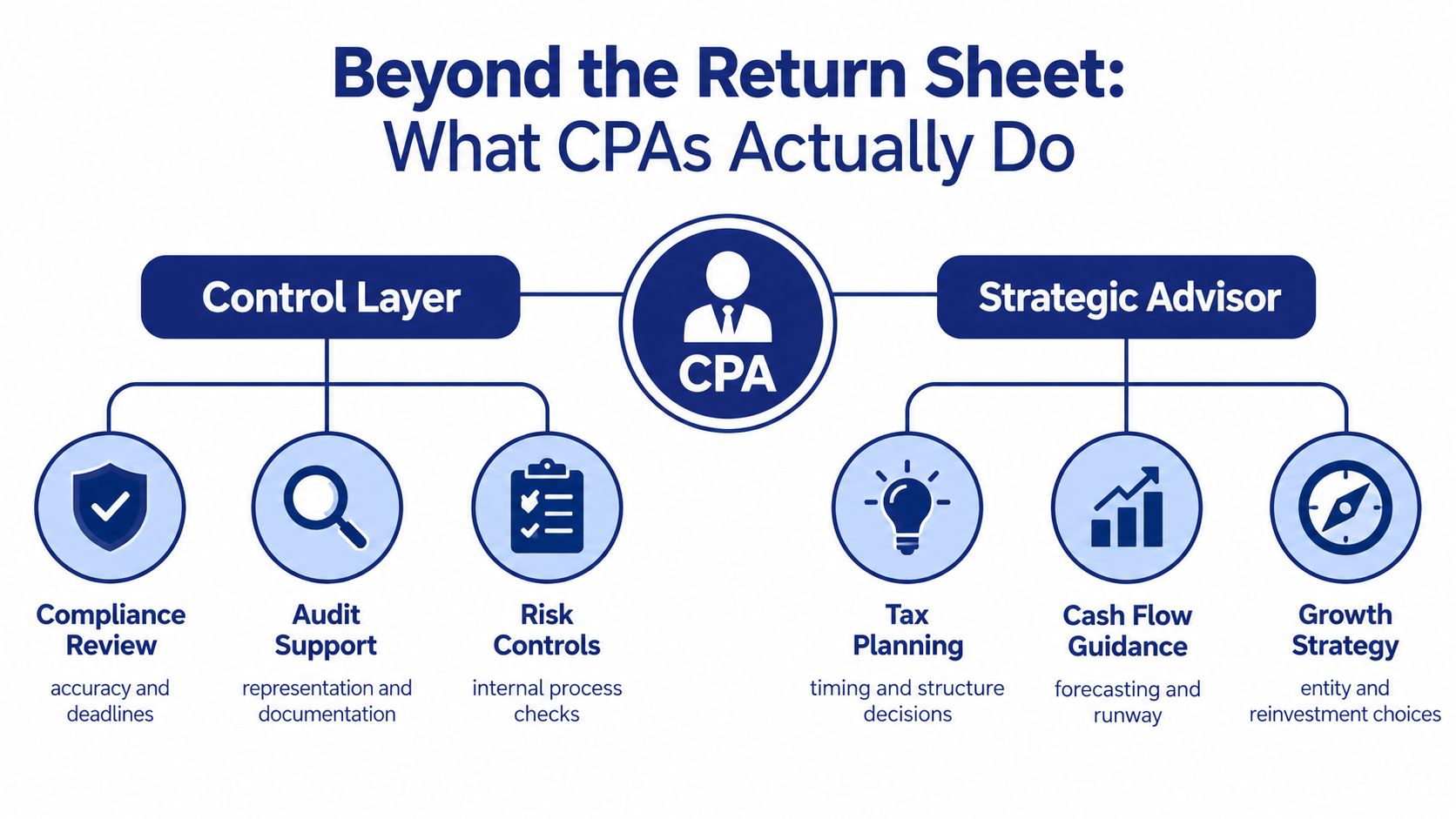
A CPA can review financial statements for accuracy, examine accounting systems for efficiency, and design or strengthen internal controls. Those controls help management catch errors, prevent misclassified transactions, and reduce the risk of material misstatements, as Thomson Reuters explains in its guidance on choosing an accounting adviser.
The value becomes obvious when a lender requests current statements, personal expenses appear in the business account, or month-end closing takes weeks. Reliable controls make reporting easier to trust. They also give owners a firmer basis for decisions.
A CPA may review who approves payments, how employees categorize expenses, whether accounts are reconciled consistently, and whether the accounting software reflects how the business operates. The goal is not paperwork for its own sake. It is to keep preventable mistakes from hiding inside numbers that look healthy.
On the advisory side, CPAs can help with cash flow analysis, budgeting, forecasting, payroll questions, profitability reviews, and business-structure decisions, as described in CPA Guide's explanation of the difference between bookkeepers and CPAs. They turn raw bookkeeping into information an owner can act on.
That may mean separating a profitable product from a popular product with weak margins. It may mean testing whether a planned hire fits available cash, reviewing how owner compensation affects the business, or preparing financial information for a financing discussion. A spreadsheet reports an outcome. A strategic CPA explains the outcome and identifies the decision it should inform.
The gap between compliance value and strategic value matters. Compliance keeps filings and records in order. Strategic work helps prevent a cash shortfall, exposes weak profitability, and gives the owner time to adjust before a risk becomes an emergency.
Payroll questions grow when you hire employees. Operating across states creates additional compliance work. Outside financing demands clearer reporting. A year-round CPA connects those issues, helping you manage financial risk before the next return sheet records the consequences.
Better accounting is not a trophy on the shelf. It is a decision system that shows what the business can safely do next.
A bookkeeper and a CPA solve different problems. A bookkeeper keeps transactions organized and accounts reconciled. A CPA brings professional licensure, evaluates financial information, and handles work that requires formal authority or representation. The roles may overlap, but treating them as interchangeable creates expensive gaps when tax, financing, or compliance decisions land on the owner's desk.
The difference between accounting and bookkeeping starts with responsibility. Bookkeepers record and classify activity, maintain supporting documentation, and produce routine reports. CPAs review the reliability and presentation of that information, then apply professional judgment to tax matters, financial reporting, and business decisions.
Licensure is the dividing line that matters most. A CPA may perform higher-level assurance work and represent a business before tax authorities, as CPA Guide outlines in its comparison. The AICPA also identifies audits, IRS representation, and financial-statement sign-off as work associated with the credential. Those rights depend on the professional's qualifications and the engagement, so confirm the scope before hiring.
| Function | Bookkeeper | CPA |
|---|---|---|
| Transaction records | Records and categorizes transactions | Reviews whether records support reliable reporting |
| Reconciliations | Maintains bank and account reconciliations | Evaluates the quality of the close and related controls |
| Financial reporting | Produces routine reports from the books | Interprets reports and advises on their presentation and use |
| Tax work | Organizes supporting records | Plans, prepares, and files tax obligations, depending on engagement |
| Business decisions | Supplies financial inputs | Advises on structure, forecasting, profitability, and owner compensation |
| IRS matters | Does not generally provide CPA-level representation authority | Can represent the business before the IRS with unlimited representation rights |
| Formal assurance | Does not perform CPA-level audits or sign-offs | Can perform audits and sign off on financial statements when qualified and engaged |
Match the hire to the risk. A bookkeeping backlog calls for a bookkeeper. A need for licensed representation, formal assurance, tax work, or financial interpretation calls for a CPA. Paying a CPA to code routine transactions wastes professional capacity. Asking a bookkeeper to make licensed judgments leaves the business exposed.
Before signing an engagement, ask who will prepare the work, who will review it, and which services require CPA authority. Clear boundaries prevent missed responsibilities and make the fee easier to judge.
Tax planning isn't a filing-season activity. A CPA's technical tax role runs through tax planning, preparation, and filing across obligations such as income tax, payroll tax, and sales or use tax. The role can also include advice on entity structure, owner compensation, and forecasted liabilities, as described in The Wall Street Journal's guidance on CPAs for small businesses.
The practical payoff is not tax trivia. It's better cash management and fewer avoidable penalties. Proactive planning can affect estimated-tax timing, improve deduction capture, and align filings with the way revenue arrives. A business with uneven sales shouldn't make financial decisions using a tax calendar disconnected from its operating calendar.
A useful CPA asks what is likely to change before the next filing. Are you hiring? Changing the business structure? Increasing owner compensation? Expanding sales into another state? Taking on financing? Those decisions can affect liabilities and reporting, so waiting until the books are closed limits the choices available.
A CPA earns strategic credibility in this setting. The conversation moves from “What did we owe?” to “What should we reserve, change, document, or decide while there's still time?” A CPA can also use projections, budgets, and financing analysis to support borrowing and growth planning, rather than treating the tax return as the only meaningful output.
The most practical arrangement is a recurring review of financial performance, tax exposure, and upcoming decisions. It doesn't need to become a parade of meetings. It does need to happen before commitments become irreversible.
Use the year to keep three questions visible:
A resource such as this guide to small-business tax deductions can help owners organize the deduction conversation, but it isn't a substitute for advice customized to the business. Generic checklists don't know your entity, payroll, revenue cycles, or expansion plans. Your CPA should.
The best tax strategy is usually less glamorous than owners expect. It's accurate books, timely questions, sensible documentation, and decisions made before the year is already over. No fireworks, just fewer unpleasant surprises.
Compliance value keeps the business inside the lines. Strategic value helps the owner choose which road to take. In a business facing uneven revenue, tighter financing, or complicated reporting, that second function can matter more than the annual filing itself.
Current guidance highlights CPA support with budgeting, forecasting, cash flow management, loan documentation, and business-structure choices, while TurboTax's guidance on finding a CPA also reflects the broader move toward year-round financial advice. The same source discusses 2025 SMB adviser research in which accountants urged businesses to monitor receivables and payables, reduce discretionary spending, and prepare for downturns.

A CPA becomes strategically valuable when the business has a decision with consequences that reach beyond tax filing. That includes pursuing a line of credit, preparing lender documentation, expanding across states, changing the entity structure, or operating through a period of unpredictable collections.
Don't evaluate the relationship only by asking whether the CPA reduced the tax bill. Ask whether the work improved the reliability of cash forecasts, clarified working capital, prevented avoidable penalties, or made a financing package easier to support.
Set a baseline before the engagement expands. Track whether you receive usable forecasts, whether receivables and payables receive regular attention, whether management reports arrive in time to guide decisions, and whether the CPA flags risks before they become urgent.
A CPA's return on investment isn't confined to tax savings. It also appears in decisions you make with better information and problems you never have to pay to repair.
Look for someone who talks about cash timing, not just profit. Profit can look respectable while unpaid invoices squeeze the bank account. Look for someone who asks how the business would handle a downturn, not just how it performed during the last reporting period. And look for someone who can explain the recommendation without making you feel like you wandered into a graduate seminar wearing flip-flops.
The contrarian recommendation is simple: hire the CPA before the major decision, not after the paperwork becomes a rescue mission. Strategic advice has the most value while the owner still has options.
A credential isn't alphabet soup. The AICPA says CPAs can perform audits, represent clients before the IRS, and sign off on financial statements, which matters when lenders, investors, or regulators need formal work they can take seriously. The AICPA's explanation of CPA licensure sets out that authority clearly.
But a license doesn't tell you whether the person understands your industry, communicates well, or will notice that your cash forecast is fantasy with formatting. You need to test the working relationship before handing over the keys.
Start with a short interview. Ask how they work with businesses of your size, what information they want before giving advice, and how often they review financial performance. Ask what they handle personally and what they delegate. Then use a focused resource such as these questions to ask accountants to pressure-test the engagement.
A good candidate will ask about the future, not just request last year's receipts. They should want to understand your revenue model, payroll, expansion plans, ownership, and financing needs. If every answer sounds like “we'll deal with that when the return is due,” keep looking.
One owner brings in a CPA before changing the company structure and planning a major hire. The CPA reviews the business model, identifies the reporting and cash-flow implications, and sets a recurring review process. The owner still has choices, and the adviser has time to make those choices useful.
Another owner waits until a lender requests formal statements and the tax deadline is breathing down everyone's neck. The records need cleanup, the reporting process needs repair, and the owner wants strategic advice yesterday. That engagement may still succeed, but the CPA is now spending energy on triage instead of prevention.
The difference isn't mystical. It's timing, scope, and communication. Your accountant should help you earn influence and respect inside the business by making financial information understandable and dependable. Owners who want to build that credibility with their wider team can also explore practical guidance on how to earn influence and respect as a leader.
Choose the professional who can explain the work, challenge your assumptions, and give you a clear answer when the answer is uncomfortable. That person is worth far more than a silent signature.
Stop treating your CPA as an annual appointment. Review your current setup and ask whether someone is helping with tax exposure, financial controls, cash flow, and important decisions throughout the year.
If your books are unreliable, fix that foundation first. If your tax bill keeps surprising you, bring planning earlier. If you're considering a hire, financing, expansion, or structure change, involve a CPA before you sign the paperwork. The point isn't to collect another adviser. It's to turn accounting into a year-round compliance function with representation and strategic judgment attached.
My recommendation is blunt: don't wait for a crisis to discover whether your financial partner is capable. Interview candidates now, define the decisions they should support, and judge the relationship by the clarity and control it gives you.
HireAccountants helps small businesses find pre-vetted remote accountants and finance professionals, including CPAs who can support accounting, tax, auditing, and consulting needs. Visit HireAccountants to review qualified candidates and get help matching financial expertise to the work your business needs next.
Let's simplify your finances today!