


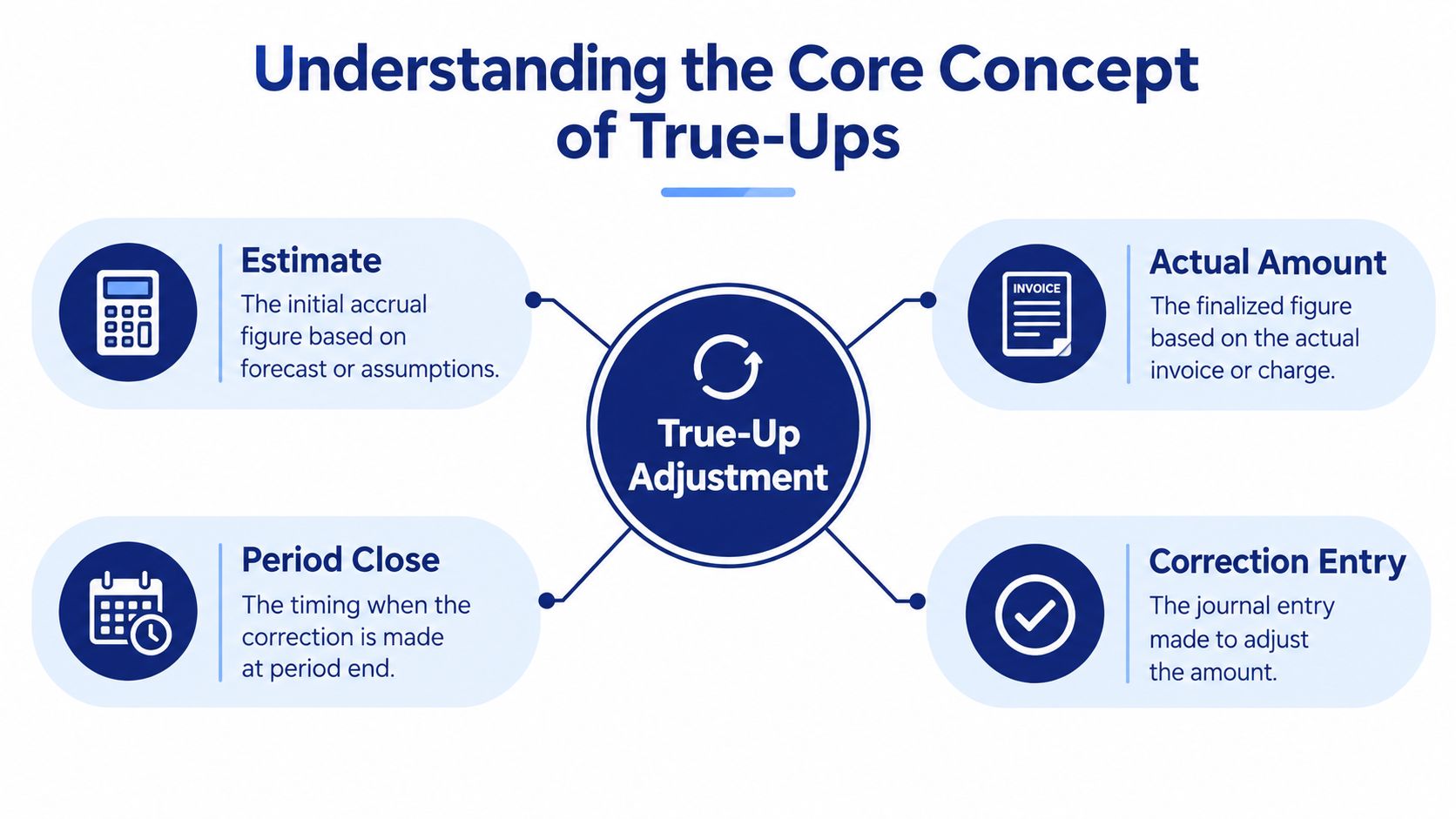
A true-up in accounting is a period-end adjustment that fixes an estimate after the actual amount becomes known. It turns provisional figures into reported totals that match reality, whether the review happens monthly, quarterly, annually, at year-end, or after an audit.
You've probably lived this scene. The books need closing, but a vendor invoice is missing, a utility bill hasn't arrived, or the final payroll data is still sitting in someone's inbox. Waiting keeps the statements stale, so finance books a reasonable accrual and moves on.
Then the invoice arrives. The estimate is wrong. That doesn't automatically mean somebody failed. It means the accounting cycle has reached the part where the guess gets replaced by evidence. The key question is less “what is a true up in accounting?” and more who pays, who receives the difference, and which period absorbs the impact?
Month-end close is a race against incomplete information. A company has used electricity, received legal advice, or consumed a service, but the supporting bill may arrive later. Accrual accounting still requires the expense to land in the period it belongs to, so the bookkeeper records an estimate rather than pretending the cost doesn't exist.
That estimate is a placeholder, not a promise. When the actual invoice turns up, the finance team compares it with the accrued balance and records the difference. The adjustment may increase the expense, reduce it, or clear an accrual that no longer reflects what the company owes.

Bad estimates create bad decisions, but estimates themselves are unavoidable. The problem starts when the accounting team treats an old estimate as final after the underlying data becomes available.
A true-up gives the business a controlled way to finish the job:
Practical rule: An estimate is acceptable when it's supported, reviewable, and scheduled for replacement. An unsupported estimate left untouched is just accounting clutter wearing a tie.
This process also creates a communication burden. A finance firm that needs to explain recurring reconciliations to clients may benefit from practical newsletters for CPA firms, especially when technical adjustments need to be translated into plain business language.
A true-up in accounting is a period-end adjustment that reconciles an estimated amount to the actual amount. Major accounting references describe it as a correction made after a period closes, often at year-end or after an audit, so the books show the correct balance once better information is available. The CPA Journal's explanation of true-up adjustments provides that foundation.
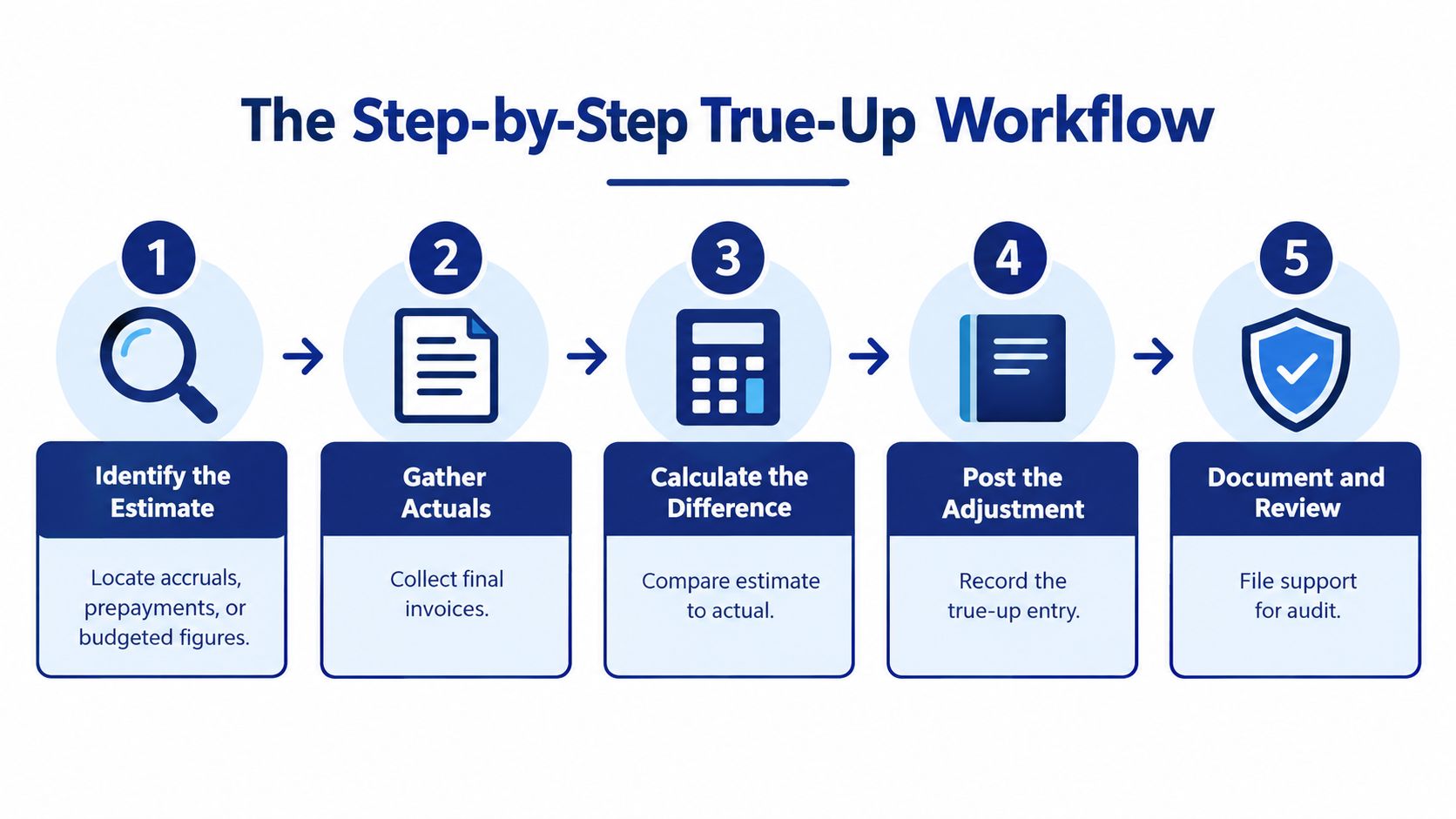
The mechanics are straightforward. Finance identifies an amount previously accrued or budgeted, obtains the final result, calculates the variance, and posts an adjusting journal entry. That entry may affect an expense, revenue, liability, asset, or another balance that depended on incomplete information.
Accrual accounting forces a practical compromise. Businesses need timely statements, but suppliers, tax authorities, payroll teams, and contract systems don't always deliver final data before the books close. Recording a supported estimate keeps the period from understating activity. The later true-up makes the estimate answerable to reality.
That's why a true-up isn't automatically the same as an error correction. An error means the original entry was wrong because of a posting mistake, misclassification, or other failure. A true-up usually means the original entry was a reasonable estimate that later needed refinement.
The concept appears across accounting, tax, payroll, and recurring contracts. Some processes reconcile monthly, quarterly, or annually, depending on how frequently actual information becomes available. The key distinction is simple: the ledger starts with an informed approximation and ends with a supported amount.
A clean true-up follows a repeatable trail. The accounting entry matters, but the evidence behind it matters just as much. Reviewers should be able to understand what was estimated, what changed, and why the adjustment belongs in the selected period.
Start with the original accrual, prepayment, budgeted amount, or contract assumption. Record the account, period, entry reference, and calculation used. If the team can't identify the estimate, it has no reliable starting point.
Use the final invoice, approved payroll report, audited tax result, usage statement, or settled transaction record. Don't substitute a fresh guess for the old guess. A true-up needs a defensible actual amount.
Compare the recorded estimate with the actual figure. The difference is the amount that needs adjusting. Check the direction carefully. A shortfall may increase an expense or liability, while an over-accrual may require a reduction.
Record the journal entry in the correct account and period. Depending on the process, the team may reverse the original estimate and book the actual amount, or post only the difference. Both routes can work if the final balances are clear and supported.
Look at the income statement, balance sheet, cash implications, and any management metrics affected by the entry. A true-up can change reported earnings without immediately moving cash, or it can trigger an invoice, refund, or settlement.
Attach the source document and write a memo that identifies the estimate, actual amount, variance, period, and reason. Then confirm that the related accrual or balance now ties to its supporting schedule. A useful general-ledger reconciliation resource can help teams formalize that final check.
In acquisitions, the same discipline applies after closing. A working-capital true-up aligns the target's agreed amount with the buyer's or seller's measured amount, often within 30–120 days after closing, and can directly change the purchase price settlement, as described in this explanation of true-up entries.
For teams cleaning up multiple accounts, a practical guide to reconciled accounts for Florida businesses offers useful context on why unresolved balances become a larger operational problem.
The same basic adjustment behaves differently depending on the underlying relationship. An internal accrual usually changes the ledger first. A contract-based true-up may also change who sends cash to whom.
Payroll teams often estimate bonuses, commissions, taxes, or other compensation-related obligations before final approvals are available. Once the approved amount arrives, finance adjusts the expense and liability to match the obligation. The employee may receive more or less than the company initially accrued, but the true-up itself is the accounting mechanism that aligns the records.
Utilities, taxes, insurance, and professional services follow a similar pattern. The company records the cost in the relevant period, then updates the balance when the invoice or final calculation arrives. A useful distinction is that the accounting team controls the entry, while the vendor, tax authority, insurer, or payroll approver controls much of the final information.
For a broader comparison of timing choices, see this guide to cash and accrual accounting methods.
Triple-net leases provide a more visible example. Landlords often collect estimated common-area maintenance, or CAM, charges during the year and later compare those payments with actual costs. According to BDO's lease accounting guidance, the lease may require an additional payment or refund, and industry guidance commonly places the reconciliation about 90 to 180 days after year-end.
| Scenario | Initial figure | Later evidence | Possible result |
|---|---|---|---|
| Payroll accrual | Estimated compensation | Approved payroll data | Expense and liability adjustment |
| Utility accrual | Expected bill | Final supplier invoice | Expense and payable adjustment |
| Triple-net lease | Estimated CAM charges | Actual property costs | Tenant payment or landlord refund |
| Acquisition | Estimated working capital | Post-closing measurement | Buyer-seller settlement |
The contract determines the cash outcome. Accounting records the consequence, but contract design decides whether the variance becomes a bill, credit, refund, or settlement.
A true-up is an accounting entry, but its economic meaning sits outside the journal. Someone made a forecast, someone relied on it, and the agreement determines who absorbs the difference when reality disagrees.
In recurring billing, a provider may estimate usage and later invoice the customer for consumption above the amount already billed. If actual usage is lower, the customer may receive a credit or refund, depending on the contract. That makes the true-up a risk-allocation mechanism, not merely a cleanup task.
In an acquisition, the parties negotiate a target working-capital position before closing. The post-closing measurement tests whether the business delivered what the agreement contemplated. If working capital falls below the agreed target, the seller may owe money to the buyer. If it exceeds the target, the settlement may move the other way.
A true-up answers a commercial question: who agreed to carry the risk that the estimate would be wrong?
A journal entry can change reported expense or revenue without immediate cash movement. A later invoice or refund creates the cash event. Conversely, a contractual true-up can produce a direct settlement even when the accounting entry merely updates a balance.
EBITDA requires the same care. If the adjustment changes an operating expense, reported EBITDA may move. If it only reclassifies balances or clears an existing accrual, the economic story may be different. Finance leaders should never describe a true-up as “just accounting” until they've checked the contract, the cash schedule, and the metric definition.
The plain-English description is accurate: you booked a guess, reality arrived, and the books receive a cleanup entry so the balance reflects what happened, as summarized in this practical explanation of true-up accounting.
| Context | Impact type | Who bears variance |
|---|---|---|
| Customer usage billing | Invoice, credit, or refund | Customer or provider, according to the contract |
| Payroll accrual | Expense and liability adjustment | Employer economically, with payment to employees where applicable |
| Lease CAM reconciliation | Additional payment or refund | Tenant or landlord, based on actual costs and lease terms |
| M&A working capital | Purchase price settlement | Buyer or seller, based on the measured shortfall or excess |
Read the agreement before debating the entry. The ledger tells you what happened. The contract tells you who owns it.
The best true-up process starts before the adjustment. Conservative estimates, clear ownership, and disciplined review reduce the chance that a small variance becomes a quarter-end surprise.
Use an estimate schedule that records the account, calculation, responsible owner, source assumptions, and expected replacement date. When the actual arrives, attach the invoice, report, or settlement statement to the journal entry. A reviewer should be able to rebuild the variance without scheduling a detective meeting.
Conservative estimating also matters. A modest over-accrual can be reduced later, while an aggressive under-accrual can understate obligations and create an unpleasant cash surprise. That doesn't mean padding expenses. It means using supportable assumptions and reviewing them when conditions change.
True-ups commonly occur monthly, quarterly, or annually, depending on the accounting process, as described in this overview of recurring true-up cycles. Choose the cadence based on exposure, transaction volume, and how quickly actual data becomes available.
A practical control set looks like this:

Technology can flag unmatched invoices and organize supporting documents, but it won't decide who bears a contractual variance. For that, finance still needs judgment. Teams that want extra capacity can also use month-end close best practices while assigning trained accounting staff to the recurring reconciliation work.
Yes. If the original estimate no longer applies, the entry may reverse the full accrued amount and record the correct balance. The important test is not the size of the reversal. It's whether the final ledger agrees with reliable supporting information.
No. Any business that records estimates and later receives actual information can need one. A small company with recurring utilities, payroll obligations, insurance, or contract billing faces the same basic issue as a larger organization. The volume changes, but the accounting logic doesn't.
It can. If the adjustment relates to deductible expenses, taxable revenue, payroll obligations, or another tax-sensitive balance, it may affect reported taxable income or liabilities. The accounting team should coordinate with a tax professional before treating a material adjustment as a routine bookkeeping entry.
No special debit or credit structure is required. A true-up uses a standard adjusting journal entry, but the entry should be clearly labeled and supported so the reviewer can distinguish it from an ordinary transaction.
No. A true-up replaces an estimate with a better-supported actual amount. A posting error, such as using the wrong account or period, is a correcting entry and may require different treatment. Calling every cleanup entry a true-up hides the question that matters most: was the original number an estimate, or was the transaction recorded incorrectly?
That depends on the transaction. An internal accrual true-up may change the books without immediate cash movement. A customer billing reconciliation, lease settlement, or acquisition adjustment can create an invoice, refund, or payment. Review the contract and payment schedule before forecasting the cash impact.
HireAccountants offers access to pre-vetted accountants and finance professionals who can support bookkeeping, reconciliations, monthly close, tax, audit, FP&A, and controller-level work. If recurring true-ups are eating your close calendar, visit HireAccountants to find accounting support matched to your workload.
Let's simplify your finances today!