


A virtual team is a group of people working interdependently toward shared goals while separated by geography, organization, or time zones. By the early 2000s, more than 60% of professional American employees worked in teams characterized by virtuality according to a summary of a 2002 Gartner Group study.
The popular advice says remote work succeeds when you buy better software, schedule more video calls, and send everyone a branded hoodie. That advice is mostly wrong. A virtual team doesn't fail because people aren't sitting together. It fails because information gets scattered across Slack, email, project boards, calendars, regional work habits, and the mysterious document someone swears they uploaded.
I've hired across three time zones, watched clean handoffs turn into accounting archaeology, and learned that distributed work rewards design, not optimism. In 2026, the question isn't what is a virtual team, but whether your company has built an operating system that lets one work without constant rescue missions.
The lazy definition is simple: people work together but aren't in the same room. That description is technically useful and operationally weak. It treats virtuality as a video-call problem, as if a stronger Wi-Fi signal could repair a missing approval, an undocumented decision, or a month-end handoff nobody owns.
A virtual team is better understood as people who work interdependently toward shared goals while separated geographically, organizationally, or temporally. That broader definition matters because “remote” doesn't always mean “virtual.” A person working from home on an independent task may be remote. A controller in Austin coordinating bookkeepers in Manila and a tax specialist in Toronto is running a virtual team.
The distinction is coordination. Each member's work affects someone else's ability to finish theirs, but the team can't rely on proximity to supply context. Nobody can lean over a desk and ask which version of the revenue schedule is final. Nobody can infer urgency from the tone of a hallway conversation. The system needs to carry that context deliberately.
Shared context answers the question, “Why does this work matter?” A finance team needs more than a task name such as “review accounts receivable.” It needs the business objective, the reporting deadline, the risk level, and the person who makes the final call.
Structured asynchronous communication lets work move when people aren't online together. Updates, decisions, reconciliations, and handoffs belong in durable written systems. Meetings should resolve ambiguity, conflict, or judgment calls, not provide a live reading of a task list.
Trust based on outputs replaces the old office habit of treating visibility as evidence of effort. Managers should inspect deliverables, controls, response norms, and escalation behavior. Watching someone turn green in Slack isn't management. It's digital birdwatching.
Practical rule: If a team can't explain where decisions live, who owns each handoff, and what happens when someone is offline, it isn't operating virtually. It's improvising online.
Communication fragmentation is the hidden failure mode. Research on virtual teams identifies faultlines created when members use different digital tools, while reviews of global virtual work repeatedly surface language barriers, time differences, distance, and knowledge sharing as recurring coordination problems as summarized by BI Norwegian Business School. For a practical comparison of adjacent arrangements, the remote work model tag overview can help clarify how hybrid, remote, and distributed structures differ.
If you're evaluating support for a finance function, don't confuse a remote individual contributor with a virtual operating model. An outsourced virtual assistant arrangement may solve a narrow workload problem, but a real team still needs shared standards, ownership, and an agreed path from question to decision.
The story usually starts with the pandemic. It shouldn't. The pandemic forced millions of companies to test distributed work at scale, but the underlying model existed because businesses had a stubborn problem: the best person for a role often didn't live near the office, and skilled workers didn't always want to relocate for the privilege of finding parking.
Management research has discussed virtual teams since at least 1998, when the Academy of Management described them as teams linked primarily through advanced computer and telecommunications technologies. Later literature characterized them as small, temporary groups of knowledge workers separated by geography, organization, or time and coordinating mainly through electronic communication in a literature review covering the model's development.
The deeper history runs through ordinary team design. Work teams appeared in the United States as early as the 1960s, expanded through quality circles and Total Quality Management in the 1980s, and became more common in the late 1980s and early 1990s as firms adopted self-managing teams as documented in the same review. Virtual teams didn't arrive as a separate organizational species. They evolved from existing team practices once technology could carry more of the coordination load.
Globalization and cross-border coordination made digital communication a structural requirement rather than a convenience. By 2002, more than 60% of professional American employees worked in teams marked by virtuality according to the Gartner study summary. The model later spread through remote work and telecommuting, with a widely cited summary reporting that nearly 3.3 million American workers telecommuted at least half the time by 2012 in the same source.
The technology matured in layers. Email and shared drives made asynchronous collaboration barely tolerable. Cloud software made documents accessible without a server-room pilgrimage. Chat, video, and shared workspaces made live coordination easier, though they also gave teams more places to lose information.
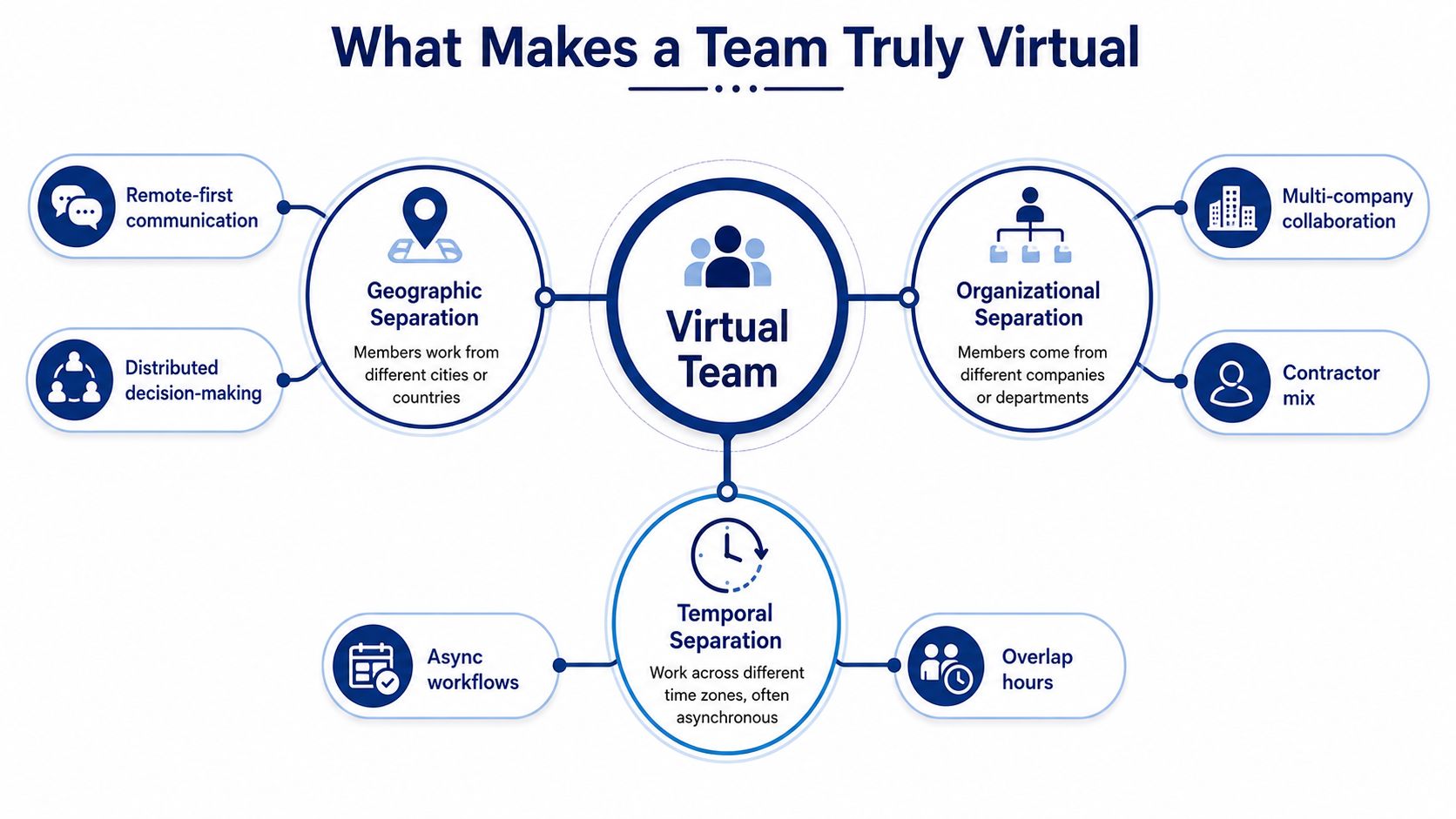
A 2021 study defines virtual teams as people working from different locations, potentially across different time zones, on a common project while using information and communication technologies intensively in its research definition. The throughline is clear. Tools accelerated a trend that businesses had already created. Distributed work is a design choice, not a contingency plan you keep folded in a drawer until the office closes.
Three kinds of separation create three different coordination problems. Pretending they're interchangeable is how managers end up applying a single “remote policy” to situations that require very different mechanics.
A US controller working with a staff accountant in Manila doesn't have the option of resolving every question through proximity. The team needs a clean close calendar, named owners, standardized workpapers, and a handoff note that explains what changed, what remains open, and what requires judgment.
Geography also affects access to people, systems, and local context. A regional team may know a vendor, tax rule, or banking practice that others don't. That knowledge needs a home in the workflow, not a private chat that disappears when someone changes roles.
A CFO may extend an in-house finance function through an external accounting partner. The contractor sits outside the org chart but inside the workflow, which creates an authority question before it creates a staffing question.
Who approves journal entries? Who owns the close checklist? Who can contact the bank? Who escalates a control issue? If the answers live in assumptions, the arrangement will eventually produce a very confident mistake.
A US accounts payable team overlapping only briefly with a European payroll specialist can't run every issue synchronously. Time-zone differences are one of the most common barriers in virtual teams, and research on global virtual-team coordination identifies geographic distance and time-zone differences as having the greatest impact on informal mutual adjustment in a review of coordination challenges.
The mechanics are straightforward, if not glamorous:
A team is virtual when these separations coexist and the operating model compensates for each one with explicit rituals. The distinction is useful for finance leaders because it replaces vague flexibility with testable design. You can inspect whether the close survives a handoff, whether external contributors understand approval rights, and whether payroll can progress while another region sleeps.
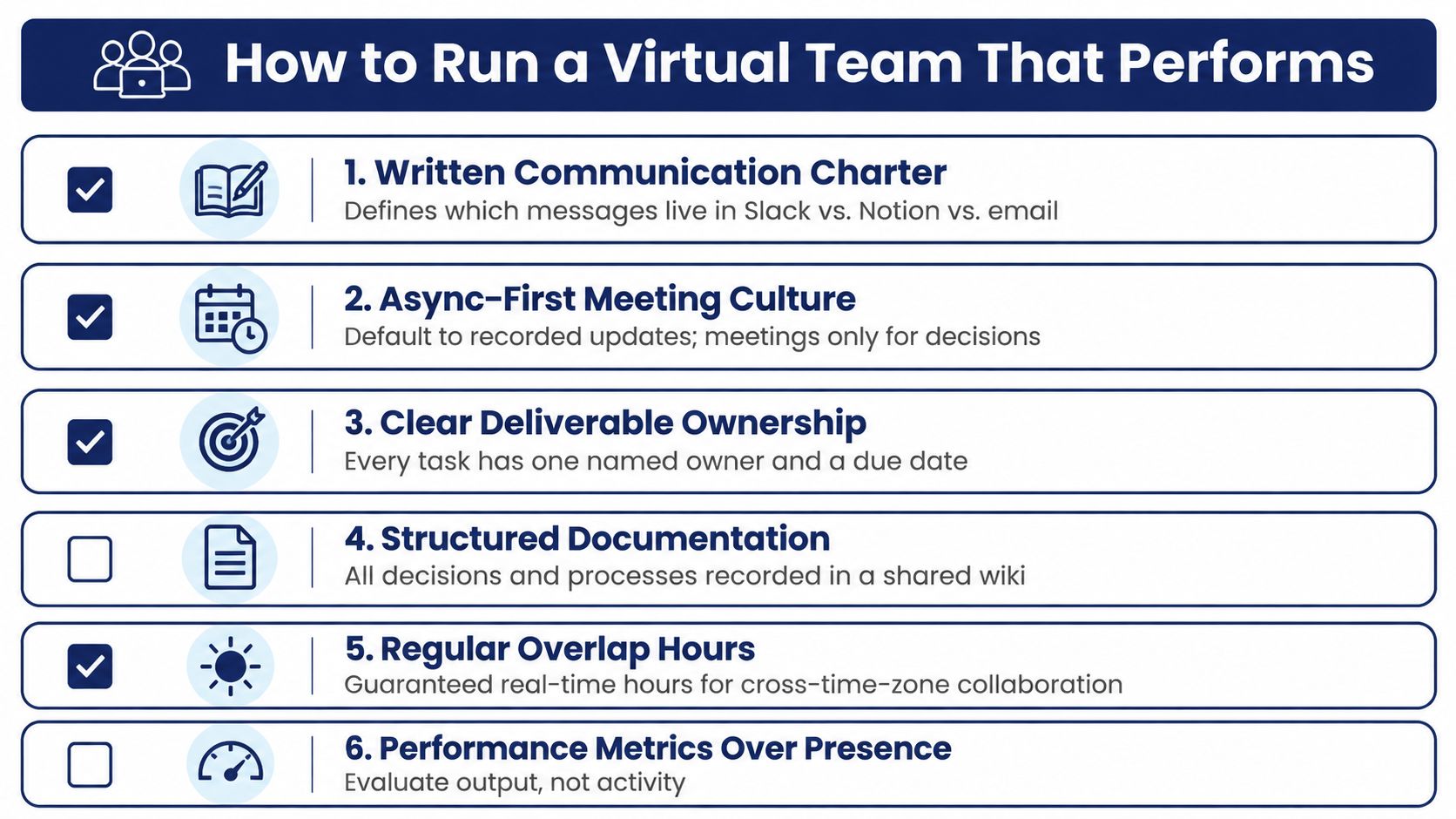
Virtual teams expand hiring beyond the radius around an office. That matters when a local market cannot supply a controller, technical accountant, or experienced bookkeeper when the business needs one. The model can also reduce dependence on commercial space and remove commuting from the employment bargain, helping some knowledge workers stay productive without spending their lives in traffic.
Finance teams gain coverage across regions. A controller in Austin, three bookkeepers in Manila, and a tax analyst in Toronto can move work through the day instead of waiting for one location to reopen. That creates continuity and access to specialized skills, provided the handoffs are designed rather than left to goodwill.
The invoice arrives in coordination time. People reconstruct context, switch between tools, clarify vague instructions, and wait for the next overlapping window. A synthesis of 103 peer-reviewed studies found that communication affects virtual-team outcomes through relational and informational mechanisms, with the communication tool and the team's development stage moderating those effects in the research synthesis. Teams need task information and social connection. Endless messages are not a management system.
| Dimension | Advantage | Trade-off |
|---|---|---|
| Talent access | Hire beyond the local labor market | Assess skills and communication without relying on office proximity |
| Coverage | Move finance work across regions and working hours | Manage handoffs, delays, and uneven availability |
| Flexibility | Support different locations and working patterns | Set boundaries before flexibility becomes permanent availability |
| Documentation | Create a durable record of decisions and controls | Make managers and contributors document work consistently |
| Trust | Judge people by outputs and reliability | Repair confidence when missing context resembles poor performance |
| Technology | Connect people, files, and workflows | Prevent tool sprawl, duplicate records, and security gaps |
| Culture | Include talent who would not relocate | Replace hallway context with deliberate connection |
| Compliance | Distribute specialized work | Control devices, access, networks, approvals, and audit evidence |
Trust deserves separate attention. A University of Linköping thesis summary identifies building strong trust as one of the hardest parts of virtual teamwork, while research on temporary virtual teams links trust with communication and cohesiveness in the thesis and related discussion. Trust is not a virtual happy hour. It grows when someone makes a clear commitment, delivers the agreed output, flags risk early, and repeats that behavior.
The cost is structural. More communication creates more work when teams lack response norms, shared documentation, and cultural alignment as discussed in recent coverage of remote collaboration. If a finance operation needs constant explanation to keep the ledger moving, remote work is not the culprit. The process lives in people's heads, and every time zone, tool, and unwritten norm adds another place for context to disappear.
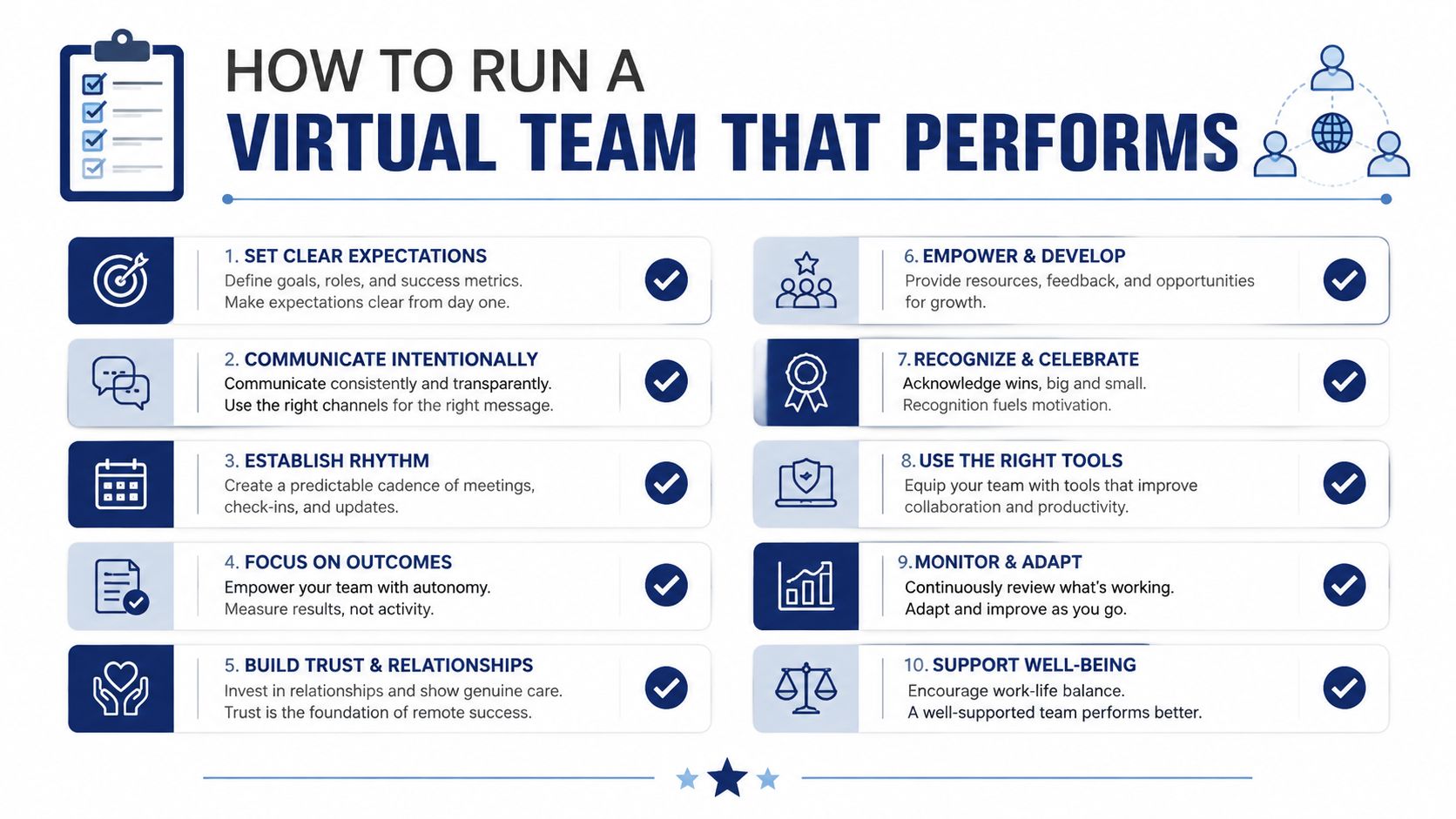
A virtual team does not fail because people work from home. It fails when information gets split across tools, time zones, and private assumptions. Run the operating model like a control environment. Set the rules before the first missed deadline reveals them.
Assign one home to each type of information:
The boundary matters more than the brand name. Five tools with clear rules beat one tool used as an everything bucket. A 2024 study of online team meetings found that speaking time, speaking turns, and degree centrality were positively related to individual effectiveness. Dyad-level effectiveness also improved with time spent in pairwise interaction and the number of interactions in its analysis of meeting telemetry. Use that finding to improve participation and coordination, not to justify longer meetings.
Make asynchronous updates the default. Require a written agenda before every meeting and record the decision immediately afterward. If a meeting only reports status, cancel it and request a written update. Nobody's career improves because they survived another branded progress call.
Reserve two to three hours of overlap across time zones for judgment-heavy work, approvals, and exceptions. Rotate inconvenient schedules so one region does not absorb every late call. The team needs a predictable operating cadence, not a daily lottery for who loses dinner.
Start with small, observable deliverables before assigning a mission-critical process. A clear 90-day onboarding plan produces evidence faster than a virtual happy hour. For finance teams, specify the first assignments: reconcile a defined account group, document an approval path, complete a controlled workpaper, or identify open close risks.
Communication-heavy roles need their own test. Technical explanations can fail through accent, pacing, or unclear phrasing even when written English is strong. Leaders hiring across borders can review guidance on how to choose an accent coach for tech leads when stakeholder trust depends on spoken clarity.
Finance teams need tighter controls than ordinary project teams. Set month-end close windows with required real-time checkpoints, codify approval thresholds, and rotate on-call responsibility so one time zone does not become the unpaid night shift. Review the process quarterly. Examine failed handoffs, repeated questions, control gaps, and decision latency.
Give every new hire a documented remote employee onboarding process covering system access, process context, role boundaries, and named contacts before that person inherits a deadline. Clear ownership beats heroic improvisation.
Hiring remotely isn't automatically cheaper, faster, or safer. A platform helps only when it reduces the specific risks that make distributed finance work painful: uncertain technical ability, unclear employment arrangements, weak communication, and slow replacement when the fit fails.
US finance hiring can be especially unforgiving for smaller companies. A role may require technical accounting knowledge, US GAAP familiarity, QuickBooks, NetSuite, or Sage fluency, and enough English proficiency to explain a reconciliation without turning it into a three-day detective story. Traditional recruiting often makes the company discover those gaps after interviews, onboarding, and a missed close.
A pre-vetted platform changes the sequence. Instead of starting with an empty funnel, a company can specify the role, review matched finance professionals, and use recruiting support to narrow the search. HireAccountants describes a workflow that combines a self-service marketplace, an AI matching engine, and a white-glove recruiting team, with shortlists of qualified accountants available in as little as 24 hours, according to the publisher's service description. That is a recruiting mechanism, not proof that every hire will work. The manager still owns the process design.
The main value isn't a bargain-basement hourly rate. It's the ability to access specialized remote finance talent without building an international hiring operation from scratch. A US company may need a senior bookkeeper in the Philippines, a tax specialist in India, or an AR analyst in Mexico. The operational questions then include contracts, payroll, tax handling, compliance records, system access, and what happens when the person is unavailable.
Platforms can package parts of that infrastructure through contracting support, HR and payroll administration, compliance assistance, and replacement processes. Those services don't eliminate risk. They make the risk visible and give the company a process for managing it.
The same logic applies to cloud accountant staffing. Finance leaders should evaluate technical fit, communication habits, availability, security controls, and ownership of deliverables, not just the candidate's location or rate.
A platform isn't a substitute for a communication charter or a close calendar. It can, however, reduce the trust deficit at the front end by giving a US company a clearer way to find, screen, engage, and replace distributed finance talent. That makes it a risk-reduction tool first and a cost tool second.
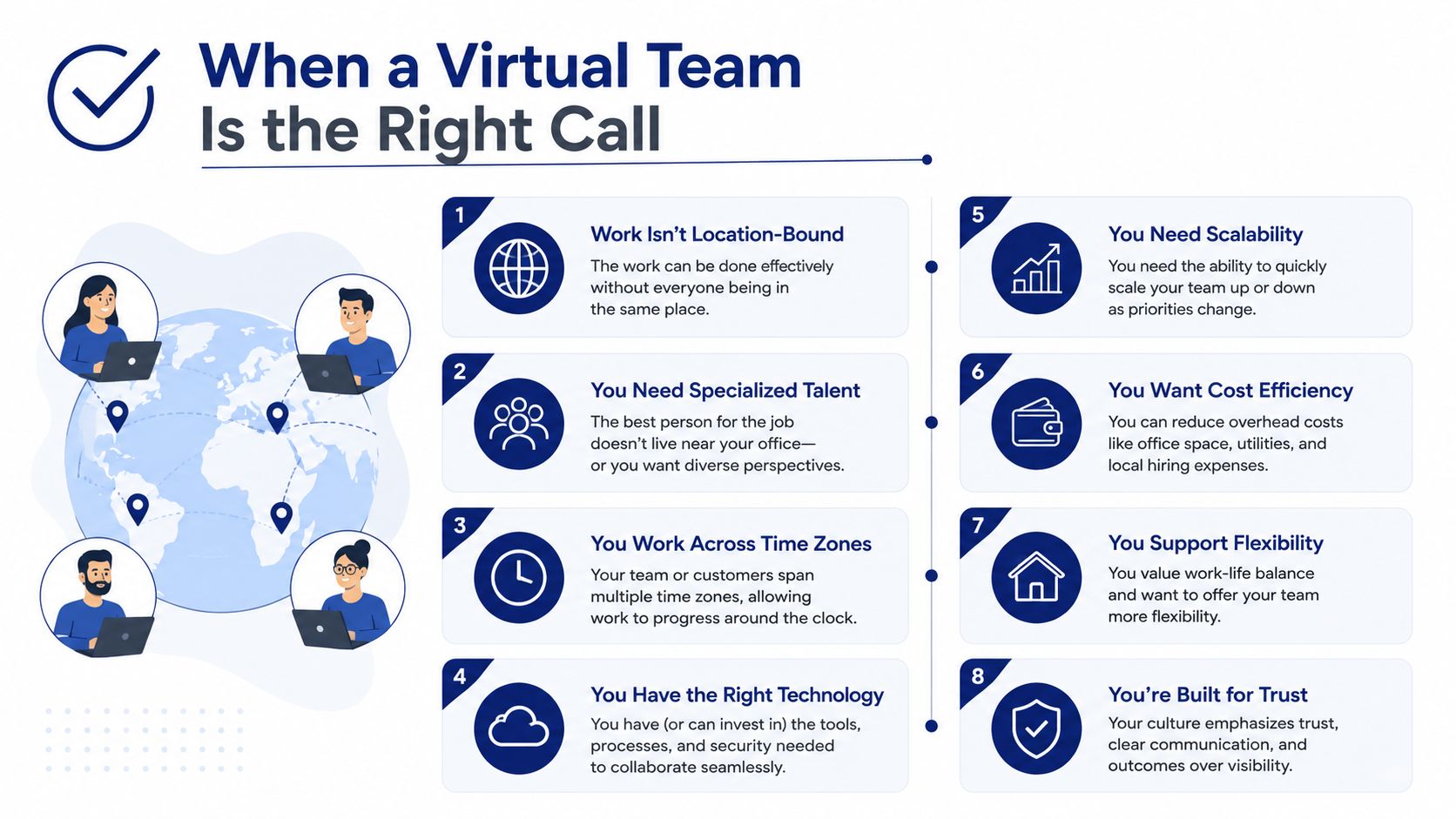
Virtual teams suit work that leaves evidence. If a role produces reconciliations, forecasts, invoices, reports, audit schedules, or documented analysis, managers can evaluate the output without confusing desk presence with performance. Mature processes also travel better than informal knowledge, and distributed teams work best when the company can protect a meaningful overlap window for decisions and exceptions.
A controller running month-end close across multiple time zones can work well when the close calendar, ownership, approval thresholds, and escalation rules are explicit. The team doesn't need to share a room. It needs to share definitions, deadlines, evidence, and consequences.
The model becomes a poor fit when the work depends on constant apprenticeship or unstructured observation. A first-year staff accountant learning the chart of accounts from a Slack thread is not receiving mentorship. They're collecting fragments and hoping the fragments form a profession.
Time-zone separation deserves an honest test. If the team can't protect overlapping hours for urgent judgment calls, then the process must support asynchronous progress with clear service expectations and escalation routes. Otherwise, every exception becomes a waiting game, and the general ledger starts keeping time in its own timezone.
The highest action comes before posting a remote role. Audit your communication stack. Find out where decisions live, which tools duplicate each other, how approvals are recorded, and whether a new hire could complete a task without asking three people for the missing context.
Don't hire a distributed team into a broken office-first culture and call the result global capability. You'll just import the chaos, add time zones, and wonder why everyone needs another meeting.
HireAccountants offers US companies access to pre-vetted remote accountants and finance professionals, with marketplace matching and recruiting support for roles such as bookkeeping, tax, audit, and financial analysis. Visit HireAccountants to define the finance work you need, review qualified talent, and build a distributed team around clear ownership instead of crossed wires.
Let's simplify your finances today!