


What is expense management? It's the full lifecycle of capturing, approving, paying, and reconciling business spend, not a sad little pile of receipts waiting for someone to reimburse. That lifecycle sits on top of a huge spend category, with US businesses alone spending about $1.2 trillion annually on travel and entertainment, and the expense-management software market valued at $14.7 billion in 2022 with projected growth at a 12.3% CAGR from 2023 to 2030 (business expense statistics).
Many teams still talk about expense management like it's an admin chore. That's outdated, and it's how finance ends up babysitting spreadsheets at 9 p.m. Instead, treat it as a control system that decides what gets spent, when it gets approved, how it gets coded, and whether the books close cleanly.
Expense management is the discipline of controlling business spend from the moment it is planned or captured, through policy checks, approval, reimbursement or payment, and all the way to reconciliation in the general ledger and reporting stack. That is the point finance teams keep missing when they treat it like a receipt dump. A real program is a control system, not an inbox cleanup project.
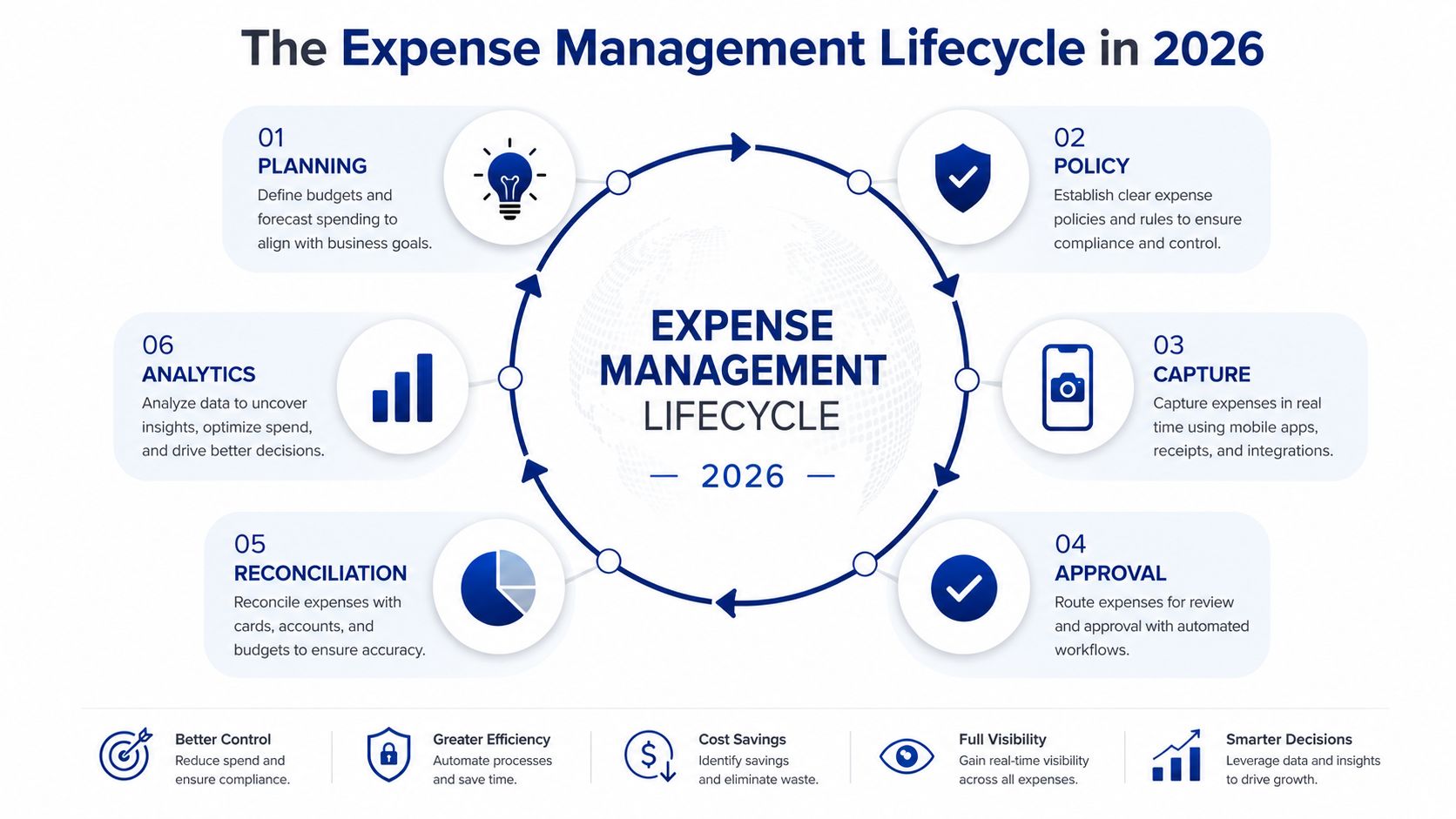
The common mistake is starting after the card swipe. That is too late. Mature expense management captures spend at the point of transaction, applies policy before money drifts out of control, reconciles the result into accounting, and feeds budget decisions and trend review without extra manual cleanup.
That is why a maze of email approvals and a shared spreadsheet is not lean, it is brittle. No one owns the whole loop, so every handoff becomes a place for delays, coding errors, and missing context.
Practical rule: If you cannot name where spend enters the system, where policy gets applied, and where it lands in the books, you do not have expense management. You have reimbursement theater.
The accounting side still has to line up cleanly. The expense workflow eventually meets finance in the ledger, and the core logic of the accounts payable process is part of that handoff. If expenses and payables do not talk to each other, month-end turns into guesswork.
A simple gut check tells you a lot. If your team spends more time chasing missing receipts than reviewing actual spend patterns, the process is broken. You are doing archaeological recovery, not expense management.
A real expense program is built, not wished into existence. The five parts are policy, capture, approval, reimbursement, and reporting, and each one solves a different problem. If one of them is weak, the whole thing turns into a soft target for errors, delay, and the occasional “why is this on my card?” mystery.
Policy tells people what's allowed before they spend. A good policy doesn't read like a legal threat, it gives clear boundaries, like which meals are reimbursable, what needs VP sign-off, and what gets rejected without debate. If your policy is longer than a page and nobody can quote it, it's decoration.
Capture is where the receipt, card swipe, or invoice enters the system. OCR-based receipt intake matters because no one enjoys typing the same vendor, date, and amount twice. The point isn't just convenience, it's reducing the chance that a bad coded transaction sneaks into month-end.
Approval routes spend to the right manager or finance owner. The best approval systems don't just say yes or no, they surface exceptions, so the reviewer only touches the weird stuff. That's where time goes back to finance instead of disappearing into a pile of routine expense reports.
Reimbursement is the payment leg for employee-initiated spend. ACH reimbursement is cleaner than scattered manual payments, because at least the money arrives without someone playing detective in payroll. If reimbursement routinely drags, employees notice, and they stop trusting the process.
Reporting closes the loop. Month-end variance reports, category trends, and policy breach summaries tell you whether the program is controlling spend or just processing it faster. That's the difference between looking busy and being useful.
Blunt version: If your reporting doesn't help you adjust policy, set budgets, or spot leakage, it's a vanity dashboard. Finance doesn't need prettier lies.
The whole point is to make each layer support the next. Policy without capture is unenforced. Capture without approval is noisy. Approval without reporting is blind. You get the idea.
The big shift in expense management is not software. It's timing. Legacy reimbursement says, spend first, report later, then finance tries to reconstruct intent from a receipt and a hopeful memory. Card-first control flips that around, so the rules exist before the swipe and the company can decide whether the spend should happen at all.
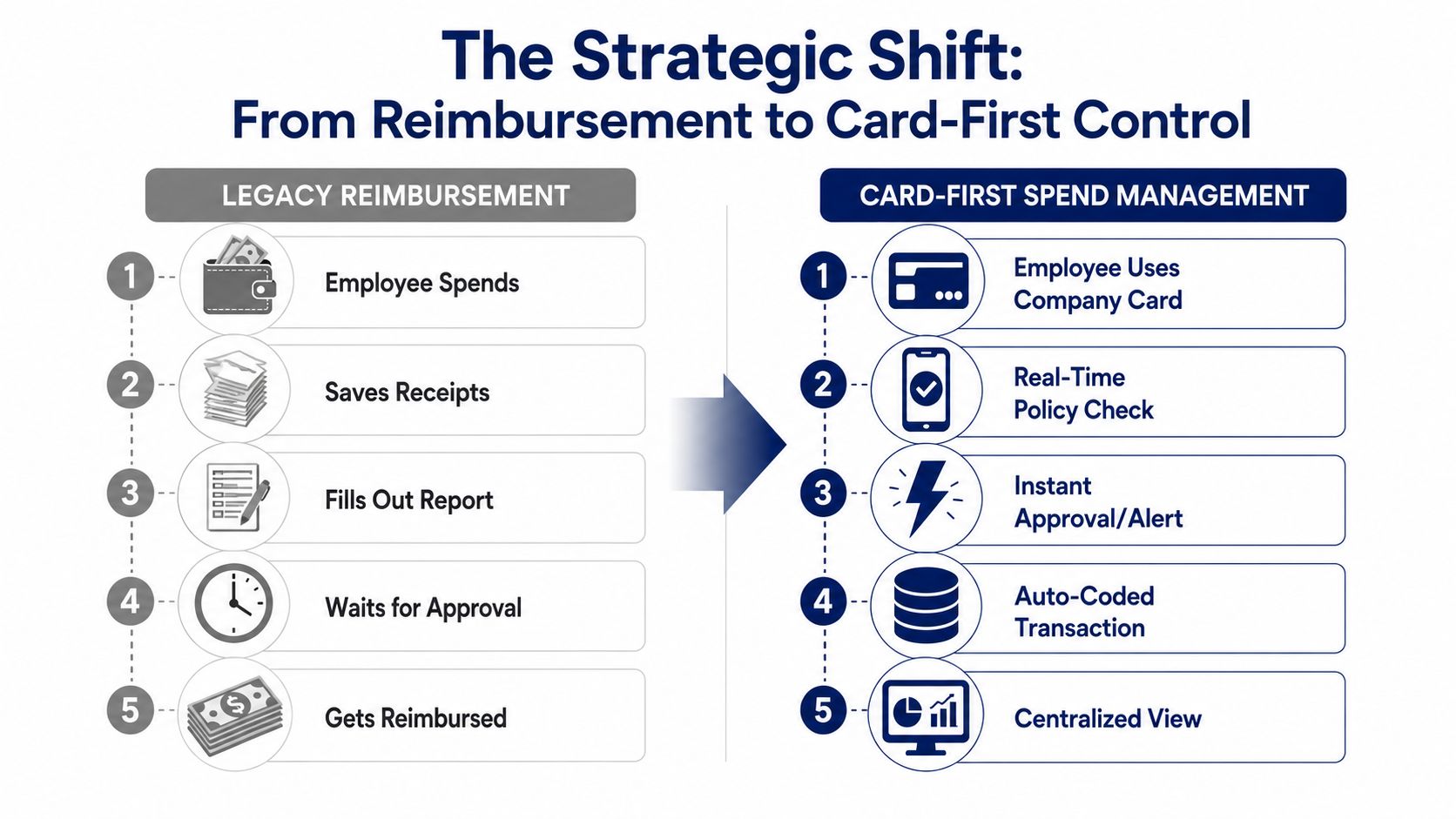
Traditional reimbursement is reactive by design. An employee buys software, books travel, or picks up office supplies, then someone has to review the receipt, check policy, chase approvals, and push payment later. That's fine if you enjoy turning finance into a long-form email response.
Card-first control changes the question from “did we approve this?” to “should this be allowed to happen?” That's the win. When spending limits, merchant category rules, and approval logic live on the card, routine noncompliant spend can get stopped before it becomes a cleanup job (Corpay on spending controls and ERP integration).
It's not magic, and anyone selling it that way is overselling. Card-first can create fragmented data if transactions live in one tool, receipts in another, and AP in a third. It can also create duplicate workflows if the same purchase has to pass through both card controls and invoice review. That's how you end up with modern software and ancient pain.
The smart move is to use card-first for what it's good at, point-of-purchase control, then keep a tight reconciliation path into finance. Otherwise, you just moved the mess around the building and gave it a fancier name.
A good example is a recurring SaaS purchase. In a card-first setup, a preset limit and policy rule can approve the charge immediately if it fits. In a legacy setup, the same purchase can sit in an inbox, wait for a manager reply, then get coded manually after the fact. Same spend, different amount of nonsense.
Most expense tools promise “visibility” like that's a business outcome. It isn't. Visibility that doesn't improve reconciliation, compliance, or close speed is just a nicer screen to stare at while the same problems linger. For most US SMBs, an integrated spend platform beats a standalone expense app because fragmented tools tend to break the audit trail at the exact moment you need it most.
Standalone expense tools are fine if all you need is receipt capture and basic approvals. They can help with expense reports, but they usually stop at the edges of reimbursement. That means the finance team still has to stitch together card data, AP data, and accounting entries by hand.
Integrated platforms go further. They connect cards, bill pay, AP, and procurement, so the ledger sees a cleaner picture of total spend. That matters more for hybrid and remote teams, where spend doesn't live in one office and paperwork doesn't magically file itself.
For smaller companies comparing software, a practical starting point is a small business accounting software shortlist, because expense tools that can't sync cleanly with the accounting stack usually create more cleanup than they save.
Two automations earn their keep fast. OCR receipt capture cuts down manual entry, and policy-rule engines prevent obvious bad spend from slipping through. Those are not glamorous features, which is exactly why they matter. Glamour doesn't close the books.
If you want to see how businesses think about spending tools in the wild, this roundup of UK business spending tracker apps is a useful comparison point, even if your stack looks different. The point isn't to copy the UK market. It's to notice which tools reduce work and which ones just hand you a prettier inbox.
My rule of thumb: Buy the tool that removes a step, not the one that merely digitizes the step you already hate.
That's why I'd rather see a company choose fewer systems that reconcile cleanly than buy the whole buffet of “AI finance” features no one uses after week two. Finance teams don't need software tourism. They need fewer exceptions and cleaner books.
A clean expense program should be measurable. If it is not, you are trusting vibes, and vibes do not survive a close. The scorecard should focus on approval latency, breach frequency, maverick spend, report cycle time, and total spend under management.
Approval latency is the time from submission to approval. Long latency means people are waiting, finance is chasing, and reimbursement or coding is stalled. If approval lives in email, this number gets ugly fast.
Breach frequency is how often policy gets broken. That tells you whether the policy is realistic or just ignored. If breaches are constant, the policy is unclear or badly enforced.
Maverick spend is off-policy purchasing. It is the awkward cousin in the budget family, the one who orders outside approved vendors or skips the process altogether. High maverick spend usually means people found a faster path around finance.
Report cycle time measures how long the entire report process takes. As noted earlier, mature programs track cycle time because it reveals bottlenecks instead of just total dollars spent. That is the metric that tells you whether the system is getting cleaner or merely slower in a more organized way.
Total spend under management is the share of company spend governed by policy rather than left uncontrolled or manual. That is the strategic KPI. It answers the blunt question, how much of your spend is inside the guardrails?
expense statistics show why sloppy workflows get expensive fast. The average expense report costs about $58 to process, around 19% of reports contain errors, and each error takes about 18 minutes and roughly $52 to correct.
The point of the scorecard is simple. If latency is down, breaches are down, and more spend is under management, the program is working. If not, you have bought software, not control.
Part of that control comes from people who can keep the books clean while the process is still changing. If you need flexible support, understanding staff augmentation is a useful concept because it frames the role as capacity plus expertise, not just another headcount line. For teams that need accounting help without a long hiring cycle, recruitment of accountants is the more practical path.
Tools don't run themselves. That's where a lot of expense programs die, usually somewhere between “we bought the software” and “why is month-end still a circus?” A founder can approve expenses between sales calls for only so long before the bookkeeping starts looking like it was assembled in a moving car.
A small startup usually starts with one person chasing approvals, another person exporting card data, and the founder rubber-stamping things at night. That's fine until the monthly close slips because no one owns policy enforcement, reconciliation, and reporting as a single job. Then the whole thing turns into a game of accounting whack-a-mole.
That's where a part-time remote accountant changes the math. The software handles capture and routing. The accountant handles exceptions, coding cleanup, ledger reconciliation, and the reporting discipline that keeps the process from drifting. It's a lot less glamorous than a “finance transformation,” but it works.
If you want a good primer on staffing this kind of support flexibly, understanding staff augmentation is a useful concept because it frames the role as capacity plus expertise, not just another headcount line. For companies that need accounting help without a long hiring cycle, recruitment of accountants becomes less about filling a seat and more about closing the loop before the books get weird.
There's a difference between automating routine tasks and outsourcing judgment. Software can route, match, flag, and sync. A human still has to decide whether the policy makes sense, whether the exception is valid, and whether the reconciliation tells the truth.
That's why finance ops teams that combine automation with pre-vetted accounting talent tend to move faster than teams trying to let software do all the thinking. The software catches the obvious stuff. The accountant keeps the process honest.
The cheapest way to avoid expense program failure is to implement it in the right order. Not the vendor's favorite order, the actual order that keeps you from rebuilding the same mess twice. Skip that, and you'll be paying for speed with rework, which is a very expensive hobby.
Baseline current spend. Know where money is going today, by category and owner. If you don't know the starting point, every future improvement is just a guess wearing a blazer.
Write a one-page policy. Keep it short enough that managers will read it. Long policies get ignored, then everyone acts surprised when the rules don't stick.
Choose your capture method. Receipt app, card feed, or AP intake. Pick one path and make it the default, because every extra path adds more cleanup.
Set approval thresholds. Decide what gets auto-approved and what needs review. You remove routine decisions from the founder's calendar.
Define receipt requirements. Spell out what documentation is mandatory and what counts as proof. If this is fuzzy, audit season will be educational in the worst possible way.
Pilot with one team. Sales, marketing, or ops, pick a group with enough spend to test the process, but not so much chaos that you can't see the pattern.
Train employees. Don't assume people will intuit the policy. They won't, because they're busy doing their actual jobs.
Launch and monitor. Track breaches, latency, and cycle time from day one. If the metrics look bad, fix the process before you blame the people.
For a reality check on how messy business spending can get when personal cards sneak in, the CreditCardCult survey on business spending is a useful reminder that policy drift is common, not rare. That's exactly why the checklist matters.
The order matters because each step depends on the one before it. Policies without capture are lip service. Capture without thresholds is just more data. Training without monitoring is corporate optimism, which is a lovely phrase for a lousy control environment.
Expense management is moving from retroactive paperwork to forecasting and cash-flow discipline. The best programs now use the same data that once lived in a shoebox to revise budgets, spot trends, and tighten controls before the month is over. That's the shift, not prettier receipts.
The mental model to keep is simple. Controls before the swipe, reconciliation after the swipe, insight in between. If a tool or hire can't support that sequence, it's not helping enough.
A 20-person company needs tight rules, a clean ledger, and someone who owns the process. A 200-person company needs the same thing, plus stronger automation and more deliberate staffing. Different scale, same principle. No one gets bonus points for making expense management more complicated than it has to be.
HireAccountants helps US companies get the finance support this process needs, from pre-vetted accountants and bookkeepers to flexible remote talent that can own reconciliation, reporting, and policy discipline without dragging hiring out for months. If your expense process is growing faster than your team, visit HireAccountants and get the accounting help that keeps the loop closed.
Let's simplify your finances today!