


You're halfway through the month, a client's 1099 has landed, and your bank account is pretending the money is all yours. Then the calendar reminds you that the IRS expects its share before you file your annual return. Charming.
That panic usually comes from treating quarterly taxes like a mysterious form-filing ritual. They're better understood as a cash-flow and penalty-avoidance system. You estimate what you'll owe, choose a defensible payment target, send the money on time, and keep records good enough that future-you doesn't have to reconstruct the business from bank statements and Slack messages.
I've overpaid, paid late, and made the classic mistake of confusing revenue with profit. The winning approach isn't perfect forecasting. It's a repeatable rhythm built around withholding, safe-harbor math, clean books, and deadlines you respect.
The first quarterly-tax surprise usually arrives after a good month. A freelancer gets paid, a founder closes a contract, or a consultant adds a side business to a perfectly ordinary W-2 job. Nobody withholds federal tax from that new income, so the gross deposit looks fantastic.
Then the owner asks the question that should've been asked before spending the money: “How much of this belongs to me?”
The answer depends on profit, deductions, credits, withholding, prior-year tax, and timing. That sounds complicated because it is more complicated than dividing revenue by four. But it's manageable once you stop trying to predict the future with supernatural accuracy.
Quarterly estimated taxes exist because the U.S. tax system generally expects people to pay as income arrives. Employees handle much of that through paycheck withholding. Self-employed people, partners, S corporation shareholders, and business owners often handle it through estimated payments or adjusted withholding.
The practical mindset: Don't chase a perfect estimate. Build a payment system that keeps you inside the IRS safe harbor and preserves your cash.
This guide focuses on how to file quarterly taxes without panic or unnecessary penalties. You'll determine whether you need to pay, build an annual estimate, account for W-2 withholding, use Form 1040-ES, select a payment method, and handle uneven income without pretending every month is identical.
The goal is simple. By the end, you should know what to do before the next deadline, what records to save, and when the math has become complicated enough to justify professional help.
Start with the threshold, not the calendar. The IRS says individuals, including sole proprietors, partners, and S corporation shareholders, generally must make estimated tax payments if they expect to owe at least $1,000 when filing their return. Corporations generally must pay if they expect to owe $500 or more. See the IRS guidance on estimated taxes for businesses and self-employed people before assuming your business structure answers the question for you.
That $1,000 individual threshold applies after accounting for withholding and refundable credits. A person with substantial freelance income might need estimates. A W-2 employee with a modest side gig might not, especially if payroll withholding already covers the expected liability.
Try this quick self-test:
Business structure still matters operationally. If you're weighing an S corporation election, a resource on S Corp for Florida businesses can help clarify the legal and payroll questions before you treat estimated taxes as the only issue. For LLC owners, filing requirements also depend on how the entity is taxed, so review what tax form an LLC files rather than guessing from the LLC label.
The common mistake is filing a payment just because someone online said every independent contractor must pay quarterly. The real question is whether your combined withholding, credits, and estimated payments leave you exposed. If the answer is no, you may not need to send a quarterly payment. If the answer is yes, ignoring the issue won't make the liability disappear. It just gives it more time to become annoying.
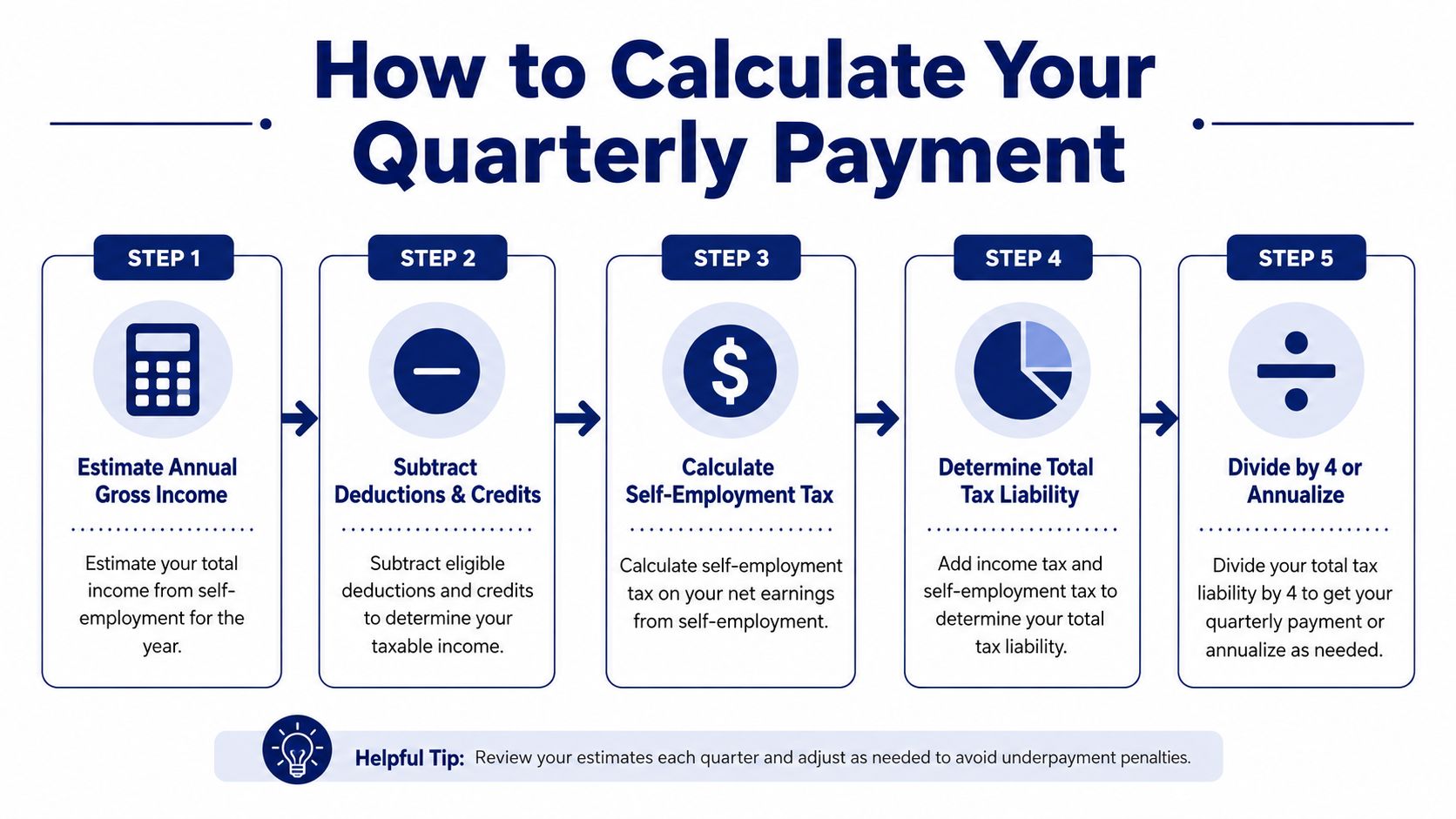
The cleanest calculation starts with an annual forecast. Estimate business revenue, subtract ordinary business expenses and other deductions, account for credits, include self-employment tax where applicable, and compare the result with withholding and payments already made.
Don't calculate from your busiest month. That's how founders end up paying tax on revenue that later gets refunded, written off, or swallowed by expenses. Use a rolling view of actual profit, then adjust the forecast when the business changes.
Use this sequence:
A self-employed consultant might forecast annual profit, calculate the resulting federal liability, subtract payments already made, and divide the remaining target across the unpaid periods. That's more defensible than moving a random percentage into a savings account and hoping the IRS appreciates the gesture.
A founder with a W-2 job and side income has another lever: withholding. Increasing payroll withholding can cover some or all of the side-business liability without sending separate quarterly vouchers. This often works well when salary is steady and side income is irregular, because payroll withholding is spread through paychecks rather than tied to a perfectly even business forecast.
Equal payments are convenient, not sacred. If most of your income arrives later in the year, the annualized income installment method can align payments with actual earnings. You calculate liability based on income received during each period instead of pretending the year's profit arrived in equal slices.
That matters for seasonal businesses, commission-heavy work, product launches, and founders whose revenue looks like a staircase designed by a caffeinated architect. Keep dated revenue, expense, withholding, and payment records so the calculation has a paper trail.
If deductions are the part you consistently miss, use a dedicated review of small-business tax deductions as a checklist, then confirm eligibility with a qualified tax professional. The point isn't to claim everything. It's to stop calculating tax from incomplete books.
Once you have a payment target, filing is mostly execution. Individual taxpayers generally use Form 1040-ES to calculate estimated tax and prepare payment vouchers. Corporations use the forms and procedures that apply to their corporate return. Don't send money without selecting the correct tax year and payment type. A payment applied to the wrong period is not a clever workaround.
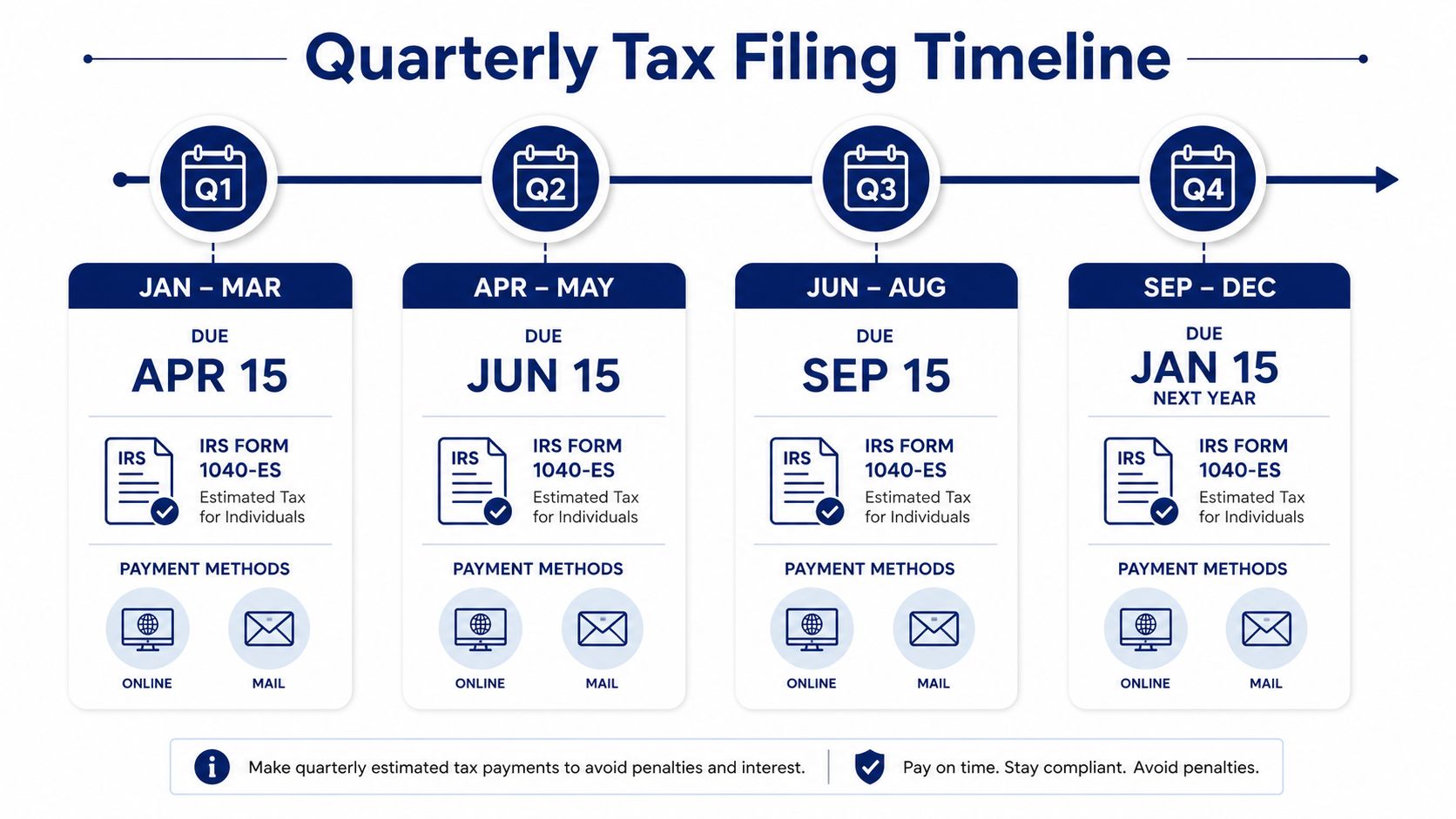
For calendar-year taxpayers, the IRS divides estimated tax into four periods:
| Income period | Typical due date |
|---|---|
| January 1 through March 31 | April 15 |
| April 1 through May 31 | June 15 |
| June 1 through August 31 | September 15 |
| September 1 through December 31 | January 15 of the following year |
The IRS estimated-tax FAQ explains that if a deadline falls on a Saturday, Sunday, or legal holiday, payment is timely on the next day that isn't a weekend or holiday. Fiscal-year taxpayers follow the tax-year calendar rather than blindly copying the calendar-year schedule. The IRS describes the broader rule as the 15th day of the fourth, sixth, and ninth months of the tax year, plus the 15th day of the first month after the year ends, in Publication 509.
My preference is electronic payment because the confirmation is easier to retrieve than a vanished paper check.
Save the confirmation number, payment date, amount, tax year, and payment type in one folder. Take a screenshot if necessary. Your accounting system should show the payment, but the IRS confirmation is the record that settles arguments with your future self.
A practical bookkeeping calendar can prevent missed deadlines and duplicated payments. A resource such as this 2026 compliance guide for bookkeeping can help you think in recurring close tasks rather than last-minute administrative sprints. For tools or outside preparation support, compare online tax preparation reviews before handing sensitive records to a provider.
One final operational rule: don't wait until the deadline to discover that your bank account, payment login, or tax software has a problem. Schedule the payment early, verify the confirmation, and reconcile it in your books. Bureaucracy rewards boring consistency.
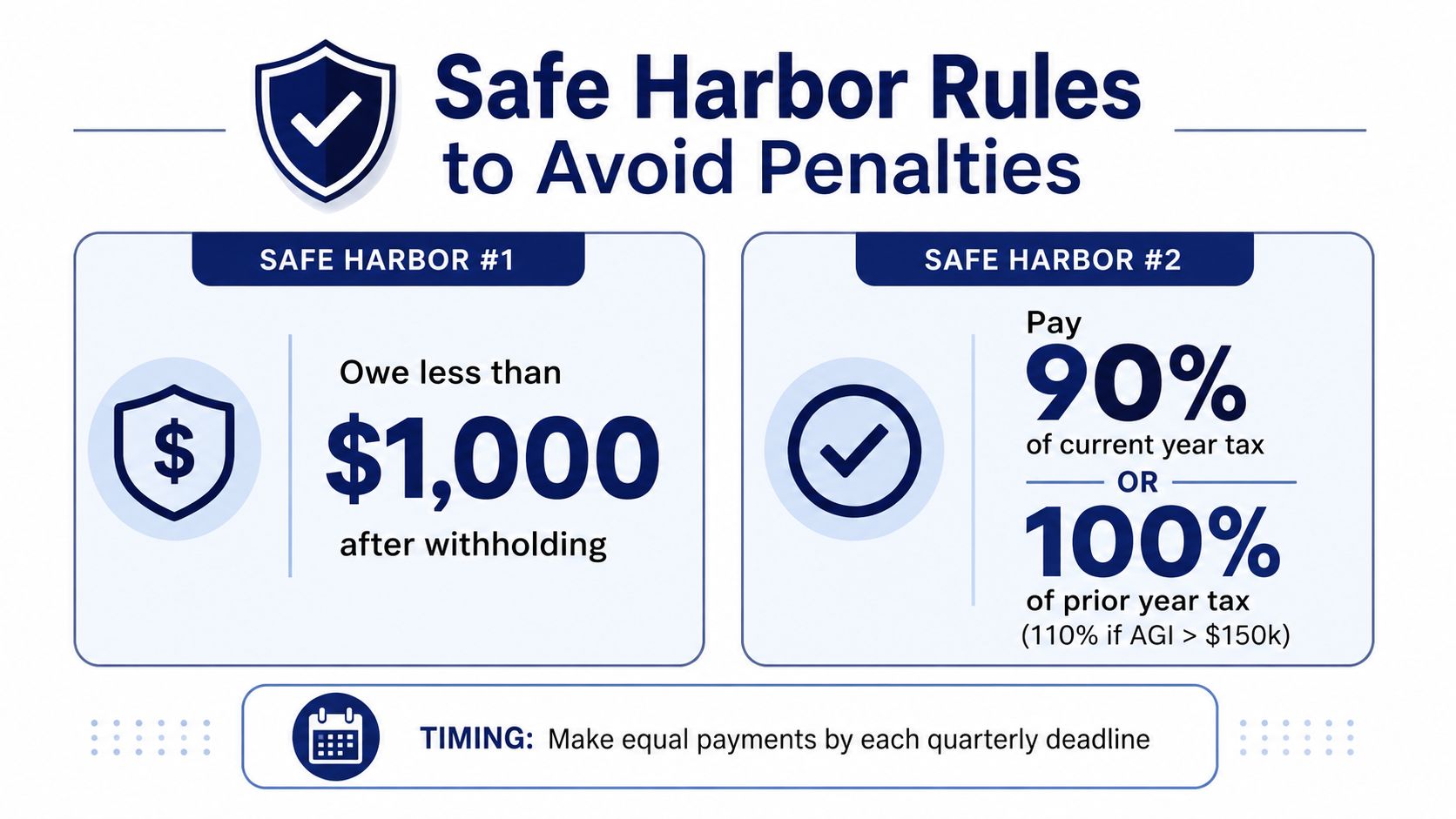
The safest quarterly-tax strategy isn't always the most accurate forecast. It's often the safe harbor. For most taxpayers, the IRS says you can generally avoid an underpayment penalty if you owe less than $1,000 after withholding and credits, or if you pay at least 90% of the current year's tax or 100% of the prior year's tax, whichever is smaller. Higher-income taxpayers may face a prior-year target of 110% when adjusted gross income exceeds the applicable limit, as described by the IRS tax topic on estimated tax penalties.
This changes the decision. You don't necessarily need to predict the final return perfectly. You need to meet a recognized payment threshold and avoid leaving a large balance exposed.
The underpayment penalty isn't a flat fee. It functions like interest on the shortfall and is calculated separately for each payment period. The applicable rate is the federal short-term rate plus 3 percentage points. In recent quarters, that translated into roughly 6% to 8% annualized, including cited examples of 7% for Q1 2026 and 6% for Q2 2026, according to the IRS estimated-tax penalty guidance.
That time-based design matters. A late or insufficient payment can create exposure for the period in which the money should have been paid, even if the final annual return produces a refund. The IRS can also charge a failure-to-pay amount that starts at 0.5% of unpaid tax per month and can rise to 25% while the balance remains unpaid, based on third-party guidance summarizing IRS rules.
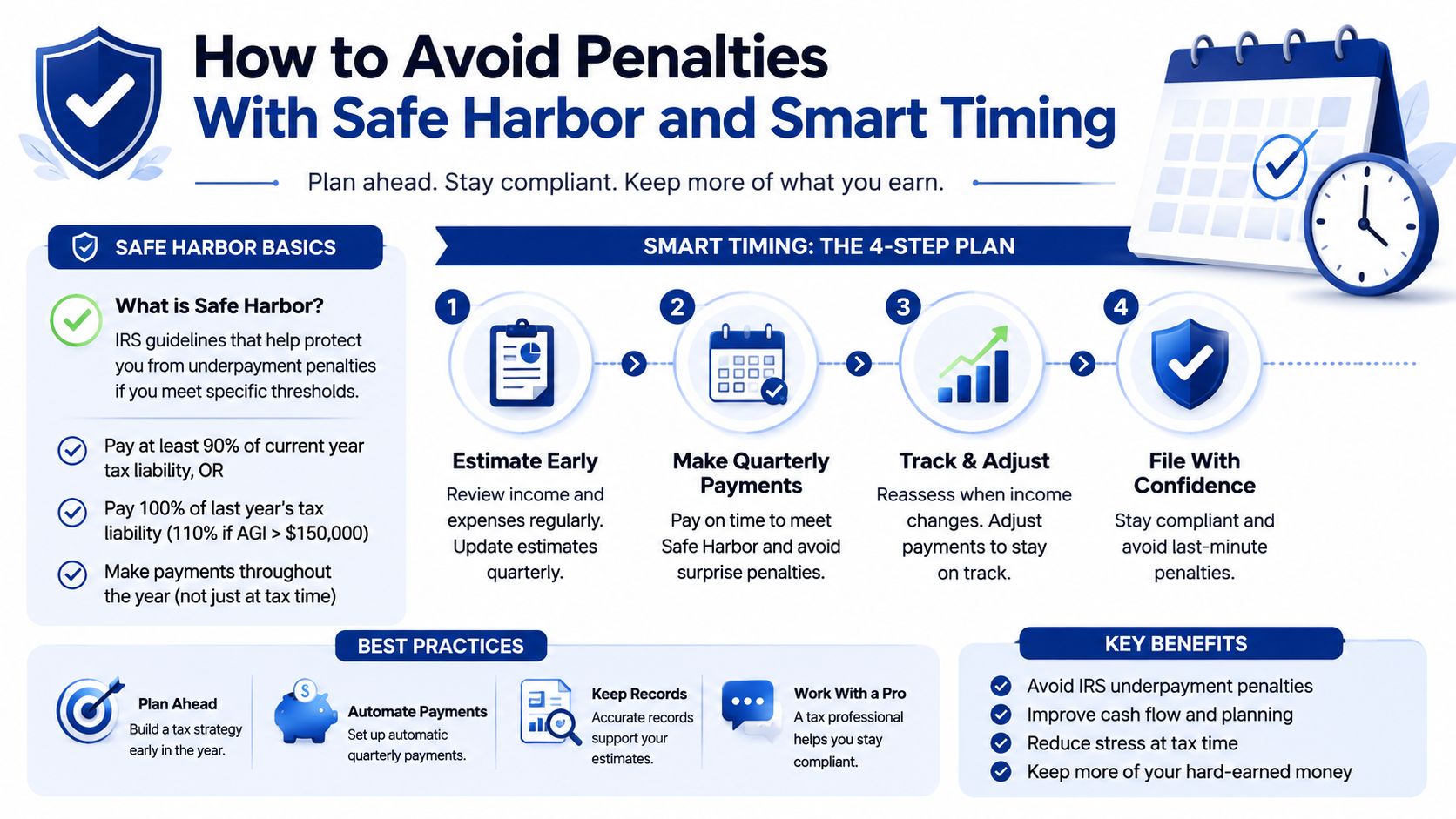
Withholding is often the underused tool. A founder with payroll income can adjust withholding to cover variable side income. That approach may be cleaner than making four rigid payments based on a forecast that becomes obsolete after one large contract.
Penalty exposure also appears to be affecting more taxpayers. An IRS-data analysis reported estimated-tax penalty counts rising from 11,103,032 in FY 2021 to 15,734,656 in FY 2025, as documented in the IRS Internal Revenue Manual. The lesson isn't to panic. It's to treat estimation as an operating process, especially when W-2 wages, 1099 income, and business distributions coexist.
My recommendation: Choose a safe-harbor target first, then improve accuracy with monthly bookkeeping. Don't gamble on a perfect estimate when a controllable payment threshold is available.
Quarterly taxes become much easier when the books produce answers before the deadline. Keep a separate business account, categorize income and expenses monthly, and review a simple profit snapshot before each payment. If your records are six months behind, your tax estimate is less a forecast and more a séance.
Automate the boring parts. Connect bank feeds, store receipts, label owner draws separately, and record every estimated payment with its date and tax period. If a refund is applied to a future estimated liability, document that transfer clearly. Otherwise, you may count the same money twice or assume the IRS has credited an amount it hasn't.
State taxes deserve their own review. State thresholds, filing rules, payment portals, and deadlines can differ from federal requirements. A clean federal process won't automatically protect you from a state underpayment issue, particularly if you work across state lines or move during the year.
A useful operating test: If you can't explain current-year profit, prior-year tax, withholding, and payments already made, you're not ready to calculate the next estimate.
Hire a professional when income streams multiply, ownership changes, payroll enters the picture, or you're spending more time fixing books than running the business. A capable bookkeeper can maintain the monthly rhythm, while a tax accountant can handle entity structure, annualized income, and penalty analysis. The trade-off is straightforward: you pay for expertise, or you pay with your time, errors, and occasionally an unpleasant letter.
If quarterly taxes keep stealing your attention, HireAccountants can connect you with pre-vetted accountants and finance professionals for bookkeeping, tax support, and ongoing finance operations. Visit the platform, explain your income setup and reporting needs, and find US-time-zone support that can keep the books current before the next payment deadline.
Let's simplify your finances today!