


You're approving payroll on a Friday afternoon when someone asks a nasty question: why did an employee in another state receive the wrong withholding, why is a contractor still classified as a contractor, and where's the proof that the tax deposit went out? You open three systems, search an inbox, and discover that the person who knows the answer is on vacation.
That's not an accounting inconvenience. It's an operational risk failure. Every paycheck creates obligations, and a business that treats payroll tax compliance as calendar housekeeping eventually ends up spending its calendar on notices, corrections, and uncomfortable conversations with the IRS.
A founder I know once treated payroll as a simple loop: approve hours, click “run,” and move on. Then a remote hire moved states, a contractor became a full-time team member, and a tax deposit was late because nobody owned the deadline. The company paid people correctly enough to keep morale intact, but its records could not explain which jurisdiction applied or why workers had been treated differently.
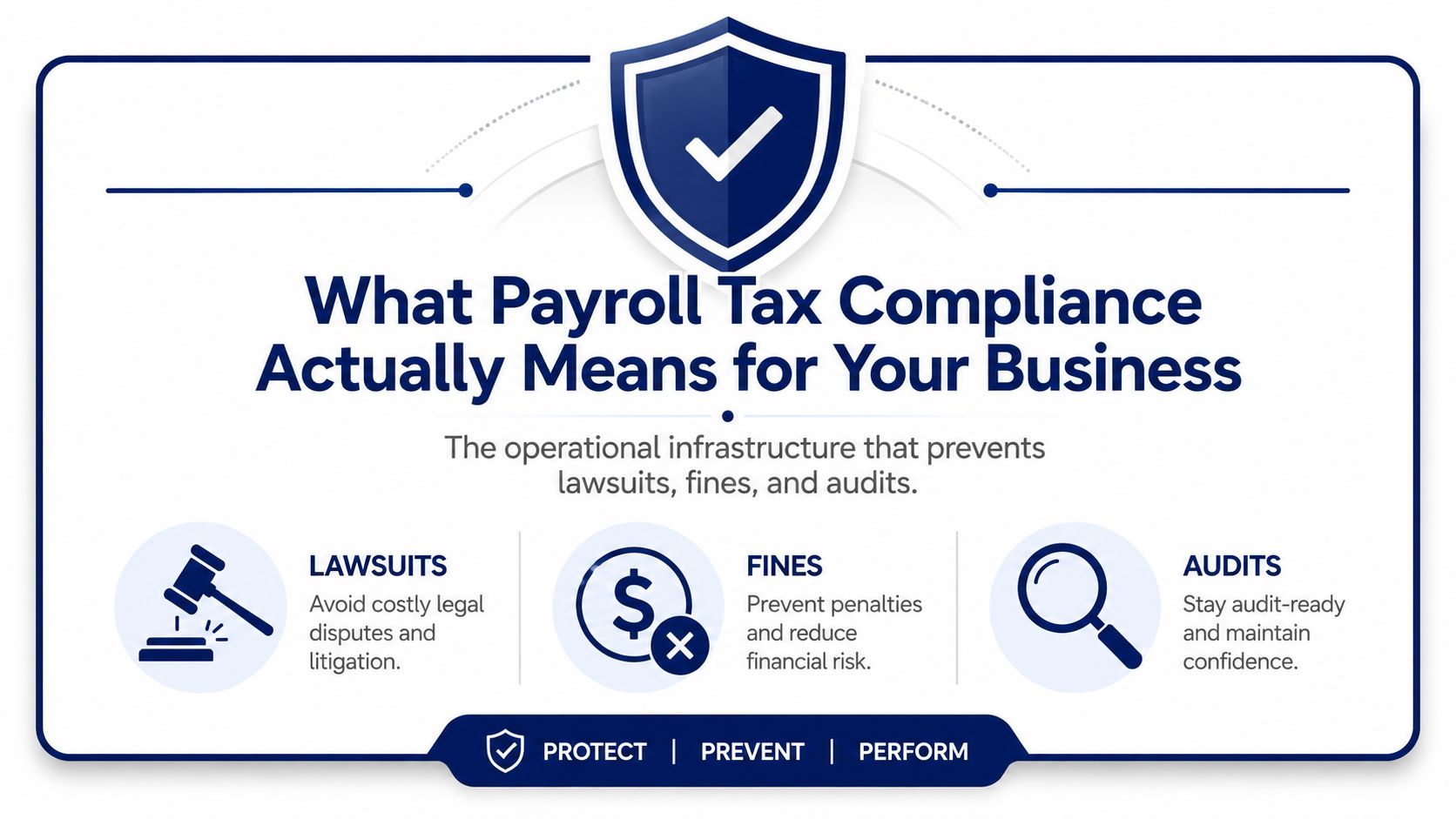
That failure exposes the core issue. Payroll tax compliance is the operating system behind every paycheck, not calendar housekeeping. It covers employee withholding, employer tax obligations, federal deposits, unemployment taxes, state and local registrations, worker classification, wage reporting, reconciliations, and evidence supporting each decision.
For a W-2 employee, payroll typically involves federal income-tax withholding, Social Security and Medicare withholding and matching, and federal unemployment taxes. State unemployment, state income tax, and local taxes may apply based on where the employee lives and works. The IRS describes depositing and reporting employment taxes as connected duties, so a classification mistake can produce missed withholding, late deposits, and incorrect returns. The IRS overview of depositing and reporting employment taxes provides a useful federal baseline before state rules enter the picture.
A contractor payment creates a different paper trail, not a free pass. Keep a defensible classification, complete onboarding records, and accurate information reporting. For cross-border teams, UK contractor tax obligations highlights the jurisdiction-specific questions U.S. founders often overlook.
The difficult cases sit at the intersection. A worker's classification affects withholding and reporting. A move across state lines can change registration, tax, and unemployment obligations. Once those facts span several jurisdictions, outsourcing stops being a convenience and becomes a control decision. If your provider cannot explain who owns each judgment and who reviews the evidence, the arrangement has not reduced your risk.
Practical rule: If nobody can explain who owns a payroll decision, assume the decision is at risk.
Treat payroll as risk management with a calendar. Every pay cycle, your controls should answer three questions: what did you owe, when did you owe it, and what proves you paid and reported it correctly? If the answer depends on one overworked administrator's memory, you are renting a control system instead of running one.
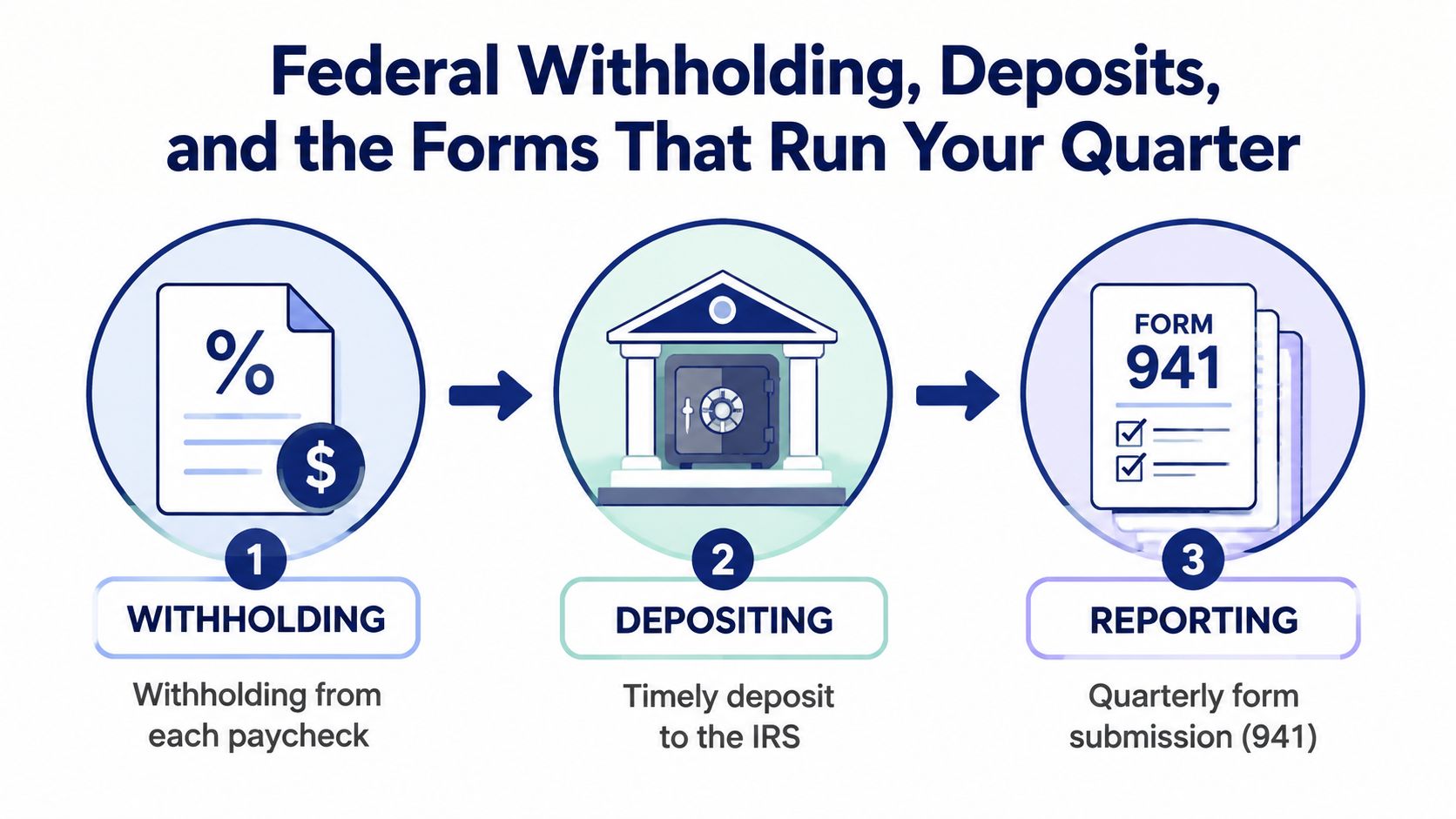
A founder pays the team on Friday, leaves the tax money in the operating account, and assumes the payroll software will handle the rest. Then the deposit schedule turns out to be semiweekly, the cash is gone, and an IRS notice becomes the company's most expensive reminder. Payroll tax compliance runs on three linked actions: withhold, deposit, report.
Withholding occurs inside each payroll run. Employee information, wage data, and applicable tax rules determine what comes out of pay and what the employer owes. That money is not operating cash. Keep it separate, or a routine payroll obligation can force an ugly financing decision.
The IRS generally assigns a monthly or semiweekly schedule according to the lookback period. Employers with reported employment taxes of $50,000 or less are generally monthly schedule depositors, with deposits due by the 15th day of the following month. Employers above $50,000 are generally semiweekly depositors. Wednesday through Friday paydays generally require deposits by the following Wednesday, while Saturday through Tuesday paydays generally require deposits by the following Friday. IRS Topic 757 explains the schedule.
Use the assigned schedule, not a generic tax-day reminder. Your calendar should show paydays, weekends, holidays, bank cutoffs, approval time, the reviewer, and a backup approver. If those details live only in one administrator's memory, the control is already weak.
Form 941 is filed for each quarter, with standard due dates of April 30, July 31, October 31, and January 31 for the first through fourth quarters. Before submission, reconcile the payroll register to the general ledger. The form connects wages, withholding, and employment tax liabilities, so an unexplained difference is a warning, not a clerical nuisance. The IRS Form 941 instructions set out the filing requirements.
Form 940 covers federal unemployment tax reporting. W-2 reporting connects payroll records with employee wage information. Build year-end reporting into every payroll run by preserving consistent employee, wage, jurisdiction, and tax-code data from the start.
Federal compliance gives you one rulebook. A distributed workforce gives you a stack of them.
An employee's home address can matter, but so can the place where the work is performed, the employer's registration status, and local rules attached to a city or municipality. A remote hire who relocates may trigger a new state registration, unemployment account, withholding setup, and reporting workflow before anyone notices the change in the HR system.
Residency and sourcing also create awkward situations. One worker may live in one state and work physically in another. Another may work from home full-time after moving without telling payroll. Reciprocal agreements can simplify withholding between certain states, but they don't eliminate the need to verify whether the agreement applies, whether the employee submitted required documentation, or whether local taxes create a separate obligation.
Build a location map that records where each employee lives, where they work, when they moved, and which jurisdictions payroll currently touches. Then connect that map to registrations, withholding accounts, unemployment accounts, local filings, and state tax rates.
| Scenario | Compliance Impact |
|---|---|
| Employee works from a new state | Review employer registration, withholding, unemployment, and filing duties before the next payroll. |
| Employee lives in one state and works in another | Analyze residency, work-location sourcing, and any reciprocal agreement. |
| Contractor works across jurisdictions | Recheck classification, disclosure, and information-reporting requirements. |
| Remote employee changes address | Update payroll records and assess whether the move changes tax obligations. |
| Team works in a city with local taxes | Confirm local registration, withholding, filing, and notice requirements. |
That small size doesn't reduce the complexity. A small startup with remote staff can face more jurisdictional complexity than a larger company operating from one office.
The operational test: Can you produce a current worker-location report that matches the addresses and jurisdictions in your payroll system?
If not, fix that before buying another dashboard. Software can't make an unknown work location compliant. It can only process the wrong assumption faster.
The employee-versus-contractor decision is a payroll tax decision wearing an HR name tag.
A W-2 employee generally brings withholding, employer payroll taxes, unemployment obligations, and wage reporting into the employer's process. A 1099 contractor generally receives payment without employee payroll withholding and handles their own tax responsibilities. The label in the contract doesn't settle the matter. The working relationship does.
The IRS examines behavioral control, financial control, and the type of relationship. Who directs how the work happens? Who controls the business and economic details? Do the parties behave like an ongoing employment relationship, or like independent businesses delivering a defined service? Form SS-8 is the IRS mechanism for requesting a determination when the classification is unclear.
| Tax Obligation | Employee (W-2) | Independent Contractor (1099) |
|---|---|---|
| Federal withholding | Employer withholds based on payroll records. | Generally no employee withholding by the client. |
| Social Security and Medicare | Employer withholds and generally matches applicable taxes. | Contractor generally handles self-employment tax obligations. |
| Federal unemployment | Employer may owe FUTA on eligible wages. | Payments aren't treated as employee wages when the classification is valid. |
| Information reporting | Wage reporting uses employee forms. | Information reporting may apply to reportable payments. |
| Audit exposure | Focus falls on payroll records and withholding. | Focus falls on whether the relationship was actually independent. |
Long-term contractors who work fixed hours, use company systems, report to a manager, and perform core business work deserve scrutiny. So do platform workers and foreign remote talent. The risk isn't limited to the tax bill. Reclassification can affect withholding, deposits, unemployment taxes, amended filings, and employment records.
Document the reasoning while the facts are fresh. Keep the written contract, scope of work, invoices, evidence of business independence, supervision records, and approval history. If you're sorting out form choices and reporting distinctions, this reference on 1099-NEC versus 1099-MISC can help keep the paperwork conversation precise.
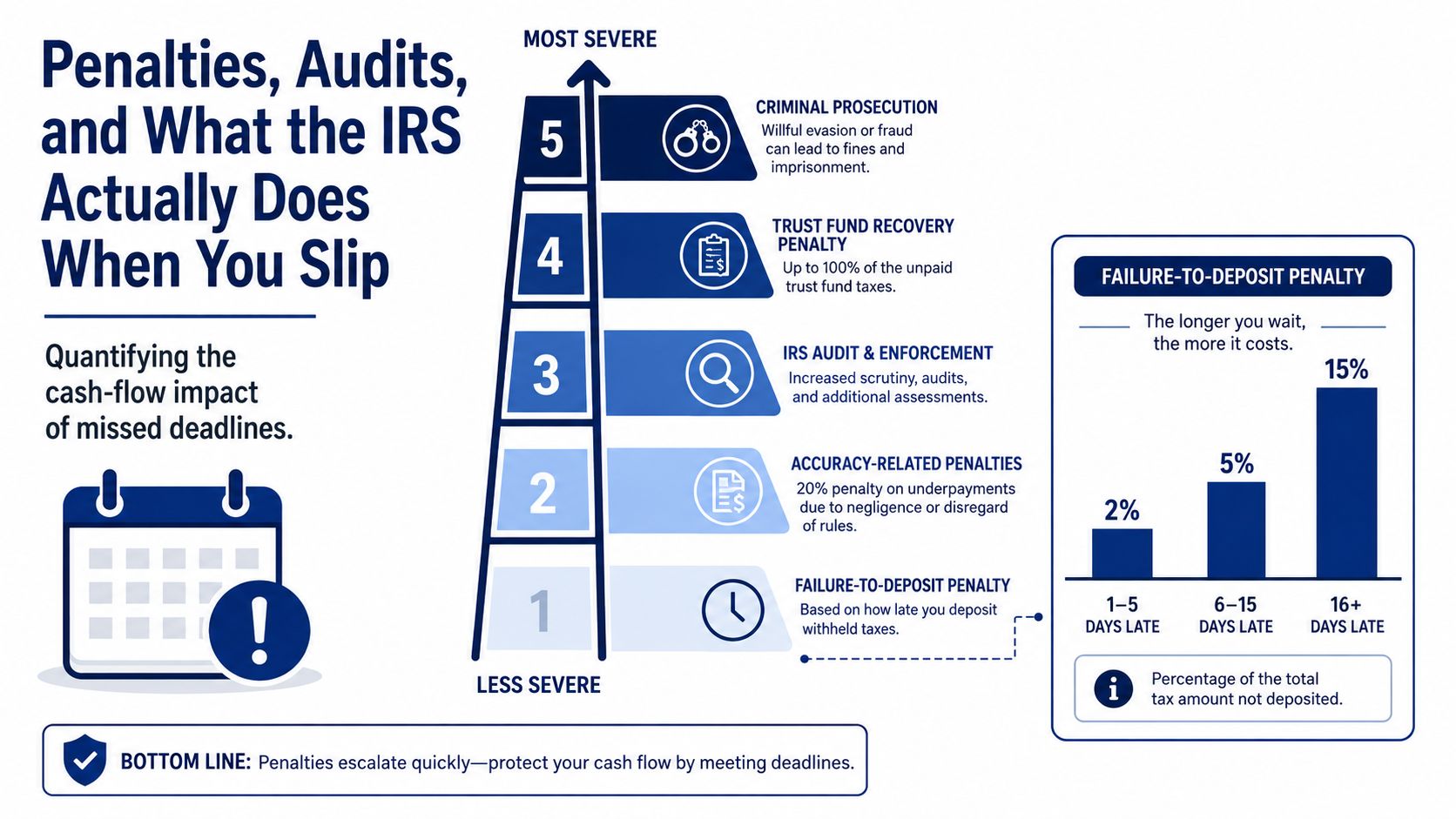
The IRS penalty ladder doesn't care whether the mistake came from a broken integration or a founder who forgot to approve an ACH. Late is late.
For federal deposits, the IRS applies 2% for deposits one to five calendar days late, 5% for six to fifteen days late, 10% for deposits sixteen or more days late, and 15% when the tax remains unpaid more than ten days after the first IRS notice demanding payment. IRS Publication 15 explains the timing rules. The cost curve gets steep quickly, which is why same-day exception handling beats heroic cleanup.
A late Form 941 can create a different exposure. The failure-to-file penalty is generally 5% of unpaid tax per month, up to 25%, with special minimum rules when the return is more than sixty days late. Paylocity's payroll tax penalties guide also lists 2026 information-return penalties of $60 per form when corrected within thirty days, $130 when corrected after thirty days but by August 1, $340 when filed after August 1 or not filed, and $680 for intentional disregard.
Those figures matter because information-return errors multiply by form count. One wrong wage record is a correction. A bad export can turn the same defect into a pile of corrections, employee questions, and avoidable correspondence.
The IRS estimated the 2022 annual gross tax gap at $696 billion, including $63 billion from nonfiling, $539 billion from underreporting, and $94 billion from underpayment. The IRS compliance analysis classifies unpaid taxes reported on time but not paid on time as underpayment, a category directly relevant to payroll operations.
The agency's activity is not theoretical. In FY 2025, the IRS closed 497,621 tax return audits and recommended $26.8 billion in additional tax. IRS tax compliance activity data shows the scale of active enforcement.
If a notice arrives, stop improvising. Preserve the payroll register, deposit confirmations, filed returns, employee setup records, and correspondence. A specialist who understands contractor equity and payroll intersections may also benefit from this 2026 guide to NQSOs, especially when compensation isn't limited to ordinary wages. For companies that need recurring help with payroll administration, contract payroll services can provide a defined owner for filings, reconciliations, and notice response.
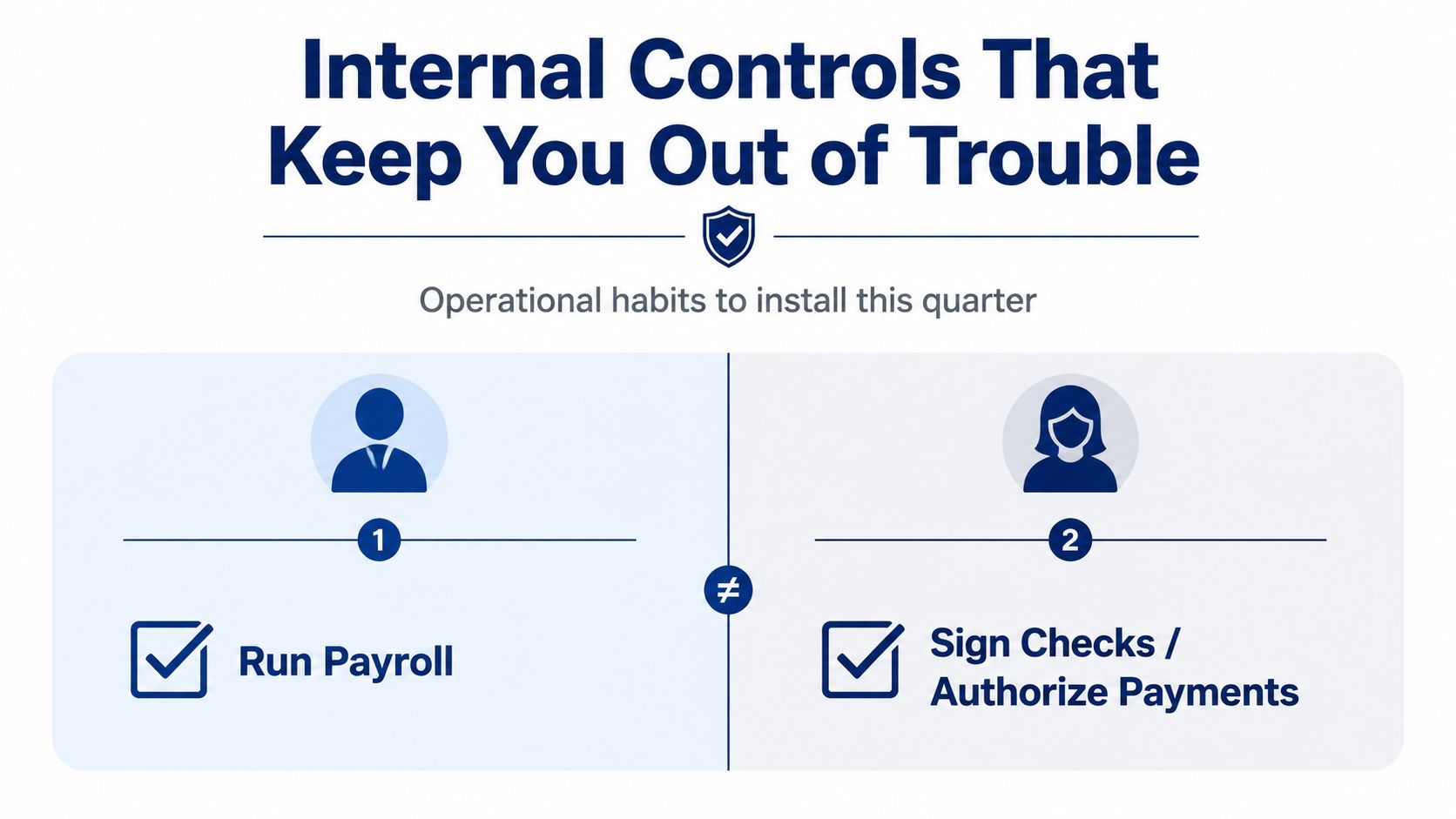
Good payroll controls are boring by design. Boring means the same person doesn't create an employee, run payroll, approve the register, and authorize the tax payment without another human checking the work.
Start with segregation of duties. One person prepares payroll. Another reviews the register and approves the ACH. A third person, or at least a documented backup, handles exceptions and notice intake. In a tiny business, you may not have three employees available, but you can still separate preparation from payment authorization through an owner review or an external accounting resource.
Perform a monthly three-way reconciliation:
At year-end, reconcile the final payroll to W-2 and W-3 reporting. Investigate differences instead of forcing a plug. A “miscellaneous adjustment” is often just an unexplained problem wearing a cheap disguise.
Use written approval for new hires, pay changes, bonuses, bank-detail changes, and contractor onboarding. Store the approval, effective date, supporting document, and person responsible in one controlled location. Keep payroll credentials in a password vault, limit access, and maintain a backup preparer who can step in without guessing.
Your notice plan should name one authorized contact, define who gathers documents, and set an internal deadline for response review. Keep deposit confirmations, filed returns, payroll registers, W-4s, state forms, classification memos, and reconciliation workpapers together. That audit trail won't make an IRS notice pleasant, but it can turn a panic spiral into a Friday afternoon document request.
The build-versus-buy decision isn't really about the software subscription. It's about whether your company can maintain accurate ownership while the workforce, jurisdictions, and compensation arrangements keep changing.
The tipping point may be your first multi-state hire, your first contractor-to-employee conversion, an acquisition, or the first IRS notice. A growing headcount adds pressure, but complexity usually breaks payroll before volume does. Once the founder becomes the backup preparer, reviewer, and notice responder, the business is already paying for payroll with attention it should spend elsewhere.
| Capability | DIY / Software | Full-Service Provider | Remote Accounting Pro |
|---|---|---|---|
| Payroll processing | Automates routine calculations when configured correctly. | Processes payroll within the provider's workflow. | Runs or reviews payroll using your systems and procedures. |
| Multi-state handling | Depends on setup, registrations, and plan coverage. | Often supports multiple jurisdictions, subject to contract scope. | Can maintain registrations, mappings, and reconciliations with direct oversight. |
| Deposit responsibility | Usually remains with the business unless explicitly delegated. | May be included, but contract language controls. | Can prepare and coordinate deposits, with authorization retained by the business. |
| Reconciliations | Requires internal time and expertise. | May be limited to payroll reports. | Can own payroll-to-ledger and return reconciliations. |
| Audit response | Founder or internal team handles notices. | Support varies by provider and agreement. | Provides a named person who knows the records and can assemble evidence. |
| Flexibility | High once configured, low when exceptions appear. | Structured and scalable, but less personal. | Adaptable to unusual workflows and changing worker arrangements. |
Payroll software alone is fine for a simple, stable setup with disciplined internal review. It isn't a substitute for classification judgment, location tracking, or a person who notices that the deposit total doesn't match the register.
A full-service provider can make sense when you want standardized processing and broad filing support. Read the agreement carefully. Ask who owns deposit timing, corrections, state registration, penalty response, and backup coverage. “We process payroll” doesn't necessarily mean “we accept every compliance liability.”
A remote accounting professional paired with software can work well when you need someone to own reconciliations, approvals, and exception management without handing your entire finance function to a bundle. HR and payroll outsourcing support is one route to evaluate when the gap is operational capacity rather than a desire for another application.
My bias: Buy software for repeatable calculations. Buy human ownership for judgment, reconciliations, and bad-news handling.
A founder skips one payroll review, then discovers the deposit, register, and state account do not agree. That is an operational failure, not a filing nuisance. Assign ownership before the next pay run.
Form 941 is generally due April 30, July 31, October 31, and January 31. Tie each filing to the payroll register and ledger, document corrections, and obtain reviewer approval before submitting.
Keep Form 940 on the annual calendar. When state unemployment notices arrive, verify the rates and confirm every state account remains active and correctly mapped. At year-end, reconcile final payroll with W-2 and W-3 reporting, review employee addresses and identifying information, and complete required contractor information returns on schedule. For related people and policy controls, the HR compliance guide provides a useful companion.
How much should I withhold from a salary?
Do not pick a convenient percentage. Use the employee's current Form W-4, applicable IRS withholding tables, pay frequency, taxable wages, and state or local requirements. Have payroll software or a qualified payroll professional calculate the amount, then compare the result with the employee's records.
What triggers an IRS payroll audit?
No single trigger gives you a safe prediction. Inconsistent wages, deposits that do not match returns, repeated corrections, classification concerns, missing records, and unexplained discrepancies can all create exposure. Accurate records, timely filings, reconciliations, and a clear explanation for unusual items give you a defensible file.
Can the owner pay themselves through the same payroll run?
The answer depends on the entity type and the owner's tax treatment. Do not copy another founder's setup. Confirm the treatment with a tax professional, configure payroll correctly, and document the decision before processing compensation.
Payroll tax compliance works when one person owns the calendar, another checks the numbers, and the company can prove both actions occurred. If worker locations, classifications, or filing volume keep changing, outsourcing becomes a control decision rather than a convenience.
HireAccountants helps U.S. companies find pre-vetted accountants and finance professionals for bookkeeping, payroll, tax, and reconciliation work, with flexible full-time or part-time arrangements. If payroll has outgrown internal capacity, visit HireAccountants to review qualified remote finance talent and assign clear ownership to the compliance process.
Let's simplify your finances today!