


You're staring at a bank feed full of uncategorized transactions, a folder of receipts that nobody has opened, and a tax bill that somehow became a surprise. Your bookkeeper said the books were “almost caught up” three weeks ago. It's 11 PM, and you're reconciling expenses yourself because “someone” clearly wasn't enough.
That's the trap. To hire a virtual bookkeeper successfully, you can't just find a person who knows QuickBooks or Xero. You need someone who can run a disciplined monthly close, investigate exceptions, protect sensitive data, and tell you when the numbers don't make sense. Cheap transaction entry is easy to buy. Reliable financial operations are not.
The first bad hire usually looks sensible. The candidate has a polished profile, a reasonable rate, and plenty of confidence. You hand over access, explain the chart of accounts, and expect clean financials to appear by month-end.
Instead, transactions get categorized without questions, unreconciled items sit in the bank feed, and the month closes only when you force it closed. You discover duplicate expenses after a vendor dispute, notice that payroll entries don't match the bank activity, and realize the bookkeeper has been waiting for missing documents without escalating the problem.
That's not bookkeeping. That's administrative drift with a login.
Virtual bookkeeping has become mainstream because cloud accounting tools let professionals manage records from anywhere with internet access. A 2025 industry explainer describes remote bookkeeping as work performed through secure cloud tools such as Xero, FreeAgent, and Hammock, while a 2026 outsourcing summary reports that 96% of CFOs rely on at least one third-party finance and accounting provider, up from 79% the prior year. The same summary places the global finance and accounting outsourcing market at $59.05 billion in 2026, with a projection of $85.92 billion by 2031. That industry overview explains why remote bookkeeping is now operationally normal, not some experimental arrangement.

Global access gives you more candidates, but it also creates more ways to get the wrong person. A virtual bookkeeper can post entries from anywhere. The harder question is whether they can explain an unreconciled balance, document a judgment call, and finish a close without needing you to act as finance manager.
Founders often focus on hourly rates because the number is visible. The cleanup work, supervision time, compliance exposure, and fraud risk stay hidden until they land on your desk. If you're already making executive hiring decisions under pressure, practical high-stakes HR advice for executives can help you think more clearly about role ownership, accountability, and risk.
The standard is simple: don't hire someone to touch your books. Hire someone who can own a repeatable close.
Before you browse profiles, write down what “done” means. A virtual bookkeeper might only categorize transactions, or they might handle reconciliations, accounts payable, payroll processing, tax support, and management reporting. Those are different jobs, with different skill requirements and different prices.
Start with the recurring workload. List your bank and credit card accounts, sales channels, payment processors, payroll system, billing tools, and reporting needs. Then identify the work that currently piles up. If the problem is unreconciled accounts, don't pay for a vague “full-service finance package” without confirming reconciliation ownership. If payroll and filing deadlines are the pain point, make those responsibilities explicit.
Use a simple scope document with four parts:
Published guidance shows how widely pricing can vary. Small businesses often pay about $300 to $1,200 per month for outsourced bookkeeping, while full-service or more complex setups can cost $500 to $2,500 or more per month. Another industry source places outsourced bookkeeping anywhere from $500 to $7,500 per month, with scope, transaction volume, payroll, reporting, and cleanup work driving the spread. The small-business bookkeeping cost guidance breaks down those pricing levers.
| Scope Level | Typical Monthly Cost | What Is Included |
|---|---|---|
| Basic | $250 to $1,000 | Transaction categorization, bank-feed maintenance, and basic reconciliation |
| Standard outsourced | $300 to $1,200 | Recurring reconciliations, document capture, payables or receivables support, and routine reporting |
| Full-service or complex | $500 to $2,500+ | Higher transaction volume, payroll, compliance support, management reporting, and close ownership |
| Broad managed engagement | $500 to $7,500 | Complex operations, cleanup, multiple entities, payroll, reporting, and expanded finance support |
These ranges are benchmarks, not promises. A business with clean records and straightforward activity may fit the lower end. A company with multiple entities, inventory, payment processors, payroll, or historical cleanup needs won't.
Keep approval authority, banking decisions, unusual journal-entry approval, and final management review with the founder or finance lead. Hand off repeatable processing, reconciliations, document follow-up, and close preparation.
Cost comparisons should use a real labor baseline. U.S. Bureau of Labor Statistics data cited in hiring guidance puts bookkeepers at just under $50,000 per year, or nearly $24 per hour, while the BLS wage reference reports a $38,790 median annual wage and $18.65 median hourly wage in May 2023, with the 10th percentile at $15.61 per hour and the 90th percentile at $27.90 per hour. Use the BLS salary context when testing savings claims. Outsourcing guidance reports potential labor savings of 40% to 60% versus in-house bookkeeping, but only when you include the full scope and manage the engagement properly. This outsourcing benchmark also flags cost-only selection as a common mistake.
The sourcing channel shapes the quality of your shortlist. A freelance marketplace gives you speed and global reach, but you'll need to inspect work history, run the assessment, check references, and manage the relationship yourself. That can work for a cleanup project or a low-complexity set of books. It's a weak setup when you need dependable monthly close ownership and backup coverage.
Specialized recruiting platforms sit between self-service hiring and outsourced delivery. They can provide pre-vetted candidates, recruiting support, and matching based on software, industry, availability, and role requirements. You'll still own the final decision, but you won't spend your entire week separating polished profiles from capable operators.
Managed bookkeeping services offer the most structure. You're buying a team, defined processes, and accountability rather than relying on one person's availability. The trade-off is less direct control over staffing and a higher service cost than a solo freelancer. For a startup with messy books or a finance function that can't afford interruption, that trade is usually sensible.
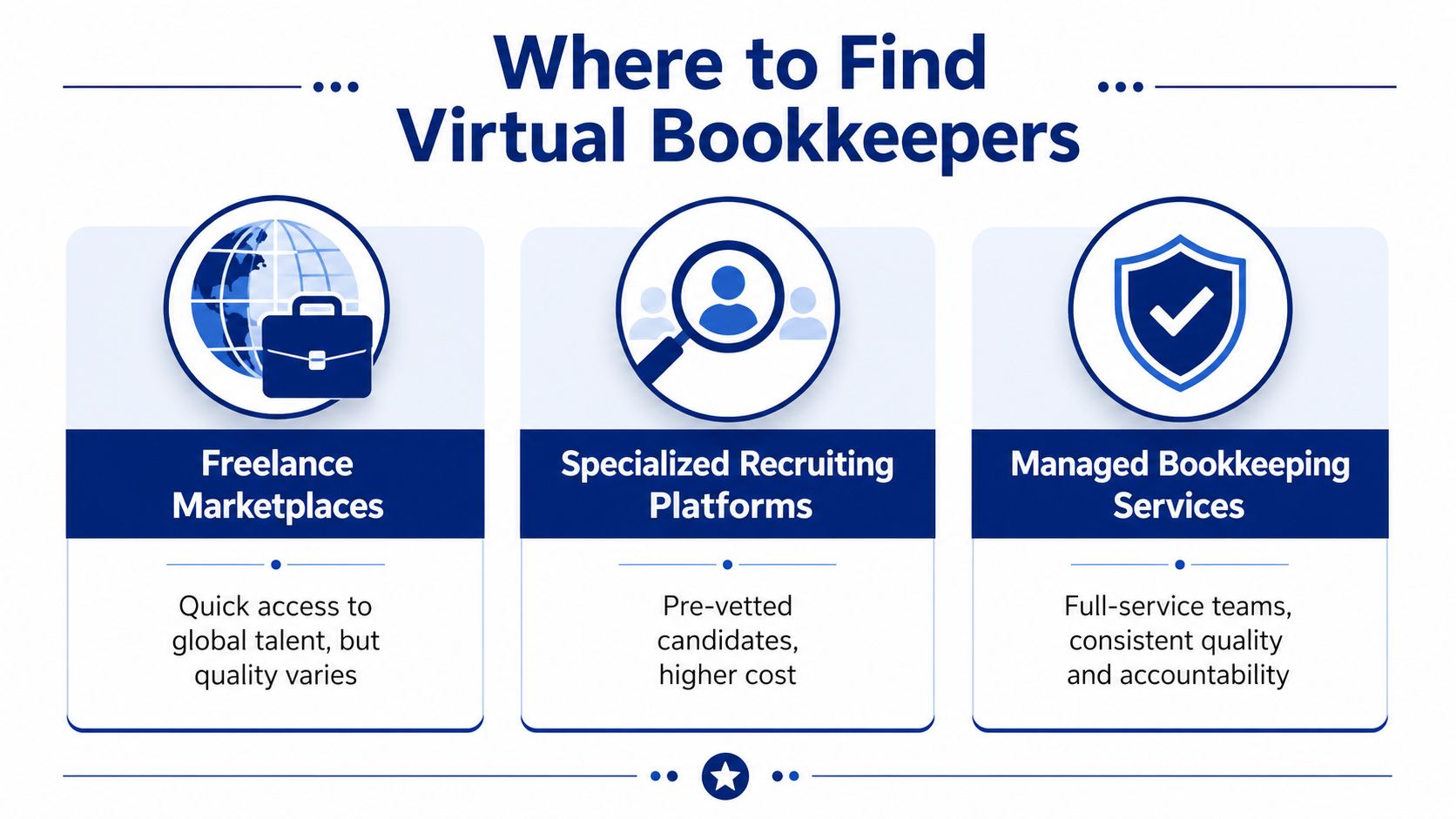
| Channel | Best Fit | Main Risk | My Take |
|---|---|---|---|
| Freelance marketplaces | One-time cleanup or straightforward recurring work | Quality varies and continuity can be fragile | Use for defined projects, not blind trust |
| Specialized recruiting platforms | Startups and SMEs needing a capable individual quickly | You still need a serious trial and operating process | Best balance for many growing companies |
| Managed bookkeeping services | Complex books, payroll, multi-entity work, or backup coverage | Higher cost and less direct staffing control | Choose this when continuity matters more than bargain pricing |
Time zones deserve more attention than they usually get. Offshore coverage can allow books to be updated overnight, so owners may begin the day with current records instead of waiting for local office hours, according to guidance on virtual bookkeeping and payroll services. That benefit only exists if the provider documents handoffs, responds during agreed overlap hours, and escalates exceptions instead of leaving them in a queue.
A remote team without communication overlap is just a delayed inbox.
Ask every provider how they handle vacation coverage, month-end spikes, missing documents, and urgent questions. A solo bookkeeper may be excellent, but one person shouldn't become a single point of failure for payroll or close. If you're evaluating broader automation and digital staffing options, an AI employees platform can provide useful context, but don't confuse automation with accounting judgment.
For a practical comparison of remote delivery models, review remote bookkeeping services alongside the individual candidates you're considering. HireAccountants is another option in this category, combining a self-service talent platform with recruiting support and AI matching for remote accounting and finance roles. Look for a sourcing model that matches your actual operating burden, not the one with the flashiest profile grid.
A resume can tell you which software a candidate has touched. It can't tell you whether they'll investigate a reconciliation difference instead of forcing the account to balance.
The best test is a practical trial close using anonymized or fabricated company data that mirrors your workflow. Give the candidate a bank feed, supporting statements, a few invoices, payroll records, and several deliberately ambiguous items. Ask for reconciliations, an exceptions log, proposed corrections, and a short close summary.
Give the candidate enough information to reveal judgment. Include a duplicate transaction, a payment processor mismatch, an expense with unclear business purpose, an old unreconciled item, and an accrual that needs review. You're not trying to trick them. You're testing whether they know when to pause, document, ask, and escalate.
Evaluate the work against specific operating criteria:
Ask questions that force process answers. “How do you reconcile a bank account?” produces rehearsed noise. “What do you do when the bank balance agrees but the payment processor clearing account doesn't?” gives you something useful. Ask who reviews their work, how corrections are documented, and which permissions they need to perform the job.
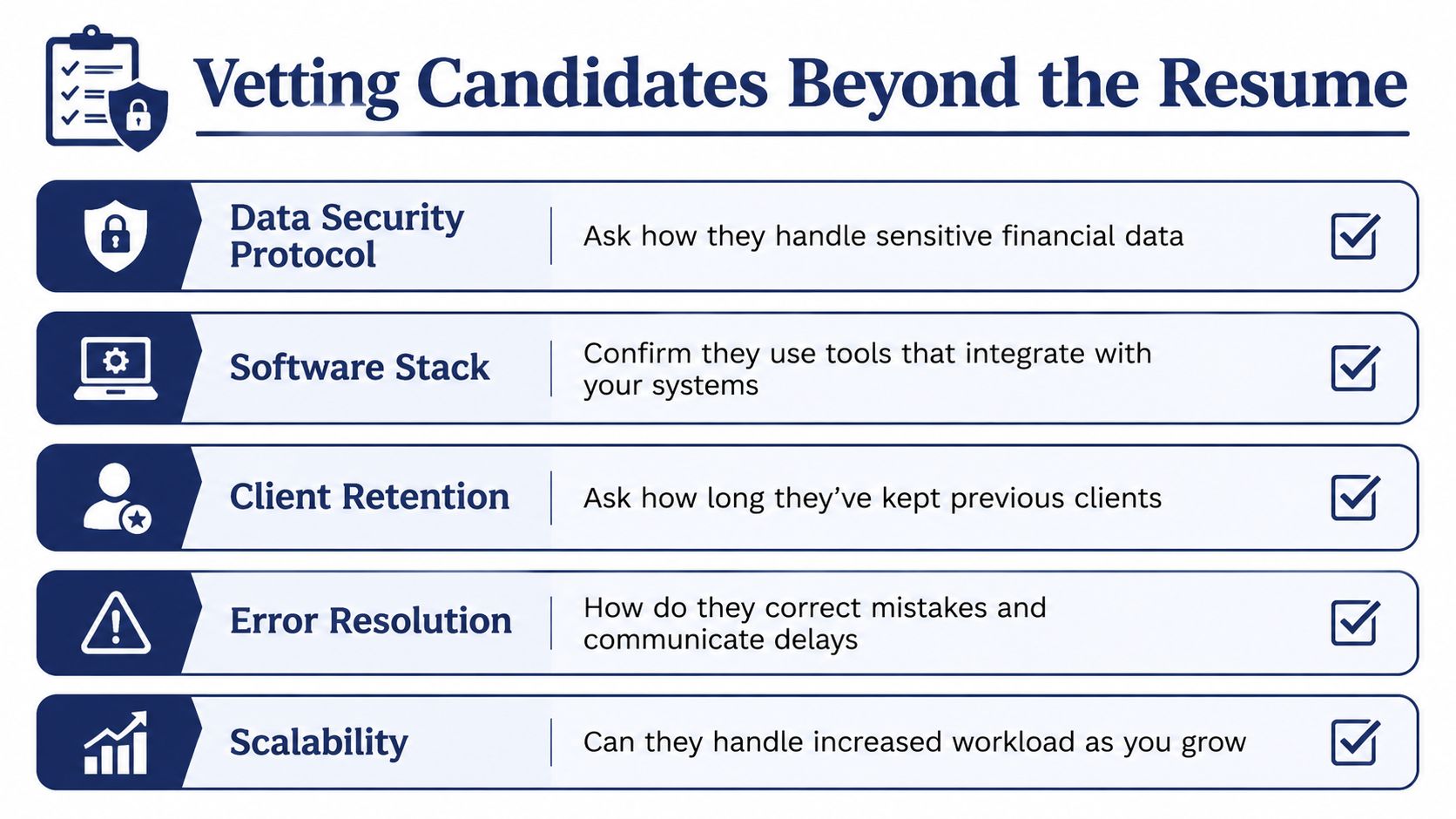
A competent bookkeeper understands that access is part of the job. Remote accounting-control guidance recommends segregation of duties, restricted software access, VPN-only server access, routine password changes, and auto-lock policies to reduce fraud and confidentiality risk in distributed teams. The remote internal-controls guidance provides the control principles to apply.
Ask the candidate how they'd separate transaction entry from payment approval. Ask what they'd do if a client requested shared credentials, and whether they'd accept broad administrator access without a documented reason. The correct answer isn't “I'm trustworthy.” The correct answer is a process that doesn't depend on trust alone.
Hiring guidance also points to software familiarity, bank-feed reconciliation, sample tasks, SOPs, access control, and ongoing review as core evaluation areas. Remote accounting roles rose from about 8% of postings in 2019 to almost 20% in 2023, while bookkeeping employment faces projected long-run decline even as openings remain substantial, according to guidance on hiring a virtual bookkeeper. That combination makes a structured assessment more valuable than a fast interview.
Use accounting interview questions to build a consistent interview scorecard, then contact references with questions about close reliability, correction habits, and communication under deadline pressure. If your outreach needs work, these recruiting emails that get replies can help you ask for useful reference feedback without sending a corporate novel.
A good hire can still fail inside a bad system. Give someone unclear ownership, scattered documents, excessive permissions, and no close calendar, then act surprised when the books wobble. That's not management. That's an experiment in preventable pain.
Start with a cloud-based workflow that provides real-time access to financial data. Use accounting software for daily entries, invoice and bill payment workflows, and standardized document capture. Put receipts and invoices in a shared system or client portal, not in a heroic email chain that only one person understands.
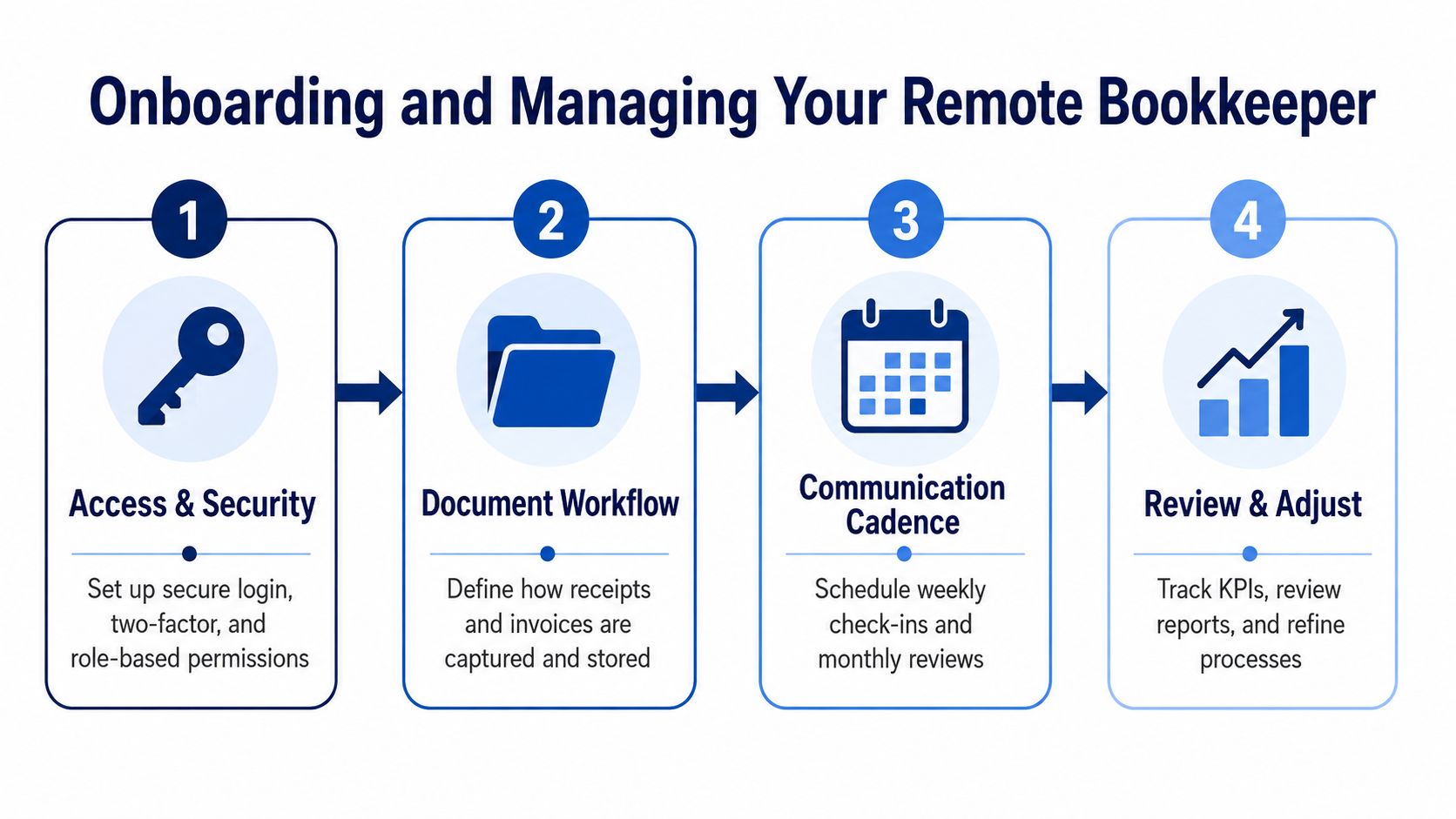
Your onboarding checklist should include:
This guide to onboarding remote employees is useful for organizing access, expectations, communication, and documentation before work begins.
Set a weekly operational check-in and a monthly financial review. The weekly call should focus on open exceptions, missing documents, upcoming deadlines, and blockers. The monthly review should examine the close checklist, reconciliation status, material corrections, and management reporting.
Track close timeliness, error rates, exception-resolution quality, and control failures. You don't need a complicated dashboard. A shared checklist with clear owners and dates will expose more than a glossy report nobody reads.
Cross-border teams need explicit overlap coverage. The overnight-update benefit described in virtual bookkeeping guidance depends on a handoff process and agreed availability, not geography alone. Also clarify who owns payroll processing, tax compliance support, and quarterly or annual reports. Remote bookkeeping providers may handle those services, but the contract must distinguish preparation, review, approval, and filing responsibility. This overview of remote bookkeeping services outlines the broader operational scope payroll can create.
Your bookkeeper should surface exceptions before you discover them in a tax notice.
Review permissions regularly, rotate passwords according to policy, and remove access immediately when the engagement ends. Keep a backup of SOPs, close checklists, and key reconciliations so the business owns the process, not just the relationship.
The best virtual bookkeeper isn't the person with the lowest rate. It's the person who produces clean reconciliations, closes on schedule, explains exceptions, respects controls, and gives you financial information you can use.
Define the scope before you shop. Choose a sourcing channel that fits your complexity and need for continuity. Run a trial close, test control judgment, check references, and set up secure access before the first live transaction.
Your next move is straightforward:
That process costs less than cleaning up a careless hire while mortgaging your office ping-pong table.
HireAccountants connects US companies with pre-vetted remote bookkeepers and finance professionals through a talent platform, recruiting support, and AI matching. If you need help building a reliable bookkeeping function with flexible engagement options and onboarding support, visit HireAccountants and start your search.
Let's simplify your finances today!