


Tax compliance means registering correctly, reporting completely, keeping supporting records, filing every required return on time, and paying the correct amount on schedule. The OECD frames it around four core obligations, registration, timely filing, accurate reporting with records, and timely payment, while also separating administrative compliance from calculating tax correctly under the law. OECD compliance-risk guidance
You're probably not thinking about this while sales are growing and the team is celebrating a good month. You're thinking about it when the bank balance looks thinner than expected, your accountant asks for three months of missing statements, and someone discovers sales tax, payroll deposits, or an estimated payment that never made it onto the calendar.
That's when founders learn the expensive version of what tax compliance means. It isn't “submit the return and move on.” It's the operating system that keeps registrations, transaction data, reconciliations, filings, payments, deadlines, and audit-ready records working together.
A founder I've seen more than once discovers the problem at exactly the wrong moment. Revenue is up, payroll is due, vendors want payment, and the tax account suddenly contains a liability nobody budgeted for. The company may have a tidy-looking profit and loss statement, but tidy bookkeeping isn't proof that every tax obligation was registered, calculated, filed, and paid.
Tax compliance is the full operating loop. You register the business and its tax accounts correctly. You capture the transactions that create tax obligations. You keep documentation that supports the numbers. You file each required return on the relevant calendar. Then you pay the correct liability, on time, through a process that leaves evidence behind.
The OECD's framework makes the distinction useful. Administrative compliance covers timely lodging and payment, while technical compliance covers calculating tax correctly under the law. A business can fail either one. Paying on time doesn't rescue an inaccurate return, and an accurate return filed after the deadline can still create penalties. OECD guidance on administrative and technical compliance
Bookkeeping records what happened. Compliance asks whether the company handled the consequences correctly.
That difference matters for US small businesses. Payroll tax deposits, for example, aren't just accounting entries. Unpaid employee payroll taxes can create trust fund recovery exposure personally against responsible founders and managers. The company's books may show the liability, but the tax authority still expects the money and may pursue the people responsible for collecting and paying it.
Practical rule: If a tax obligation can surprise you after the cash has already been spent, it belongs in a recurring control process, not in someone's memory.
The goal is predictable cash planning, verifiable good standing, and documentation that can survive an inquiry. Compliance feels invisible when it works. Nobody celebrates a clean reconciliation or a correctly archived payroll report. But when the system breaks, the team gets notices, penalties, interest, emergency calls, and the cheerful group chat full of panicked GIFs.
The rest of the process comes down to five connected layers: registration, data capture, reconciliation and reporting, filing, and payment. Weakness in one layer travels quickly into the next.
Think of tax compliance as an operating system, not a year-end chore. Each layer feeds the next, and the system only works when the records, calculations, deadlines, and payments agree.
The first layer is getting the company into the right tax systems. That can include federal registration, state tax accounts, local registrations, an EIN, payroll accounts, and sales tax permits. The exact setup depends on the entity, activities, employees, locations, and jurisdictions where the business operates.
A missing registration creates a basic problem: the company may not receive the notices, filing instructions, or payment credentials needed to comply. Founders should keep a central register showing every account, account number, jurisdiction, filing type, responsible owner, and access method.
The second layer captures the activity that creates tax obligations. Connect bank accounts, cards, payroll records, point-of-sale data, invoices, payment processors, inventory systems, and contractor information where the workflow allows it.
The goal isn't to collect data for its own sake. It's to make sure taxable sales, wages, withholding, deductible expenses, fixed assets, and contractor payments don't disappear between systems. A spreadsheet can help at an early stage, but it becomes fragile when people manually copy figures between disconnected tools.
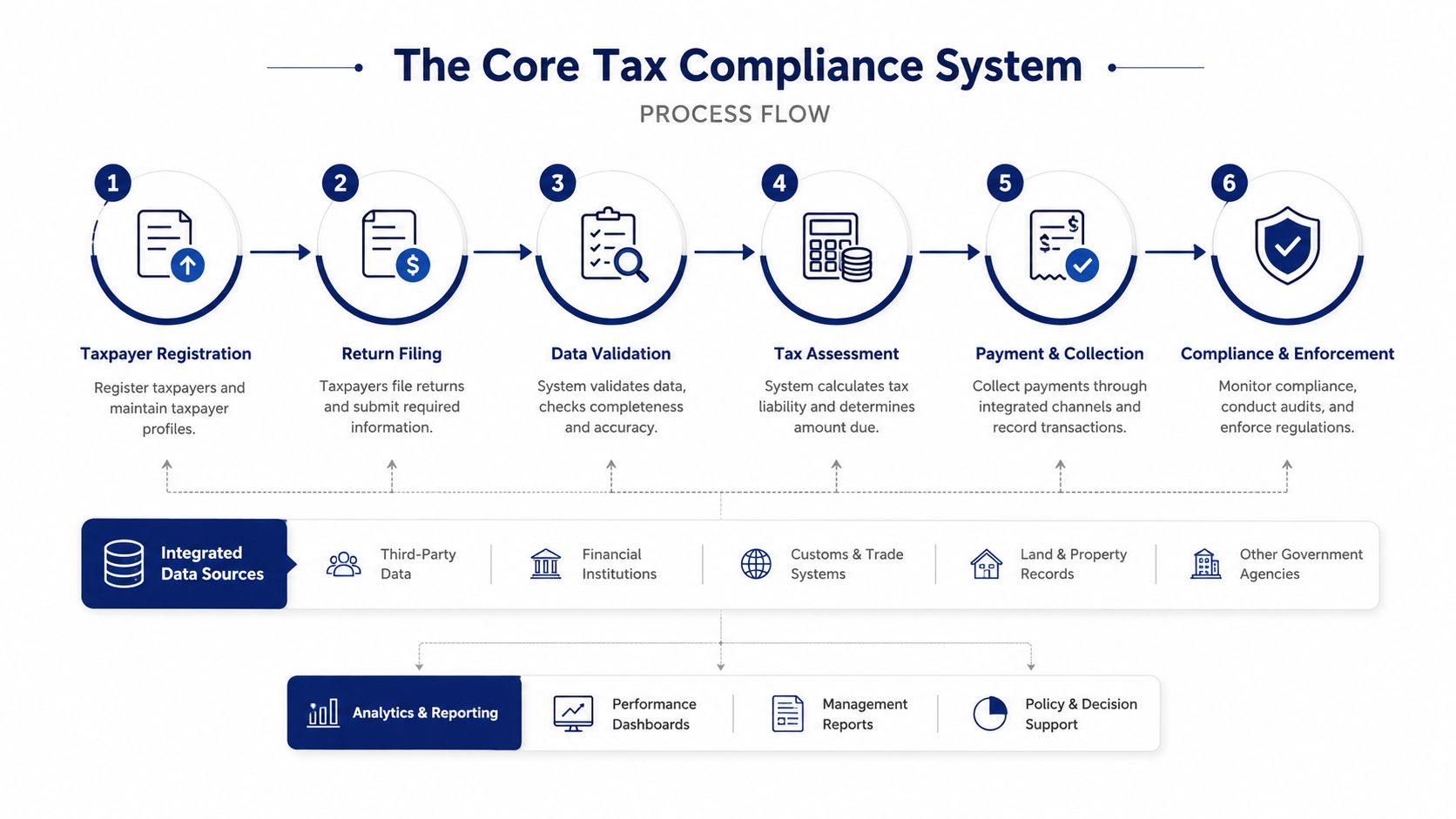
The third layer is where many businesses stumble. Reconciliation checks whether the accounting records match bank activity, payroll reports, sales channels, payment processors, and filed returns.
Skipping reconciliation is the usual culprit behind misreported liability. The books may contain duplicate deposits, missing refunds, uncategorized transfers, or sales recorded in the wrong state. Those errors don't stay politely inside the ledger. They can distort income tax, payroll reporting, sales tax, and cash forecasts at the same time.
The fourth layer maps returns and informational forms to jurisdiction-specific calendars. The fifth layer pays the liability and stores proof of payment. A filed return without payment is incomplete, and a payment without a filed return can be just as messy to trace.
OECD-aligned compliance systems treat registration, filing, accurate reporting with recordkeeping, and payment as measurable control points rather than one annual event. Benchmarking guidance for tax administrations That's the right mental model for a company, too. Build the pipeline, assign owners, review exceptions, and keep evidence.
US business tax compliance is a stack, not a single return. The entity determines the main income tax form, but payroll, sales tax, information reporting, state taxes, and local obligations can sit beside it.
A C corporation generally files Form 1120. An S corporation uses Form 1120-S. A partnership generally files Form 1065. A sole proprietor typically reports business activity on Schedule C attached to a personal Form 1040. Pass-through owners also need to understand how business results affect their personal returns.
The form is only the visible part. The source documents underneath it include the general ledger, trial balance, payroll registers, bank statements, loan records, fixed-asset schedules, inventory records, contractor files, and sales reports. If those inputs aren't reconciled, the return preparer is working from a guess with better stationery.
Employers generally deal with Form 941 quarterly, payroll tax deposits, Form 940 for annual FUTA reporting, state unemployment filings, and employee W-2 processing. Businesses that pay eligible contractors also need a reliable 1099 workflow, including collecting tax information and tracking reportable payments.
Assign payroll compliance to someone who reviews payroll before submission, confirms deposits afterward, and retains the reports. The person running payroll shouldn't be the only person approving the payment. That's not bureaucracy. That's a basic control against expensive mistakes.
Sales and use tax obligations vary by state. Economic nexus thresholds, marketplace facilitator rules, product taxability, customer location, and filing cadence all matter. An e-commerce company can create obligations in places where it has no office, while a services company may face a different analysis based on the service and customer location.
Maintain a sales nexus matrix with states, registration status, collection rules, marketplace treatment, filing frequency, filing owner, and last review date. Don't wait for a state notice to discover that the business crossed a threshold months ago.
Franchise taxes, excise taxes, and gross receipts taxes can also apply across states. They're easy to miss because they may not track federal income tax profit.
| Tax Type | Who Handles It | Key Source Documents | Typical Deadline |
|---|---|---|---|
| Federal income tax | Tax accountant and finance owner | Trial balance, general ledger, payroll, fixed assets, prior returns | Annual filing calendar, with extensions where applicable |
| Payroll taxes | Payroll owner, reviewer, and finance approver | Payroll register, Form 941 data, deposit confirmations, W-2 records | Recurring deposits, quarterly filings, annual forms |
| Sales and use tax | Tax owner or sales-tax specialist | Point-of-sale reports, invoices, exemption certificates, marketplace reports | State-specific cadence |
| Contractor information reporting | Accounts payable and tax reviewer | W-9 records, vendor ledger, payment reports | Annual information-return calendar |
| Franchise, excise, and gross receipts taxes | State tax owner or external accountant | State apportionment data, revenue reports, entity records | Jurisdiction-specific calendar |
Entity filing details deserve their own review because classification can change the return. Use this guide to check what tax form an LLC files before assuming “LLC” answers the question.
Most compliance failures don't begin with a dramatic act of evasion. They begin with an unattended workflow. Payroll gets processed but deposits aren't verified. A contractor's classification never gets reviewed. A sales channel expands into another state and nobody updates the nexus matrix.
| Risk | Warning Sign | Penalty or Consequence |
|---|---|---|
| Missed payroll deposits | Unreconciled payroll liabilities or missing deposit confirmations | Trust fund recovery exposure for unpaid payroll taxes, potentially reaching responsible individuals |
| Misclassified workers | Contractors doing employee-like work with no classification review | Payroll tax assessments, penalties, and employment-law exposure |
| Late corporate or pass-through filing | No signed filing calendar or return owner | Failure-to-file penalties, interest, and notice escalation |
| Unpaid sales and use tax | Stale nexus review or unexplained tax payable balance | State assessments, penalties, interest, and collection action |
| Ignored 1099 reporting | No W-9 tracker or incomplete vendor records | Penalties for incorrect information returns |
| Weak record retention | Missing invoices, payroll reports, or payment proof | Inability to support deductions or defend reported figures |
| S-election cash surprise | Owners treat pass-through tax planning as an afterthought | Unexpected owner-level tax obligations and strained cash planning |
For federal income tax returns, the IRS generally applies a failure-to-file penalty of 5% of unpaid tax for each month or part of a month late, capped at 25%. If the return is more than 60 days late, the minimum penalty is $100, or 100% of the tax due if that amount is smaller. IRS failure-to-file penalty guidance
The supplied filing brief also identifies a failure-to-pay penalty of 0.5% per month and 1099 penalty tiers from $60 to $310 per incorrect form. Those amounts should be verified against the current notice, filing type, and facts before anyone treats them as a final assessment.
Cash-flow warning: A tax liability doesn't become less real because the bookkeeping team hasn't finished reconciling it.
The practical fix is boring and effective: reconcile bank and payroll accounts, review worker classifications, maintain a 1099 workflow, and update the sales nexus matrix. For payroll-specific controls, this payroll tax compliance resource provides a useful starting point.
Tax rules also change in ways that can affect digital assets, investment activity, and reporting mechanics. A founder reviewing those issues may find the OneSafe analysis of tax law changes useful context, but it shouldn't replace advice tied to the company's actual jurisdictions and transactions.
Tax compliance becomes manageable when the company gives it a rhythm. The right cadence removes the annual archaeology project where everyone searches old inboxes for a missing sales report.
Every monthly close should reconcile bank and card accounts, review payroll liabilities, inspect unusual transactions, update sales tax accruals, and confirm that balance-sheet tax accounts make sense. The finance owner should document open exceptions instead of parking them in a vague “we'll investigate” bucket.
Use one chart of accounts across the company. If revenue, contractor costs, refunds, and tax liabilities move between inconsistent categories, the return preparation process becomes slower and less reliable.
Quarterly checkpoints should include estimated tax calculations, Form 941 and state payroll filings, sales tax submissions, and a review of upcoming annual forms. The owner should see both the liability and the cash required to settle it before approving other spending.
Each cycle needs three roles, even if one person temporarily fills more than one role: an owner who prepares the work, a reviewer who challenges it, and an approver who authorizes payment. A single approver can create exposure without a second set of eyes.
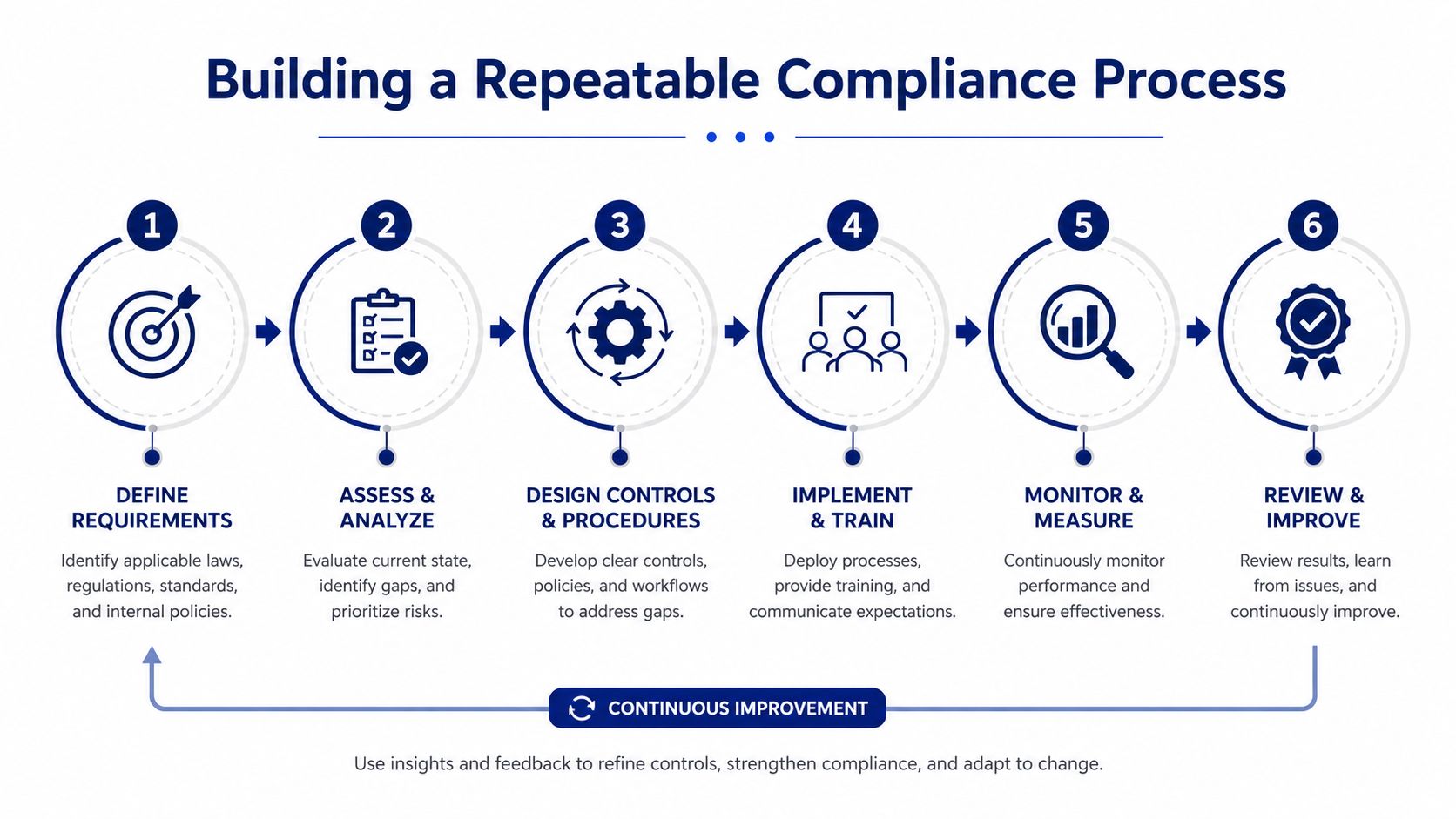
Annual compliance includes collecting 1099 information, processing W-2s, preparing Form 1120, Form 1120-S, or Form 1065 where applicable, reviewing state franchise obligations, and archiving the supporting file.
Record retention should follow the applicable tax rule, contract, and audit risk. IRS guidance commonly points to keeping individual tax records for three years, and tax-practitioner rules also require retention for three years after the close of the return period. Recordkeeping guidance summarized for US tax compliance Businesses may need longer retention for specific assets, employment records, state requirements, or internal policy. Don't delete evidence because a folder looks old.
Create an exception path for amended returns, tax notices, refunds, and audits. Every exception needs a date received, assigned owner, response deadline, supporting documents, and final resolution. Consistency lowers avoidable rework and helps the company make better cash decisions. It isn't glamorous, but neither is mortgaging the office ping-pong table to pay a surprise liability.
The right question isn't “Can software do taxes?” It's “Which parts of our compliance system are repetitive, and which parts require judgment?”
| Option | Best Fit | Tradeoff |
|---|---|---|
| Spreadsheets and full DIY | Simple activity, few jurisdictions, founder with strong finance discipline | Low cash cost, high dependence on memory and manual controls |
| QuickBooks, Xero, Gusto, or Avalara | Repetitive bookkeeping, payroll, and sales-tax workflows | Automation improves consistency, but bad setup still produces bad outputs |
| Fractional bookkeeper or controller | Growing transaction volume, monthly close needs, investor reporting | Adds review capacity without building a full internal department |
| Outsourced tax professional or accountant | Multi-state activity, complex entity structure, notices, audits, or specialist filings | Higher cost, but better judgment and coverage for situations software can't interpret |
A seed-stage SaaS company with one entity, limited payroll complexity, and clean books may do well with accounting software plus a fractional bookkeeper. A multi-state e-commerce brand dealing with marketplace data and product taxability needs specialist sales-tax support sooner. A C corporation approaching an audit or preparing investor-grade reporting shouldn't ask a spreadsheet to impersonate a tax department.
QuickBooks or Xero can support the ledger and close. Gusto can manage core payroll workflows. Avalara can assist with sales-tax calculations and filings. None of these tools knows whether the business registered in every required jurisdiction, classified a worker correctly, or made a sensible technical tax position without accurate inputs and human review.
Software pays for itself when it removes repetitive entry and produces reliable reports. It becomes false economy when the team spends its evenings correcting integrations, rebuilding historical data, and answering notices.
Fractional controllers and bookkeepers help establish reconciliations, close procedures, ownership, and reporting discipline. Outsourced tax professionals add return preparation, planning, notice response, multi-entity coordination, and audit support.
If you need specialist capacity, multi-entity coverage, or audit support, HireAccountants can connect US companies with pre-vetted accounting and finance professionals through a marketplace and recruiting service. The platform covers roles including bookkeeping, tax accounting, auditing, and financial management.
Hiring decisions benefit from understanding the people behind the work, including roles such as customer care tax careers. For a practical guide to evaluating a provider, use this resource on how to find a tax accountant.
A founder-ready compliance check should verify the operating system, not just collect green ticks.
Your first week can be concrete: pull every registration, list recurring filings, reconcile the last completed period, archive the supporting records, and schedule the next review. Ownership must belong to roles, not vibes, because people leave and tax deadlines don't.
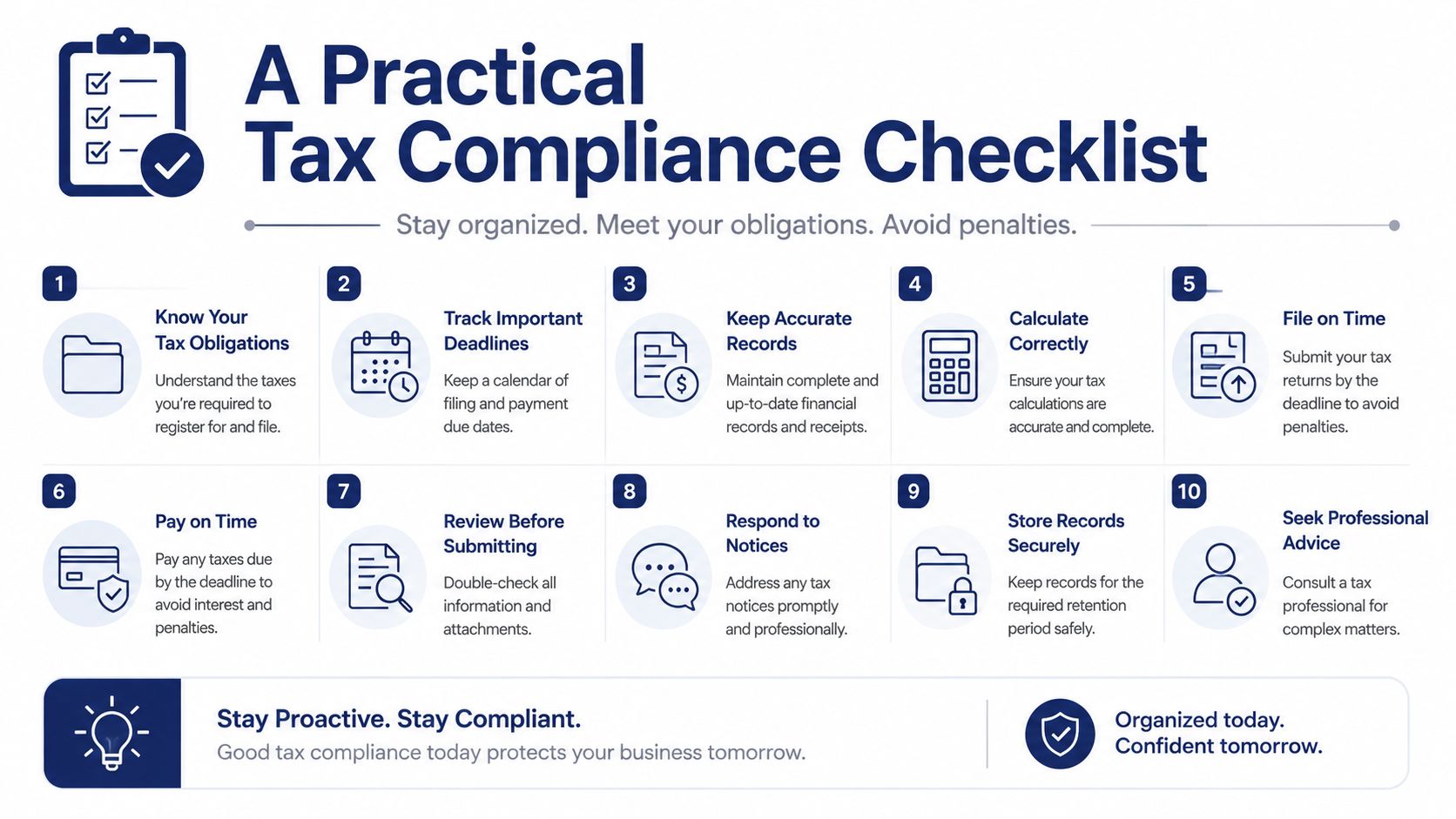
If your books are behind, filings are scattered, or no one clearly owns payroll and sales-tax compliance, visit HireAccountants to find pre-vetted accountants and finance professionals who can build the reconciliations, calendars, records, and tax support your business needs. Stop waiting for tax season to reveal the gaps, and put a repeatable compliance process in place before it becomes a cash problem.
Let's simplify your finances today!