


You're staring at a pile of receipts, half-paid invoices, and a spreadsheet that only makes sense because you built it. Your bank balance looks healthy, but you can't explain which customers paid, which bills are late, or whether payroll will feel comfortable next month. The bookkeeping isn't technically impossible. It's consuming the attention your startup needs for hiring, sales, and product decisions.
That's where virtual bookkeeping earns its keep. Instead of passing paper around an office, you move financial record-keeping into cloud software and give a remote bookkeeper structured access to the systems, documents, and workflows that keep your books current. Done properly, it replaces the monthly panic with a repeatable operating rhythm.
Sarah, a startup founder I've encountered in one form or another many times, used to keep receipts in three places: a desk drawer, her email inbox, and a folder called “final receipts new.” None of those places made cash flow clearer. Her team missed invoice follow-ups, reconciliations drifted, and month-end became a frantic exercise in reconstructing what had already happened.
Virtual bookkeeping changed the setup, not the underlying work. A remote professional connected to the company's cloud accounting platform, reviewed transaction feeds, organized supporting documents, reconciled accounts, and prepared reports without sitting in the same office. Sarah stopped treating bookkeeping as an administrative chore to squeeze between meetings and started using it as an operating system for the business.
So, what is virtual bookkeeping? It's the remote management of financial records through cloud-based accounting software and secure digital collaboration tools. The method remains bookkeeping. Transactions still need to be recorded, accounts still need to reconcile, and reports still need to make sense. The difference is that bank feeds, uploaded documents, and shared portals replace paper receipts and in-office handoffs, enabling near real-time reporting, as explained in this overview of virtual bookkeeping workflows.
Cloud infrastructure is the reason this model has moved from novelty to normal business practice. The cloud accounting software market was estimated at $7.4 billion in 2023 and is projected to reach $16.2 billion by 2030, according to cloud accounting software market data. Virtual bookkeeping rides on that same infrastructure for bank feeds, invoice capture, reconciliation, and reporting.
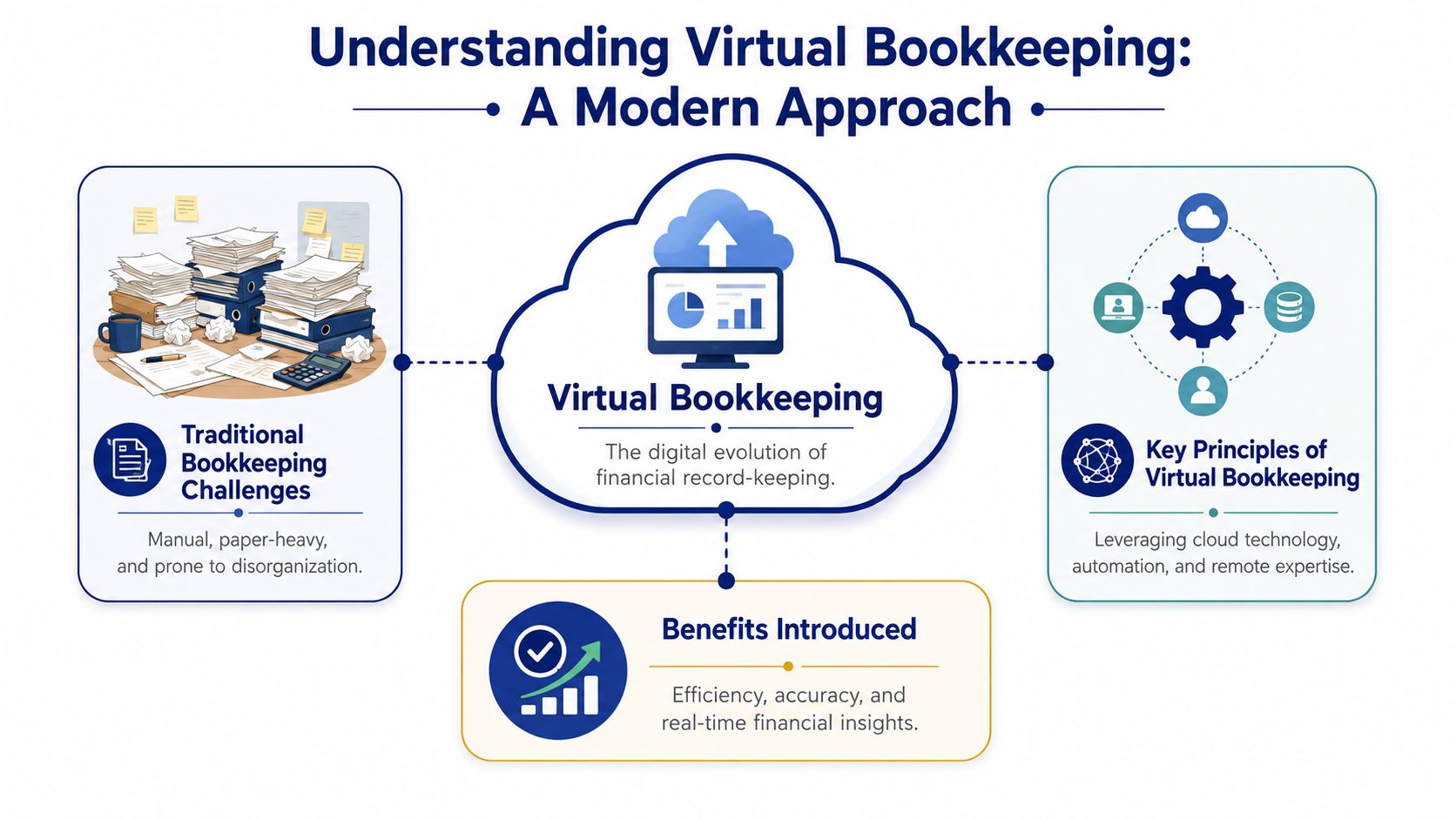
A startup doesn't need more accounting theater. It needs clean answers to practical questions: How much cash is available? Which customers owe money? Which expenses are growing? Can the company afford the next hire?
A virtual model can help you get those answers without building a full in-house finance department. If you're comparing providers, an online virtual accounting firm can be one route, while a freelance bookkeeper or remote employee may suit a different level of complexity.
The important point is simple: virtual bookkeeping isn't bookkeeping from another planet. It's bookkeeping delivered through connected systems, remote expertise, and a workflow designed to keep financial information usable.
Virtual bookkeeping works because the accounting platform becomes the shared source of truth. Your bank and credit-card feeds send transactions into the system, your team uploads receipts and invoices through a secure portal, and the bookkeeper reviews what the software has collected. Nobody should be emailing a spreadsheet named “latest version” back and forth. That's how finance teams accidentally create archaeological sites.
The system usually has four moving parts:
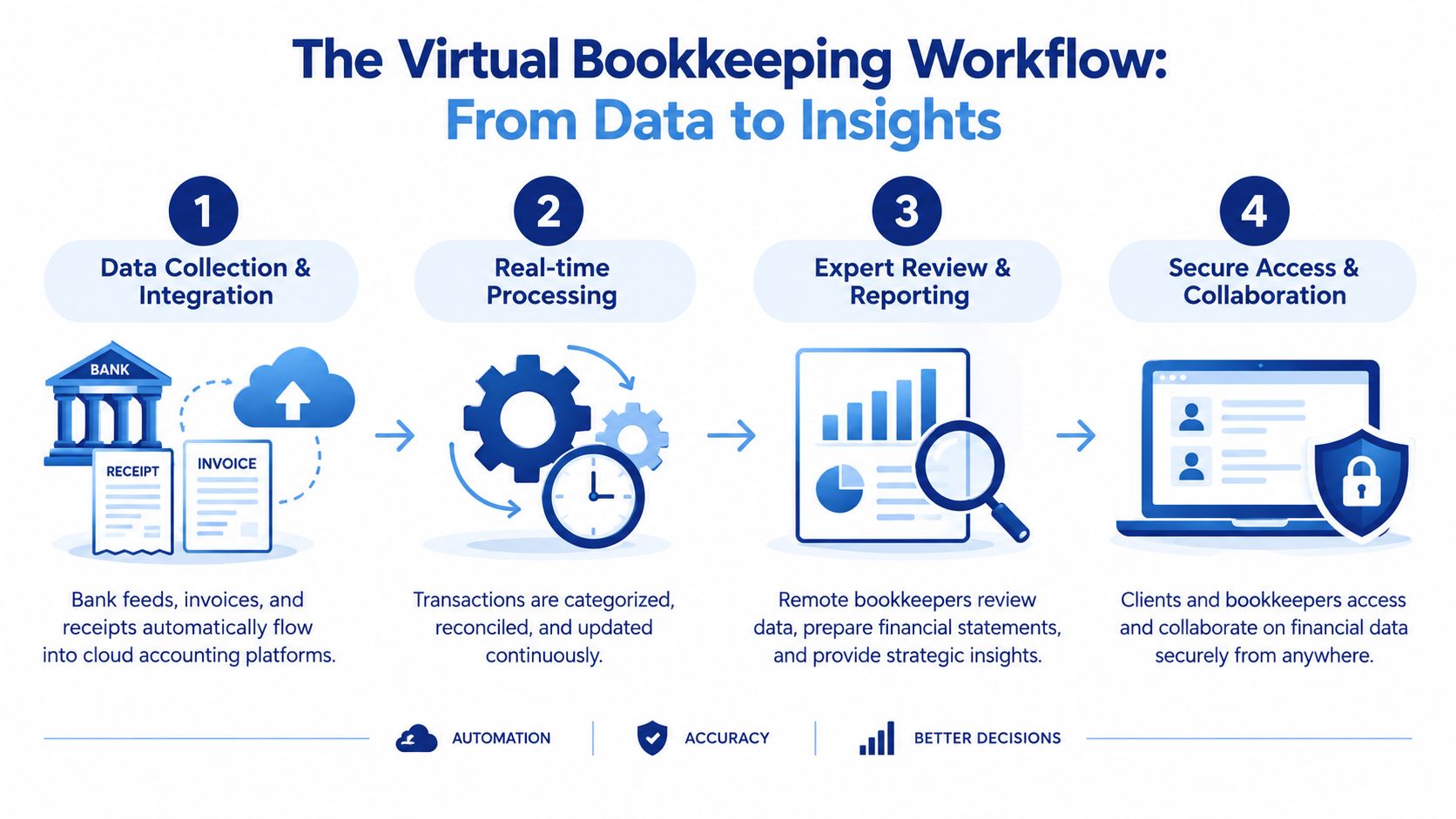
Automation is the main technical lever. Bank-feed synchronization, auto-categorization, and basic reporting reduce repetitive manual steps, allowing the bookkeeper to focus on exceptions and maintain an audit trail, as described in this explanation of virtual bookkeeping automation.
That shift matters. A weak operator uses automation to avoid looking closely at the books. A strong operator uses it to spend more time on transactions that don't fit the pattern. Software can suggest a category, but it can't reliably understand every unusual payment, founder reimbursement, customer refund, or vendor change without review.
The remote team may include a bookkeeper, an accounting manager, and a company-side approver. The company controls business context and approvals. The bookkeeper maintains records and reconciliations. The manager checks quality and escalates issues. Keep those responsibilities explicit, or “virtual” quickly becomes code for “nobody knows who owns this.”
You should have a clear document request process, defined review dates, a communication channel, and an escalation path for unresolved items. You should also know which reports arrive after the close and which decisions the bookkeeper is authorized to make without approval.
Practical rule: Automate routine transactions, not accountability.
A clean virtual workflow feels boring. That's a compliment. Your financial data should move through predictable channels, exceptions should land with a named person, and reports should arrive before you need to make the decision they inform.
Virtual bookkeepers perform familiar work through remote systems. The service may include transaction coding, bank and credit-card reconciliation, accounts payable, accounts receivable, payroll synchronization, expense tracking, and management reporting. The right package depends on transaction volume and complexity, but the operating principle stays the same: capture consistently, review exceptions, close on schedule.
A workable monthly rhythm starts before month-end.
During the month, employees upload receipts, vendors send invoices, and bank feeds collect transactions. The bookkeeper categorizes activity, matches payments to bills, flags missing documentation, and keeps accounts payable and receivable records current.
Automation earns its lunch. Bank-feed sync, auto-categorization, and basic reporting remove repetitive manual work, while human review protects the audit trail, according to guidance on automation in virtual bookkeeping.
At close, the bookkeeper reconciles bank and credit-card accounts against the accounting records. They investigate differences rather than forcing the numbers to agree. That distinction matters. A reconciliation that “works” only because someone plugs an unexplained adjustment into the books is not a clean close. It's a financial jump scare scheduled for later.
A typical close sequence looks like this:
The bookkeeper shouldn't unilaterally invent policy while coding transactions. If software subscriptions, contractor costs, or customer refunds need special treatment, document the rule and apply it consistently.
Startups usually need more than a beautifully formatted profit and loss statement. Ask for a balance sheet, cash activity, accounts receivable aging, accounts payable aging, and a short list of unresolved exceptions. Those reports turn bookkeeping into a decision tool instead of a historical scrapbook.
Virtual bookkeeping wins on access and flexibility. Traditional bookkeeping wins on physical presence and the comfort of having someone nearby. The mistake is treating either model as automatically safer or more accurate. Controls and operating discipline matter more than whether the bookkeeper's chair is ten feet away.
The strongest argument for outsourcing is lower fixed overhead. Published industry summaries report cost reductions of about 20% to 60% compared with in-house teams, driven by scalable staffing and lower fixed costs, according to outsourcing cost comparisons. That doesn't mean every company will land at the same result. Scope, complexity, oversight, and cleanup work can change the economics quickly.
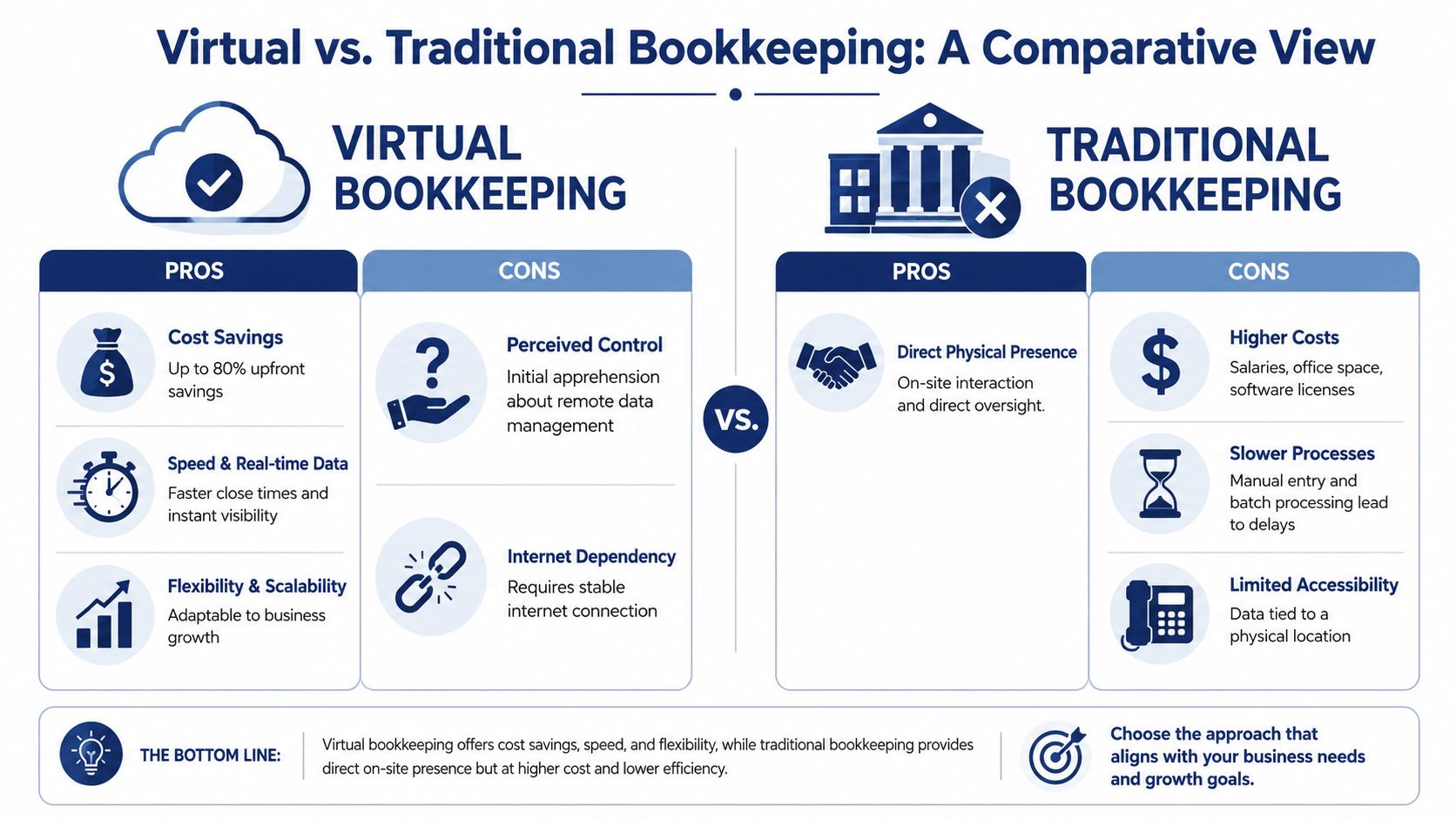
Cloud access gives founders and finance leads a current view without waiting for someone to retrieve a file from an office computer. Remote staffing also lets you add specialized support without committing to a permanent office setup or a full-time role before the workload justifies it.
The model is especially useful when your company has distributed employees, multiple locations, or a finance function that needs coverage beyond local hiring constraints. You can also choose a specialist familiar with SaaS revenue, ecommerce settlements, agencies, or other operating patterns instead of forcing one generalist to learn everything from scratch.
Physical presence can simplify spontaneous conversations. A founder can point at a document, explain a confusing transaction, and resolve it immediately. Some owners also feel more control when the finance professional works onsite.
That comfort can be misleading. A person in the office can still use poor passwords, misclassify transactions, or delay reconciliations. Remote work exposes the need for access controls, documented procedures, and review ownership. It doesn't create those needs.
| Operating concern | Virtual bookkeeping | Traditional bookkeeping |
|---|---|---|
| Cost structure | More variable and scalable | More fixed, with staffing and office costs |
| Data access | Available through cloud systems | Often tied more closely to local systems |
| Communication | Digital and scheduled | Easier spontaneous face-to-face contact |
| Process speed | Strong when feeds and portals work well | Can slow down with paper and batch handoffs |
| Main risk | Weak access management or unclear ownership | Key-person dependency and limited flexibility |
My recommendation is blunt: choose virtual bookkeeping when you value current information, flexible capacity, and documented digital processes. Choose traditional only when physical presence is operationally necessary, not because an office makes messy books feel more respectable.
Remote financial work is secure only when the company treats access as a control system, not a convenience. Giving a contractor one shared login and hoping they “remember to be careful” isn't a security policy. It's a future incident report wearing a tiny hat.
A practical baseline includes separate user logins, role-based permissions, encrypted cloud storage, secure document portals, and immediate access removal when staff leave, as recommended in online security guidance for virtual bookkeepers. Every person should have the access required for their job and no more.
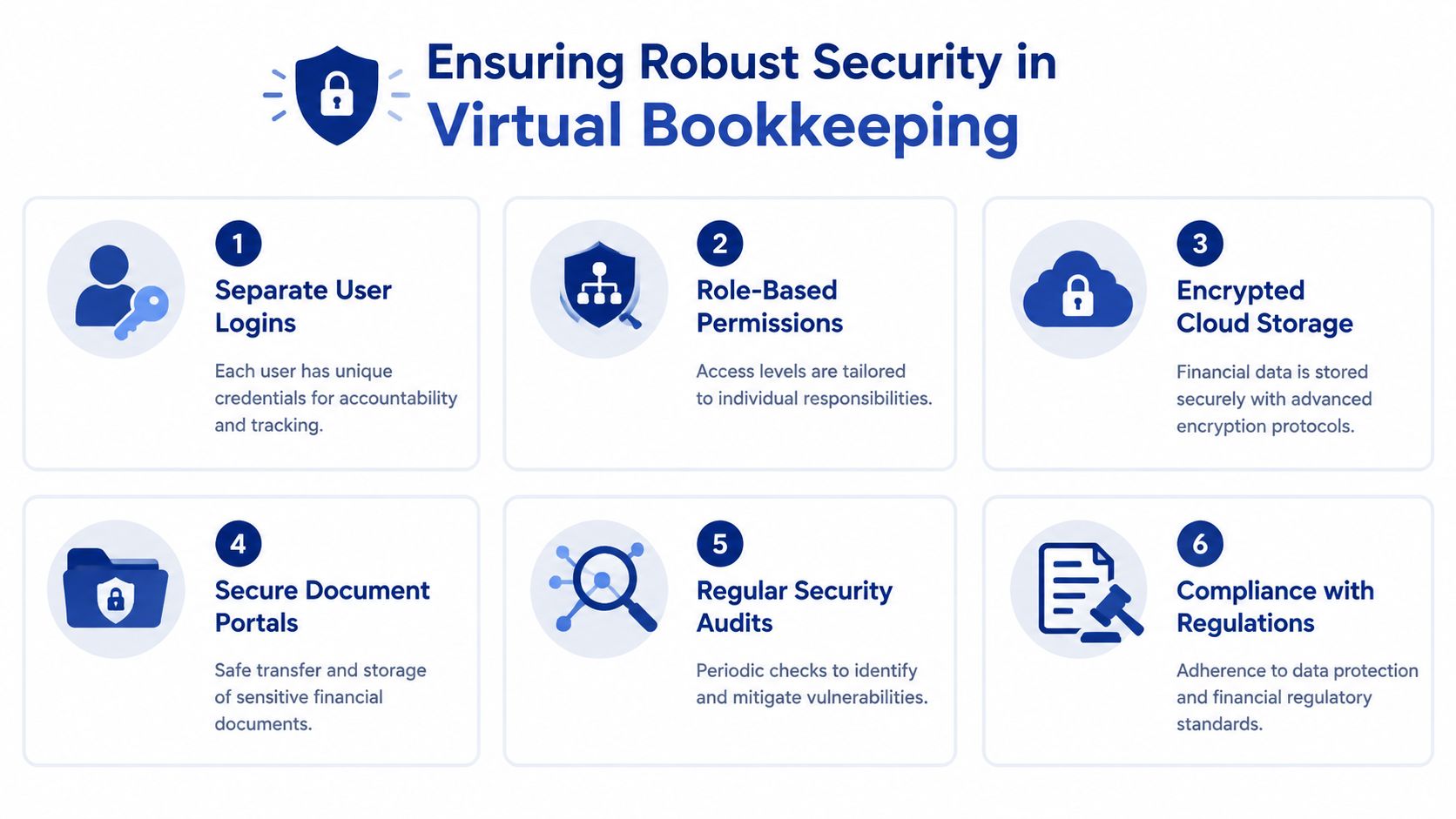
Document handling deserves its own rule. If your team exchanges bank statements, payroll records, tax documents, or signed approvals as PDFs, use a controlled process to secure your PDF documents before they move through the workflow. A password-protected file is not a substitute for a secure portal, but casual document sharing is an avoidable weakness.
Ask providers how they protect data, where documents live, how they manage access, and what happens when a staff member leaves. If a provider mentions certifications or formal compliance frameworks, ask what the certification covers and whether it applies to the systems handling your information. Don't accept a badge as proof that the provider understands your specific workflow.
Your contract should define confidentiality, data ownership, retention, breach notification, access removal, and subcontractor use. It should also identify who approves payments and changes to bank details. Virtual bookkeeping works best when the company preserves approval authority while the bookkeeper handles preparation and review.
Security rule: Convenience belongs in the workflow. It doesn't belong in your permission model.
Virtual bookkeeping pricing usually falls into three shapes. A flat monthly fee gives you predictable budgeting. Per-transaction pricing ties cost to activity but can make a growing company's bill less predictable. A hybrid retainer combines a recurring base with extra charges for payroll, cleanup, reporting, or unusual volume.
Published pricing ranges put basic outsourced bookkeeping at $250 to $900 per month, while broader full-service accounting packages can reach $1,500 to $5,000 per month, according to outsourced bookkeeping pricing guidance. Those figures are useful for initial budgeting, not for blindly comparing proposals. A cheap package that excludes reconciliations or month-end review may be expensive once you add the missing work.
| Service Tier | Monthly Cost |
|---|---|
| Basic bookkeeping | $250 to $900 |
| Broader bookkeeping package | $500 to $2,000 |
| Full-service accounting | $1,500 to $5,000 |
For a basic package, expect transaction categorization, account reconciliation, and standard reports. A broader package may include payables, receivables, payroll coordination, and a more structured close. Full-service accounting may add controller-level review, tax coordination, forecasting support, or other finance responsibilities, but the exact scope varies by provider.
Ask every candidate to define “monthly close.” Does it include bank reconciliation? Credit cards? Accruals? Payroll review? Accounts receivable follow-up? A report without documented exceptions? If the proposal leaves those questions floating around, the price is not clear yet.
Your return comes from more than the invoice. Consider the founder hours no longer spent chasing receipts, the finance errors caught earlier, the collections questions answered sooner, and the decisions enabled by current reports. Then compare that value with the cost of internal hiring, management time, software, office space, and the risk of a single overloaded employee becoming the company's only finance system.
A virtual provider is worth considering when the monthly fee buys reliable close ownership and useful visibility, not just data entry. If the provider only transfers your mess into the cloud, you've purchased remote mess management.
Start with delivery model, not hourly rate. “Virtual bookkeeper” is a broad label. It can describe an onshore professional, an offshore clerk, or a nearshore specialist working in a time zone that overlaps with your team. The important tradeoff is responsiveness and collaboration speed, not price alone, as outlined in this comparison of virtual bookkeeping delivery models.
Offshore talent can offer strong value, but a substantial time-zone gap may turn a simple clarification into an overnight queue. Nearshore talent working US business hours can make back-and-forth collaboration easier, especially when your books influence daily cash decisions. Onshore support may provide the closest cultural and operational alignment, but it can carry a higher cost structure. Pick based on the speed your business needs.
Score candidates against the work your company performs, not against polished profiles.
Use a practical test. Give the candidate a fictional bank-feed exception, a duplicate invoice, and an unexplained founder expense. Ask what they'd investigate, what they'd document, and what they'd escalate. You're testing judgment, not typing speed.
A freelancer may suit a straightforward business with a stable transaction pattern. A specialized remote professional can work better when you need dependable coverage and recurring close ownership. A provider with multiple reviewers may reduce key-person risk, but you'll need to understand handoffs and accountability.
If you want a structured hiring process, this guide to hiring a bookkeeper can help organize the evaluation. My own bias is clear: prioritize overlap, clean communication, and exception-handling ability over the cheapest proposal. Saving money while waiting three days for an answer about a customer payment is a false economy.
The first close is where most virtual bookkeeping relationships reveal their quality. A provider can sound excellent during a sales call, but the actual test starts when they encounter old uncategorized transactions, inconsistent vendor names, missing receipts, and a chart of accounts built during a particularly optimistic Friday afternoon.
Give the relationship a controlled launch.
Begin with read-only or restricted access wherever possible. Connect the accounting platform, bank feeds, credit cards, payroll system, expense tools, invoice systems, and secure document portal. Then map the chart of accounts and document how your company treats recurring expenses, reimbursements, refunds, contractor payments, and owner activity.
Use a short test period before handing over the entire workflow. Submit representative receipts, invoices, payment records, and unusual transactions. Review how the bookkeeper categorizes each item and whether they ask sensible questions. A test transaction catches misunderstandings more cheaply than a corrupted close.
Agree on:
Remote onboarding works better when it treats people, systems, and responsibilities as one process. For a broader employee setup framework, Benely's guide to employee onboarding offers useful structure that can be adapted for remote finance hires.
Schedule a close review after the first reporting cycle. Don't spend the meeting admiring the report. Ask which transactions remained unresolved, which categories need policy decisions, what the bookkeeper noticed about cash movement, and which workflow caused friction.
You can also use this remote employee onboarding guide to formalize access, communication, and accountability for distributed team members. As the company grows, connect bookkeeping reviews to cash planning, budget updates, and FP&A discussions. Current books become valuable when someone uses them to decide what happens next.
HireAccountants helps US companies find pre-vetted remote bookkeepers and finance professionals through a marketplace, AI matching engine, and recruiting support. If you need nearshore talent aligned with US working hours, visit HireAccountants to review candidates and start building a bookkeeping workflow that keeps your cash visibility current.
Let's simplify your finances today!